Mechanism Capital Founder: Excessive Worry About Bubbles Is Foolish

marsbitОпубліковано о 2026-02-11Востаннє оновлено о 2026-02-11

Анотація

Mechanism Capital founder Andrew Kang argues that excessive worry about market bubbles is misguided in the current technological landscape. He emphasizes that we are at a uniquely asymmetric moment in history, driven by exponential advancements in AI, robotics, energy, and other innovative fields. Short-term volatility and corrections are noise compared to the long-term transformative potential of these technologies. Kang predicts a near-future "singularity" with billions of AI agents, humanoid robots, space data centers, multi-planetary colonization, and revolutionary medical therapies. He states that the technological progress and economic growth compressed into the next 20 years will surpass the entirety of human history. Companies leveraging AI are already seeing order-of-magnitude improvements in productivity. Traditional valuation models are inadequate for pricing this unprecedented growth, which could reach "20-sigma" levels in historical statistical terms. The wealth creation will be extreme, and those without exposure will find it difficult to enter the market later. Kang advises adopting a long-term, exponential mindset and avoiding short-term trading, as the potential upside represents the largest asymmetric opportunity in history.

Original Author:Andrew Kang, Founder of Mechanism Capital

Compiled by: Ken, Chaincatcher

For those who have experienced at least one full market cycle, you develop an instinct to be wary of price increases that far exceed historical growth rates. Witnessing the dot-com bubble, the 2008 global financial crisis, and the rise and fall of cryptocurrencies sets off pattern recognition alarms in your brain. You are afraid to enter the market because prices are too high, and you want to sell your assets for fear of being at a peak.

But it is important to recognize that we are in one of the most profound and unique asymmetric moments in history. The only move right now is to extend your time horizon and completely abandon short-termism.

Excessive worry about bubbles is foolish. Trying to time the market is also foolish. Short-term fluctuations and corrections will always happen, but given how close we are to the "singularity," these fluctuations are completely just noise. Artificial intelligence, robotics, energy, and innovation are about to experience runaway explosive growth.

Within the next decade, we will have billions (or more) of AI agent workforces, humanoid robots, space data centers, multi-planetary colonization, and significantly improved medical therapies; we will fundamentally change the development pace and output of technological breakthroughs in all fields. The technological progress and economic growth we compress into the next twenty years will exceed the sum total of all human civilization history.

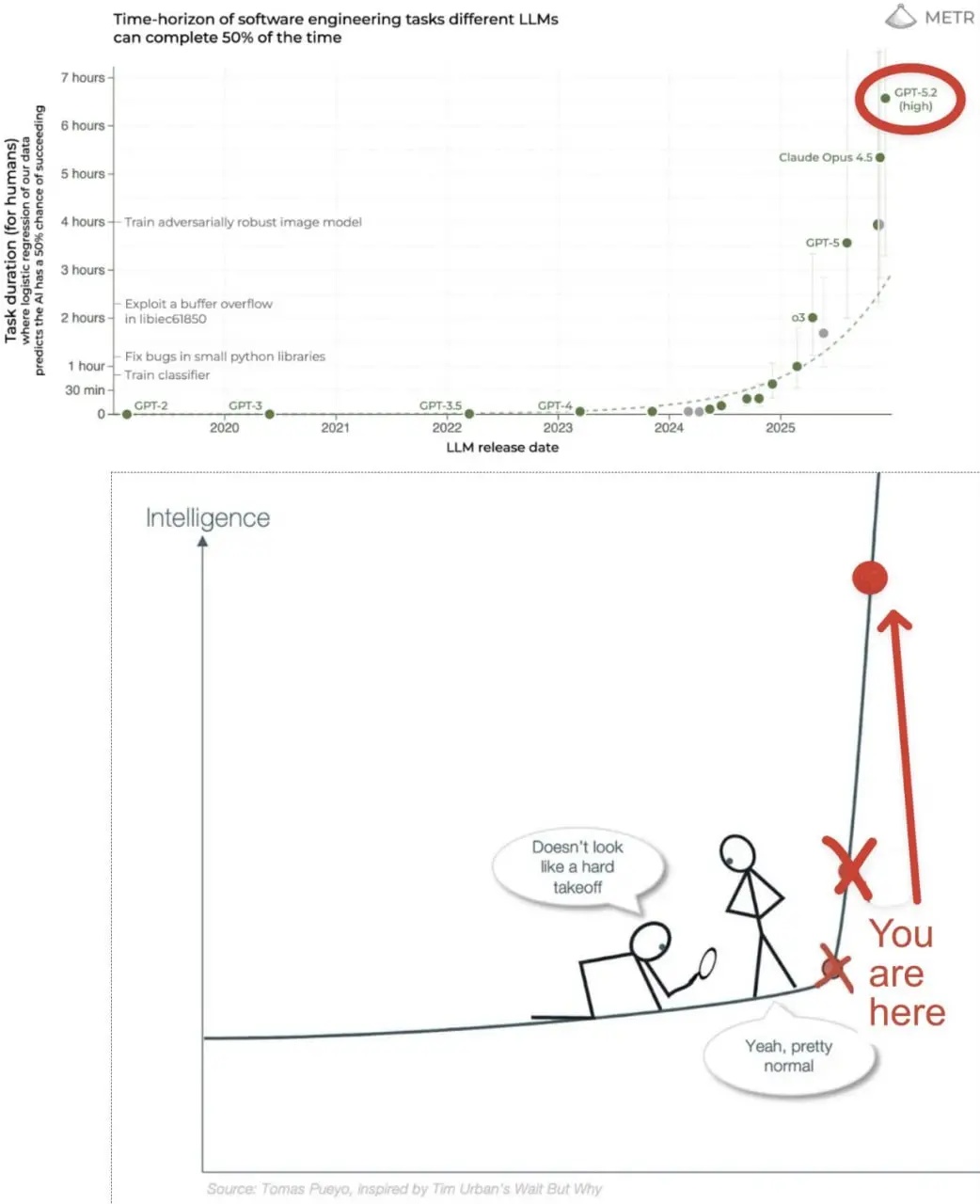
We are already in an extremely steep phase of the J-curve, but this is hard to perceive when we zoom in to the micro level of daily or weekly views. 100% of Anthropic's product code is now written by Claude. Product managers have a virtual team of software engineers, so efficient it's as if they can change time. The improvement in product iteration speed for companies that efficiently utilize AI is not single-digit, not double-digit, but triple-digit.

Moreover, the capabilities of these tools are still evolving at an even faster rate. Whether we officially achieve Artificial Superintelligence (ASI) in 2027 or 2029 doesn't really matter. It will happen. By the time it's officially announced, the assets you want to own will have already multiplied in price.

It is highly likely that the actual economic growth over the next 3-10 years will be on the order of 20 standard deviations (20-sigma) in any historical distribution model. This growth, once considered almost impossible, will be driven by unprecedented second and third-order changes. Traditional valuation models cannot price these transformations. The potential upside is so vast that traditional present value calculations struggle to capture them.

The speed of wealth appreciation will be staggering, much like how cryptocurrencies initially created numerous billionaires and millionaires in a short time, but the magnitude this time will be far more extreme. If you have no exposure, it will be difficult to pull the trigger and buy into such vertically rising asset prices; but unlike previous bubbles, the creation of real economic value will better keep pace with the vertical rise in asset prices. Over the past three years, those operating in the market with the cognition of an "exponential perspective" have reaped significant rewards. If you haven't adopted this perspective yet, it's not too late.

While it's important to always be mindful of downside risk, this is the largest upside risk in world history. Learn to bear risk over longer time horizons. Now is not the time for swing trading. For the vast majority of people, long-term investing typically outperforms short-term trading, but the gap in expected value between "trading" and "investing" will be wider than ever before. Ask yourself, what is the value of the call option embedded in the singularity?
Пов'язані питання

QAccording to Andrew Kang, why is it foolish to be overly concerned about market bubbles in the current economic climate?

AHe believes we are at a profoundly unique asymmetric moment in history, where the potential upside from technological advancements like AI, robotics, and energy innovation is so immense that short-term volatility and bubbles are merely noise. The focus should be on long-term growth rather than short-term fluctuations.

QWhat does Andrew Kang predict will be achieved in the next decade in terms of technological progress?

AHe predicts that in the next decade, we will have billions of AI agent workers, humanoid robots, space data centers, multi-planetary colonization, and significantly improved medical therapies. The technological progress and economic growth compressed into the next 20 years will exceed the sum of all human civilization history.

QHow does Andrew Kang describe the current stage of the J-curve in technological development?

AHe describes the current stage of the J-curve as extremely steep, though it is hard to perceive at a daily or weekly micro-level. Companies effectively using AI are seeing product iteration speed improvements not in single or double digits, but in triple digits.

QWhat does Andrew Kang suggest about the timing of achieving Artificial Superintelligence (ASI) and its impact on asset prices?

AHe suggests that whether ASI is achieved in 2027 or 2029 is not important because it is inevitable. By the time it is officially announced, the prices of assets one would want to own will have already increased manifold.

QAccording to the article, why might traditional valuation models fail in the current economic transformation?

ATraditional valuation models are unable to price the unprecedented second and third-order changes driven by technologies like AI. The potential upside is so vast that traditional present value calculations struggle to capture them, making historical distribution models irrelevant for predicting future growth.

Пов'язані матеріали

Stuck Polymarket: The Real Test After Riding the Traffic Boom Has Arrived

Polymarket, a leading prediction market platform, is facing significant technical challenges as its growth outpaces its current infrastructure on Polygon. Users are experiencing laggy transactions, unresponsive orders, and delayed confirmations, severely impacting the trading experience. In response, DeFi Engineering VP Josh Stevens outlined a comprehensive engineering overhaul. The plan includes reducing on-chain data delays, fixing order cancellation issues, rebuilding the central limit order book (CLOB), improving website performance, and developing a unified SDK and API. A major revelation was the ongoing "chain migration," indicating a potential move away from Polygon. The core issue is that Polymarket has evolved from a simple prediction market into a high-frequency trading platform, making Polygon's limitations—such as block space, gas fees, and block time—a ceiling for further growth. The migration is not just a simple chain switch but a fundamental rebuild of its trading system to support more complex products like perpetual contracts (Perps). This announcement has sparked competition among chains like Solana, Sui, and Algorand, all vying to host Polymarket. For Polygon, losing this key application, which contributes significantly to its gas fee revenue, would be a major setback. The real test for Polymarket is no longer attracting users but proving it can provide a stable, reliable trading environment that retains them.

Odaily星球日报35 хв тому

Stuck Polymarket: The Real Test After Riding the Traffic Boom Has Arrived

Odaily星球日报35 хв тому

Lowering Expectations for BTC's Next Bull Market

The author, Alex Xu, explains his decision to significantly reduce his Bitcoin holdings (from full to ~30% of his portfolio) during the current bull cycle, citing a lowered long-term outlook for BTC's price appreciation in the next cycle. He outlines six key reasons for this reduced expectation: 1. **Diminished Growth Drivers:** The narrative of exponential user adoption has largely played out with institutional ETF adoption. The next major growth phase—adoption by sovereign national reserves or central banks—seems unlikely in the near future. 2. **Personal Opportunity Cost:** More attractive investment opportunities have emerged in other assets, such as undervalued companies. 3. **Industry-Wide Contraction:** The broader crypto industry is struggling, with most Web3 business models (SocialFi, GameFi, DePIN) failing. This overall萧条 (depression) reduces the fundamental demand and consensus for Bitcoin. 4. **Strain on Major Buyer:** MicroStrategy, a major corporate buyer of BTC, faces rising financing expenses for its debt, which could slow its purchasing rate and create significant marginal pressure on the market. 5. **Increased Competition from Gold:** The emergence of "tokenized gold" has closed the functional gap (portability, divisibility) between physical gold and Bitcoin, offering a strong competitor in the non-sovereign store-of-value space. 6. **Security Budget Concerns:** The block reward halving continues to exacerbate the long-standing issue of funding Bitcoin's network security, with new fee source explorations like Ordinals and L2s largely failing. The author's decision to hold a significant (though reduced) position reflects a cautious, not bearish, outlook. He remains open to increasing his exposure if the fundamental reasons for his skepticism change or if new positive catalysts emerge.

marsbit1 год тому

Lowering Expectations for BTC's Next Bull Market

marsbit1 год тому

Can Iran 'Control' the Strait of Hormuz?

Iran has announced a comprehensive plan to assert control over the strategic Strait of Hormuz, a critical global oil shipping chokepoint. The proposed measures include requiring all vessels to obtain Iranian permission for passage, imposing fees for security, environmental protection, and navigation management—preferably paid in Iranian rials—and absolutely banning Israeli ships. Vessels from countries deemed hostile by Iran’s top security bodies may also be barred. Analysts suggest Iran’s motives are multifaceted: increasing pressure on the U.S. and Israel by leveraging control over oil transit to influence global prices and inflation; creating a new revenue stream, potentially exceeding $7.7 billion annually, to counter Western sanctions and support postwar reconstruction; and using transit permissions as bargaining chips in future negotiations, notably with the U.S. However, the plan faces significant practical and diplomatic challenges. Enforcing comprehensive interception and fee collection in the busy waterway, patrolled by international military forces, would be difficult. The U.S. has already countering with a blockade of Iranian ports and threats to intercept any ship paying fees, potentially strangling Iran’s oil exports and fee revenue. Broad international opposition, led by European and Gulf states, and legal controversies further complicate implementation. The proposal may ultimately serve more as a negotiating tactic than a feasible policy, with its execution remaining highly uncertain.

marsbit2 год тому

Can Iran 'Control' the Strait of Hormuz?

marsbit2 год тому

Торгівля

Спот
Ф'ючерси
活动图片





