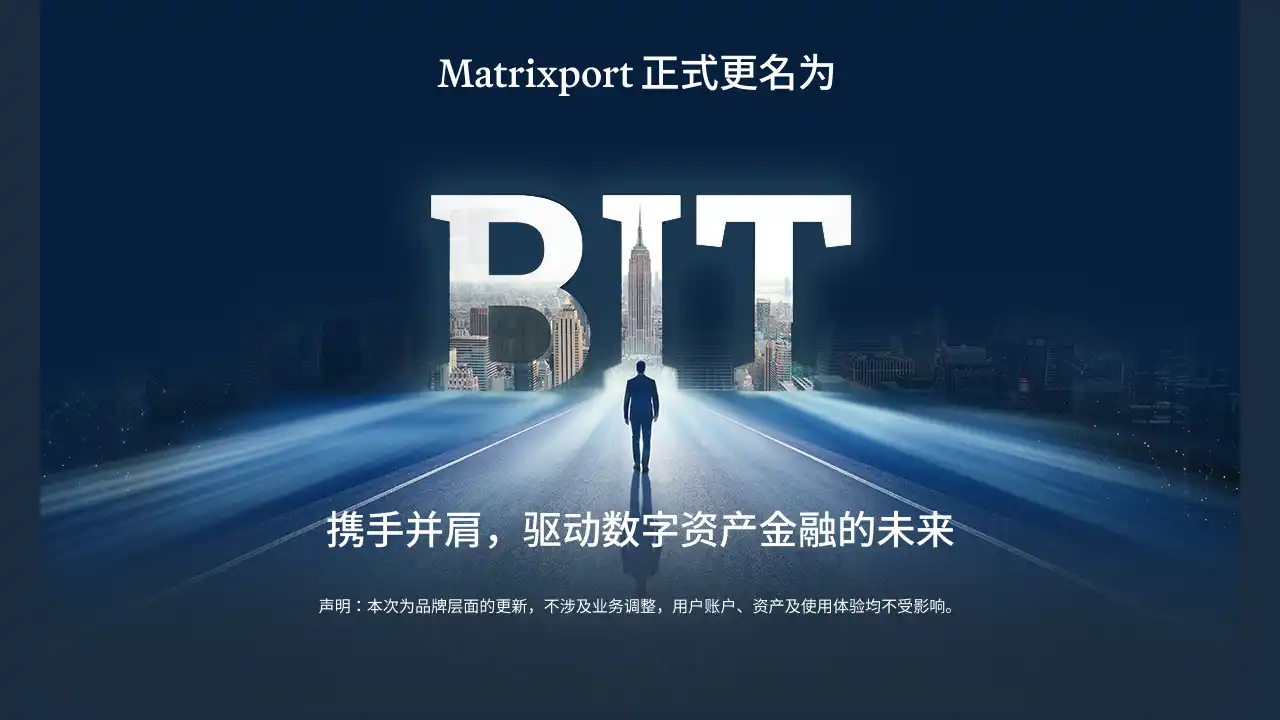
Matrixport Officially Rebrands as BIT, Clarifying New Strategic Positioning

marsbitОпубліковано о 2026-03-20Востаннє оновлено о 2026-03-20

Анотація

Digital financial services group Matrixport has officially rebranded to BIT, marking a new phase in its strategic positioning. The company will now operate globally under the unified BIT brand. Alongside the rebranding, BIT released its "2026 Trust Whitepaper," which systematically details the group's established governance and risk control frameworks to provide a verifiable foundation of trust for clients and partners. As the digital asset industry undergoes increasing institutionalization and regulatory maturation, market demands for robust governance and compliance capabilities are growing. The new BIT brand better reflects the company's current business focus and strategic direction for future development. CEO John Ge stated that the industry is entering a stage where governance and compliance are increasingly critical. The name BIT represents the evolution of the company's business and its long-term commitment to building trusted digital asset financial infrastructure. The brand's tagline, "Bridge into Tomorrow," signifies its vision to connect traditional finance with digital asset markets and build lasting trust with clients. The rebrand does not affect existing customer accounts, products, or services, and all legal entities and contractual arrangements remain unchanged. As part of its next strategic phase, BIT is also exploring opportunities in U.S. capital markets, including a potential public listing. Founded in 2019 and headquartered in Singapore, BIT operates...

Digital financial services group Matrixport today announced its official rebranding as BIT and will operate globally under the unified BIT brand. Along with the brand upgrade, BIT simultaneously released the "2026 Trust Whitepaper," systematically disclosing for the first time the governance and risk control framework the group has established and continues to operate, providing customers and partners with a verifiable foundation of trust.

Currently, as the digital asset industry's institutionalization process accelerates and the regulatory system becomes increasingly完善, market demands for platform governance capabilities and compliant operations are continuously rising. The new BIT brand more clearly reflects the company's current business positioning and represents the strategic direction for the next phase of development.

BIT CEO John Ge stated: "The digital asset industry is entering a new phase where governance capabilities and compliant operations are becoming increasingly important. BIT embodies the成果 of the company's continuous business evolution and our long-term commitment to building a trusted digital asset financial infrastructure."

He added: "'Bridge into Tomorrow' is not only our brand proposition but also represents our vision of connecting traditional finance with the digital asset market and establishing long-term trust with our customers."

The company stated that this rebranding does not affect existing customer accounts, products, or services, with all relevant legal entities and contractual arrangements remaining unchanged.

As part of the next phase of its strategy, BIT is also actively exploring opportunities related to the U.S. capital markets, including a potential public listing.

About BIT

BIT (formerly Matrixport), founded in 2019, is a global digital asset financial services group built on integrity. The group is headquartered in Singapore and has offices in seven countries and regions worldwide. Through a robust governance system, technological capabilities, and compliant operations, it connects traditional finance with the digital asset market.

BIT provides global institutional and professional investors with services covering trading, custody, asset management, liquidity, and financing solutions, and supports the on-chain introduction and application of real-world assets (RWA). Its entities hold corresponding licenses and are regulated in Singapore, Hong Kong, Switzerland, the UK, the US, and Bhutan, including a Major Payment Institution (MPI) license in Singapore and a collective asset management license issued by Switzerland's FINMA.

Currently, the group manages over $6 billion in assets, with a monthly trading volume exceeding $7 billion. It has累计 paid over $2 billion in interest to customers, boasts a valuation exceeding $1 billion, and has been入选 the "2024 Hurun Global Unicorn List" and the "2025 Singapore FinTech Unicorn List."


Пов'язані питання

QWhat is the new name of the digital financial services group formerly known as Matrixport?

AThe new name is BIT.

QWhat did the company release alongside its rebranding to BIT?

AThe company released its '2026 Trust Whitepaper', which systematically discloses the governance and risk control framework it has established and continues to operate.

QWhat is the significance of the new brand name 'BIT' according to the CEO?

AThe CEO stated that 'BIT' represents the company's evolved business focus and its long-term commitment to building trusted digital asset financial infrastructure. It also stands for the brand proposition 'Bridge into Tomorrow', symbolizing the vision to connect traditional finance with the digital asset market and build long-term trust with clients.

QDoes the rebranding to BIT affect existing customer accounts, products, or services?

ANo, the company stated that the rebranding does not affect existing customer accounts, products, or services, and all relevant legal entities and contractual arrangements remain unchanged.

QWhat is one of the strategic opportunities BIT is exploring as part of its next phase?

ABIT is exploring opportunities in the U.S. capital markets, including a potential public listing.

Пов'язані матеріали

How Many Tokens Away Is Yang Zhilin from the 'Moon Chasing the Light'?

The article explores the intense competition between two leading Chinese AI companies, DeepSeek and Kimi (Moon Dark Side), and the mounting pressure on Yang Zhilin, the founder of Kimi. While DeepSeek re-emerged after 15 months of silence with its powerful V4 model—boasting 1.6 trillion parameters and low-cost, long-context capabilities—Kimi has been focusing on long-context processing and multi-agent systems with its K2.6 model. Yang faces a threefold challenge: technological rivalry, commercialization pressure, and investor expectations. Despite Kimi’s high valuation (reaching $18 billion), its revenue heavily relies on a single product with low paid conversion rates, while DeepSeek’s strategic silence and open-source influence have strengthened its market position and valuation prospects, now targeting over $20 billion. Both companies reflect broader trends in China’s AI ecosystem: Kimi aims for global influence through open-source contributions and agent-based advancements, while DeepSeek prioritizes foundational innovation and hardware independence, notably shifting to Huawei’s chips. Their competition is seen as vital for China’s AI progress, with the gap between top Chinese and U.S. models narrowing to just 2.7% on the Elo rating scale. Ultimately, the article argues that this rivalry, though anxiety-inducing for leaders like Zhilin, is essential for driving innovation and solidifying China’s role in the global AI landscape.

marsbit6 год тому

How Many Tokens Away Is Yang Zhilin from the 'Moon Chasing the Light'?

marsbit6 год тому

TechFlow Intelligence Bureau: ChatGPT Helps Amateur Mathematician Crack 60-Year-Old Problem, CFTC Sues New York Regulator Over Coinbase and Gemini

An amateur mathematician, with the assistance of ChatGPT, has solved a combinatorial mathematics puzzle originally proposed by Hungarian mathematician Paul Erdős in the 1960s. This marks another milestone in AI-aided mathematical research, demonstrating the evolving capabilities of large language models in formal reasoning. In other AI developments, OpenAI introduced a new privacy filter tool for enterprise API usage, automatically screening sensitive data. Meanwhile, the Qwen3.6-27B model achieved 100 tokens per second on a single RTX 5090 GPU using quantization, significantly lowering the cost barrier for local AI deployment. In crypto and Web3, the U.S. CFTC sued New York’s financial regulator, challenging its oversight of Coinbase and Gemini—a first-of-its-kind federal-state regulatory clash. Following a vulnerability, KelpDAO and major DeFi protocols established a recovery fund. Tether froze $344 million in assets linked to Iran’s central bank upon U.S. Treasury request, highlighting the centralized control risks in stablecoins. Separately, Litecoin underwent a 3-hour chain reorganization to undo a privacy-layer exploit. In the U.S., former President Trump invoked the Defense Production Act to address power grid bottlenecks affecting AI data centers and dismissed the entire National Science Board, raising concerns over research independence. A retail trader gained 250% on a $600k Intel options bet amid AI-related speculation. Xiaomi announced its first performance electric vehicle, targeting rivals like Tesla. Meanwhile, iPhone users reported devices automatically reinstalling a hidden app daily, suspected to be MDM-related. A Chinese securities report noted that A-share institutional crowding has reached its second-longest streak since 2007, signaling high valuations and potential style rotation. The day’s developments reflect a dual narrative: AI is enabling unprecedented individual breakthroughs, while centralized power structures—whether governmental or corporate—are becoming more assertive, underscoring that decentralization is as much a political-economic challenge as a technical one.

marsbit6 год тому

TechFlow Intelligence Bureau: ChatGPT Helps Amateur Mathematician Crack 60-Year-Old Problem, CFTC Sues New York Regulator Over Coinbase and Gemini

marsbit6 год тому

Торгівля

Спот
Ф'ючерси
活动图片




