Matrixdock Launches Silver Token XAGm, Building On-Chain Silver Reserve Asset Based on FRS Standard

marsbitОпубліковано о 2026-03-17Востаннє оновлено о 2026-03-17

Анотація

Matrixdock, a leading RWA platform, has launched XAGm, an institutional-grade silver token backed by fully allocated physical silver. The token is supported by LBMA Good Delivery standard silver bars, enabling this widely traded precious metal to enter the on-chain financial ecosystem. XAGm expands Matrixdock’s on-chain precious metals system, supporting use cases such as trading, collateralization, and DeFi applications. Unlike gold, which primarily serves as a store of value, silver possesses both investment and industrial demand, introducing stronger cyclical dynamics and diversified utility in on-chain markets. XAGm is one of the few institutional-grade tokenized silver products, with verifiable asset backing held in professional vaults. The token is issued under Matrixdock’s FRS (Fungible Reserve Standard) framework, which ensures transparent and sustainable alignment between on-chain tokens and underlying physical assets. Initially deployed on Ethereum, XAGm is set to expand to other blockchain ecosystems to improve accessibility and liquidity. This launch further develops Matrixdock’s Reserve Layer, combining gold and silver to create a more resilient and diversified on-chain asset base for the decentralized financial system.

Matrixdock, a leading global RWA platform, today announced the launch of the silver token XAGm for institutional use. This product is backed by fully allocated physical silver as the underlying asset and incorporates silver bar assets that comply with the LBMA Good Delivery standard, enabling silver—a widely traded precious metal commodity in traditional markets—to enter the on-chain financial system.
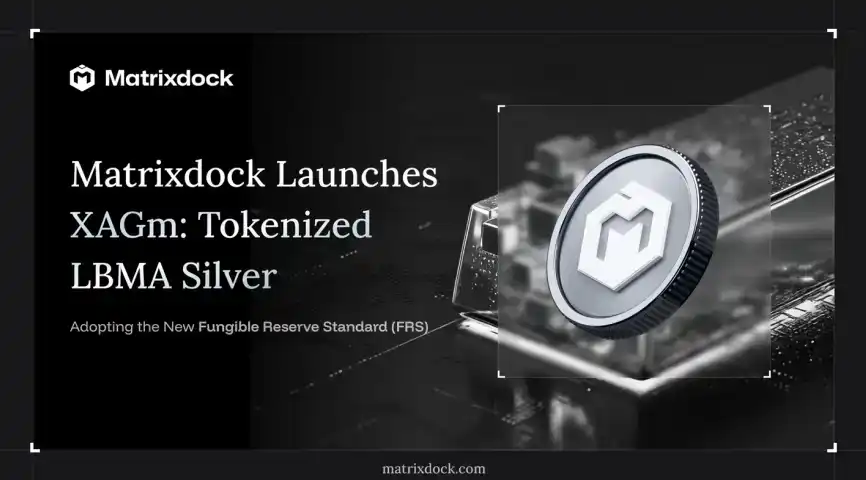
The launch of XAGm further enriches Matrixdock's on-chain precious metal asset system, allowing silver, a precious metal asset that has long played a significant role in traditional markets, to enter a programmable on-chain financial environment. It supports various financial application scenarios such as collateralization, trading, capital allocation, and DeFi.

As real-world assets continue to enter the blockchain financial system, market focus is gradually shifting from "whether assets can be on-chain" to "which assets can operate stably on-chain in the long term." Against this backdrop, precious metal assets with mature market structures, stable value foundations, and global liquidity are becoming important asset types in the on-chain financial system, featuring institutional-grade structural design.

Combining Investment and Industrial Attributes, Silver Expands On-Chain Trading and Collateral Scenarios

Unlike gold, which primarily serves as a store of value, silver is influenced by both investment demand and industrial consumption, resulting in more pronounced cyclical characteristics. This dual nature as both a financial asset and an industrial commodity enables silver to support more diverse trading, collateral, and asset allocation scenarios in the on-chain market.

If gold provides a stable value anchor for reserve assets in the on-chain financial system, then silver introduces greater market activity and cyclical characteristics to this system. The two form a complementary relationship, providing a more complete structural foundation for the on-chain precious metal asset system.

As one of the few tokenized silver products in the current market with an institutional-grade structural design, XAGm is backed by physical silver in the form of LBMA Good Delivery standard silver bars, stored in professional institutional vault facilities. Through clear asset allocation arrangements and information disclosure mechanisms, the correspondence between XAGm tokens and the underlying silver assets can be independently verified within the established framework, providing institutional participants with an auditable and verifiable channel for on-chain silver asset allocation.

FRS Issuance Framework: Supporting the Long-Term Operation of Real Assets On-Chain

In terms of asset structure design, XAGm adopts Matrixdock's FRS (Fungible Reserve Standard) issuance framework. FRS is an issuance mechanism designed by Matrixdock for RWA on-chain, establishing a transparent and verifiable correspondence between the on-chain token supply structure and the underlying asset holding structure through programmable means, enabling tokens to continuously reflect the economic attributes of the held real assets. While maintaining the integrity of the underlying assets' economic attributes, FRS also incorporates long-term operational costs such as custody and auditing into the mechanism design, thereby providing a more sustainable structural model for long-term RWA assets.

XAGm will first be deployed on the Ethereum network, with plans to gradually expand to more blockchain ecosystems in the future to further enhance the accessibility and liquidity of assets in different on-chain financial environments.

The launch of XAGm also marks the continuous expansion of Matrixdock's Reserve Layer system. With the successive introduction of gold and silver as two types of precious metal assets, Matrixdock is building an on-chain reserve structure composed of assets driven by different economic cycles, providing a more stable and diversified asset infrastructure for the on-chain financial system.

Eva Meng, Head of Matrixdock, stated: "There are still relatively few tokenized silver products in the current market that truly meet institutional-grade standards. With XAGm, we are bringing fully allocated silver assets, custodied by professional institutional vaults, on-chain, operating within a clear and verifiable framework. Gold primarily serves as a store of wealth, while silver plays a complementary role driven by both industrial demand and monetary attributes. Together, they will provide a more complete and resilient asset foundation for on-chain precious metal infrastructure."

In the future, Matrixdock will continue to expand into more high-quality real-world assets, including precious metals and other commodity assets with mature market structures, to promote the construction of a more transparent and resilient on-chain reserve asset system, providing long-term sustainable infrastructure support for the development of the on-chain financial ecosystem.


Пов'язані питання

QWhat is the name of the new silver token launched by Matrixdock and what standard is it built on?

AThe new silver token is called XAGm, and it is built on the FRS (Fungible Reserve Standard).

QWhat is the primary purpose of the FRS (Fungible Reserve Standard) framework used for XAGm?

AThe FRS framework is designed to establish a transparent and verifiable correspondence between the on-chain token supply structure and the underlying asset holding structure, ensuring the token continuously reflects the economic attributes of the real asset while incorporating long-term operational costs like custody and auditing.

QHow does the role of silver (XAGm) differ from that of gold in the on-chain financial system according to the article?

AGold primarily serves as a store of value, while silver, influenced by both investment demand and industrial consumption, introduces stronger market activity and cyclical characteristics, creating a complementary relationship within the on-chain precious metals system.

QWhat specific standard do the physical silver bars backing XAGm comply with, and how is the asset's authenticity verified?

AThe physical silver bars backing XAGm comply with the LBMA Good Delivery standard. The correspondence between the tokens and the underlying silver is independently verifiable within a defined framework through clear asset allocation arrangements and information disclosure mechanisms.

QOn which blockchain network will XAGm be initially deployed, and what are the plans for its future expansion?

AXAGm will first be deployed on the Ethereum network, with future plans to expand to more blockchain ecosystems to enhance its accessibility and liquidity across different on-chain financial environments.

Пов'язані матеріали

Polymarket's "2028 Presidential Election" Volume King Is... LeBron James???

An article from Odaily Planet Daily, authored by Azuma, discusses a peculiar phenomenon observed on the prediction market platform Polymarket regarding the "2028 US Presidential Election" event. Despite having a real-time probability of less than 1%, unlikely candidates such as NBA star LeBron James (with $48.41 million in trading volume), celebrity Kim Kardashian ($33.84 million), and even ineligible figures like Elon Musk ($23.14 million) and New York City Mayor Zohran Mamdani ($18.39 million) account for approximately 70% of the total trading volume. In contrast, high-probability candidates like Vice President JD Vance ($10.58 million), California Governor Gavin Newsom ($15.71 million), and Secretary of State Marco Rubio ($9.32 million) have significantly lower trading activity. The article explains that this counterintuitive trend is not driven by irrational speculation but by rational strategies. Polymarket offers a 4% annualized holding reward for certain markets, including the 2028 election, to maintain long-term pricing accuracy. This yield exceeds the current 5-year US Treasury rate (3.98%), attracting large investors ("whales") to hold "NO" shares on low-probability candidates for risk-free returns. Additionally, some users utilize a platform feature that allows converting a set of "NO" shares into corresponding "YES" shares for better liquidity or pricing efficiency, rather than directly buying "YES" shares for their preferred candidates. Thus, the seemingly absurd trading activity is strategically motivated.

marsbit30 хв тому

Polymarket's "2028 Presidential Election" Volume King Is... LeBron James???

marsbit30 хв тому

Dialogue with ViaBTC CEO Yang Haipo: Is the Essence of Blockchain a Libertarian Experiment?

"ViaBTC CEO Yang Haipo: Blockchain as a Hardcore Libertarian Experiment" In a deep-dive interview, ViaBTC CEO Yang Haipo reframes the essence of blockchain, arguing it is not merely a new technology or infrastructure but a hardcore libertarian experiment. This experiment, born from the 2008 financial crisis and decades of cypherpunk ideology, tests a fundamental question: to what extent can freedom and self-organization exist without centralized trust? The discussion highlights the experiment's verified outcomes. On one hand, it has proven its core value of censorship resistance, providing critical financial lifelines for entities like WikiLeaks and individuals in hyperinflationary or sanctioned countries via tools like stablecoins. However, Yang points out a key paradox: the most successful product, USDT, is itself a centralized compromise, showing users prioritize a less-controlled pipeline over pure decentralization. On the other hand, the experiment has exposed the severe costs of this freedom—a "dark forest" without safeguards. Events like the collapses of LUNA, Celsius, and FTX, resulting in massive wealth destruction and prison sentences for founders, underscore the system's fragility and the inherent risks of an unregulated environment. Yang observes that despite decentralized protocols, human nature inevitably recreates centralized power structures, speculative frenzies, and narrative-driven cycles (from ICOs to Meme coins), where emotion and belonging often trump technological substance. Looking forward, he believes blockchain's future is significant but niche. Its real value lies in serving specific, real-world needs for financial sovereignty and bypassing traditional controls, not as a universal infrastructure replacing all centralized systems. For the average participant, Yang's crucial advice is to cultivate independent judgment. True freedom is not holding a crypto wallet, but possessing a mind resilient to groupthink and narrative hype in a high-risk, often irrational market.

marsbit44 хв тому

Dialogue with ViaBTC CEO Yang Haipo: Is the Essence of Blockchain a Libertarian Experiment?

marsbit44 хв тому

Торгівля

Спот
Ф'ючерси
活动图片