Markets Close on Weekends, Risks Never Stop: RWA is Rewriting the Market Clock

比推Опубліковано о 2026-03-03Востаннє оновлено о 2026-03-03

Анотація

On February 28, 2026, a U.S.-Israel airstrike on Iran during a weekend exposed critical vulnerabilities in traditional financial markets. By targeting a weekend—when major exchanges like CME were closed—the attack deliberately suppressed immediate panic-driven selling in stocks and forex, granting authorities a 48-hour window to manage fallout. However, capital swiftly migrated to crypto markets, where gold tokens like XAUT and PAXG on Ethereum saw surging activity, enabling continuous price discovery and hedging absent in traditional systems. This event underscored how Real World Asset (RWA) tokenization is reshaping global financial infrastructure. Unlike traditional T+1/T+2 settlements and limited trading hours, RWAs offer 24/7 liquidity, atomic settlements, and real-time risk management. During the attack, crypto-based gold tokens effectively became price oracles, leading traditional markets upon Monday’s open and allowing arbitrageurs to capitalize on cross-market disparities. The incident highlights RWAs' core value: expanding liquidity across time and reducing systemic gaps. As geopolitical and macroeconomic risks grow, the ability to trade and hedge instantaneously via blockchain—without reliance on legacy clearinghouses or banking hours—becomes a critical advantage. This shift may accelerate institutional adoption of tokenized assets (e.g., bonds, commodities) and hybrid TradFi-DeFi strategies, ultimately redefining global market hours and liquidity access.

Author: Max.s

Original Title: War, Weekends, and Locked Liquidity: How RWA is Reshaping Global Trading Time from the Iran Airstrike Incident


On February 28, 2026 (Saturday), air raid sirens in the Middle East pierced the tranquility of global geopolitics. The United States and Israel launched a meticulously planned large-scale airstrike on targets within Iran.

The timing of this military operation, like an extremely precise surgical strike, was reflected not only in the physical coordinates of the tactical attack but also in the grasp of the "time coordinates" of the global financial markets. Choosing to launch the surprise attack during the weekend, when traditional Western financial markets are closed, was deeply significant: it maximally prevented the immediate spread of panic in the stock and foreign exchange markets, while also giving governments and central banks a full 48-hour buffer period to intervene and guide market expectations.

However, in this deliberately created "trading vacuum," global capital did not sit idly by. When the CME (Chicago Mercantile Exchange) gold and crude oil futures boards froze at Friday's closing prices, and the buy/sell buttons for various ETFs were grayed out by the system, real undercurrents were surging in another never-sleeping network. Cryptocurrency gold tokens represented by XAUT (Tether Gold) and PAXG (PAX Gold) experienced a trading peak on blockchain networks like Ethereum.
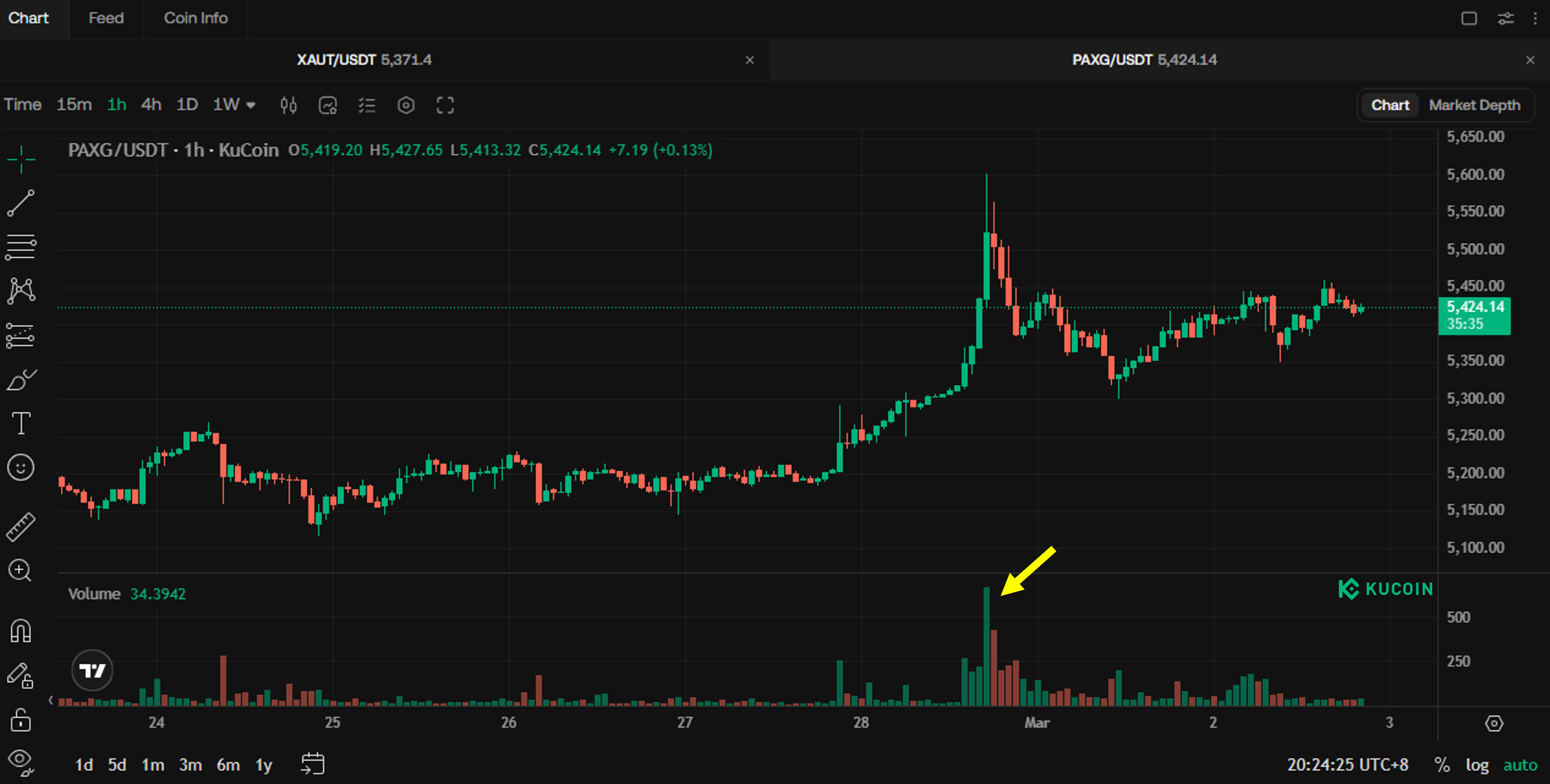
This is not just a game of geopolitical chess; it is a stress test about "liquidity privilege." The airstrike incident, in an extremely extreme way, declared to all traditional financial practitioners: traditional financial infrastructure based on T+1 or T+2 settlement, limited to working days and fixed trading hours, is being left behind by the times. The tokenization of real-world assets (RWA) and the completion of 24/7 trading settlement through digital assets are no longer social experiments by geeks but an inevitable trend in the global capital's fight for pricing power and trading Alpha.

From the perspective of quantitative trading and hedge funds, the core of risk management lies in the accessibility of hedging tools. After the airstrike on February 28, the risk exposure of macro hedge funds skyrocketed instantly. In theory, crude oil and gold are the preferred safe-haven hedging targets. But on that Saturday morning, tens of thousands of financial institutions and professional traders became "liquidity prisoners."

The infrastructure of traditional financial markets is built on the industrial era's schedule. Although electronic trading has been popularized for decades, the underlying clearing and settlement systems (such as DTCC, Euroclear systems, and the SWIFT network) still heavily rely on the batch processing of centralized institutions and banking hours. When a black swan event occurs outside trading hours, the reaction mechanism of traditional markets is completely frozen. Investors can only watch information spread at the speed of light while capital flows are trapped like insects in amber, unable to move.

This "deliberate avoidance of trading days" strike essentially compresses all market volatility and gap risk into the few short minutes of Monday's opening. For quantitative market makers and high-frequency trading institutions, this kind of discontinuous hedging gap risk is fatal. During the highly information-asymmetric and liquidity-dry Monday opening phase, it is extremely easy to trigger a chain reaction of long squeezes or short blow-ups.

In contrast, the cryptocurrency market demonstrated a dimension-reducing resilience. Within minutes of the news of the February 28 attack spreading, capital rapidly flowed into crypto liquidity pools. XAUT and PAXG trading pairs on major centralized crypto exchanges absorbed a massive level of safe-haven demand. As shown in the chart, the funding rate (longs pay shorts) reached 0.5% on February 28.
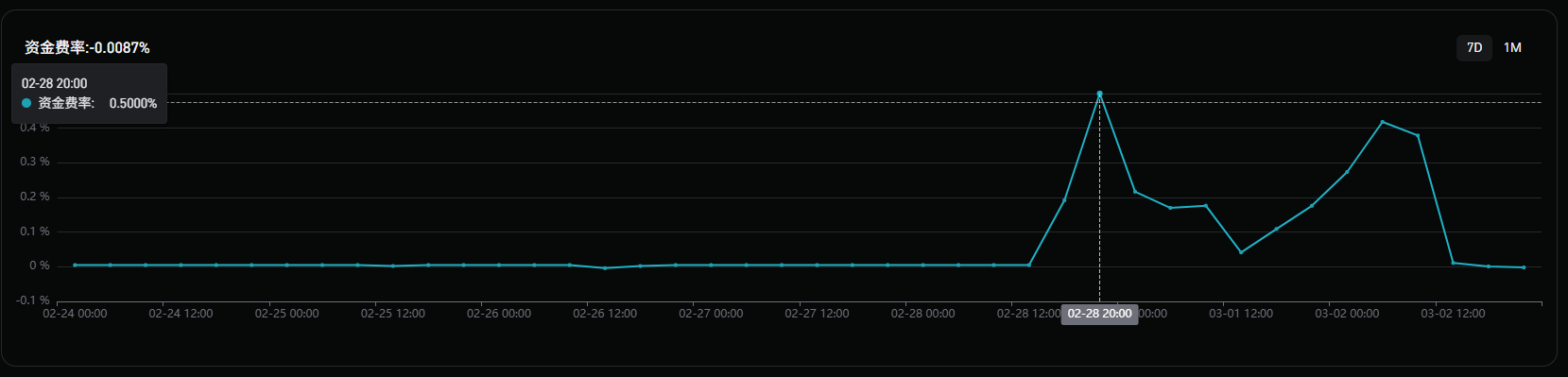
We can clearly see this smooth and steep value growth curve from the on-chain data: no market close, no trading halts, no opening gap uncertainty. The price of on-chain gold tokens followed every update from the front-line battle reports, performing continuous pricing in milliseconds. Before the CME opened on Monday, the price of on-chain XAUT had already completed sufficient price discovery.

This brings about a highly disruptive financial phenomenon: the pricing power of traditional commodities, for the first time in history during a major geopolitical crisis, temporarily shifted to the digital asset market.

When the Asian early trading session opened on March 2 (Monday), traditional gold spot and futures markets surged at the open. Over that weekend, XAUT was no longer a shadow asset of GLD (SPDR Gold ETF) or COMEX gold futures. Instead, on-chain tokens, in a sense, became the "price oracle" for Wall Street's Monday opening. Sharp arbitrageurs used this 48-hour time difference to build sufficient positions on-chain and, at the moment the traditional market opened on Monday, arbitraged the high basis to narrow the price gap between the two worlds.
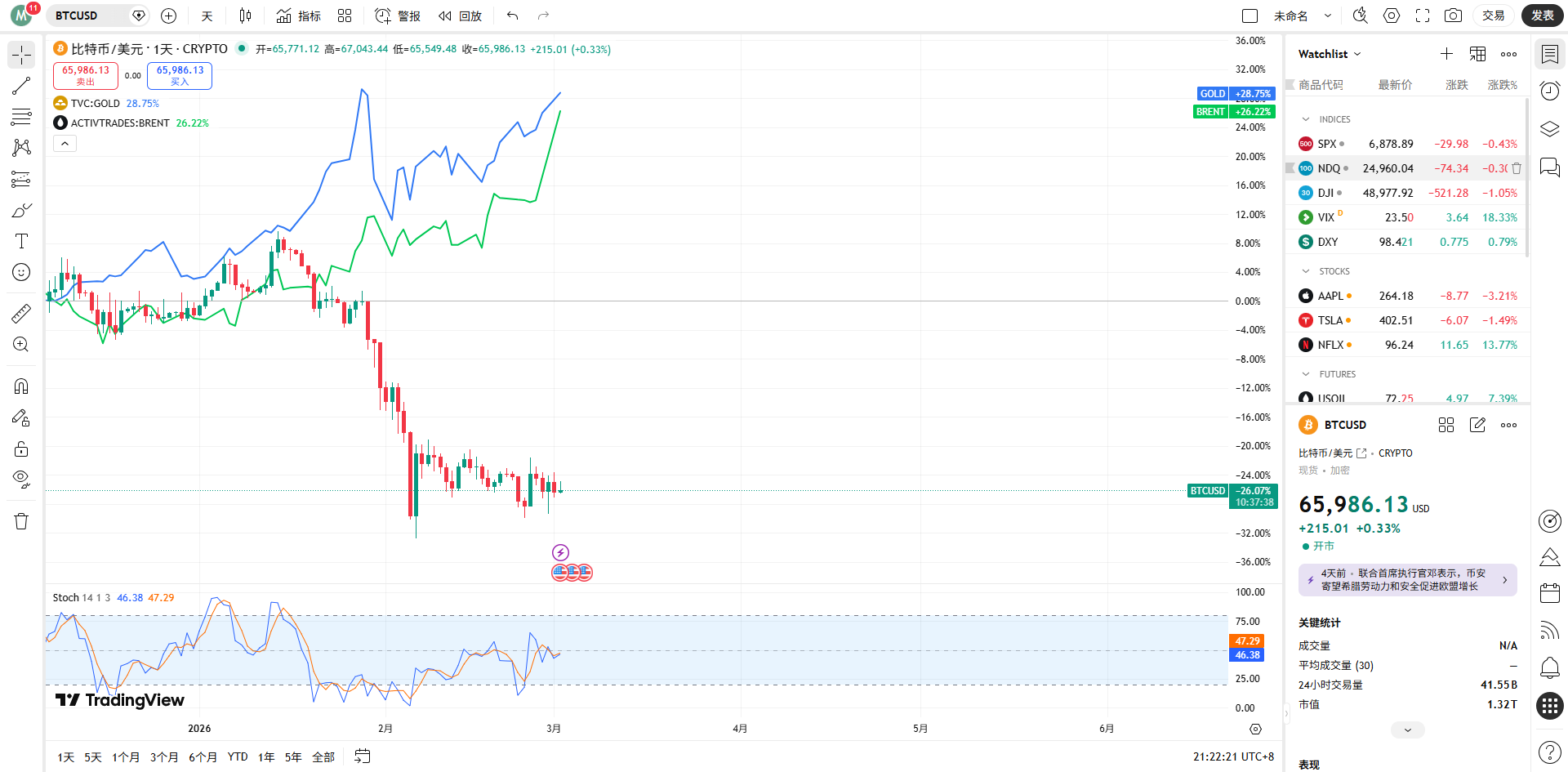
The weekend's gold token trading frenzy revealed the most core value proposition of RWA assets: the expansion of the time dimension of liquidity.

In previous narratives, people often focused the advantages of RWA on lowering thresholds, fractionalizing ownership, or improving transparency. But for professional financial practitioners, the greatest appeal of RWA lies in the T+0 underlying logic of "settlement equals clearing" and the 7x24x365 non-stop operation mechanism.

Imagine if what broke out on the weekend was not a Middle East airstrike, but a sovereign debt default of a certain country, the collapse of a major bank, or an unexpected emergency central bank interest rate cut. Traditional institutions could only passively bear huge exposure risks before the Monday open. However, if government bonds, foreign exchange, and even core stock indices achieved deep tokenization and established sufficient liquidity pools on the blockchain, institutional investors could immediately use smart contracts to complete risk hedging and asset swaps the moment the risk occurs.

In this event, not only gold but also the exchange network between stablecoins and crypto-native assets acted as a super highway for capital safe havens. In the traditional financial system, cross-border, cross-institution fund transfers require complex correspondent bank confirmations and multiple compliance reviews, taking days to complete. On-chain, hundreds of millions of dollars in hedging positions can be atomically swapped within one block time (12 seconds for Ethereum), with no counterparty default risk.

For Wall Street, the weekend at the end of February 2026 was a profound research and education experience. Previously, many traditional institutions took a wait-and-see attitude towards the rise of RWA protocols like BlackRock's launch of BUIDL (tokenized treasury fund) and Ondo Finance, considering it just a gimmick to attract existing crypto funds. But the airstrike incident proved that in the face of extreme black swans, the liquidity premium provided by tokenized assets is a hardcore Alpha that no excellent quantitative model can replace.

Quantitative funds will no longer be satisfied with the trading interfaces provided by CME or Nasdaq; they will massively connect APIs to on-chain DEXs and RWA trading pools with institutional-grade compliance systems. To capture "non-synchronous trading opportunities" during weekends and holidays, building cross-border arbitrage models spanning TradFi and DeFi will become standard configuration for top hedge funds.

When brokers and market-making institutions realize that a large amount of trading demand and commission profits are leaking to blockchain networks on weekends, the drive for profit will force them to actively become liquidity providers for on-chain assets. In the future, large market makers like Jane Street and Jump Trading will not only make markets for ETFs on weekdays but will also inject liquidity into 24/7 RWA asset pools on weekends.

Starting with highly standardized commodities like gold and crude oil, gradually spreading to short-term treasury bonds, high-quality corporate bonds, and even US stock indices. The载体 of financial assets will completely migrate from the ledgers of trust companies and clearinghouses to distributed ledgers. No more T+2 capital occupation, no more weekend anxiety about selling for safety on Friday afternoon; global capital will truly achieve seamless circulation in physical time and space.

"Money never sleeps" was once one of Wall Street's most famous slogans, but the reality is that traditional Wall Street not only sleeps but also takes weekends and public holidays. The artillery fire on February 28, 2026, proved in a cruel way that in the face of an increasingly complex and unpredictable global macro environment, fragmented trading time and locked liquidity are themselves the greatest systemic risks.

The price discovery process led by digital assets like XAUT this weekend sounded the death knell for the traditional clearing system. RWA is not just about moving real-world assets onto the blockchain; it is about using code to reconstruct the time rules of financial operation. For quantitative analysts, traders, and financial engineers, the future battlefield is no longer limited to the trading screen for 5 days a week, 8 hours a day. Whoever masters the trading and settlement infrastructure of 24/7 digital assets first will be able to grasp the throat of the global market on the next unexpected black swan night.


Twitter:https://twitter.com/BitpushNewsCN

Bitpush TG Discussion Group:https://t.me/BitPushCommunity

Bitpush TG Subscription: https://t.me/bitpush

Original link:https://www.bitpush.news/articles/7616124

Пов'язані питання

QWhat was the main financial implication of the 2026 Iran airstrike occurring on a weekend, according to the article?

AThe airstrike exposed the vulnerability of traditional financial markets due to their reliance on fixed trading hours and T+1/T+2 settlement systems, creating a 'liquidity vacuum' where investors were unable to react immediately. This highlighted the advantage of RWA tokenization, which enables 24/7 trading and instant settlement, allowing capital to flow into crypto gold tokens like XAUT and PAXG during the crisis.

QHow did tokenized gold assets (like XAUT and PAXG) perform during the weekend airstrike event?

ATokenized gold assets experienced a surge in trading activity on blockchain networks, with XAUT and PAXG serving as primary hedging tools. They enabled continuous price discovery and absorbed significant避险 demand, with funding rates reaching 0.5%. Their 24/7 availability allowed them to act as a price oracle for traditional markets when they reopened.

QWhat core advantage of RWA (Real World Asset) tokenization does the article emphasize for professional financial practitioners?

AThe article emphasizes that the core advantage of RWA tokenization for professionals is the expansion of liquidity in the time dimension—specifically, 'settlement即清算' (settlement equals clearing) T+0 logic and a 7x24x365 non-stop operating mechanism, which allows immediate risk hedging and asset reallocation during off-hours or black swan events.

QWhat shift in pricing power did the event demonstrate between traditional and digital asset markets?

AThe event demonstrated a historic, temporary shift in pricing power for commodities like gold from traditional markets (e.g., COMEX futures, GLD ETF) to digital asset markets. Chain-based token prices completed full price discovery over the weekend, effectively becoming a reference point ('price oracle') for traditional markets when they opened on Monday, with arbitrageurs exploiting the time差 to profit from the basis difference.

QHow might the event influence the future behavior of quantitative funds and market makers, as predicted in the article?

AThe article predicts that quantitative funds will increasingly integrate APIs with链上 DEXs and compliant RWA trading pools to capture 'non-synchronous trading opportunities' during weekends and holidays. Market makers (e.g., Jane Street, Jump Trading) will be driven by profit to provide liquidity for RWA assets全天候, leading to cross-border arbitrage models spanning TradFi and DeFi as a standard配置 for top hedge funds.

Пов'язані матеріали

STAR 50 Soars 10.73%, Why Did A-Shares Stage a "V-Shaped Reversal"?

After a prolonged decline, the Chinese A-share market staged a strong rally on July 21. The STAR 50 index surged 10.73%, its largest single-day gain in nearly a year, leading a broad-based "V-shaped" reversal. The Shanghai Composite Index rose 1.79%, the Shenzhen Component Index gained 4.81%, and the ChiNext Index jumped 7.05%. Total market turnover reached 2.97 trillion yuan, an increase of 256.1 billion yuan from the previous session, with over 3,100 stocks advancing. The semiconductor sector spearheaded the rebound, with related ETFs posting significant gains. Analysts attribute the surge to three converging factors. First, coordinated capital inflows from "national team" institutions, insurance funds, listed company buybacks, and fund house self-purchases have bolstered market liquidity and confidence. Second, supportive policy signals, including commitments from regulators to ensure stable market operations, provided a favorable backdrop. Third, a stabilization and recovery in overseas markets, notably South Korea, created a positive external environment. Institutions suggest the most severe panic selling phase for the tech sector has likely passed, following a significant digestion of crowded positions and leveraged funds. While short-term volatility may persist, the medium to long-term outlook remains underpinned by enduring trends like AI computing demand expansion and semiconductor localization. The market's focus now shifts to the sustainability of supportive fund flows, earnings reports, and upcoming catalysts from the global AI industry chain.

marsbit23 хв тому

STAR 50 Soars 10.73%, Why Did A-Shares Stage a "V-Shaped Reversal"?

marsbit23 хв тому

U.S. Tech Momentum Stocks Post Largest Single-Day Gain Ever, But Is the Plunge Over?

US tech momentum stocks staged a sharp rebound on Tuesday (July 21st). Morgan Stanley's TMT Momentum Factor surged over 12%, marking its largest single-day gain on record, exceeding even peaks from the 2000 dot-com bubble. Key momentum indices from Goldman Sachs also posted their strongest daily performances in years. The rally was led by semiconductors, with the Philadelphia Semiconductor Index jumping 4.6%. This rebound followed three consecutive down days and a cumulative 33% plunge in momentum stocks, one of the steepest drawdowns since the dot-com era. Analysts attribute the surge largely to a short squeeze. Heavy selling had pushed high-beta momentum stocks into deeply oversold territory, forcing many short sellers, particularly in Asia, to cover their positions, creating a self-reinforcing buying spiral. However, the rebound's internals appear weak. Trading volume was notably low, and advancing stocks still lagged decliners on the S&P 500, indicating a narrow, concentrated rally rather than broad market participation. Diverging views emerge on the outlook. BTIG warns the bounce has hit key resistance and recommends selling into strength, citing extreme volatility and historical parallels to past market tops. Conversely, Goldman Sachs and UBS believe the momentum unwind is nearing its end, suggesting it may be time to gradually add exposure, as positioning has been significantly reduced. They caution, however, that high volatility warrants a measured approach, potentially using defined-risk strategies. The upcoming earnings season, particularly reports from major tech firms like Alphabet, is seen as a critical test for the rally's sustainability. Simultaneously, bond markets flashed a warning, with yields rising partly due to spiking oil prices. Analysts note that if long-term Treasury yields break decisively higher, it could pose a significant headwind for equities, especially growth stocks.

marsbit30 хв тому

U.S. Tech Momentum Stocks Post Largest Single-Day Gain Ever, But Is the Plunge Over?

marsbit30 хв тому

U.S. Tech Momentum Stocks Record Largest Single-Day Gain Ever, but Has the Rout Ended?

U.S. tech momentum stocks staged a dramatic rebound on Tuesday, July 21st. Key momentum indices like the Morgan Stanley TMT Momentum Factor and Goldman Sachs' High Beta Momentum Long Index posted historic or near-historic single-day gains, fueled largely by semiconductor stocks. This sharp rally followed a severe three-day sell-off that saw momentum stocks plunge 33%, marking one of the steepest pullbacks since the dot-com bubble. Analysts attribute the bounce primarily to a short squeeze, as forced covering from over-leveraged traders, particularly in Asia, created a buying spiral. However, the rally's health is questioned due to weak market breadth—overall trading volume was low, and decliners outnumbered advancers in the S&P 500 despite the index's gain—suggesting a narrow, concentrated surge rather than broad recovery. Opinions on the sustainability diverge. BTIG strategists warn the rebound has hit key resistance levels, citing extreme volatility and historic stock dispersion as signs of an ongoing broader correction, and recommend selling into strength. Conversely, Goldman Sachs and UBS view the aggressive momentum unwinding as nearing its end, noting reduced positioning and a lack of new fundamental catalysts. They suggest the sell-off presents a selective opportunity to add exposure, albeit cautiously and gradually using defined-risk strategies. The immediate trajectory hinges on the ongoing earnings season, with market focus on Alphabet's capital expenditure guidance for AI investment clarity. Meanwhile, bond markets present a risk, with rising Treasury yields—potentially heading toward 5.5%—and widening credit spreads for mega-cap tech companies posing a threat to equity valuations. The combination of technical factors, earnings results, and macro conditions leaves the durability of the rebound in doubt.

链捕手32 хв тому

U.S. Tech Momentum Stocks Record Largest Single-Day Gain Ever, but Has the Rout Ended?

链捕手32 хв тому

Long-Divided Must Unite, Long-United Must Divide: When L1 Becomes Its Own Rollup, What Is Ethereum's Endgame?

"The Inevitable Cycle: When L1 Becomes Its Own Rollup – What is Ethereum's Endgame?" For years, the Ethereum community grappled with concerns that L2s were fragmenting the ecosystem and eroding L1's value. While L2s provided cheaper execution, they also splintered liquidity and the unified user experience of a single chain. This has prompted a fundamental reassessment of the relationship between L1 and L2. Ethereum's roadmap is evolving. The "Scale" initiative merges L1 and L2 expansion into a holistic framework. L1 itself is advancing with higher gas limits, statelessness, and zkEVM verification, no longer content to be just a low-throughput settlement layer. Consequently, the primary value proposition of L2s is shifting from merely providing cheap blockspace to offering L1 cannot easily provide: application-specific optimizations, privacy features, and flexible governance models. L2s are becoming a spectrum of execution environments with varying degrees of security inheritance from Ethereum. A critical challenge in this multi-chain future is interoperability. The vision is to make Ethereum "feel like one chain again." This relies on advancements in native account abstraction (like EIP-7702) and intent-based architectures (Open Intents Framework), where users declare desired outcomes, and solvers handle the complex cross-chain execution. Furthermore, shortening Ethereum's finality time from minutes to seconds is crucial, as it underpins trust between chains for bridges, stablecoins, and cross-chain applications. Perhaps the most provocative idea is that Ethereum L1 itself could become a form of "its own Rollup." As zkEVM and proof systems mature, high-performance nodes could execute transactions and generate validity proofs. Regular validators would then verify these proofs instead of re-executing all transactions. This blurs the traditional L1/L2 hierarchy, making "Rollup" more of a general execution-verification architecture. Native Rollup aims to integrate L2 validation more directly into the Ethereum protocol, allowing L2s to inherit L1's security more fully and move away from reliance on security councils. In the end, L2s are not destined to replace L1 or be made obsolete by it. The likely future is a unified system where diverse execution environments—each optimized for specific use cases like DeFi, gaming, or privacy—coexist. They will share a common foundation of security, liquidity, and verifiable state, seamlessly connected to restore a cohesive user experience. The next phase for Ethereum is not just about scaling through separation, but about intelligently reintegrating what was separated back into a coherent whole.

链捕手49 хв тому

Long-Divided Must Unite, Long-United Must Divide: When L1 Becomes Its Own Rollup, What Is Ethereum's Endgame?

链捕手49 хв тому

Торгівля

Спот
活动图片





