Market Watch: First Cooling of On-chain Pokemon Card Packs, Are Speculative Funds Turning to Memecoins?

marsbitОпубліковано о 2026-08-10Востаннє оновлено о 2026-08-10

Анотація

Market Observation: On-chain Pokemon card packs (or 'gacha') experience their first monthly decline since February, with July transaction volume dropping to $290.3 million from June's record $354.8 million. Concurrently, trading volumes on Memecoin platforms like Pump.fun increased. This suggests speculative crypto capital may be rotating; as Memecoin activity recovers, some gacha players might reallocate funds and attention. Notably, Courtyard, likely the platform with the least crypto-native user base, hit a record high of $85.3 million in July, indicating robust genuine collector demand persists separate from speculative trends. While top platforms Collector Crypt, Monster, Phygitals, and Beezie saw declines, the secondary market for trading cards remained near its all-time high. The July dip appears more as a natural correction—potentially amplified by the Memecoin resurgence—rather than a broader slowdown in the card market. Meanwhile, broader crypto market volatility and correlations continue to decline, signaling a calmer, more fragmented trading environment. The final missing piece for a potential new bull market cycle is a sustained rise in BTC's price.

Author: Marc Arjoon & Jake Koch-Gallup

Compiled by: TechFlow

TechFlow Insights: On-chain gacha experienced its first monthly decline since February, with July trading volume dropping from June's $354.8 million to $290.3 million. Meanwhile, trading volume on platforms like Pump.fun for Memecoins has been rising. This suggests that crypto speculative funds may be rotating—some gacha players exit when the Memecoin market recovers. Notably, Courtyard, with the least crypto-native user base, hit a record high, indicating that genuine collecting demand remains strong.

The market is quiet but lacks the final push! Market volatility and asset correlations continue to decline, entering a calmer state. This leaves the market with the final piece needed to start a new bull run. Meanwhile, on-chain gacha saw its first monthly decline since February, hinting that some speculative funds may be flowing back into Memecoins. Let's dive deeper.

Market Dynamics

In the past 24 hours, the 2025 crypto stock sector led the market, rising 2.6%, the only sector with significant gains. The increase was concentrated in Galaxy (+3.6%) and Circle (+3.1%), which just released Q2 earnings. Circle benefited from low expectations after Morgan Stanley recently slashed its price target by 64% to $38. But the strength was narrow. Bullish (-1.5%) and Gemini (-0.6%) closed lower, and the broader crypto stock index fell 1.1%. This suggests the rally was driven by company-specific earnings reactions, not a revaluation of the entire sector.
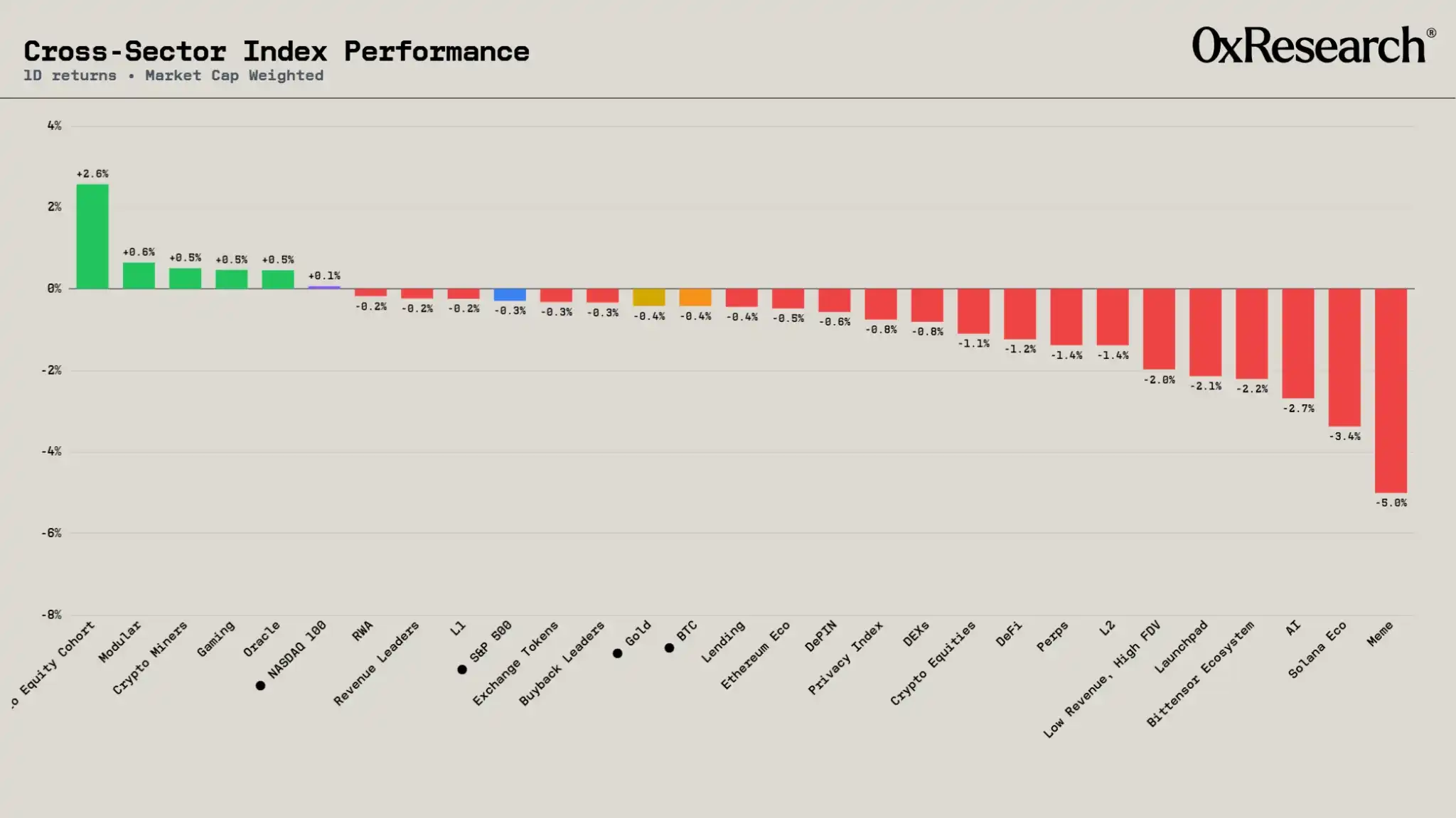
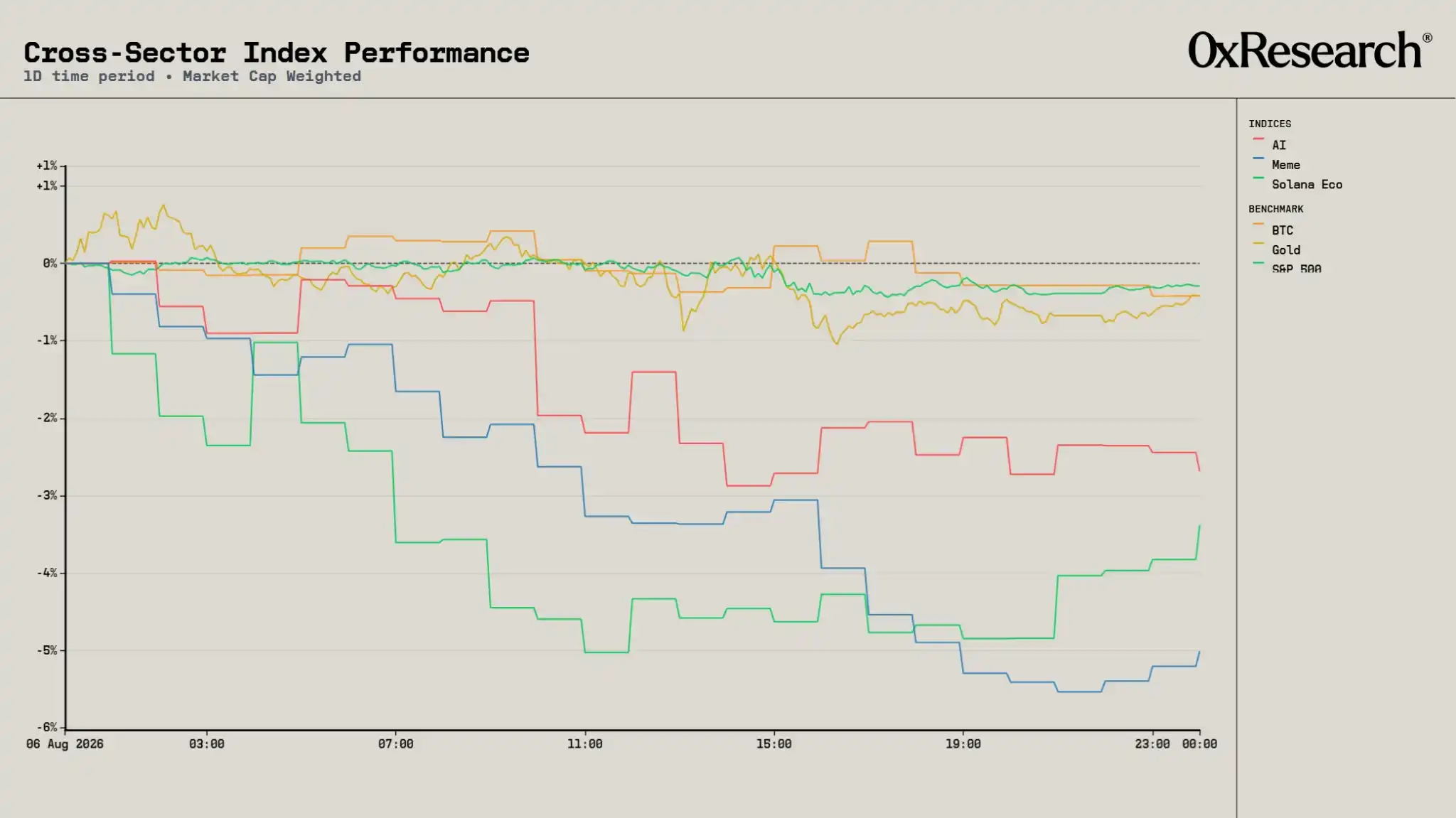
Outside this sector, market performance was negative. As stocks consolidated below record highs this week, BTC fell 0.4%, roughly in line with gold (-0.4%) and the S&P 500 (-0.3%). BTC's resilience to equity pullbacks once again failed to translate into upside participation. The relative strength story was internal to crypto. BTC ranked at the top of the digital asset sectors, with long-tail assets selling off, led by Meme (-5.0%), Solana Ecosystem (-3.4%), and AI (-2.7%).
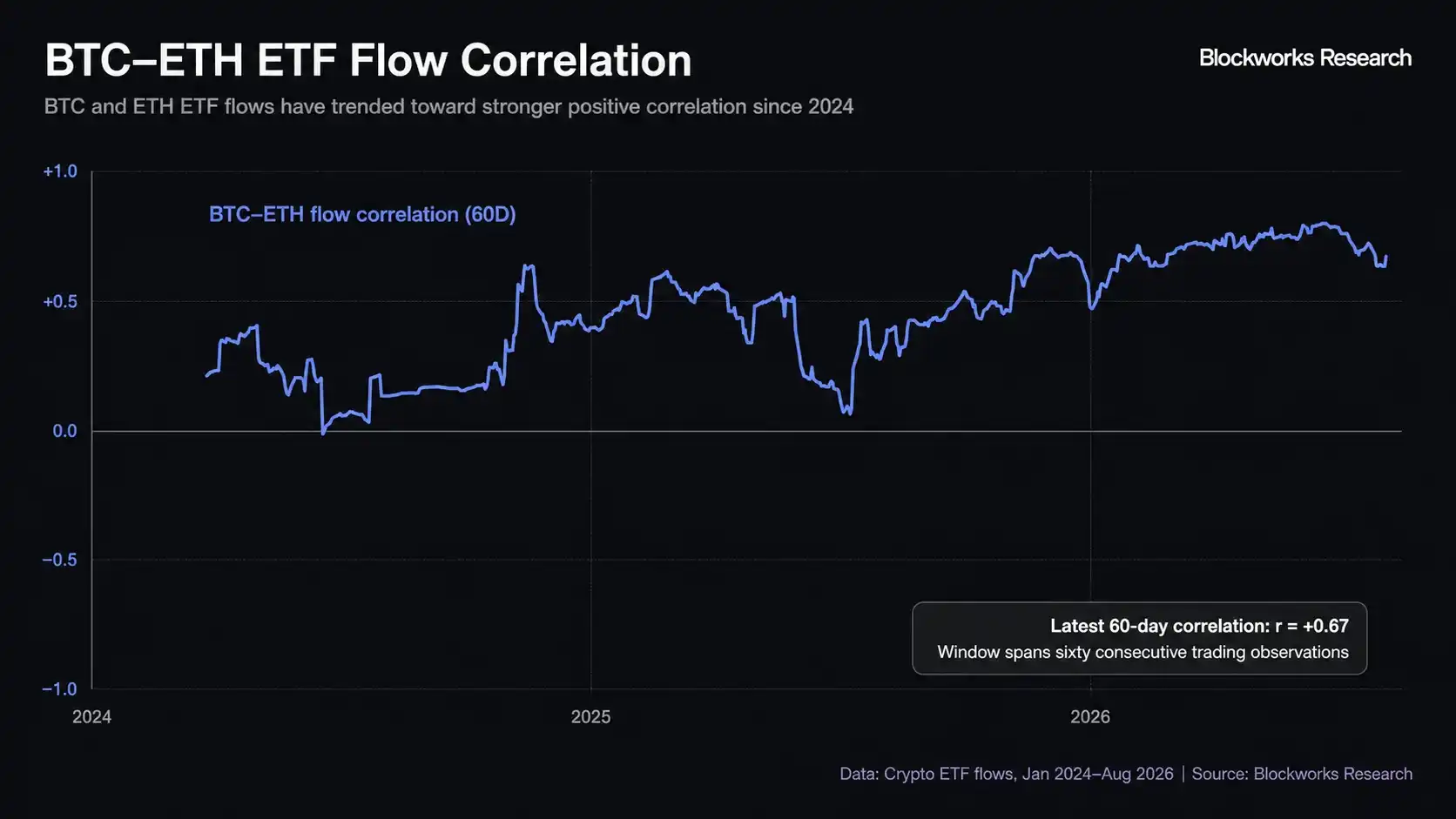
As mentioned in yesterday's article, we know crypto ETF flows have been weak. BTC and ETH ETF flows are becoming increasingly synchronized. Their 60-day rolling correlation has risen to +0.67, near the top of its range. ETF demand is behaving more like a single crypto allocation, but this isn't surprising, as this tends to happen during downtrends.
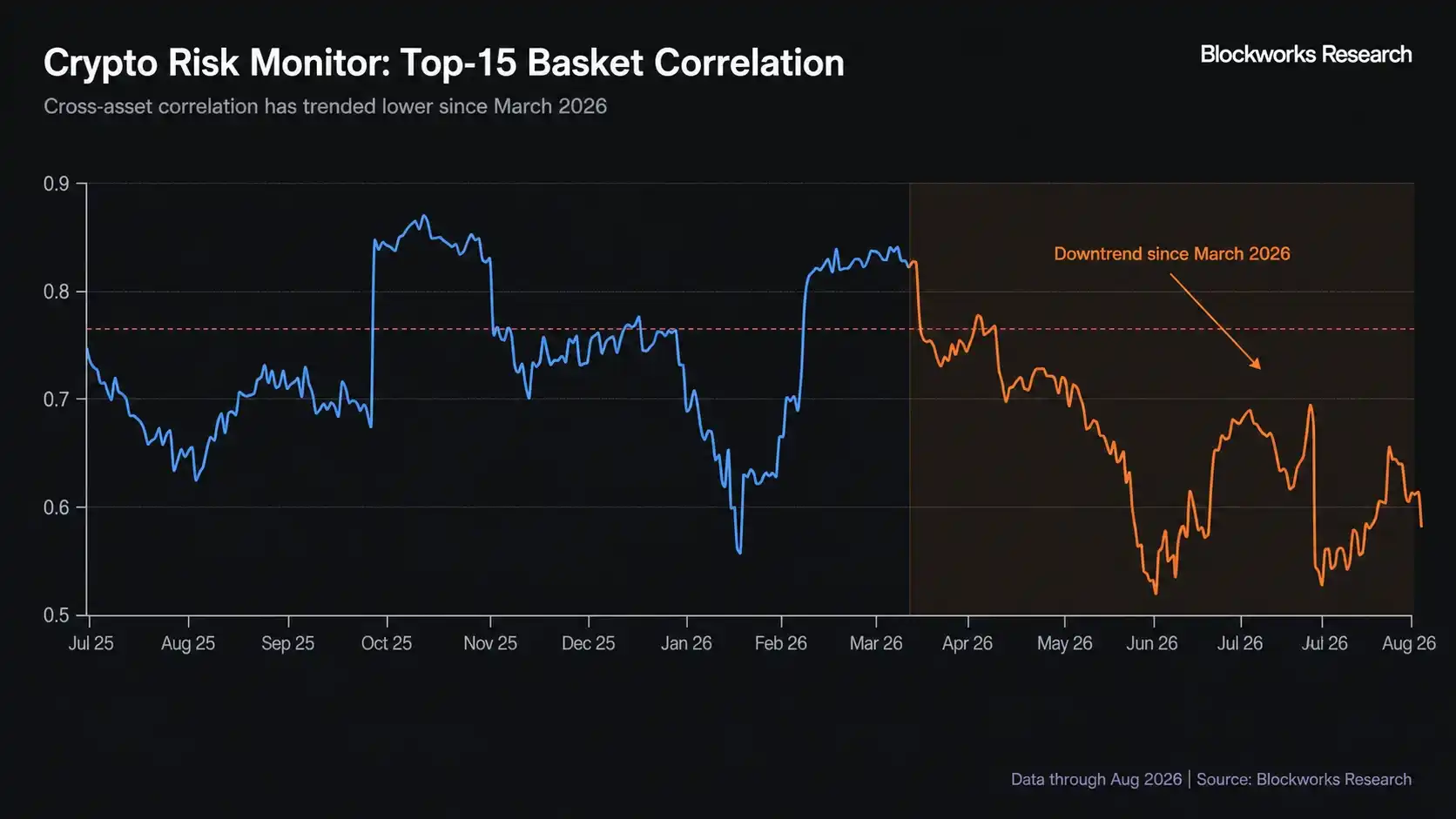
Fortunately, overall correlation has been trending down since March 2026. This has led to weaker market co-movement and a more fragmented trading environment.
Similarly, market volatility has dropped from over 60 in March to the low 30s in August. The decline indicates the market is entering a calmer state, with readings now comfortably below risk thresholds.
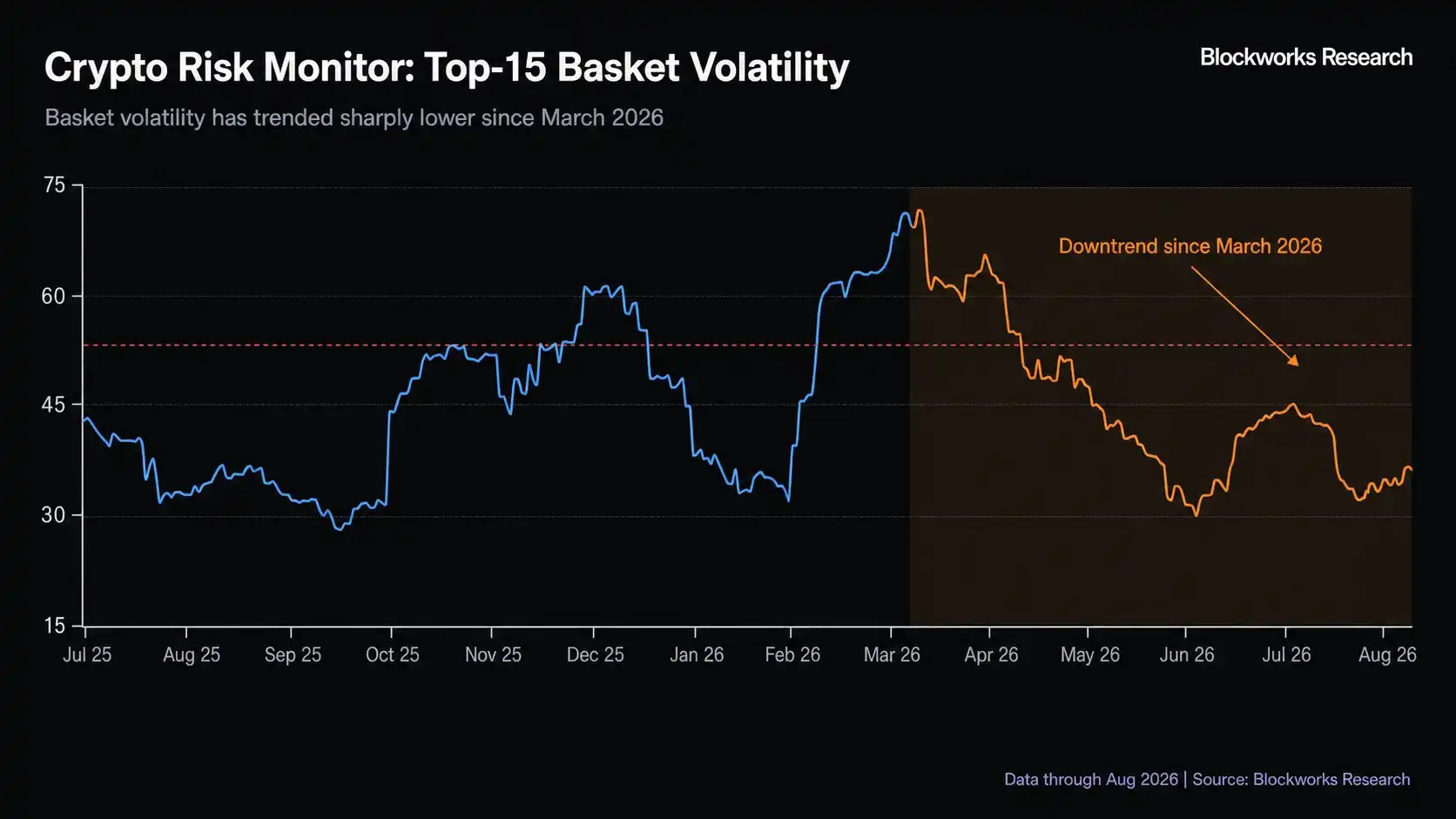
As market volatility and correlation decline, the only element left to start a new bull market is a sustainable rise in BTC price.

Gacha Cooling Down

On-chain gacha was one of crypto's hottest sectors in 2026, but July marked the first monthly decline since February.

Total on-chain gacha spending in July was $290.3 million, the second-highest monthly total on record, just behind June's record of $354.8 million. For the fifth consecutive month, Collector Crypt was the largest gacha platform, generating $154.9 million in spending, accounting for 53% of July's total. However, Collector Crypt's monthly spending fell 26% sequentially from June's $209.5 million.

Courtyard achieved its best monthly record in July, reaching a historical high of $85.3 million, up 7% sequentially. Courtyard's performance is particularly noteworthy because it likely has the least crypto-native user base among major platforms. Its continued growth indicates that on-chain gacha is a product category that resonates beyond the existing on-chain user base. Courtyard accounted for 29% of gacha spending in July.
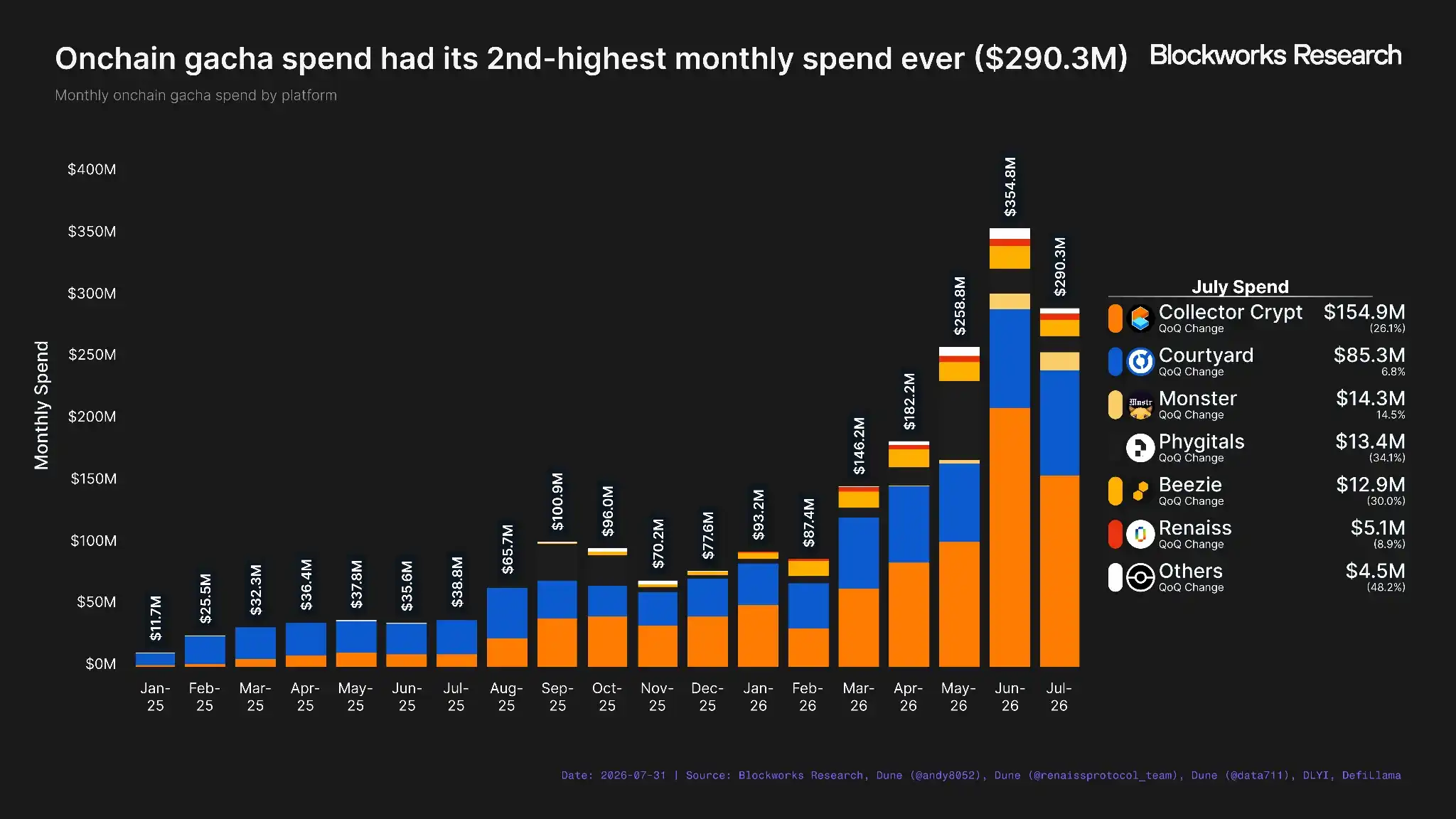
The platform rankings also saw a reshuffle, with Monster surpassing Phygitals and Beezie to become the third-largest gacha platform in July. Monster generated $14.3 million in volume, up 15% sequentially, and released a series of updates aimed at improving user experience:

Lucky Boost - Opening a pack and getting a common card increases the expected value of the next pack by 0.1%

Dupe Shield - Drawing the same card in consecutive packs grants the user a free pack

These updates went live on July 17 and 23 respectively. From the launch of Lucky Boost to month-end, Monster generated $9.7 million in volume, accounting for 68% of its July total.

Both Phygitals ($13.4 million, down 34% sequentially) and Beezie ($12.9 million, down 30% sequentially) experienced down months despite launching significant product updates. Phygitals launched a mobile app at month-end, while Beezie expanded to Solana on July 23. Overall, the top five gacha platforms (Collector Crypt, Courtyard, Monster, Phygitals, and Beezie) accounted for 97% of on-chain gacha spending in July.

Looking beyond on-chain gacha, trading card secondary market volume remained essentially at its all-time high of $694.7 million, compared to $695.6 million in June. Weakening trading card demand was not the reason for July's on-chain gacha decline.

It's also possible that a one-month decline doesn't have much to read into. On-chain gacha spending grew at a staggering pace in the first half of 2026; some degree of pullback was inevitable. However, another possible explanation is that on-chain gacha faces new competition for attention and funds from crypto-native traders.

Throughout July, Collector Crypt spending declined while Pump.fun trading volume rose. Collector Crypt's average daily spending fell from $5.6 million in the first 7 days of July to $3.4 million in the last 7 days, a 39% drop. During the same period, Pump.fun's average daily trading volume increased from $320.6 million to $388.5 million, a 21% rise. This relationship doesn't necessarily imply causation, but it intuitively makes sense. A significant portion of Collector Crypt's user base consists of active on-chain traders who rotate into whatever hot sector emerges. When Memecoins regain momentum, some of the capital and attention flowing into on-chain gacha may shift elsewhere, even as trading card demand remains strong.
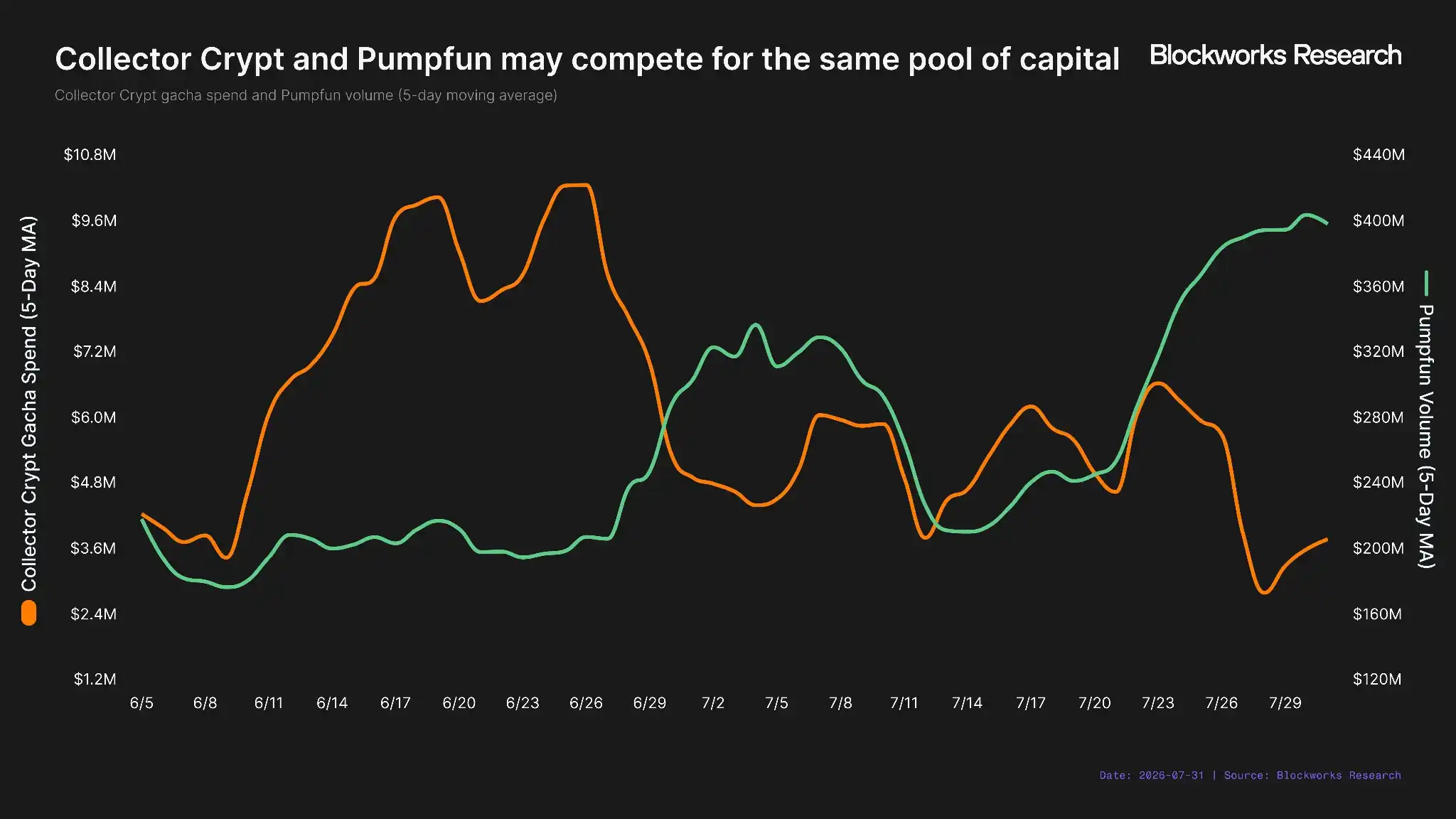
Courtyard's performance further supports this possibility. While most crypto-native gacha platforms experienced pullbacks, Courtyard hit a record high in July. As mentioned, Courtyard likely has the least crypto-native user base among major platforms, meaning its users may be less inclined to rotate back into Memecoins when speculative activity heats up.

For now, July's decline looks more like a natural correction, potentially amplified by the resurgence of Memecoin activity, rather than evidence of a broader slowdown in the trading card market.


Пов'язані питання

QAccording to the article, what is the key observation regarding the on-chain Pokemon card opening (gacha) market in July?

AThe on-chain gacha market experienced its first monthly pullback since February, with July transaction volume dropping to $290.3 million from $354.8 million in June, suggesting a potential cooling of speculative interest.

QWhich on-chain gacha platform performed exceptionally well in July and why is its performance considered significant?

ACourtyard performed exceptionally well in July, hitting a new all-time high of $85.3 million. This is significant because Courtyard likely has the least crypto-native user base among major platforms, indicating strong genuine collector demand beyond pure crypto speculation.

QWhat does the article suggest might be one reason for the decline in on-chain gacha activity on platforms like Collector Crypt?

AThe article suggests that the decline might be due to a rotation of speculative capital and trader attention back to Memecoins, as evidenced by rising transaction volumes on platforms like Pump.fun while Collector Crypt's daily spending fell during the same period.

QWhat are the two key market conditions that have been declining, according to the analysis, and what do they indicate?

AThe two key declining market conditions are asset correlation and volatility. Their decline indicates the market is entering a calmer, less interconnected state, which is seen as the final piece needed for a potential new bull market, contingent on sustainable BTC price appreciation.

QWhat user-centric updates did the Monster platform implement in July, and what was their impact?

AMonster implemented two user-centric updates: 'Lucky Boost' (increasing the next pack's expected value by 0.1% after opening a common card) and 'Dupe Shield' (granting a free pack for pulling the same card consecutively). Following the launch of Lucky Boost on July 17th, Monster generated $9.7 million in volume until month-end, accounting for 68% of its total July volume.

Пов'язані матеріали

Trading Volume Halved: Korea's Two Major Crypto Exchanges Launch Listing Wars

As South Korea's stock market cools from its peak summer performance, leading cryptocurrency exchanges Upbit and Bithumb are intensifying their competition to list new digital assets. Following a significant slump in crypto trading volume during the first half of 2025—with total volume across five major KRW-based exchanges falling nearly 50% year-on-year as capital flooded into equities—the two exchanges have sharply increased their listing pace since July. In just over a month, both Upbit and Bithumb have each added 17 new KRW-trading pairs, far exceeding their average of 6-10 listings per month earlier in the year. This acceleration coincides with a decline in the Korean Composite Stock Price Index's (KOSPI) daily trading volume and a reduction in the proportion of retail investor participation in stocks. Analysts suggest that with the stock market's "wealth effect" diminishing, crypto exchanges are now competing more aggressively for the limited attention and risk capital of local retail investors. The newly listed assets are already contributing significantly to trading activity on the platforms. On Upbit, for example, several coins listed since July now rank among its top-traded assets by volume, collectively accounting for nearly 20% of its 24-hour trading volume recently. However, this surge in new listings appears to be primarily redistracting existing capital within the shrunken crypto market rather than attracting substantial new inflows. Consequently, the strategies of the two dominant exchanges, which together control about 96% of the KRW crypto trading market, are becoming increasingly similar, with both rushing to list the same trending assets to prevent the other from capturing all available trading demand.

marsbit19 хв тому

Trading Volume Halved: Korea's Two Major Crypto Exchanges Launch Listing Wars

marsbit19 хв тому

Behind a 26-Year-Old Hong Kong Trader's $150 Million Loss: A South Korean Stock Market 'Great Escape'

In 2026, the South Korean stock market, propelled by the AI boom's demand for high-performance memory chips, witnessed a dramatic rally and subsequent crash, illustrating the perils of excessive leverage, structural market flaws, and retail investor frenzy. The initial surge was driven by soaring share prices of memory giants Samsung Electronics and SK Hynix. This "once-in-a-lifetime" wealth creation story captivated local Korean retail investors, many of whom invested heavily using leverage, and attracted global capital through products like Hong Kong-listed leveraged ETFs. However, the market's heavy reliance on these two stocks and widespread leverage created systemic fragility. The turning point came in June 2026. A series of circuit-breaker halts triggered a vicious cycle of forced liquidations, leading to a steep market plunge. The collapse erased fortunes, leaving many leveraged retail investors in debt. It also exposed a high-profile case in Hong Kong where a 26-year-old trader, using unauthorized company funds and double leverage on a SK Hynix ETF, incurred massive losses of HKD 150 million. Analysis points to key factors behind the extreme volatility: the overwhelming dominance of two stocks in the KOSPI index, a culture of rampant retail leverage, and a fundamental mispricing where investors treated cyclical semiconductor stocks as perpetual growth stories. As the market entered a volatile consolidation phase, seasoned investors emphasized core risk management principles: avoiding leverage, understanding industry cycles, maintaining a margin of safety, and being wary of extreme market consensus. The episode serves as a stark reminder that high returns are inextricably linked to high risk, especially when amplified by leverage.

marsbit30 хв тому

Behind a 26-Year-Old Hong Kong Trader's $150 Million Loss: A South Korean Stock Market 'Great Escape'

marsbit30 хв тому

Торгівля

Спот
活动图片