Mapping the New Finance Ecosystem: Nine Major Sectors in a 'Hundred Regiments Battle', with Tokenization, Stablecoins, and Neo-Banks as the Main Battlefields

marsbitОпубліковано о 2026-01-19Востаннє оновлено о 2026-01-19

Анотація

Andy, founder of The Rollup, outlines the landscape of Neo Finance in 2026, identifying it as the fastest-growing sector in the global financial system. The ecosystem comprises nine major segments, including over 100 projects, with tokenization, stablecoins, and neobanking highlighted as the primary growth areas. Tokenization of real-world assets like bonds and commodities is gaining significant traction. Stablecoins remain the top entry point for new users, with yield-bearing variants growing exponentially. Neobanks are leveraging DeFi infrastructure to offer consumer-friendly banking experiences with superior yields. The article emphasizes that outdated crypto practices are fading, and a new financial era driven by utility and adoption is emerging.

Author: Andy, Founder of The Rollup

Compiled by: Felix, PANews

Andy, the founder of The Rollup, recently published an article discussing the market landscape of Neo Finance in 2026, pointing out that Neo Finance will become the fastest-growing sector in the global financial system. Below are the details.

The Neo Finance sector will give birth to more true 'billion-dollar unicorn' companies than ever before. It is poised to become the fastest-growing sector in the global financial system for years, and even decades, to come.

Below is the market landscape for Neo Finance in 2026, covering nine major segments and over 100 ecosystem projects:
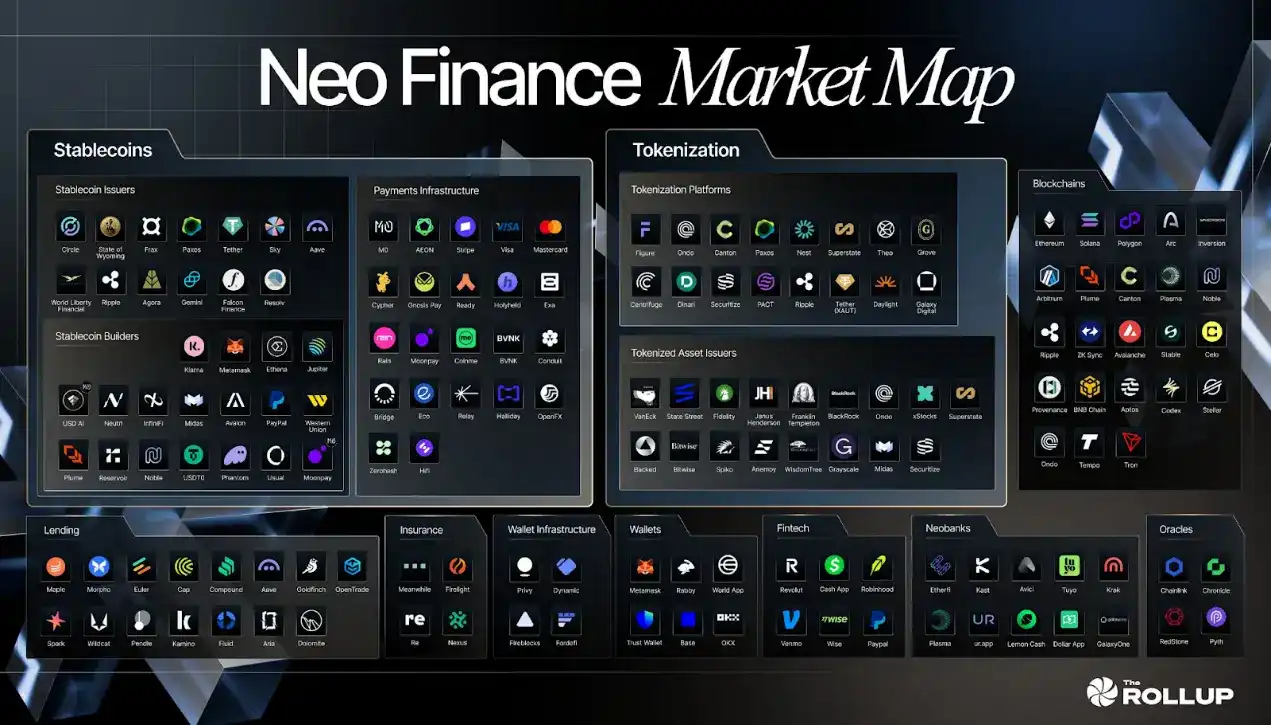
The combination of front-end consumer-grade user experience and back-end efficient DeFi infrastructure will provide users with a 'bank-like experience' that is both familiar and far superior to traditional banking.

Users' savings can be traded and transferred globally and are available 24/7. A simple example: a user's 'checking account' could earn a 5% annual interest rate, compared to 0.25% from a traditional bank.

Driven by teams focusing on different parts of the technology stack, the Neo Finance market has the potential to fundamentally change how the world interacts with money.

Let's take a look at some key areas in the market map.

Tokenization

Tokenization is the process of bringing real-world assets (such as treasury bonds, stocks, commodities, credit, money markets, etc.) on-chain.

The infrastructure and tokenization agent layer includes: Figure, Ondo Finance, Paxos, Centrifuge, Superstate Inc, Midas, Grove Finance, Nest, Dinari, Securitize, and other companies.
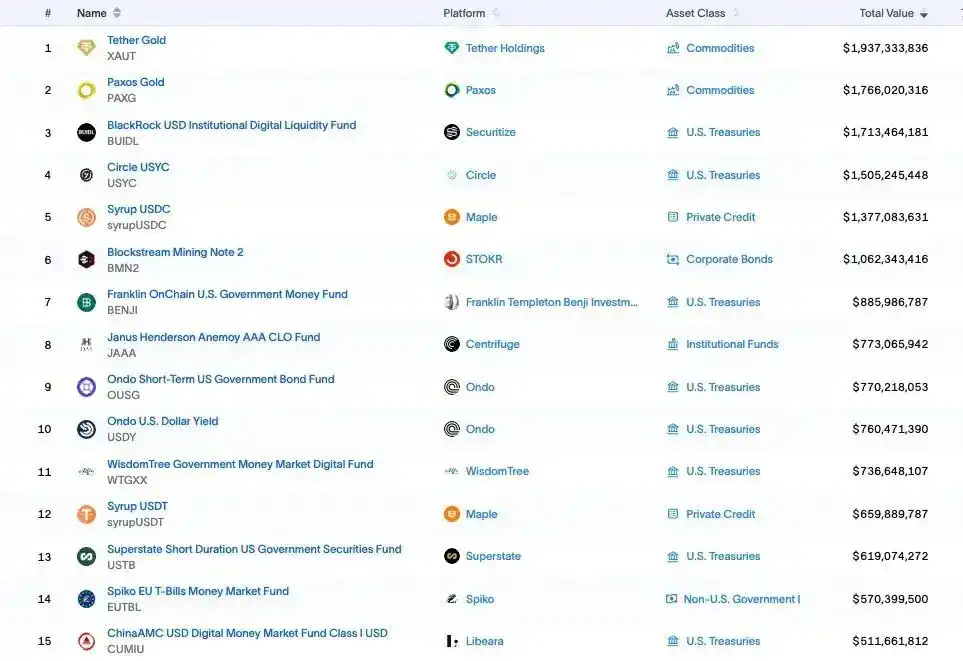
Tokenization has been discussed for years, but 2025 is the year it truly begins to scale.

Stablecoins

Stablecoins are by far the most successful crypto product, with 90% of new finance customers preferring stablecoins as their first point of contact with cryptocurrency.

The stablecoin issuer sector is booming, with numerous companies emerging, such as: Circle, Paxos, Tether, and Sky.

Meanwhile, yield-bearing stablecoins (or 'yield coins') like $sUSDS, $sUSDe, $BUIDL, $USYC, and $syrupUSDC have seen exponential growth over the past 18 months, with a supply exceeding $13 billion.
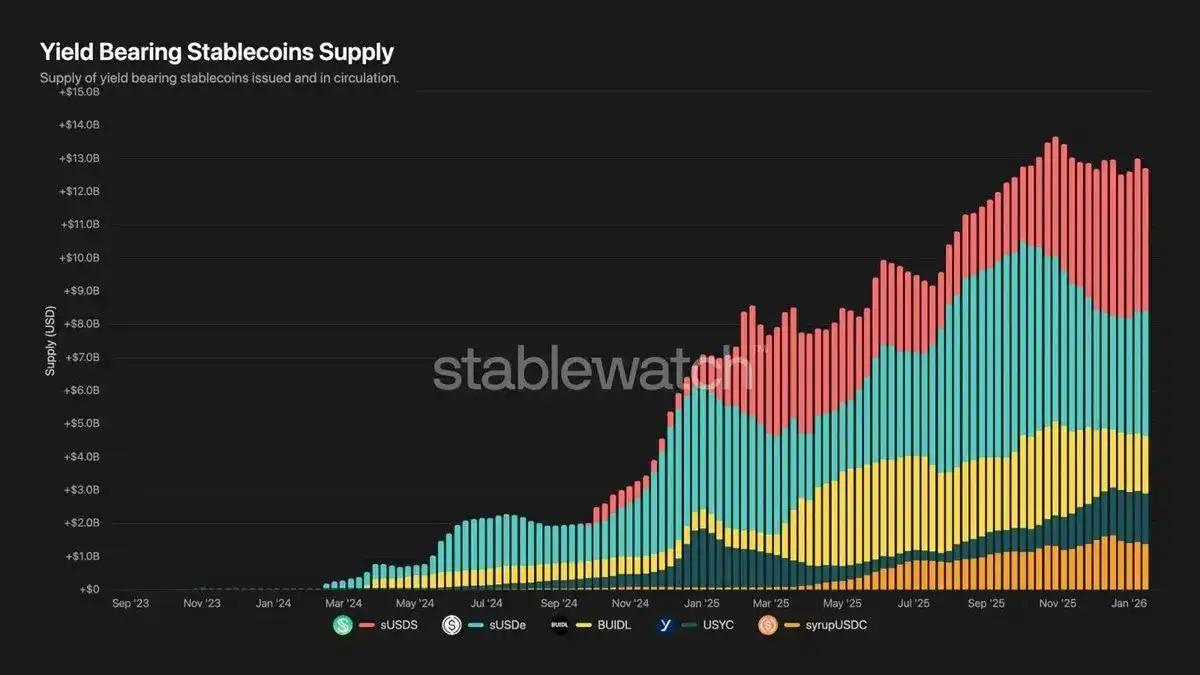
Users no longer have to choose between stability and yield as they did in the CeDeFi space during 2020-2022; now they can have both.

Neo-Banks

In the neo-bank sector, many teams are emerging, such as ether.fi, KAST, Tuyo, Galaxy, and others. These teams are leveraging DeFi backends to build consumer-facing 'bank-like' experiences from the ground up.
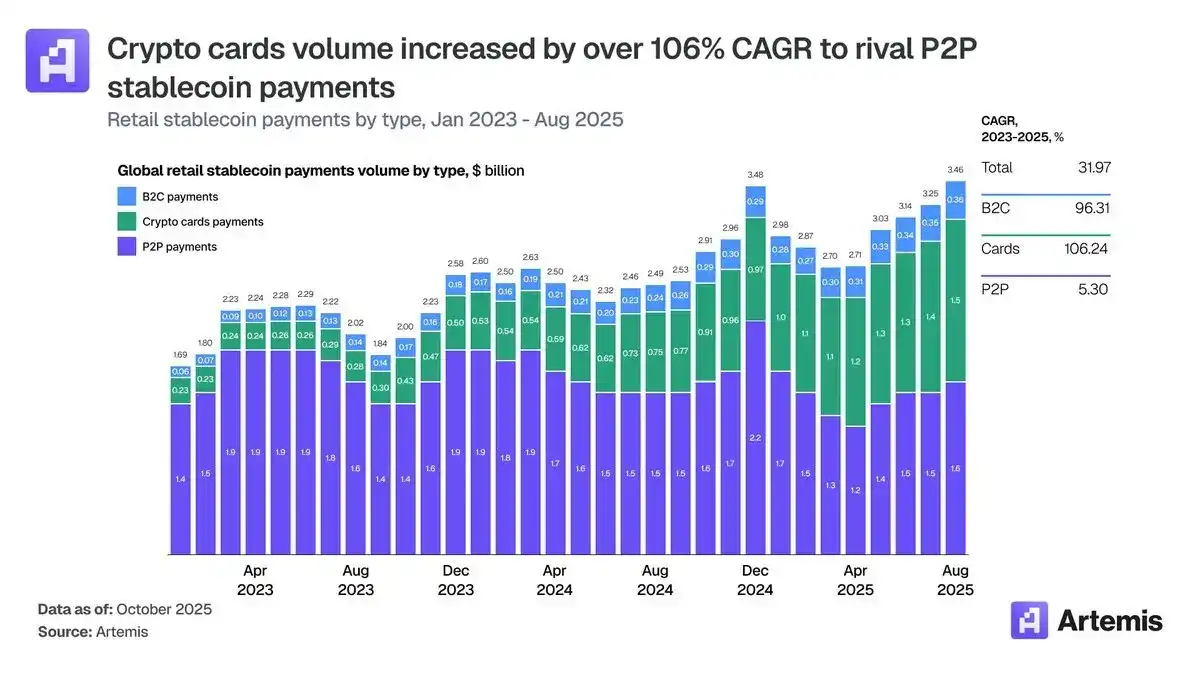
Remember the 'DeFi Mullet'? (PANews Note: Refers to a front-end with a TradFi user-friendly interface and a back-end powered by DeFi underlying technology) It's still here, and the data proves it.

Tokenization, stablecoins, and neo-banks are the three key areas of focus currently, expected to see the most significant growth in 2026 and beyond.

Beyond this, the crypto market is facing a harsh reality: old strategies are failing.

High FDV, low circulating supply launches aimed at dumping on retail; protocols lacking value accrual pathways; alt DEXs on 'ghost' chains; VC-backed projects where founders cash out hundreds of millions before achieving any PMF (Product-Market Fit).

All these plays are outdated, and this trend will continue.

In fact, I got into crypto after reading 'The Truth Machine' in 2017. Back then, I was almost certain this technology would reshape finance. Somehow, it feels like we veered off the original mission. Nine years later, we are closer than ever to that dream becoming a reality.

Everything is in place, the opportunity is here. Welcome to the era of Neo Finance.

Related reading: Nihilism and Vicious Cycles: Why Should We Oppose Over-Financialization?

Пов'язані питання

QWhat are the three main areas of focus in the Neo Finance ecosystem according to the article, and why are they significant?

AThe three main areas are tokenization, stablecoins, and neobanks. They are significant because they are expected to drive the most substantial growth in 2026 and beyond, combining consumer-friendly front-end experiences with efficient DeFi back-end infrastructure to revolutionize how the world interacts with money.

QHow does the article describe the current state and growth of 'yield stablecoins'?

AThe article states that yield stablecoins (or 'yield coins') like $sUSDS, $sUSDe, $BUIDL, $USYC, and $syrupUSDC have experienced exponential growth over the past 18 months, with their supply exceeding $13 billion.

QWhat is the 'DeFi Mullet' concept mentioned in the article, and what does it refer to?

AThe 'DeFi Mullet' refers to a business model where the front-end offers a user-friendly interface familiar to traditional finance (TradFi) users, while the back-end is powered by decentralized finance (DeFi) infrastructure.

QWhat outdated practices in the crypto market does the article claim are no longer effective?

AThe article claims that outdated practices include high Fully Diluted Valuation (FDV) with low circulating supply to sell to retail investors, protocols with no path to value accrual, alt-DEXs on 'ghost' chains, and venture-backed projects where founders cash out millions before achieving any Product-Market Fit (PMF).

QWhat major shift does the article suggest happened in 2025 regarding tokenization?

AThe article suggests that 2025 was the year when tokenization, the process of putting real-world assets like treasuries and stocks on-chain, truly began to scale and see mass adoption after being discussed for many years.

Пов'язані матеріали

In Jinjiang, Fujian, a Storage Super Unicorn Lies Quiet

In Fujian's Jinjiang, a city known for sportswear, lies a quiet semiconductor giant: Fujian Jinhua Integrated Circuit Co. (JHICC). Once a promising domestic DRAM manufacturer alongside Yangtze Memory and ChangXin Memory Technologies (CXMT), its journey was derailed in 2018 when the U.S. placed it on an Entity List and filed criminal charges for alleged trade secret theft. This halted production for years. A turning point came in February 2024 when a U.S. federal court found JHICC not guilty. However, it had lost crucial time. While CXMT soared to become a top-valued A-share company in 2024, JHICC, with an estimated valuation of 80 billion RMB, was just restarting. Its current output is primarily customized DDR4 chips, not the advanced DDR5/HBM demanded for AI, but it still benefits from the broader memory chip upcycle. JHICC's story is tied to Chen Zhengkun, a veteran engineer who left Micron to lead the venture. Founded in 2016 with state-backed funding, JHICC partnered with Taiwan's UMC to develop DRAM technology. Rapid progress was cut short by the U.S. actions, which Micron initiated, partly due to its heavy reliance on the Chinese market. Post-sanctions, Chen's team worked to rebuild the production line with reduced reliance on U.S. technology. According to its records, JHICC achieved small-scale production and revenue growth under immense pressure. It now focuses on the stable "niche" DRAM market (e.g., TVs, routers) with a monthly capacity of ~40,000 wafers, aiming for 60,000 by 2026. It holds over 1,000 patents but remains on the Entity List. For Jinjiang, investing in JHICC was a bold industrial leap. The local government provided unwavering financial and logistical support during the crisis, helping the company survive. JHICC has become the anchor for a growing local semiconductor cluster. Though its scale lags behind domestic peers, JHICC's persistence symbolizes a hard-won foothold in a global market long dominated by Samsung, SK Hynix, and Micron. Having missed one boom, it seeks a place in the new AI-driven memory supercycle.

marsbit19 хв тому

In Jinjiang, Fujian, a Storage Super Unicorn Lies Quiet

marsbit19 хв тому

Must-Watch Events Next Week|CLARITY Act Could Face Senate Vote; SpaceX, Circle to Report Earnings (8.3-8.9)

**Summary: Key Events and Developments to Watch (August 3-9)** The upcoming week is marked by significant financial disclosures, key legislative deadlines, and notable product updates. **Major Financial Events:** Several companies are scheduled to release their Q2 2026 earnings. American Bitcoin (ABTC) will report on August 3, followed by SpaceX and Hut 8 Mining Corp. on August 4, and Circle on August 5. Notably, a significant portion of SpaceX shares (up to 12% of total shares) will be unlocked on August 6 following their earnings release. **Key Legislative Deadline:** The U.S. Senate faces an August 7 deadline to secure 60 votes for the CLARITY Act, a bipartisan bill aiming to establish a federal regulatory framework for cryptocurrencies. The Senate may hold a full vote on the bill during the week. **Economic Data:** The U.S. July Non-Farm Payrolls report will be released on August 7, providing crucial labor market data. **Technology & Product Updates:** * **Shutdowns:** DeFi portfolio tracker Zapper and wallet app Ctrl Wallet will cease operations on August 3. * **Upgrades:** LayerZero will deprecate its v1 relayers on August 3. XRP Ledger's new version 3.3.0, featuring five new functions, is expected next week. * **AI:** Elon Musk announced that the advanced Grok 4.6 AI model is set for release around August 7. * **Bitcoin:** The BIP-110 forced signaling for a potential Bitcoin network change is scheduled to begin around August 8. **Other Notable Events:** Chinese robotics firm Unitree Tech has set its preliminary price inquiry for its IPO for August 5. South Korean exchange Upbit will delist AQT and AERGO tokens on August 3.

marsbit2 год тому

Must-Watch Events Next Week|CLARITY Act Could Face Senate Vote; SpaceX, Circle to Report Earnings (8.3-8.9)

marsbit2 год тому

Торгівля

Спот
活动图片





