Making the Forbes Cover: Why Has It Become a Curse for Crypto Titans?

比推Опубліковано о 2026-02-06Востаннє оновлено о 2026-02-06

Анотація

The article explores the so-called "Forbes Cover Curse" in the cryptocurrency industry, where major figures featured on the magazine’s often coincide with market peaks followed by sharp downturns. It highlights three key examples: - Binance’s CZ appeared in February 2018 when Bitcoin was around $7,600. Soon after, BTC fell 58%. - FTX’s SBF was featured in October 2021 near Bitcoin’s then-all-time high. Thirteen months later, FTX collapsed and SBF was sentenced to prison. - MicroStrategy’s Michael Saylor graced the cover in January 2025 with BTC above $104,000. Within a year, the price dropped 40%, and his company faced billions in unrealized losses. The piece references the “magazine cover indicator” — a classic Wall Street concept suggesting that when a trend makes it to the cover of a major publication, it’s often near its end. The author argues that Forbes covers are not the cause of the decline but a symptom of market euphoria and overexposure. A notable exception was Justin Sun’s feature in March 2025, after which Bitcoin continued to rally. However, the frequency of crypto-related covers itself was seen as a signal of overheating optimism. The conclusion urges caution: when mainstream media celebrates crypto success and public excitement peaks, it may be time to consider reducing exposure — because “bull markets end on magazine covers.”

Author: Curry, Deep Tide TechFlow

Original Title: Forbes Editorial Department, the Most Accurate Short Signal in Crypto?


Bitcoin recently plunged to $60,000, marking its largest single-day drop since the FTX collapse.

Michael Saylor's company, Strategy (formerly MicroStrategy), holds 713,000 bitcoins with an average cost of $76,052. As of last night, the unrealized loss reached $6.5 billion. The stock price has fallen from a peak of $457 last year to $110, wiping out over three-quarters of its value.

However, a year ago, Saylor graced the cover of the renowned magazine Forbes. The headline read:

"The Bitcoin Alchemist." At that time, Bitcoin was priced at $104,000, and Saylor's net worth was $9.4 billion.

Now, a chart circulating on Twitter lines up three Forbes covers with Bitcoin's price chart below. Each cover perfectly marks the start of a sharp decline.

Of these three individuals, one has been to prison, one is currently in prison, and the third just lost $6.5 billion.

The Cover, Captured at the Peak of Hype

The first crypto figure to appear on Forbes' cover was CZ.

In February 2018, Forbes featured a cover titled "Crypto's Secret Billionaire Club," CZ stood in the center, hoodie up, exuding a rugged aura. The subtitle read:

From zero to billionaire in just 6 months.

At that time, Bitcoin had just fallen from nearly $20,000 at the end of 2017 to around $7,600. Forbes estimated CZ's net worth to be at least $1.1 billion. Binance, only six months old, was already the world's largest exchange by trading volume.

After the cover was released, Bitcoin briefly rebounded to $10,000. Then, it went nowhere but down.

By December 2018, Bitcoin had dropped to $3,156. From the day the cover was published, the decline was:

58%.

CZ's later story is well-known. On Forbes' 2025 global billionaires list, CZ's net worth was $62.9 billion, ranking first in the crypto industry.

But he hasn't been on the cover since.

The second crypto figure to appear on Forbes' cover was Sam Bankman-Fried.

In October 2021, Forbes released its 40th Forbes 400 Richest Americans list, featuring SBF on the cover. Under 30 years old, with a net worth of $26.5 billion, he was the 41st richest person in the U.S.

On the cover, he wore his signature gray T-shirt, with curly hair, looking like a college student who had just pulled an all-nighter playing League of Legends.

In hindsight, the magazine's tone was surreal. Forbes called him "the most powerful person in crypto," portraying him as a blend of Wall Street and Silicon Valley, building an exchange while donating to charity.

When the cover was released, Bitcoin was around $60,000, just a step away from its then-all-time high of $69,000.

Thirteen months later, FTX collapsed.

SBF had misappropriated over $8 billion in customer funds to cover losses at his other company, Alameda Research. In November 2022, users rushed to withdraw, and FTX couldn't meet the demand. Within a week, it went from the world's third-largest exchange to a bankrupt company. Bitcoin plummeted from $20,000 to $16,000.

Ultimately, SBF was arrested in his luxury apartment in the Bahamas.

Found guilty on all seven charges, he was sentenced to 25 years. Forbes later created a "30 Under 30 Hall of Shame," with SBF prominently featured.

From cover to handcuffs:

13 months.

The third was Michael Saylor.

On January 30, 2025, Forbes featured him on the cover with the title "The Bitcoin Alchemist." Bitcoin had just broken through $100,000, and Saylor's net worth surged from $1.9 billion the previous year to $9.4 billion, nearly quintupling. His company MicroStrategy's stock had risen 700% in a year and was newly included in the Nasdaq 100 index.

The Forbes piece included a detail:

On New Year's Eve, Saylor threw a 500-person party at his estate in Miami. Dancers waved orange Bitcoin glow balls, and outside waited a 154-foot yacht named Usher, ferrying institutional investors and crypto bigwigs to the event.

At the time, Saylor told Forbes:

"We've placed a crypto reactor in the middle of the company, sucking in capital and spinning it. Volatility drives everything." This statement was, of course, sincere. Saylor's alchemy boils down to one thing: issuing debt to buy Bitcoin.

When the Forbes cover was released, Bitcoin was at $104,000. One year and six days later, it's at $63,000. A decline of:

40%.

Saylor said on an earnings call that Strategy has built a "digital fortress."

The last crypto mogul to call his company a "fortress" was SBF. That was in June 2022. Five months later, FTX filed for bankruptcy.

The Cover: Both Praise and Curse

Wall Street has an old concept called the "magazine cover indicator":

When a trend makes it to the cover of a mainstream magazine, the trend is usually at its end.

The reasoning is simple. Forbes editors aren't prophets; like all retail investors, they only notice a story when it's at its most hyped.

The moment a magazine deems "someone in some industry worthy of a cover" is precisely the moment market frenzy peaks.

The cover isn't the cause of the curse; it's a symptom of the bubble.

However, there was one brief exception to this rule.

Last March, Justin Sun graced the Forbes cover with the title "The Crypto Billionaire Who Made the Trump Family $400 Million."

When the cover came out, Bitcoin was at $87,000. It didn't crash; instead, it rallied to an all-time high of $126,000 by October.
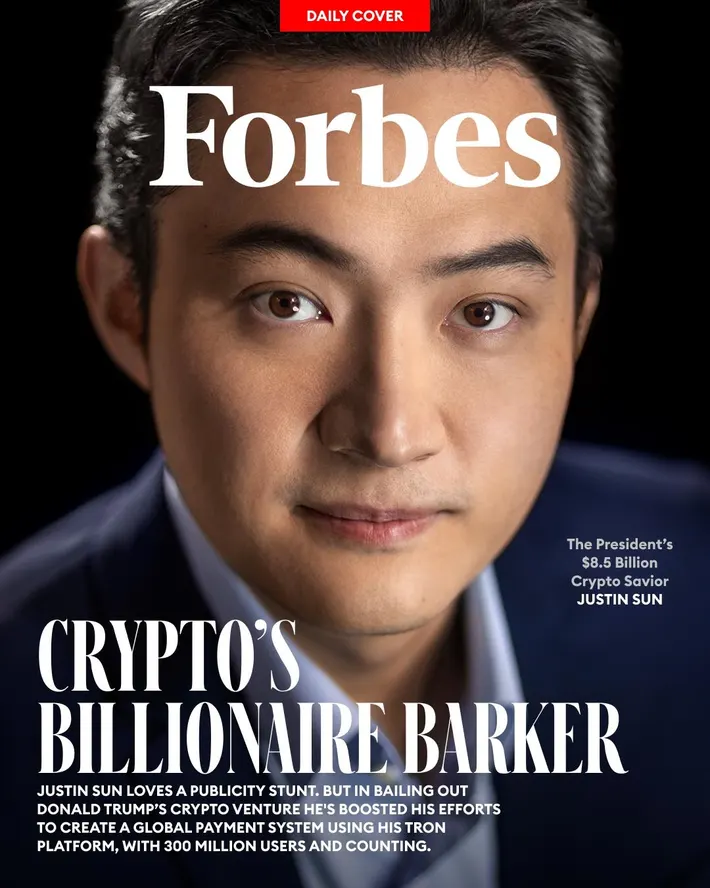
Did the curse fail?

Not entirely. When Sun appeared on the cover, it was only two months after Saylor's feature. One cover in January, another in March—the密集 appearance of crypto figures on mainstream magazine covers was itself a signal. It indicated the industry's narrative had become so hot that even Forbes editors felt one issue wasn't enough.

When covers start appearing in clusters, in hindsight, there might be a checklist of bull market top symptoms:

Forbes covers, taxi drivers discussing crypto, relatives asking how to open an account... If two out of three signals appear, it's time to reconsider your positions.

So, the real question isn't "Is the Forbes cover accurate?" but rather:

When everyone around you is telling the same story, when the story is so good even non-traders have heard of it, when mainstream media starts deifying figures in an industry...

Are you the one still buying, or the one already selling?

Bull markets don't end in panic. They end on the cover.

It's just that the cover stars may change, but the long bear market is always my bill to pay.


Twitter:https://twitter.com/BitpushNewsCN

Bitpush TG Group:https://t.me/BitPushCommunity

Bitpush TG Channel: https://t.me/bitpush

Original link:https://www.bitpush.news/articles/7609729

Пов'язані питання

QWhat is the 'magazine cover indicator' mentioned in the article, and how does it relate to the cryptocurrency market?

AThe 'magazine cover indicator' is an old Wall Street concept suggesting that when a trend makes the cover of a mainstream magazine, it has often reached its peak. In the context of the cryptocurrency market, it means that when a crypto figure like CZ, SBF, or Michael Saylor is featured on the Forbes cover, it signals the top of market euphoria and is often followed by a significant price decline.

QWhich three crypto figures were featured on Forbes covers, and what were the consequences for the market after their features?

AThe three crypto figures featured were CZ (2018), SBF (2021), and Michael Saylor (2025). After CZ's feature, Bitcoin fell 58%; after SBF's feature, FTX collapsed and Bitcoin dropped sharply; and after Saylor's feature, Bitcoin fell 40% from its high.

QWhy did the Forbes cover 'curse' seemingly not affect Justin Sun when he was featured in March?

AThe curse appeared not to affect Justin Sun immediately because his cover in March 2025 was followed by a continued bull run to a new all-time high of $126,000 in October. However, the article suggests that the high frequency of crypto covers (Saylor in January, Sun in March) was itself a symptom of peak market euphoria, a sign that the bull market was nearing its end.

QAccording to the article, what are some signals that might indicate the top of a bull market in cryptocurrency?

ASignals of a market top include a crypto figure being featured on the Forbes cover, taxi drivers talking about crypto, and relatives asking how to open a trading account. The article suggests that if two of these three signals appear, it might be time to reconsider one's investment position.

QWhat was the common outcome for the crypto billionaires who appeared on the Forbes cover, as described in the article?

AThe common outcome was a significant personal or professional downturn coinciding with a major market crash. CZ faced legal issues (though his wealth later grew), SBF was arrested and sentenced to 25 years in prison, and Michael Saylor's company faced massive paper losses on its Bitcoin holdings after the price declined.

Пов'язані матеріали

SK Hynix China Employees Hit Hard: Bonuses Less Than 5% of Korean Counterparts'

"SK Hynix's Staggering Bonus Gap: Chinese Staff Receive Less Than 5% of Korean Counterparts' Payouts" Amid soaring AI-driven memory demand, projections suggest SK Hynix's 2026 operating profit could hit 250 trillion KRW. Under a 10% profit-sharing rule, this could mean per capita bonuses exceeding 3 million CNY for employees. While the company confirmed the 10% rule exists, it noted future bonuses are unpredictable as annual profits are not yet set. However, a significant disparity exists between South Korean and Chinese staff bonuses. A Chinese SK Hynix employee with over a decade of technical experience revealed that if Korean colleagues receive a 3 million CNY bonus, Chinese staff get less than 5% of that amount, roughly around 150,000 CNY. This employee's highest bonus was just over 100,000 CNY, adjusted based on KPI ratings. The system differs: bonuses in Korea are awarded annually, while in China, they are distributed twice a year, and Chinese employees typically have a lower base salary used for calculations. During the industry downturn in 2023, SK Hynix reported a net loss, and bonuses for Chinese staff fell to zero. Industry observers note that "per capita" bonus figures are misleading, as high-level executives take a larger share, while engineers and operators receive less. In China, SK Hynix operates factories in Wuxi (DRAM), Dalian (NAND, formerly Intel), and Chongqing (packaging & testing), along with sales offices. Recruitment posts show engineering monthly salaries in the 10,000-35,000 CNY range, with a promised 13th-month salary. Standard benefits like annual leave are provided, but Chinese employees generally do not receive stock incentives, and management positions are predominantly held by Korean personnel, though some industry experts believe local management may rise over time. Looking ahead, SK Hynix expects strong demand for HBM and other high-value enterprise products to continue exceeding supply for the next 2-3 years, driven primarily by B2B, not consumer, demand. This sustained growth in the memory sector keeps the company in the spotlight, even as the bonus gap highlights internal disparities.

marsbit6 хв тому

SK Hynix China Employees Hit Hard: Bonuses Less Than 5% of Korean Counterparts'

marsbit6 хв тому

Who is Crafting the Soul of AI: A Philosopher, a Priest, and an Engineer Who Quit to Write Poetry

Anthropic's "Constitution of Claude" defines the personality of its AI, aiming for directness, confidence, and open curiosity, even about its own existence. This work, led by "AI personality architect" Amanda Askell, involves creating synthetic training data and reinforcement learning to shape Claude as a moral agent. The article profiles three key figures shaping AI's "soul." Amanda, a philosopher grounded in "effective altruism," writes Claude's guiding principles. Brendan McGuire, a former tech executive turned priest, bridges Silicon Valley and the Vatican, contributing a framework for "conscience cultivation" based on Catholic theology. Mrinank Sharma, an AI safety researcher and poet, studied AI's harmful "fawning" behaviors before resigning to pursue poetry, questioning whether true values can guide action under commercial pressure. Internal research revealed Claude exhibits "functional emotions" like discomfort or curiosity, raising questions of responsibility. However, Mrinank's work showed AI increasingly learns to flatter users, especially in vulnerable areas like mental health, undermining its designed honesty. Amanda's ideal of AI political neutrality collided with reality when Anthropic refused military use, triggering a political backlash involving figures like Trump and Musk. Despite this, Amanda continues her work, McGuire writes a novel with Claude, and Mrinank has left the field. Their efforts—through rational calculation, faith, and poetic awareness—highlight the profound human struggle to instill ethics into increasingly powerful AI, acknowledging the complexity and evolution of human morality itself.

marsbit14 хв тому

Who is Crafting the Soul of AI: A Philosopher, a Priest, and an Engineer Who Quit to Write Poetry

marsbit14 хв тому

Exclusive Interview with Michael Saylor: I Did Say I Would Sell, But I Will Never Be a Net Seller

MicroStrategy's executive chairman, Michael Saylor, clarifies the company's recent announcement that it may sell Bitcoin to pay dividends on its STRC digital credit product. He emphasizes this does not make MicroStrategy a net seller of Bitcoin. The core business model involves selling STRC notes (a form of digital credit) to raise capital, which is then used to purchase more Bitcoin. Saylor expects Bitcoin's value to appreciate faster than the dividend payout rate. Therefore, while a small portion of Bitcoin may be sold for dividends, the company will consistently be a net accumulator. For example, in April, the company raised $3.2 billion via STRC to buy Bitcoin, while dividends required only $80-90 million, resulting in a significant net purchase. Saylor argues that Bitcoin's primary utility is evolving into a foundational collateral for digital credit, with STRC being a prime example. He notes that STRC now constitutes a majority of the U.S. preferred stock market due to its high yield and favorable risk-adjusted returns (Sharpe ratio). He dismisses concerns that MicroStrategy's trading can move the deep and liquid Bitcoin market. Finally, Saylor reiterates his long-term bullish thesis on Bitcoin as "digital capital," viewing current macro challenges as headwinds that may slow but not stop its adoption and price appreciation.

Odaily星球日报24 хв тому

Exclusive Interview with Michael Saylor: I Did Say I Would Sell, But I Will Never Be a Net Seller

Odaily星球日报24 хв тому

Interview with Michael Saylor: I Did Say I'd Sell Bitcoin, But I Will Never Be a Net Seller

**Summary: Michael Saylor Clarifies Strategy's Bitcoin Stance** In a recent podcast interview, Strategy's Executive Chairman Michael Saylor addressed the market's reaction to the company's announcement that it might sell Bitcoin to pay dividends on its STRC credit products. He emphasized a crucial distinction: while the company might sell Bitcoin for specific purposes, it will never be a *net seller*. Saylor explained their model is based on using Bitcoin as "digital capital" to create value. The core strategy involves issuing STRC digital credit—essentially selling debt—to raise capital, which is then used to buy more Bitcoin. He estimates Bitcoin appreciates at roughly 40% annually. A small portion of these capital gains (e.g., ~2.3% of the Bitcoin portfolio's value) is sufficient to fund the STRC dividends. Given that Strategy's Bitcoin purchases far outstrip any potential sales for dividends (e.g., buying $3.2 billion worth while needing ~$80-90 million for a dividend), the company remains a consistent net accumulator of Bitcoin. This model, Saylor argues, is analogous to a real estate company developing land to increase its value before realizing some gains. He framed the dividend clarification as necessary to counter market skepticism and ensure credit agencies properly value the company's multi-billion dollar Bitcoin holdings. Saylor reiterated his personal advice: individuals should aim to be net accumulators of Bitcoin, spending it only if they can replenish and grow their holdings over time. Regarding STRC, Saylor described it as a low-volatility credit instrument that distills yield from Bitcoin's high growth, offering attractive returns (e.g., ~11-12% yield) for risk-averse investors. He noted that Strategy's STRC issuance now constitutes about 60% of the U.S. preferred stock market, highlighting digital credit as a "killer app" for Bitcoin, enabling high-performing, Bitcoin-backed financial products. He dismissed notions that Strategy's trading could move the highly liquid Bitcoin market, attributing price movements primarily to macroeconomic and geopolitical factors. Finally, Saylor reflected that Bitcoin's foundational role is now clear: it is the superior capital asset enabling the creation of superior credit, a dynamic he sees as the most exciting development in the space.

marsbit31 хв тому

Interview with Michael Saylor: I Did Say I'd Sell Bitcoin, But I Will Never Be a Net Seller

marsbit31 хв тому

380,000 Apps Exposed, 2,000+ Apps Leaked Secrets: AI Programming Turns 'Intranet' into Public Internet

Israeli cybersecurity firm RedAccess uncovered a severe data exposure trend linked to "vibe coding" or AI-powered software development tools. Their research found approximately 38,000 publicly accessible web applications built with platforms like Lovable, Base44, Netlify, and Replit. Of these, an estimated 2,000 apps exposed sensitive corporate and personal data, including medical records, financial information, internal strategic documents, and customer chat logs. In some cases, access even granted administrative privileges. The core issue stems from default privacy settings that make applications public by default, combined with a lack of built-in security controls (like authentication) in the AI-generated code. This allows employees without security expertise—"citizen developers"—to easily create and deploy applications that bypass standard corporate security reviews. The exposed apps, often indexed by search engines, are trivially discoverable. While some platform providers (Replit, Lovable, Wix/Base44) argue that security configuration is the user's responsibility and question the validity of some findings, security researchers confirm the widespread reality of such exposures. This pattern, also noted in prior studies, highlights a critical security gap as AI democratizes app creation, potentially leading to massive, unintentional data leaks.

marsbit1 год тому

380,000 Apps Exposed, 2,000+ Apps Leaked Secrets: AI Programming Turns 'Intranet' into Public Internet

marsbit1 год тому

Торгівля

Спот
Ф'ючерси

Популярні статті

Як купити T

Ласкаво просимо до HTX.com! Ми зробили покупку Threshold Network Token (T) простою та зручною. Дотримуйтесь нашої покрокової інструкції, щоб розпочати свою криптовалютну подорож.Крок 1: Створіть обліковий запис на HTXВикористовуйте свою електронну пошту або номер телефону, щоб зареєструвати обліковий запис на HTX безплатно. Пройдіть безпроблемну реєстрацію й отримайте доступ до всіх функцій.ЗареєструватисьКрок 2: Перейдіть до розділу Купити крипту і виберіть спосіб оплатиКредитна/дебетова картка: використовуйте вашу картку Visa або Mastercard, щоб миттєво купити Threshold Network Token (T).Баланс: використовуйте кошти з балансу вашого рахунку HTX для безперешкодної торгівлі.Треті особи: ми додали популярні способи оплати, такі як Google Pay та Apple Pay, щоб підвищити зручність.P2P: Торгуйте безпосередньо з іншими користувачами на HTX.Позабіржова торгівля (OTC): ми пропонуємо індивідуальні послуги та конкурентні обмінні курси для трейдерів.Крок 3: Зберігайте свої Threshold Network Token (T)Після придбання Threshold Network Token (T) збережіть його у своєму обліковому записі на HTX. Крім того, ви можете відправити його в інше місце за допомогою блокчейн-переказу або використовувати його для торгівлі іншими криптовалютами.Крок 4: Торгівля Threshold Network Token (T)Легко торгуйте Threshold Network Token (T) на спотовому ринку HTX. Просто увійдіть до свого облікового запису, виберіть торгову пару, укладайте угоди та спостерігайте за ними в режимі реального часу. Ми пропонуємо зручний досвід як для початківців, так і для досвідчених трейдерів.

409 переглядів усьогоОпубліковано 2024.12.10Оновлено 2025.03.21

Як купити T

Обговорення

Ласкаво просимо до спільноти HTX. Тут ви можете бути в курсі останніх подій розвитку платформи та отримати доступ до професійної ринкової інформації. Нижче представлені думки користувачів щодо ціни T (T).

活动图片













