‘Make TON great again’ – Block rate rises 6x, blockchain speed is now 10x

ambcryptoОпубліковано о 2026-04-10Востаннє оновлено о 2026-04-10

Анотація

The TON blockchain has increased its speed tenfold and now produces blocks six times faster, resulting in sub-second transaction times. This upgrade, part of the "Make TON Great Again" (MTONGA) framework announced by Telegram founder Pavel Durov, is the first of seven planned steps. The next phase aims to reduce transaction fees by six times. If achieved, lower fees would make TON significantly cheaper than competitors like Solana, potentially positioning it as a more cost-effective option for stablecoin transfers and DeFi applications. Despite currently ranking as the 14th fastest blockchain, TON has experienced a decline in activity since late 2024, with DEX volumes and TVL dropping significantly. However, these trends are partly attributed to broader market conditions. The upgrades are intended to attract new users amid intense competition among Layer 1 blockchains.

The TON blockchain has increased its speed tenfold and now plans to lower fees as top Layer 1 (L1s) compete for users.

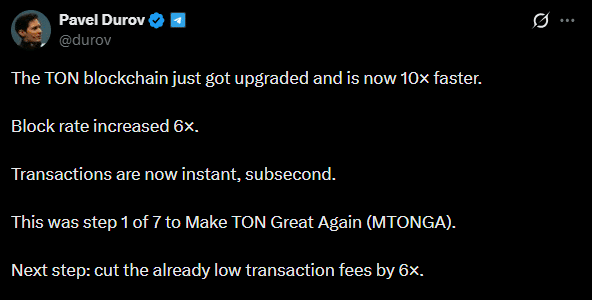
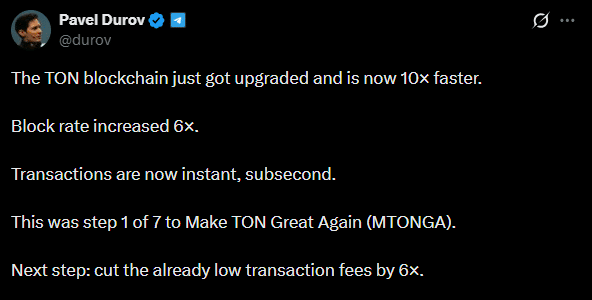
On the 9th of April, Telegram founder Pavel Durov announced that the recent upgrade, Catchain 2.0, was successful. According to him, the blockchain now creates blocks six times faster, and transactions are now ‘instant, subsecond.’
Source: X

Durov added that the 10x faster speed was the first of the seven steps of blockchain’s overhaul plan, dubbed the Make TON Great Again (MTONGA) framework. The second step will cut the transaction cost by 6x.

Will the upgrades improve TON activity?

According to ChainSpect, TON now ranks 14th among the fastest blockchain networks. On the sub-second block times, it only rivals Solana and BNB Chain.

Worth pointing out, BNB Chain also made updates to scale its speed and lower the costs of transactions. The end goal is to attract users seeking faster and cheaper transfers that can also empower other DeFi applications.

This is especially true for stablecoin transfers, which are dominated by Ethereum. However, rising competition from cheaper options like Tron, Solana, BNB Chain, and now TON has slashed its market share in stablecoin settlement.
Source: Token Terminal

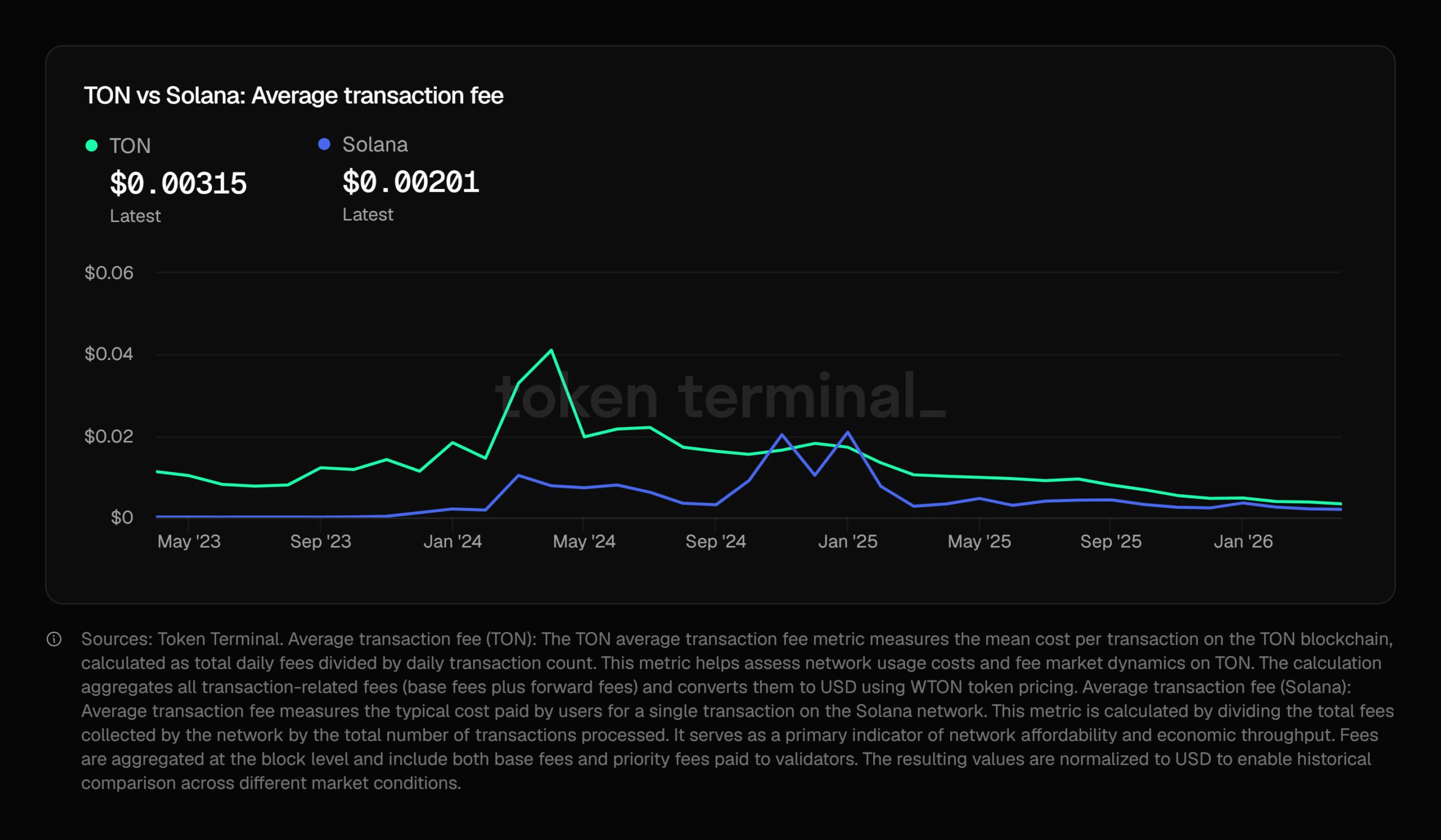
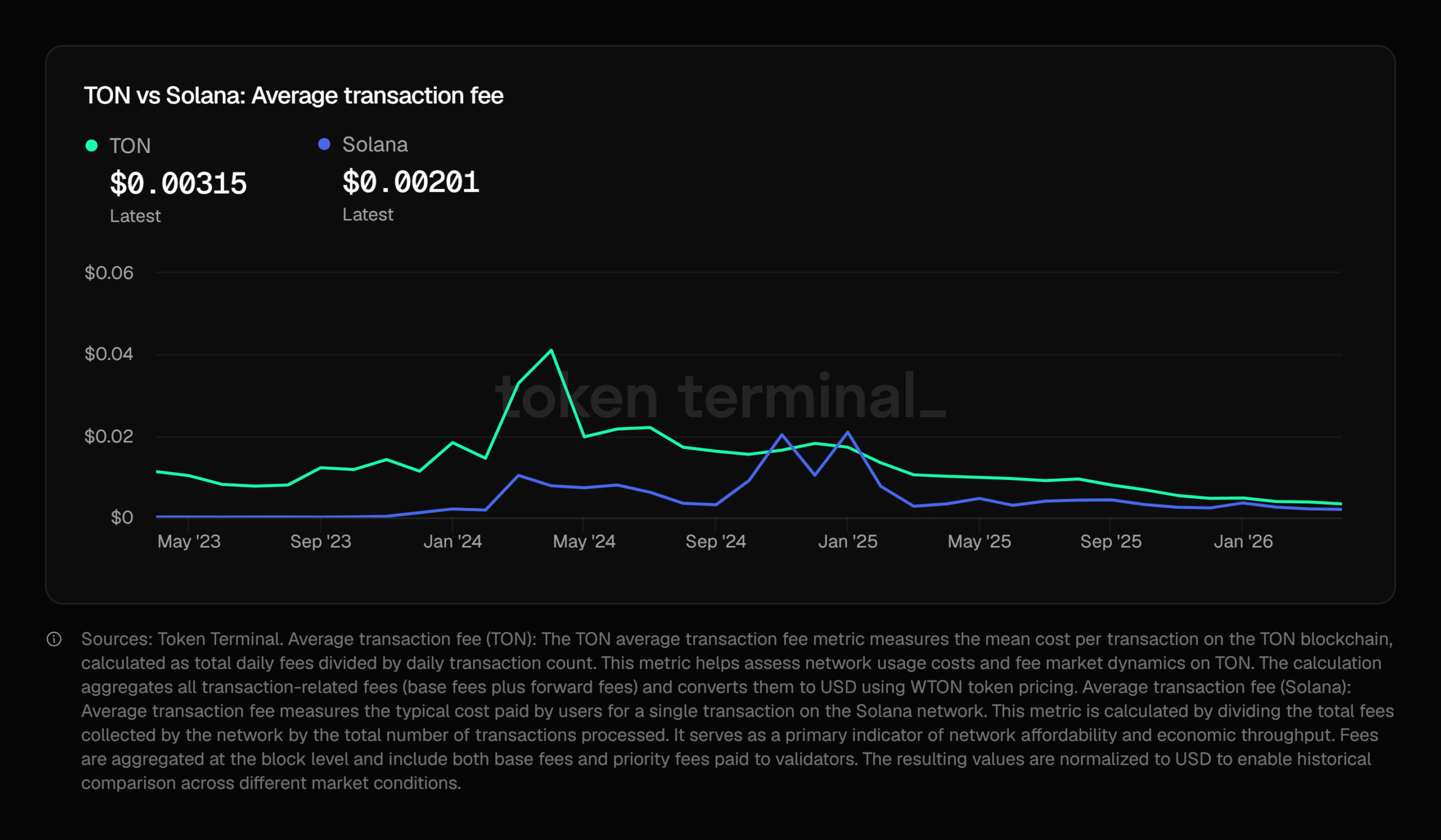
Currently, TON’s average transfer cost is about $0.00315, while Solana charges $0.00201. In other words, Solana is 40% cheaper than TON.

But if the 6x lower fees are achieved, TON would be 3.5x or 72% cheaper than Solana. That would be a competitive advantage, especially for stablecoin transfers.

As of writing, TON was the 13th largest chain in terms of stablecoin liquidity. Even so, the TON blockchain has seen a broader downtrend in activity since late 2024.

The DEX volumes have dropped from 2024 highs of $1.4B to $26M as of April 2026. Similarly, the TVL (total locked value) has decreased from a record high of $766M to $55M.
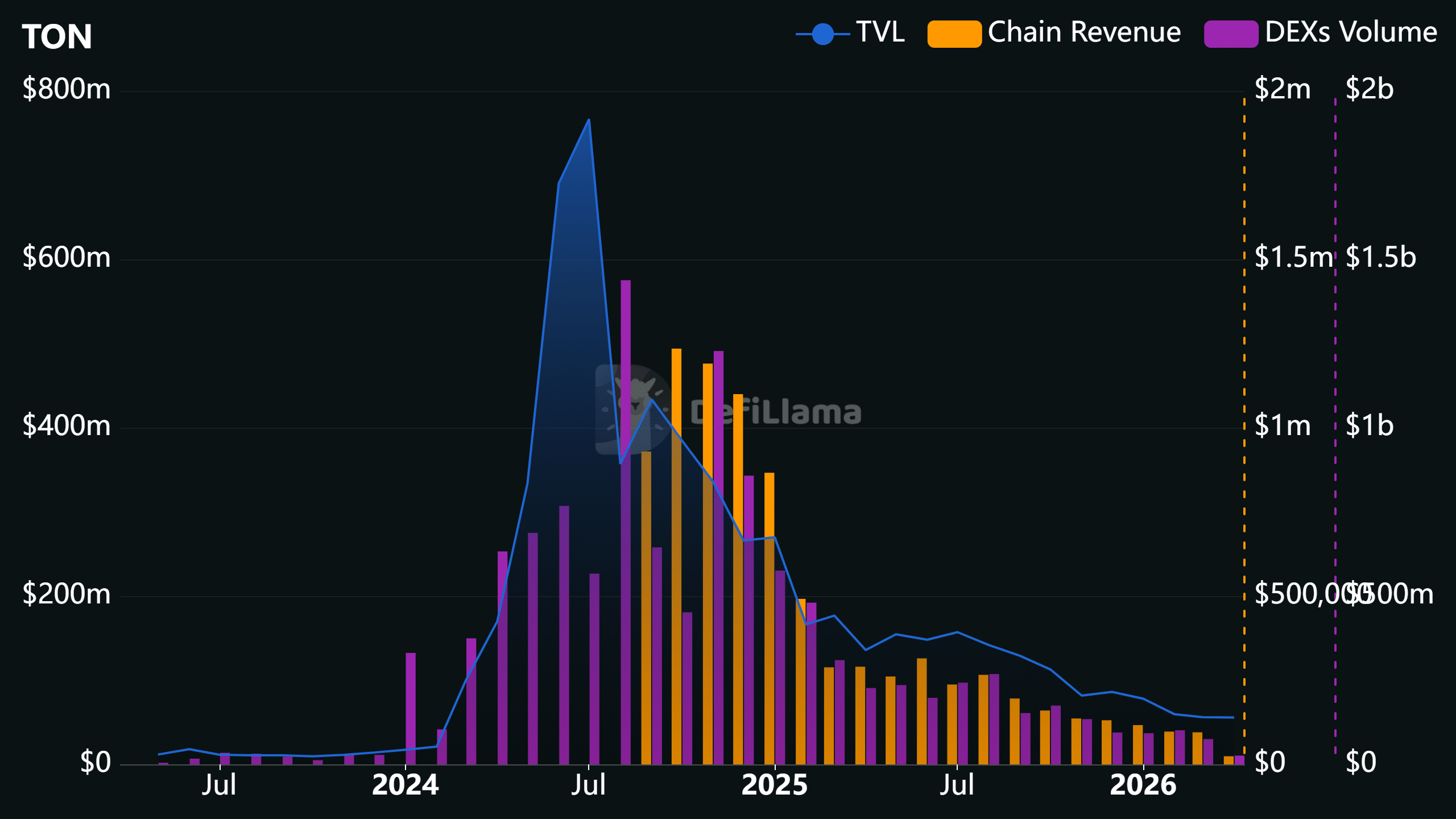
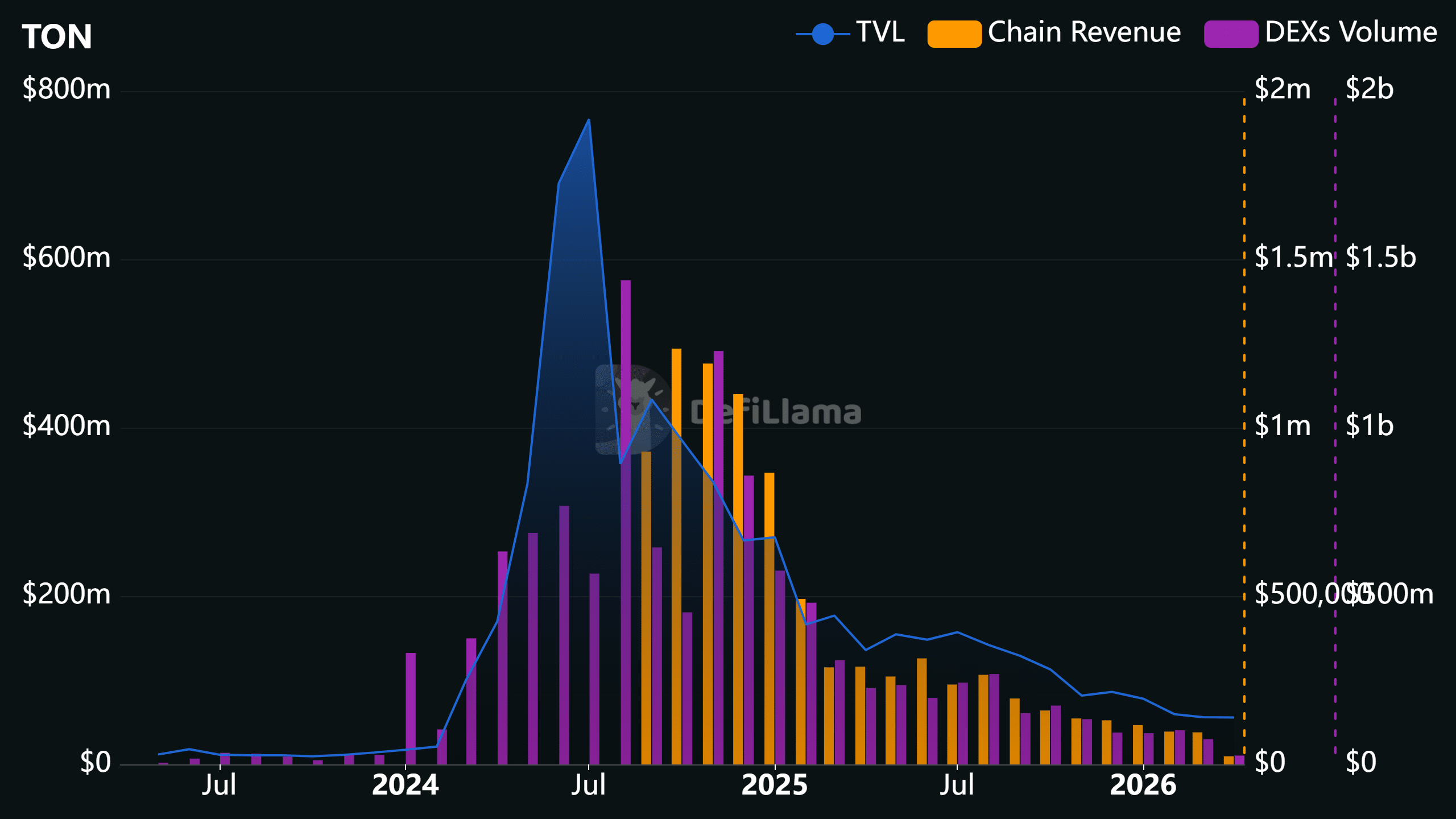
Source: DeFiLlama

But the dropping activity was due to broader market contraction. But it remains to be seen whether the lower fees will attract new users to the chain.


Final Summary

  • TON is now 10x faster and could soon be 3.5x cheaper than Solana amid cutthroat competition for on-chain users.
  • Telegram’s Pavel Durov said the plans are part of the Make TON Great Again (MTONGA) framework as chain activity slows.

Пов'язані питання

QWhat is the name of the upgrade that made TON blockchain 10x faster and who announced it?

AThe upgrade is called Catchain 2.0 and it was announced by Telegram founder Pavel Durov.

QAccording to the article, how much faster is TON at creating blocks and what is the new transaction speed?

ATON now creates blocks six times faster, and transactions are now 'instant, subsecond'.

QWhat is the second step in the 'Make TON Great Again' (MTONGA) framework?

AThe second step is to cut the transaction cost by 6x.

QHow does the article suggest TON's potential future fees would compare to Solana's if the 6x reduction is achieved?

AIf the 6x lower fees are achieved, TON would be 3.5x or 72% cheaper than Solana.

QWhat two key metrics (DEX volumes and TVL) have significantly decreased on TON since late 2024?

ADEX volumes dropped from $1.4B to $26M, and the TVL (total value locked) decreased from $766M to $55M.

Пов'язані матеріали

GitHub, Transfixed by AI

On the night of February 9th, GitHub suffered a major outage caused by a simple configuration change—reducing a cache refresh interval from 12 to 2 hours—that triggered a cascade of failures. This was not an isolated event, but part of a broader pattern. In early 2026, GitHub experienced at least 8 major incidents, failing to meet its promised 99.9% availability. These outages stemmed from structural issues: explosive growth in load, tight service coupling, and insufficient protection against abnormal traffic. This unprecedented load is driven by AI Agents. In 2025, GitHub handled ~1 billion commits. By 2026, weekly commits reached 275 million, projecting to ~14 billion for the year—a 14x increase. AI tools like Claude Code now contribute 4.5% of all public repository commits, with weekly submissions surging 25x in just three months. AI-generated pull requests jumped from 4 million to 17 million per month in half a year. Unlike human developers, AI Agents work continuously, generating commits at a scale that overwhelms infrastructure designed for human rhythms. The surge also shattered GitHub's business model. Copilot's flat-rate pricing, based on assisting human developers, became unsustainable as Agentic AI sessions consumed resources worth hundreds of dollars for a few dollars in fees. In response, GitHub imposed usage limits and, by June 1st, shifted to a pay-per-use "AI Credits" system. Facing this new reality, GitHub realized a 10x scaling plan was insufficient. It announced a need to *redesign* its architecture for 30x current scale—decoupling services, adding fault isolation, and improving change management to prevent cascading failures. Other platforms like Stripe and AWS are facing similar challenges with AI Agents. Fundamentally, GitHub is transitioning from a human collaboration platform to an "exhaust pipe" for automated AI workflows. Its detailed post-mortem reports aim to maintain trust during this turbulent rebuild. The February outage was not just a technical glitch, but a signal of the software industry's entry into a new, AI-driven era.

marsbit27 хв тому

GitHub, Transfixed by AI

marsbit27 хв тому

Both Suffer Massive Losses Exceeding $90 Billion, Which Is in Greater Peril: Strategy or Bitmine?

Facing massive paper losses exceeding $90 billion each amidst a sharp market downturn, "Digital Asset Treasury" (DAT) giants Strategy and Bitmine find themselves in a precarious position, but with different underlying risks. Strategy, heavily invested in Bitcoin (BTC), faces significant financial strain. Its strategy relies heavily on debt, including convertible notes and preferred stock (STRC) requiring substantial dividend payments. With its cash reserves dwindling and BTC offering no staking yield for cash flow, Strategy's high leverage makes it vulnerable. A continued price decline could force asset sales to meet obligations, potentially creating a negative feedback loop. Its market value has already fallen sharply. In contrast, Bitmine, an Ethereum (ETH) holder, appears on firmer financial ground. It primarily funds its purchases through equity offerings (like ATM programs), avoiding debt pressure. It also generates income by staking a large portion of its ETH holdings. While not immune to market drops and shareholder dilution concerns, Bitmine maintains more flexibility, recently announcing a new preferred share offering to raise further capital. The core divergence lies in their financing: Bitmine uses equity (investor money), while Strategy uses debt (borrowed money). Consequently, Bitmine currently faces less immediate liquidity pressure than Strategy, which must navigate the dual challenge of servicing debt/dividends and a declining core asset (BTC) price.

marsbit34 хв тому

Both Suffer Massive Losses Exceeding $90 Billion, Which Is in Greater Peril: Strategy or Bitmine?

marsbit34 хв тому

Торгівля

Спот
Ф'ючерси

Популярні статті

Як купити TON

Ласкаво просимо до HTX.com! Ми зробили покупку The Open Network (TON) простою та зручною. Дотримуйтесь нашої покрокової інструкції, щоб розпочати свою криптовалютну подорож.Крок 1: Створіть обліковий запис на HTXВикористовуйте свою електронну пошту або номер телефону, щоб зареєструвати обліковий запис на HTX безплатно. Пройдіть безпроблемну реєстрацію й отримайте доступ до всіх функцій.ЗареєструватисьКрок 2: Перейдіть до розділу Купити крипту і виберіть спосіб оплатиКредитна/дебетова картка: використовуйте вашу картку Visa або Mastercard, щоб миттєво купити The Open Network (TON).Баланс: використовуйте кошти з балансу вашого рахунку HTX для безперешкодної торгівлі.Треті особи: ми додали популярні способи оплати, такі як Google Pay та Apple Pay, щоб підвищити зручність.P2P: Торгуйте безпосередньо з іншими користувачами на HTX.Позабіржова торгівля (OTC): ми пропонуємо індивідуальні послуги та конкурентні обмінні курси для трейдерів.Крок 3: Зберігайте свої The Open Network (TON)Після придбання The Open Network (TON) збережіть його у своєму обліковому записі на HTX. Крім того, ви можете відправити його в інше місце за допомогою блокчейн-переказу або використовувати його для торгівлі іншими криптовалютами.Крок 4: Торгівля The Open Network (TON)Легко торгуйте The Open Network (TON) на спотовому ринку HTX. Просто увійдіть до свого облікового запису, виберіть торгову пару, укладайте угоди та спостерігайте за ними в режимі реального часу. Ми пропонуємо зручний досвід як для початківців, так і для досвідчених трейдерів.

650 переглядів усьогоОпубліковано 2024.12.10Оновлено 2026.06.02

Як купити TON

Обговорення

Ласкаво просимо до спільноти HTX. Тут ви можете бути в курсі останніх подій розвитку платформи та отримати доступ до професійної ринкової інформації. Нижче представлені думки користувачів щодо ціни TON (TON).

活动图片

