Loss of Tens of Millions in Annual Income Sparks Governance Controversy, Aave Labs Accused of 'Stabbing DAO in the Back'

marsbitОпубліковано о 2025-12-15Востаннє оновлено о 2025-12-15

Анотація

The recent dispute between Aave Labs and Aave DAO over fee allocation from the CoWSwap integration has exposed deeper governance and value-capture tensions within the Aave ecosystem. Aave Labs switched the default swap integration on its frontend from ParaSwap to CoWSwap, redirecting an estimated $10M+ in annual fees from the DAO treasury to an address controlled by Aave Labs. Aave Labs argues that its frontend is a separate product, not part of the protocol, and has the right to monetize it. Critics, including Aave DAO delegates, contend that the Aave brand’s value was built through DAO-funded efforts, risk management, and community trust, and that the Labs are extracting value that should belong to token holders. The conflict extends to other issues, including the controversial Horizon RWA deployment—which critics say has cost the DAO more than it has earned—and a proposed deployment on MegaETH that bypassed ongoing DAO discussions. The core issue is the blurred line between the protocol, managed by the DAO, and the frontend products, operated by Aave Labs. With Aave V4 intending to move more complexity into abstraction layers, the dispute over who controls—and profits from—the user experience becomes critical for the future of value distribution between equity (Labs) and token holders (DAO).

Author: Ignas, Crypto KOL

Compiled by: Felix, PANews

Recently, a debate has erupted between Aave Labs and Aave DAO regarding the fee distribution issue triggered by the CoWSwap integration. This debate is also seen by the community as a potential crisis in DeFi governance. The author of this article provides an interpretation of this debate from a perspective striving for neutrality. The details are as follows.

On December 4th, lending protocol Aave Labs migrated the default swap integration on its front-end interface, aave.com, from ParaSwap to CoWSwap. While this might seem like a minor product update, it actually exposed deep-seated, long-standing internal conflicts within Aave.

This conflict is not about CowSwap, fees, or even user experience; it's about ownership. That is, who controls Aave, who decides on allocations, and who captures the value created around the protocol.

Under the old setup, the swap function primarily served as a user retention tool:

Users could rebalance their positions or swap assets without leaving the Aave interface. Importantly, all referral fees or positive slippage surplus fees were redistributed as revenue to the Aave DAO treasury.

The CoWSwap integration changed this dynamic.

According to Aave documentation, swaps now incur a fee of approximately 15 to 25 basis points. Orbit delegate EzR3aL (Note: A seasoned governance participant and independent delegate of Aave DAO) investigated where these fees were going and concluded that these fees were no longer going to the DAO treasury but were instead flowing to an address controlled by Aave Labs.

"Assuming just $200,000 is transferred weekly, the DAO loses at least $10 million per year." —EzR3aL

Did Aave Labs unilaterally cut off a revenue stream for the DAO and divert it to a private company?

Aave has functioned smoothly for years because, although the division of responsibilities was blurry, the interests of the parties were aligned.

  • The DAO governs the protocol
  • Aave Labs builds the front-end interface

Funds mostly flowed in the same direction, so no one paid too much attention to defining the boundaries.

Now, this tacit coordination seems to have broken down.

As Aave founder and CEO Stani.eth wrote:

  • "At that time, Aave Labs decided to donate (these funds) to the Aave DAO under those circumstances (these funds could also have been returned to the users)."

Aave Labs' response: "The protocol and the product are different concepts."

From Aave Labs' response on the forum:

  • "This front-end interface is operated by Aave Labs, completely independent of the protocol and the governance of the DAO."
  • "This front-end interface is a product, not a protocol component."

From their perspective, this is normal. Running a front-end requires funding, security requires funding, and support requires funding.

The flow of Paraswap's surplus to the DAO was not a permanent rule. There was no established precedent.

ACI (a service provider for Aave DAO) and its founder Marc Zeller see this as an issue of fiduciary duty.

"Every service provider on the Aave DAO payroll has a mandatory fiduciary duty to the DAO, and thus to act in the best interests of AAVE token holders." — Marc Zeller's comment on the forum.

He believes there was an implicit understanding: the DAO lends the brand and intellectual property, and the profits from the front-end should also belong to the DAO. "It seems we were all in the dark, taking this for granted."

Marc Zeller also claims the DAO lost revenue, and that routing decisions might push volume to competitors, costing the Aave DAO about 10% of potential revenue.

Protocol vs. Product

Aave Labs draws a clear line between the protocol and the product.

The DAO manages the protocol and its on-chain economy. Aave Labs operates the front-end interface as a separate product with its own philosophy, independent of the DAO.

As the Aave founder explained in this tweet:

  • Aave Labs' front-end interface is a product based entirely on our own philosophy, which we have been developing for over 8 years, similar to other interfaces that utilize the Aave protocol, such as DeFi Saver.
  • It is entirely reasonable for Aave Labs to monetize its products, especially since it does not touch the protocol itself, and given the ByBit security incident, this ensures secure access to the protocol.

The Aave DAO does not own the intellectual property because a DAO is not a legal entity and cannot hold trademarks or enforce trademark rights in court.
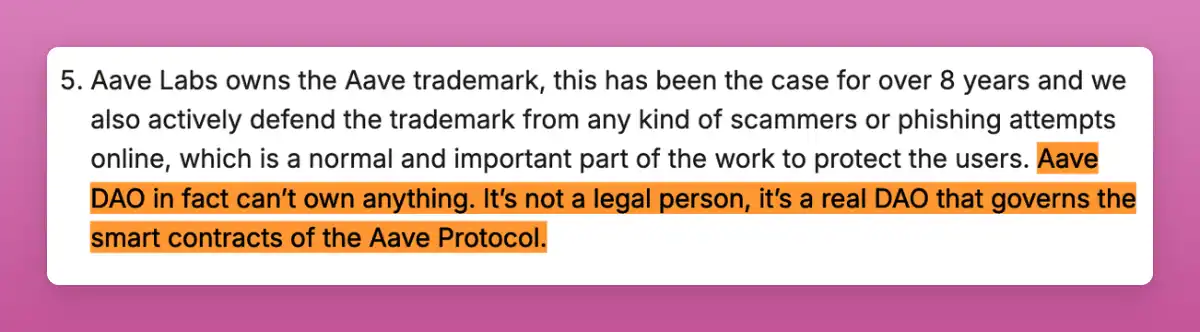
The DAO manages the smart contracts and on-chain parameters of the Aave protocol, but not the brand itself.

However, the DAO has been granted a license to use the Aave brand and visual identity for protocol-related purposes. Past governance proposals explicitly granted the DAO broad rights to use the visual identity "for the benefit of the Aave protocol, the Aave ecosystem, and the Aave DAO."
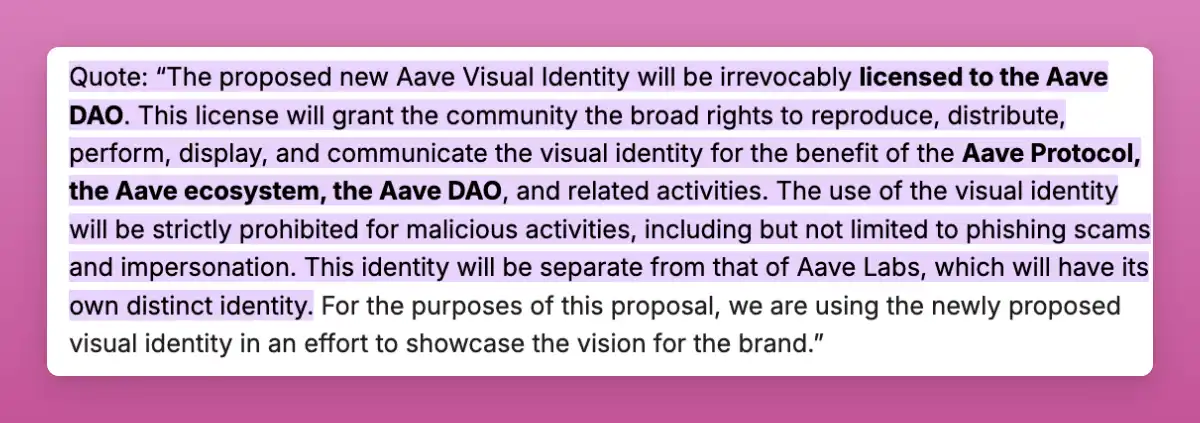
Source: Aave

As EzR3aL stated:

  • "Charging this fee is only possible because the Aave brand is well-known and accepted within the ecosystem. This is a brand that the Aave DAO paid to build."

The value of the Aave brand does not stem from a logo.

Its value stems from:

  • The DAO carefully managing risks
  • Token holders bearing protocol risk
  • The DAO paying fees to service providers
  • The DAO surviving multiple crises without collapsing
  • The protocol earning a reputation for safety and reliability

This is what EzR3aL means by "the DAO paid to build the brand."

Not paid in a legal sense, but paid in an economic sense—through capital, governance, risk, and time invested.

Does this sound familiar?

It harkens back to the similar issue between Uniswap Labs and the Foundation regarding Uniswap front-end fees. Ultimately, Uniswap realigned equity and token holder interests, completely removing the front-end fees.

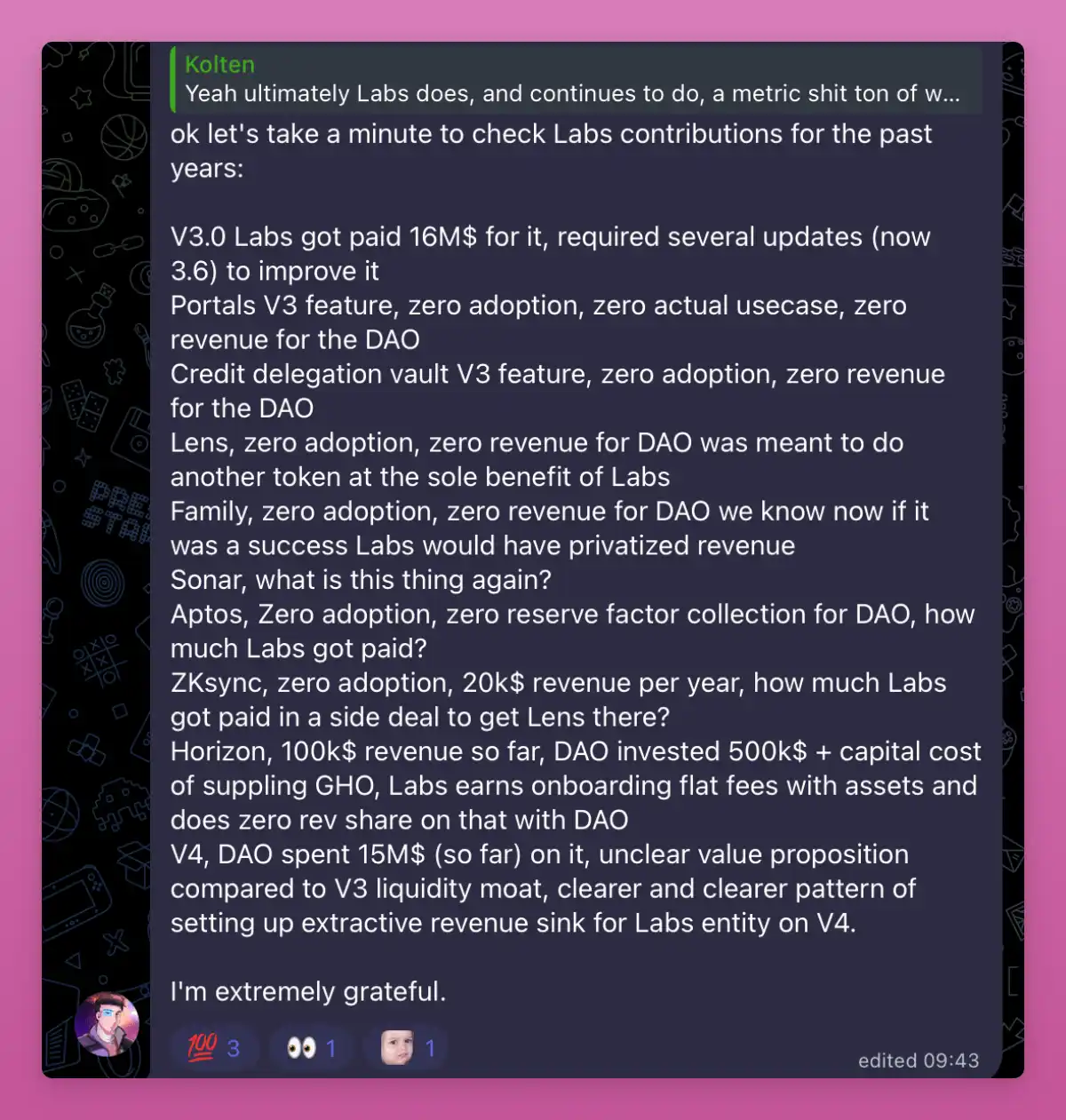
This is why the equity / DAO dynamic can be harmful (this is something I found in a TG group chat).
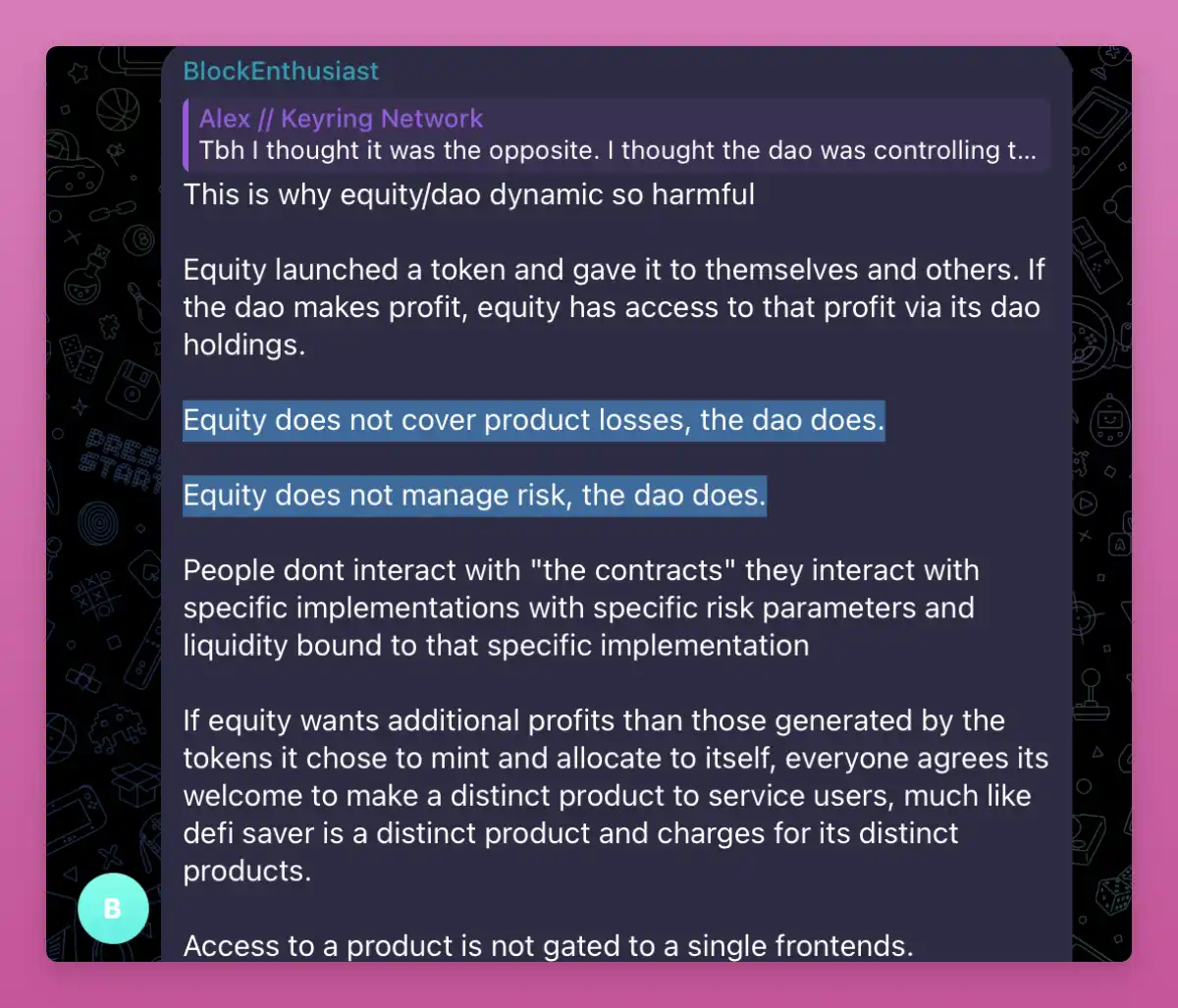
The content of the above image is as follows:

"Equity issued a token and distributed these tokens to itself and others. If the DAO generates profits, Equity can receive profits through its share of tokens in the DAO.

  • But Equity does not bear the losses of the product; these losses are borne by the DAO.
  • Equity does not manage risk either; risk management is handled by the DAO.

Users do not interact directly with the 'contract' but with specific implementations that have specific risk parameters and liquidity tied to that specific implementation.

If Equity wants to obtain additional benefits beyond the profits generated by the tokens it minted and distributed to itself, everyone agrees it is completely free to develop an independent product to serve users, just as DeFi Saver is an independent product and charges for its unique services.

Access to a product should not be restricted to a single front-end in the first place."

As of writing, the only point Aave Labs agrees with the critics on is communication.

  • The truly valid criticism here is about communication. Or rather, the lack thereof.

Things were complicated enough; now they are worse.

Aave Labs proposed Horizon as a dedicated RWA instance.

Initially, the proposal contained something that immediately alarmed the DAO: a new token with a decreasing share of yields.

Representatives from various factions strongly opposed this (including the author), arguing that introducing a separate token would dilute AAVE's value proposition and undermine alignment.

The DAO ultimately won, and Aave Labs was forced to concede. The new token plan was scrapped.

But this created a larger rift.

Despite numerous concerns (one explicitly pointed out the need for clear responsibilities between Aave Labs and the DAO), Horizon was launched. It was the most contentious vote won.
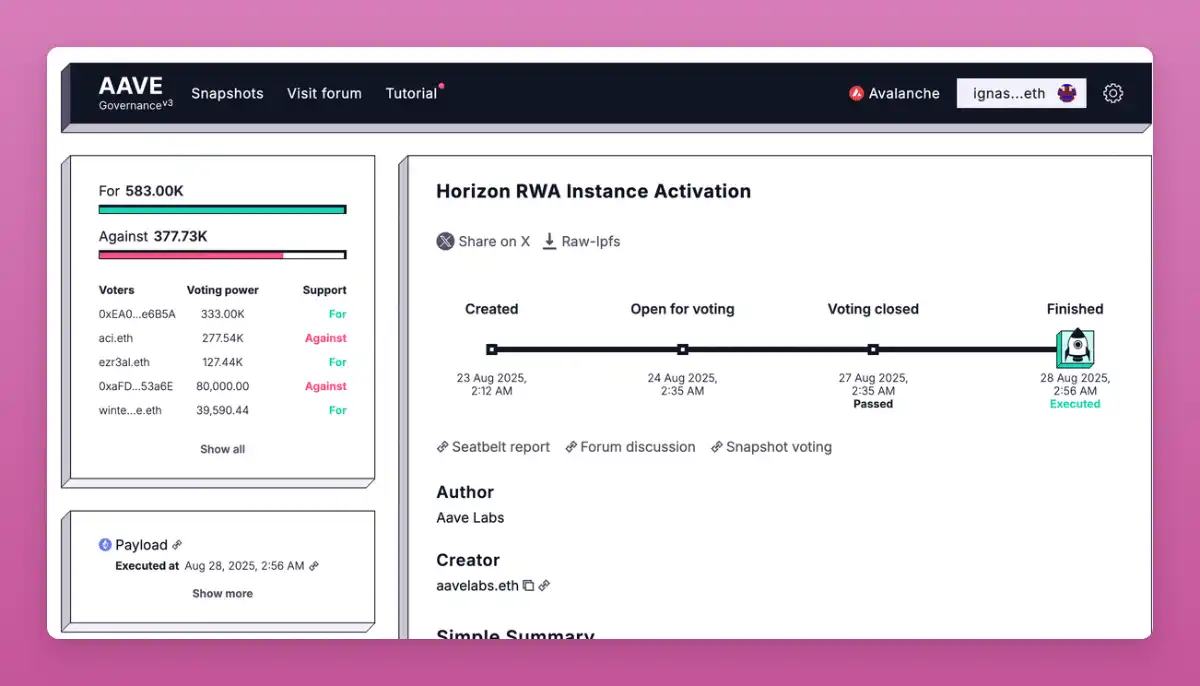
I voted against deployment, advocating for a friendly agreement to prevent future escalation of conflicts. And this is exactly the current situation. Economic issues quickly became the focal point of contention.

According to data cited by Marc Zeller, so far, Horizon has generated approximately $100,000 in total revenue, while the Aave DAO has invested $500,000 in incentives, putting its net book value at around -$400,000.

And this doesn't even account for other factors.

Marc also pointed out that tens of millions of GHO were deployed to Horizon, but their yield is lower than the cost required to maintain GHO's peg.

If these opportunity costs are factored in, the DAO's true economic situation might be worse.

This prompted ACI to raise a question that goes beyond Horizon itself:

If a project funded by the DAO has poor direct economic performance, is that the whole story?

Or, are there additional benefits, integration fees, or off-chain arrangements that token holders cannot see?

Over the years, deployments and plans proposed by multiple Labs have ultimately resulted in costs for the DAO exceeding its benefits.
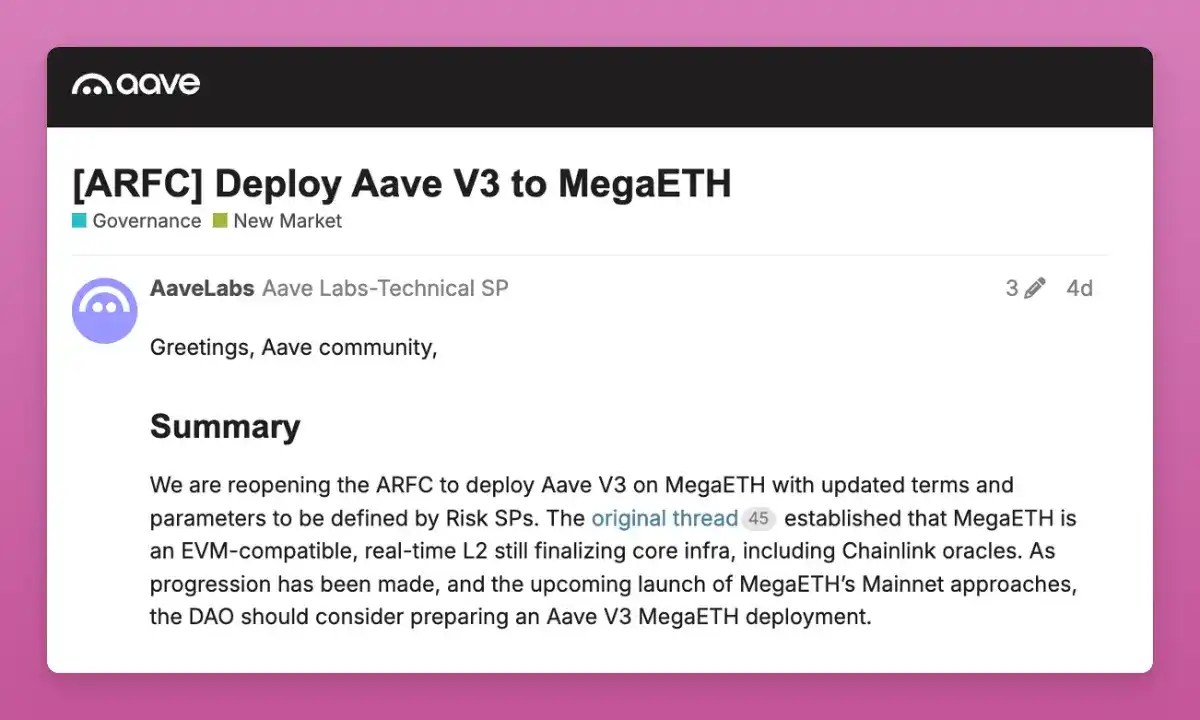
Discussions ensued just days after Aave Labs presented a DAO proposal to deploy Aave V3 on MegaETH.

In return, "Aave Labs will receive 30 million points from MegaETH."

Then, "These points may be distributed as incentives in the Aave V3 MegaETH market according to Aave DAO's GTM strategy."

The problem is that when a product is operated by a private entity, using assets backed by the DAO, transparency is crucial, and incentives must be distributed as agreed.
Source: Aave

The proposal was also surprising for another reason:

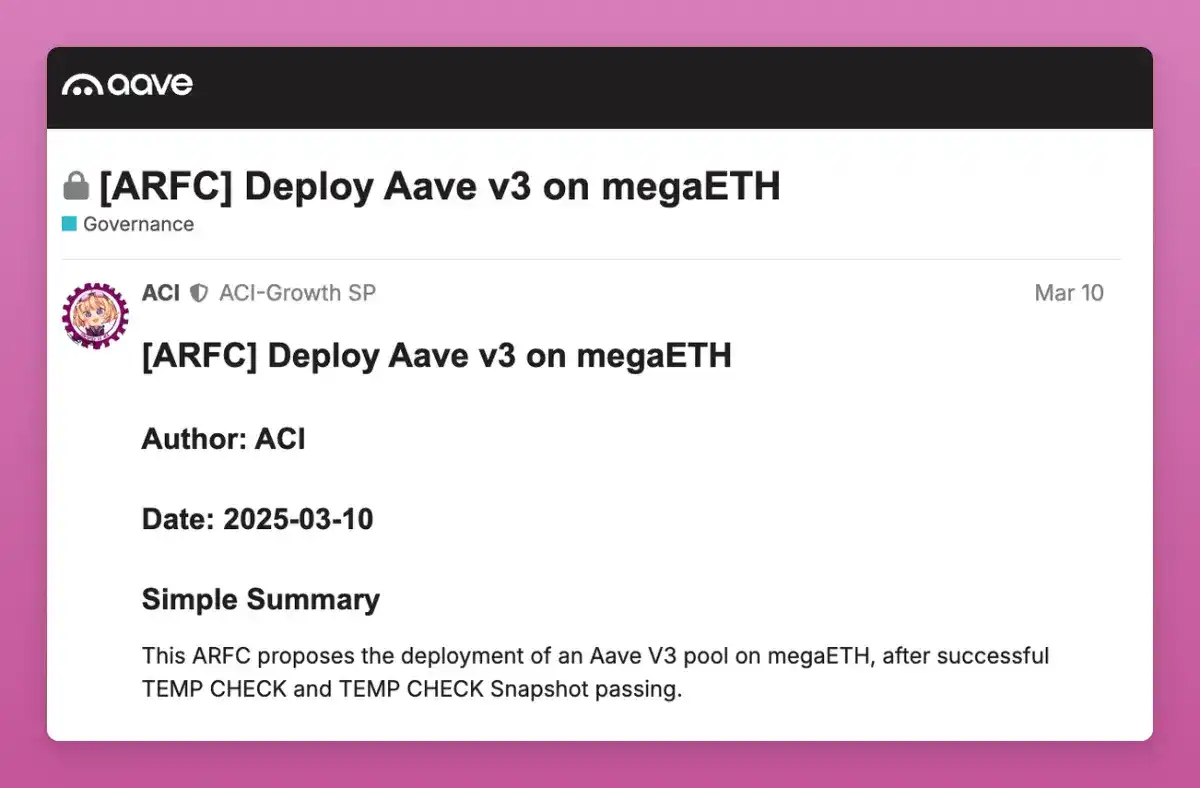
Aave DAO has been working with multiple service providers, notably ACI, which proposed a deployment on MegaETH as early as March. Discussions were still ongoing.
Source: Aave

As Marc commented on the forum:

  • "During the ongoing discussion, we were very surprised to find that Aave Labs decided to bypass all precedent, abandon all ongoing progress, and contact MegaETH directly. We only learned about this when the proposal was posted on the forum."

Treasury

Another part of this debate concerns the Aave Vaults.

Aave Vaults are application-level products built and funded by Aave Labs. Technically, they are ERC-4626 vault wrappers built on top of the Aave protocol, abstracting position management for users.

Stani explained this very clearly:

  • "Aave Vaults are simply 4626 vault wrappers built and funded by Aave Labs."

From Aave Labs' perspective, this should not be controversial.

The vaults are not protocol components. They do not affect the protocol's profitability.
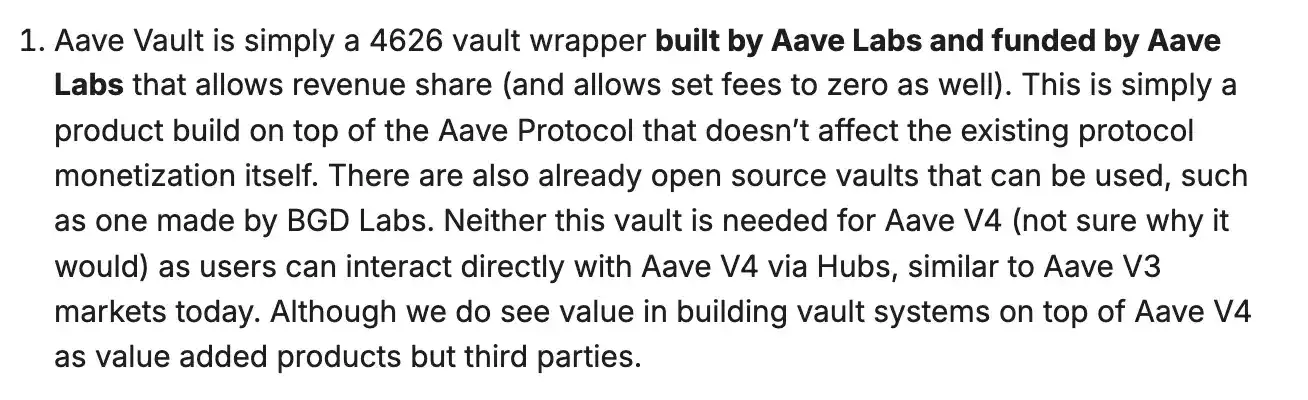
They are optional; users can always interact directly with Aave markets or use third-party vaults.

  • "For Aave V4, these vaults are not necessary... users can interact directly with Aave V4 through Hubs."

And because the vaults are a product, Aave Labs believes they have the right to monetize them.

  • "It is entirely okay for Aave Labs to monetize its products, especially since they do not involve the protocol itself."

So why are the vaults dragged into this fight?

The reason lies in the distribution channel.

If the vaults become the default user experience for Aave V4, then a Labs-owned, Aave-branded product could become the bridge between the user and the protocol, charging transaction fees while relying on the reputation, liquidity, and trust accumulated by the DAO.

Even as adoption of Aave products increases, the AAVE token could be negatively impacted.

Again, the author believes this issue falls into the same category as the debate between Uniswap Labs and the Foundation regarding front-end products.

In summary, CowSwap, Horizon, MegaETH, and Aave Vaults all face the same core issue.

Aave Labs sees itself as an independent builder, operating an opinionated product on top of a neutral protocol.

The DAO increasingly sees protocol value being monetized outside its direct control.

The Aave DAO does not own the intellectual property, but it has been granted a license to use the Aave brand and visual identity for protocol-related purposes.

This debate is crucial because the upcoming Aave v4 version is explicitly designed to move complexity from the user side into abstraction layers.

More routing, more automation, and more products sitting between the user and the core protocol.

More abstraction means more control over the user experience, and user experience control is key to value creation/extraction.

This article strives to remain neutral. However, it is hoped that a consensus can be reached regarding value capture for $AAVE token holders.

The author hopes the consensus reached will not only benefit Aave itself but also because Aave sets an important precedent for how equity and tokens can coexist.

Uniswap Labs has already gone through this process and ultimately aligned the outcome in favor of $UNI holders.

Aave should do the same.

Related reading: Uniswap Protocol Fee Distribution Proposal Ignites the Market, What Impact Does It Have on the Future of DeFi?


Трендові криптовалюти

Пов'язані питання

QWhat is the core issue in the dispute between Aave Labs and Aave DAO regarding the CoWSwap integration?

AThe core issue is about ownership and value capture. The dispute centers on who controls the Aave protocol, who decides how value is distributed, and who benefits from the fees generated. Specifically, the integration redirected fees that previously went to the Aave DAO treasury to an address controlled by Aave Labs, raising concerns about the diversion of revenue.

QHow does Aave Labs justify its decision to redirect fees from the CoWSwap integration to its own address instead of the DAO treasury?

AAave Labs justifies this by drawing a clear distinction between the protocol and the product. They argue that their front-end interface (aave.com) is a separate product they operate independently from the protocol and DAO governance. They claim it is reasonable for them to monetize their own product, especially since running the front-end requires funding for security, maintenance, and support.

QWhat was the estimated annual financial impact on the Aave DAO treasury from the fee redirection, according to the critic EzR3aL?

AAccording to EzR3aL, assuming a weekly transfer of $200,000, the Aave DAO would lose at least $10 million in revenue annually due to the fee redirection to Aave Labs.

QWhat broader precedent from another DeFi project is mentioned as a comparison to this situation?

AThe article draws a parallel to a similar dispute between Uniswap Labs and the Uniswap Foundation regarding front-end fees. Ultimately, Uniswap realigned equity and token holder interests by completely removing the front-end fees, setting a precedent for resolving such conflicts in favor of the token holders.

QBeyond the CoWSwap fees, what other examples are cited where Aave Labs' actions allegedly created tension with the DAO over value capture?

AOther cited examples include the controversial launch of the Horizon RWA instance, which reportedly had a negative economic impact on the DAO; a proposal to deploy Aave V3 on MegaETH where Aave Labs stood to receive incentives; and the development of Aave Vaults, which are product-level wrappers that could become a default user experience and potentially extract value outside of direct DAO control.

Пов'язані матеріали

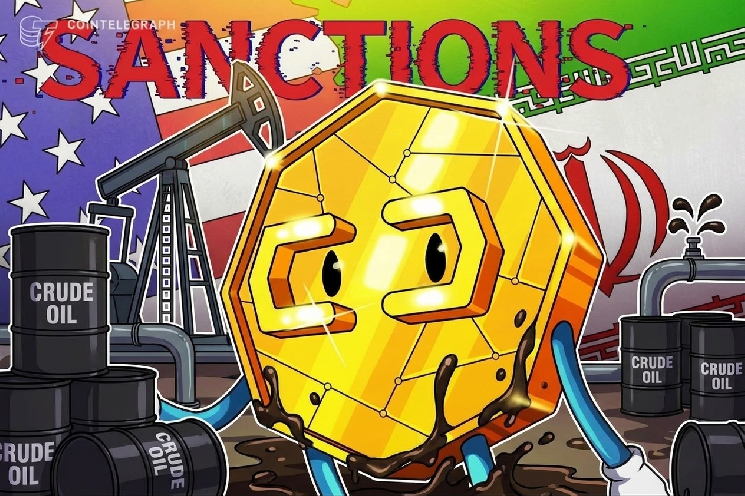
U.S. Aims at Iran's Crypto Sector Due to Oil Payments Exceeding $100 Billion

The U.S. Treasury Department has expanded sanctions on Iran to target its digital asset sector, citing over $100 million in cryptocurrency payments allegedly used to facilitate Iranian oil sales. The Treasury’s Office of Foreign Assets Control (OFAC) announced new sectoral sanctions covering digital assets, technology, gold, aviation, and shipping, alongside sanctions against nearly 60 entities, individuals, and vessels linked to nuclear, missile, cyber, and oil networks. The move allows OFAC to sanction foreign persons and firms operating in or supporting Iran’s crypto sector, which the Treasury stated is increasingly used as a "tool of choice" to circumvent sanctions, including by the Islamic Revolutionary Guard Corps (IRGC). Specific targets include Ukrainian broker Ivan Obukhov and his UAE-registered firm Foscom FZE, accused of processing over $100 million in crypto payments to facilitate oil sales for the IRGC’s Quds Force. This follows recent U.S. actions against Iran-linked crypto exchanges, including sanctions against UK-based Zedcex and Zedxion in January, four Iranian exchanges including Nobitex in June, and exchanges Shelbit and Aban Tether in August. Unlike previous targeted sanctions, the new measures establish a framework to penalize broader involvement in Iran’s crypto sector, significantly expanding OFAC’s authority under Executive Order 13902. Designated persons’ U.S.-linked property will be blocked, and foreign banks facilitating significant transactions for them may face U.S. account restrictions.

cryptonews.ru22 хв тому

U.S. Aims at Iran's Crypto Sector Due to Oil Payments Exceeding $100 Billion

cryptonews.ru22 хв тому

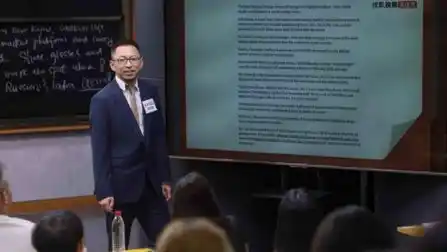
Conversation with Charles Zhang: Amidst the AI Frenzy, Why Pursue 'Anti-Efficiency' Content?

Dialogue with Charles Zhang: In the Era of AI's Sprint, Why Create "Anti-Efficiency" Content Standing out among China's early internet pioneers, Charles Zhang, founder and CEO of Sohu, maintains a distinct personal identity. He keeps a consistent public presence and embodies traits of high-energy individuals: sleeping only 4-5 hours daily, running 5km or marathons, and hosting frequent offline tech forums and dialogues with Nobel laureates. He has shifted focus from external business expansion to internal self-reconstruction, adhering to his own pace. "People aren't afraid of being busy; the busier you are, the better your health. Having nothing to do can lead to emotional issues and poor health." Marking the 10th anniversary of his live-streamed "Charles Zhang's English Class," he recently took it offline for a real-world classroom session. Following this, he discussed the course's decade-long journey, Sohu Video's content ecosystem, and the value of content in the AI era. **Pen and Mouth Diligence: A Class Against Instant Mastery** His English class began in August 2016 on "Qianfan Live." He spends about 40 minutes daily preparing, reviewing dozens of news headlines, reading five in detail, and selecting three for the lesson. Over ten years, he has completed over 2000 live sessions totaling more than 110,000 minutes, with over 52 million views. Initially, the stream was a way to "talk more" and combat emotional struggles. He started by repeating after TV news anchors, then moved to live-streaming with the launch of Qianfan Live. It was 40% for personal emotional regulation ("like a monk chanting sutras"), 30% to deliver authentic news, and 30% to promote the new platform. This daily "ritual" helped him overcome depression, leading to what he calls his "peak life state." From a product perspective, it was counter-intuitive—launched without prior market research or growth strategies, based on the founder's personal need that resonated with users. Yet, his content creation follows a strict routine. The decade of covering geopolitics, economics, tech, health, and society has built a vast "knowledge compound interest" system. In an age of AI summaries and algorithmic content, Zhang insists on "hard work": meticulous reading, handwritten notes, and manually created teaching materials, refusing AI-generated content. The English class is now a fixed daily rhythm; preparing for his weekly physics class requires a full day of solitary deduction on a blackboard. In his live streams, Zhang positions himself as a "content creator," not a CEO or teacher. He sees physics as extreme brain training and English as a "sensor" to understand the world. This explains why a top entrepreneur persists for a decade in seemingly "unprofessional" pursuits—it's the information input and psychological healing method he found during a low point. It's fundamentally an "anti-efficiency" commitment. He believes the meaning of reading lies in finding community and spiritual support, not just fleeting conversation points. For today's media, he states: "Reading news isn't the goal. As humans with many confusions, we need reference points, to find a group, find kindred spirits, or seek support and spiritual nourishment. Large language models can't satisfy these starting points; they only give you information." This offers solace and a value defense for media professionals impacted by AI summaries. **"Don't Think Earth Stops Turning Because AI Arrived"** A content creator expressed anxiety: after feeding their article to AI, it produced a more comprehensive, profound version, making their work feel valueless. Zhang responded with an analogy: "Carrots from the market, with a bit of soil, not glossy, taste delicious and flavorful. Tomatoes forced by chemical fertilizer have no taste at all." He sees AI giving world content a "plastic feel," but acknowledges its significant role in improving information access efficiency, especially in physics and social science research where he often queries AI for quick professional answers. The key, Zhang stresses, is that the outside world still needs to guide our perspective. LLMs provide "information," while the outside world offers "viewpoints." He cares deeply about *what* that external viewpoint is and *how* someone thinks about an issue. "Don't think the Earth stops turning because AI arrived," he analyzes. AI currently replaces rule-based work, noting significant impact on the software industry with many programmers laid off as even less experienced people can now write decent code. However, AI cannot yet replace arts, social sciences, emotions, and creative content. "Hollywood remains thriving, producing great works. Oscars will continue, Nobel Literature Prizes will still be awarded—all by real people, with works conceived by real people." While wary of AI, Zhang isn't anti-technology and is open to its applications. Sohu itself has launched AI assistants. In Sohu's AI practice, Zhang defines his role as a "large language model corpus provider." He believes LLM training is inseparable from human-original content as its data foundation, so original content retains irreplaceable value. "The era of self-media indeed offers everyone new ways to discover their strengths and achieve growth." He suggests every young person should consider self-media. Most importantly, the bottom line of content creation should be "authenticity." If using AI avatars, they must be clearly labeled; not doing so and misleading viewers wastes their time, especially when people still prefer real human content. Behind AI's sprint lie unavoidable realities. As AI quickly provides seemingly perfect answers, people grow accustomed to accepting "summarized" results, omitting processes of questioning, deduction, and trial-and-error, leading to a decline in deep thinking. Zhang's "anti-efficiency" practice with his two live-streamed classes is his answer to AI's狂奔: In an algorithm-driven era chasing ultimate efficiency, don't expect AI to fill inner voids. Read books, speak in front of a camera, sweat on a running track, and build connections with real people.

marsbit31 хв тому

Conversation with Charles Zhang: Amidst the AI Frenzy, Why Pursue 'Anti-Efficiency' Content?

marsbit31 хв тому

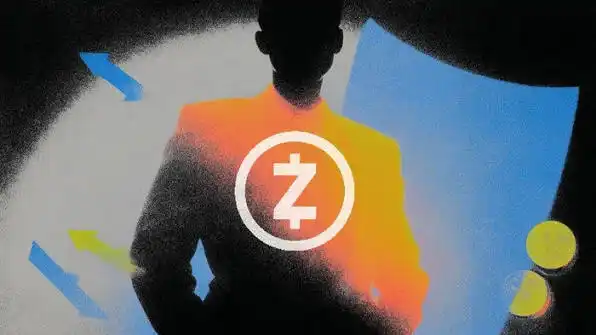
Zcash's ETF Gilding: How a Privacy Coin Was Packaged by Wall Street into a Compliant Asset

The article traces the decade-long path of Zcash (ZEC), a privacy-focused cryptocurrency, to its potential launch as the first privacy coin spot ETF, with Grayscale's ZCSH filing in August 2026. It argues ZEC's suitability stemmed not from regulatory acceptance of its privacy technology, but from its centralized, institutional structure from inception—a commercial company (ECC) with venture capital backing and a Founder's Reward—making it easier to package than decentralized alternatives. Three key institutions, intertwined in a network, drove the process: Grayscale (owned by DCG, an early ZEC investor), which had held ZEC in a trust since 2017; Coinbase, providing custody, prime brokerage, derivatives, and venture investment; and ZODL, a new for-profit entity formed in 2026 when ECC's core development team split from the non-profit foundation. The major regulatory hurdle was SEC scrutiny (2023-2026) over ZEC's historical structure, which resembled an unregistered investment contract due to automatic block rewards to ECC and the Foundation. This was resolved through governance changes (NU6 upgrade in 2024) that ended direct funding and shifted control to community voting, coinciding with a broader shift in SEC enforcement policy. Notably, the law firm Davis Polk represented both the Zcash Foundation in its SEC defense and Grayscale in the ETF filing. The push is also driven by DCG's dire financial needs amid Genesis bankruptcy lawsuits, seeking high-fee products (the ZEC ETF charges 2.5%). Concurrently, major mining operations by entities like Cypherpunk Technologies (backed by Winklevoss Capital) and DCG's Fortitude Mining expanded, motivated by profitability and aiming to influence the network. The article concludes with irony: to become a compliant ETF asset, ZEC must shed its core privacy feature for the fund's holdings, which will be held in transparent, auditable addresses. Wall Street is not adopting privacy technology but packaging the *concept* of privacy into a tradable, fee-generating financial product. The transformation was not a single master plan but the result of a network of aligned interests capitalizing on regulatory, governance, and market shifts over ten years.

marsbit41 хв тому

Zcash's ETF Gilding: How a Privacy Coin Was Packaged by Wall Street into a Compliant Asset

marsbit41 хв тому

Торгівля

Спот

Популярні статті

Як купити DAO

Ласкаво просимо до HTX.com! Ми зробили покупку DAO Maker (DAO) простою та зручною. Дотримуйтесь нашої покрокової інструкції, щоб розпочати свою криптовалютну подорож.Крок 1: Створіть обліковий запис на HTXВикористовуйте свою електронну пошту або номер телефону, щоб зареєструвати обліковий запис на HTX безплатно. Пройдіть безпроблемну реєстрацію й отримайте доступ до всіх функцій.ЗареєструватисьКрок 2: Перейдіть до розділу Купити крипту і виберіть спосіб оплатиКредитна/дебетова картка: використовуйте вашу картку Visa або Mastercard, щоб миттєво купити DAO Maker (DAO).Баланс: використовуйте кошти з балансу вашого рахунку HTX для безперешкодної торгівлі.Треті особи: ми додали популярні способи оплати, такі як Google Pay та Apple Pay, щоб підвищити зручність.P2P: Торгуйте безпосередньо з іншими користувачами на HTX.Позабіржова торгівля (OTC): ми пропонуємо індивідуальні послуги та конкурентні обмінні курси для трейдерів.Крок 3: Зберігайте свої DAO Maker (DAO)Після придбання DAO Maker (DAO) збережіть його у своєму обліковому записі на HTX. Крім того, ви можете відправити його в інше місце за допомогою блокчейн-переказу або використовувати його для торгівлі іншими криптовалютами.Крок 4: Торгівля DAO Maker (DAO)Легко торгуйте DAO Maker (DAO) на спотовому ринку HTX. Просто увійдіть до свого облікового запису, виберіть торгову пару, укладайте угоди та спостерігайте за ними в режимі реального часу. Ми пропонуємо зручний досвід як для початківців, так і для досвідчених трейдерів.

306 переглядів усьогоОпубліковано 2024.12.11Оновлено 2026.06.02

Як купити DAO

Обговорення

Ласкаво просимо до спільноти HTX. Тут ви можете бути в курсі останніх подій розвитку платформи та отримати доступ до професійної ринкової інформації. Нижче представлені думки користувачів щодо ціни DAO (DAO).

活动图片