Looking Back at Prediction Markets by the End of 2025: Scale, Players, and the Watershed Moment

比推Опубліковано о 2025-12-29Востаннє оновлено о 2025-12-29

Анотація

By the end of 2025, prediction markets have fundamentally shifted from being event-driven tools reliant on black swan events to platforms sustained by structural trading demand. The total monthly trading volume has grown from under $100 million in early 2024 to over $1 billion by late 2025, indicating a phase of explosive growth and consistent liquidity. The industry has evolved into five distinct segments: 1. **Compliant Markets**: Kalshi (CFTC-regulated, exchange-like) and Polymarket (globally liquid, later US-compliant) lead with institutional and high-frequency trading, especially in sports contracts. 2. **Crypto-Native Experiments**: Platforms like Opinion explore high-risk, crypto-policy, and speculative events, driving innovation but facing regulatory uncertainty. 3. **High-Frequency Trading Platforms**: Limitless shortens contract cycles, blurring lines between prediction markets and derivatives trading. 4. **Embedded Markets**: Myriad Markets integrates prediction features into wallets and super-apps, reducing user acquisition costs and making participation more casual. 5. **Native Information Markets**: Platforms like predict.fun and media integrations use incentives and community mechanisms to blend prediction with content and social interaction. Regulation in 2025 has not meant full liberalization but rather the establishment of boundaries—predictive contracts are recognized as financial instruments, yet state-level gambling laws remain a friction point. Th...

If we were to summarize prediction markets in 2025 in one sentence, it might be:

This is the first year prediction markets no longer rely on black swan events but instead begin to rely on structural trading demand.
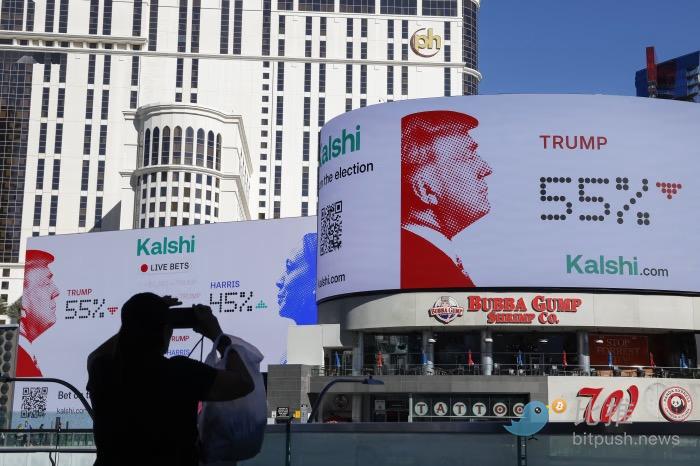
This was almost unimaginable in the past. For a long time, prediction markets were more like "event tools": they only became briefly active during major uncertainties like elections, pandemics, or wars, then quickly cooled down. But this year, high-frequency events such as sports matches, macroeconomic data, and policy changes provided prediction markets with a stable trading rhythm, making them exhibit, for the first time, operational characteristics close to those of financial exchanges—sustained liquidity, frequent trading, and clear settlements.

On the surface, this is a change in scale; but more importantly, it is a change in role.
Prediction markets are shifting from "betting on whether something will happen" to "how the market prices uncertainty." In other words, probabilities are no longer just personal opinions but are beginning to be treated as price signals that can be repeatedly referenced, much like interest rates, exchange rates, or stock prices.

The True Scale of Prediction Markets in 2025

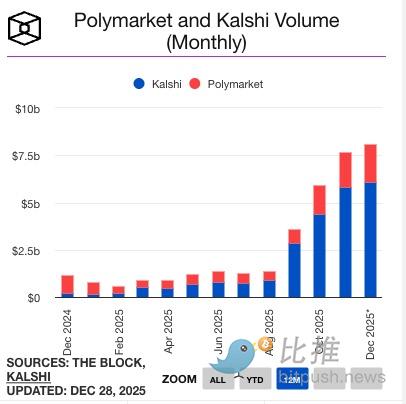
The overall trading volume of prediction markets has grown by an order of magnitude over the past two years. According to industry data from Dune & Keyrock, the monthly trading volume of prediction markets has increased from less than $100 million in early 2024 to stabilize in the range of over $1 billion by the end of 2025, showing explosive growth.

Taking leading platforms as an example, data from The Block shows that Kalshi approached a trading volume of nearly $6 billion in November 2025, with sports contracts contributing the vast majority of the transactions;

Meanwhile, on-chain data and platform disclosures from Polymarket indicate that it also maintained monthly trading volumes in the tens of billions of dollars during several peak months in 2025.

The message behind these numbers is clear: prediction markets no longer rely on "occasional major events" but have entered a stage where they can operate sustainably in everyday environments.

The Industry Gradually Forms "Five Major Camps"

If we only look at trading volume, it is easy to overlook the most critical change in 2025—platforms have embarked on completely different development paths.

For the average reader, it can be simply understood as: some platforms are striving to "become like exchanges," some are trying to "make predictions lighter and more frequent," and others are exploring "whether predictions can be embedded into everyday products."

These differences determine the form prediction markets will take in the future.

First Camp: The Mainstream of Compliant Prediction Markets—Parallel Competition of Two Paths

In 2025, the true marker of prediction markets entering mainstream finance was not the growth in trading volume but the clear differentiation of compliance paths.

One path is the "local compliance, exchange-oriented route" represented by Kalshi. Kalshi chose from the outset to operate entirely within the regulatory framework of the U.S. Commodity Futures Trading Commission (CFTC), defining prediction contracts as standardized event derivatives. In 2025, with the large-scale launch of sports contracts, its trading structure evolved significantly toward high frequency and short cycles, and its product form increasingly resembled that of traditional financial exchanges.

The other path is represented by Polymarket. This is a more challenging route: after initially building scale by leveraging global liquidity, Polymarket completed a compliance restructuring in 2025, acquiring a licensed entity and gaining regulatory approval to officially return to the U.S. market. This made it one of the few platforms in the industry with both a global user base and U.S. compliance status.

The difference between the two lies not in "whether they are compliant" but in the accumulation before compliance. Kalshi's advantage lies in institutional certainty and local distribution capabilities; Polymarket's advantage lies in the global liquidity it has already formed and broader event coverage. They represent two different evolutionary directions for prediction markets within the regulatory framework.

Second Camp: Crypto-Native Experimental Platforms

Outside the mainstream compliance path, there remains a category of platforms that serve the function of trial and error and innovation.
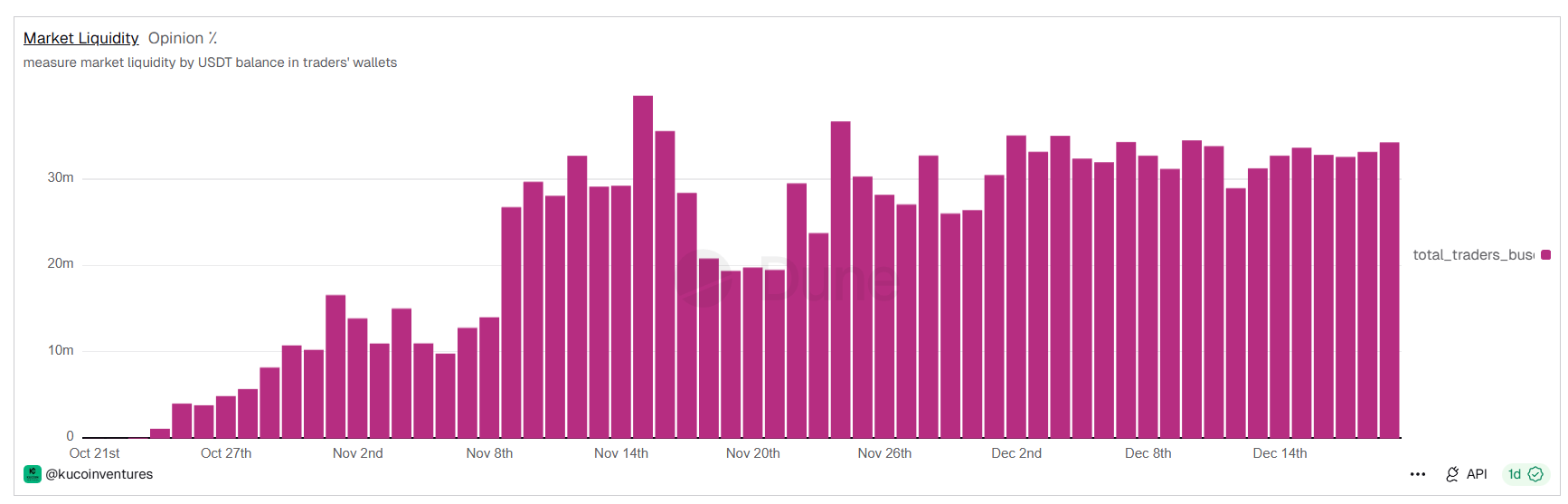
Represented by platforms like Opinion, this camp leverages the native liquidity and community diffusion capabilities of the crypto ecosystem to achieve rapid growth. They are more aggressive in event selection, often covering crypto policies, extreme hypotheses, or highly controversial issues that mainstream platforms have not yet addressed.

The significance of these platforms lies not in short-term scale but in being the first to price highly uncertain questions. However, their trading data often comes from platform displays or third-party statistics and has not yet entered a clear compliance framework, so long-term sustainability remains to be verified.

Third Camp: High-Frequency, Exchange-Thinking Prediction Markets

Platforms represented by Limitless are pushing prediction markets in a new direction.

Here, prediction is no longer an act of "waiting for results" but a trading behavior of high-frequency entry and exit of positions. Contract cycles are deliberately shortened, settlement frequencies are continuously increased, and user behavior resembles that of short-term traders rather than event analysts.

This model blurs the line between prediction markets and derivative trading, also hinting that regulators may need to address new product definitions in the future.

Fourth Camp: The Wallet and Super-Entry Embedded Route

The value of Myriad Markets lies not in trading volume but in its path choice.

Through integration with mainstream wallets, prediction markets are embedded into users' daily asset management processes. Users do not "enter a prediction market" but participate casually while viewing assets or completing interactions.

The long-term significance of this model is its extremely low customer acquisition cost and highly natural user conversion, indicating that prediction markets are shifting from "high-participation-cost behavior" to "everyday light decision-making behavior."

Fifth Camp: Information Markets Native to Public Chains and Content Ecosystems

Platforms represented by predict.fun attempt to treat prediction markets as a native information application.

They rely on public chain ecosystems for diffusion, use incentive mechanisms to drive participation, and deeply integrate prediction behavior with content and communities. At the same time, traditional media are exploring similar directions, using prediction markets as interactive supplements to news content rather than mere trading tools.

Although this camp may struggle to compete with compliant platforms in terms of trading scale in the short term, the product forms and participation mechanisms they explore could influence the usage methods and content organization structures of prediction markets in the medium to long term.

Compliance Is Not Deregulation but Setting Boundaries

In 2025, prediction markets were not "fully liberalized."

A more accurate description is: regulators explicitly acknowledged for the first time that prediction contracts can exist as financial instruments but did not relinquish control over their boundaries. Federal-level attitudes gradually clarified, while state-level gambling regulations became new sources of friction. This inconsistency means prediction markets will remain in a state of "expandable but not uncontrollable."

For the average user, the most important cognitive shift in 2025 is: prediction markets are no longer just about "betting on right or wrong" but about "trading the market's pricing of uncertainty."

Price reflects consensus rather than fact; liquidity is often more important than opinion; profit comes from judgment differences, not the final result itself; and the biggest risk often comes from rule changes, not misjudgment.

Conclusion

Looking back at 2025, the real change in prediction markets is not which platform is more lively, but that a more fundamental question began to be taken seriously:

Who has the right to price uncertainty?
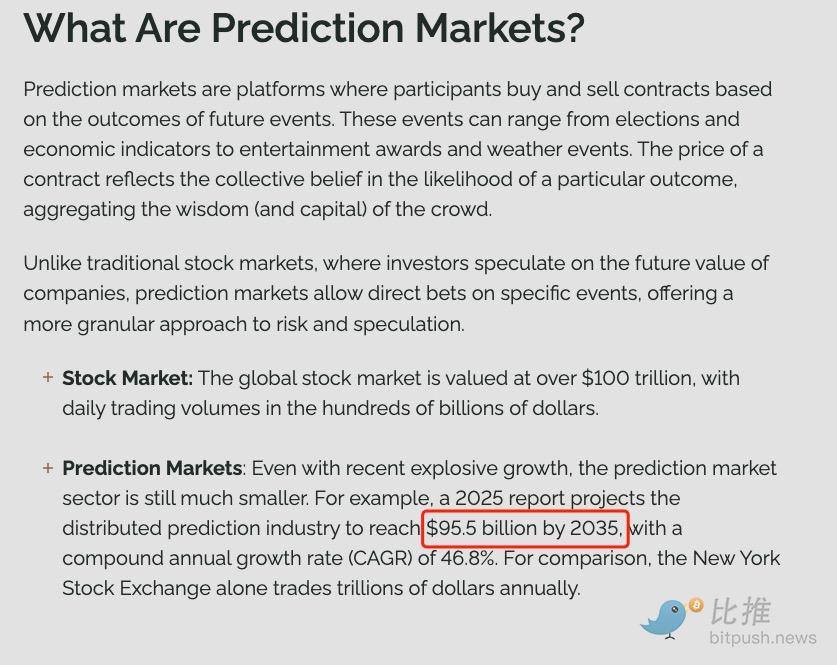
Compliant platforms are setting boundaries, experimental platforms are exploring possibilities, and the true winners may not emerge until after 2026. What is certain is that prediction markets are no longer just gambling but are becoming a tool to help people understand uncertainty. A report released by Certuity predicts that by 2035, the prediction market size could reach $95.5 billion, with a compound annual growth rate of 46.8%.

2025 is just the beginning.

Author: Bootly


Twitter:https://twitter.com/BitpushNewsCN

Bitpush TG Discussion Group:https://t.me/BitPushCommunity

Bitpush TG Subscription: https://t.me/bitpush

Original link:https://www.bitpush.news/articles/7599007

Пов'язані питання

QWhat is the key shift in prediction markets highlighted for 2025?

APrediction markets shifted from relying on black swan events to depending on structural trading demand, moving towards pricing uncertainty like traditional financial instruments.

QWhat was the approximate monthly trading volume of prediction markets by the end of 2025?

AThe monthly trading volume stabilized above $1 billion by the end of 2025, up from less than $100 million in early 2024.

QName the two main compliance paths for prediction markets as described in the article.

AThe two main compliance paths are represented by Kalshi (domestic compliance and exchange-like structure under CFTC regulation) and Polymarket (global liquidity with later U.S. compliance through regulatory approval).

QWhat is the significance of the 'wallet and super entry embedded route' exemplified by Myriad Markets?

AIt embeds prediction markets into daily asset management workflows, reducing user acquisition costs and transforming prediction participation into a light, everyday decision rather than a high-cost activity.

QWhat is the article's conclusion about the fundamental question prediction markets began to address in 2025?

AThe fundamental question is 'Who has the right to price uncertainty?', with prediction markets evolving from mere betting tools into instruments for understanding and pricing uncertainty.

Пов'язані матеріали

South Korean Exchanges 'Battle' Regulators, Challenging the Boundaries of Enforcement and Legislation

South Korea's cryptocurrency industry is engaged in a rare, direct confrontation with regulators. The Financial Intelligence Unit (FIU), the primary anti-money laundering (AML) watchdog, has recently imposed heavy penalties on major exchanges like Upbit and Bithumb for alleged violations involving unregistered overseas VASPs and AML procedures. However, exchanges are now actively challenging these actions in court and through industry associations. In a significant shift, the Seoul Administrative Court ruled in favor of Upbit's operator, Dunamu, overturning part of an FIU-ordered business suspension. The court found the FIU's penalty criteria and justification insufficiently clear. Similarly, the court suspended the enforcement of a six-month business suspension against Bithumb pending a final ruling, citing potential irreversible harm to the exchange. Beyond legal battles, the industry is contesting proposed legislative amendments. The Digital Asset eXchange Alliance (DAXA) strongly opposes a draft rule that would mandate Suspicious Transaction Reports (STRs) for all crypto transfers over 10 million KRW (~$6,800). DAXA argues this "poison pill" clause violates legal principles and would overwhelm the STR system, increasing reports from 63,000 to an estimated 5.45 million annually for major exchanges, thereby crippling effective AML monitoring. This conflict highlights a structural tension in South Korea's crypto governance: comprehensive digital asset laws are still developing, while regulators rely heavily on AML enforcement. The industry's move from passive compliance to active legal and legislative challenges signifies a new phase, pressing for clearer rules and more proportionate enforcement. While short-term disputes may intensify, this clash could ultimately lead to a more mature and sustainable regulatory framework for South Korea's vibrant crypto market.

marsbit41 хв тому

South Korean Exchanges 'Battle' Regulators, Challenging the Boundaries of Enforcement and Legislation

marsbit41 хв тому

After 50x Storage Surge, Justin Sun Always Looks to the Next Decade

Sun Yuchen, known for his controversial stunts like a $30 million lunch with Warren Buffett (canceled due to a kidney stone) and eating a $6.2 million duct-taped banana, is often overshadowed by a significant fact: his decade-long track record of spotting major investment trends. In 2016, he famously advised young people to invest in Bitcoin, Nvidia, Tesla, and Tencent instead of buying property. A hypothetical $20,000 investment in Nvidia and Tesla from that list would now be worth over 50 million RMB. His latest major call was on November 6, 2025, predicting a "50x storage opportunity" tied to the AI boom, which materialized with Sandisk's stock surging nearly 50-fold by 2026. Looking ahead, Sun now focuses on the next frontier: Physical AI. He identifies four key areas: 1. **Embodied AI/Robotics**: He sees this reaching its "iPhone moment," with companies like UBTech and Galaxy General leading in commercialization. 2. **Drones**: Viewed as the first commercially viable form of Physical AI, revolutionizing sectors from warfare (e.g., AeroVironment's Switchblade) to logistics. 3. **Spatial Computing**: Beyond VR, it's about AI understanding physical space, a foundational technology for robotics and autonomous systems, exemplified by Apple's Vision Pro. 4. **Space Exploration**: After a 2025 suborbital flight with Blue Origin, Sun advocates for space as the ultimate frontier, discussing blockchain's potential role in space asset management and data transactions. His investment philosophy involves betting on entire, inevitable trends rather than single companies. For robotics, he sees Tesla (the body/manufacturer) and Nvidia (the brain/AI platform) as complementary plays. In defense drones, he highlights companies making tanks obsolete (AeroVironment) and those augmenting fighter jets (Kratos). For space, he participated in Blue Origin's flight and anticipates SpaceX's potential IPO to redefine the sector's valuation. Sun Yuchen's vision frames the next two decades not as a revolution in information flow (like the internet), but in the fundamental operation of the physical world through AI-powered robots, autonomous systems, and spatial intelligence, ultimately extending human and AI activity into space. While many still focus on conventional assets, he continues to look toward the next technological horizon.

marsbit1 год тому

After 50x Storage Surge, Justin Sun Always Looks to the Next Decade

marsbit1 год тому

The Billionaires Behind the Most Expensive Midterm Election in History

"The Most Expensive Midterm Elections and Their Billionaire Backers" This analysis details the unprecedented scale of spending in the 2026 midterm elections, highlighting the key billionaire donors shaping the political landscape. Jeff Yass, founder of Susquehanna International Group, has contributed over $81 million, ranking third among individual donors behind George Soros ($102.6M) and Elon Musk ($84.8M). Yass is a major donor to Trump's MAGA Inc. and supports school choice and various candidates. Overall, federal committees have raised over $4.7 billion this cycle, with political ad spending projected to reach $10.8 billion. Republican-aligned groups are significantly out-raising their Democratic counterparts. "Dark money" from undisclosed sources continues to grow. The core stakes involve control of Congress and policy direction for Trump's final term. Donors are also motivated by specific issues: Sergey Brin and Chris Larsen are funding opposition to a proposed California wealth tax and supporting crypto-friendly policies. Other top donors include OpenAI's Greg Brockman and his wife Anna ($50M total to MAGA Inc. and an AI-focused PAC), Richard Uihlein ($45.3M to conservative causes), venture capitalists Marc Andreessen and Ben Horowitz (each over $44M to crypto/AI PACs and MAGA Inc.), Miriam Adelson ($42.6M to GOP leadership PACs), Paul Singer ($33.9M), and Diane Hendricks ($25.8M to MAGA Inc.). The article notes that the peak fundraising period is still ahead, with major primaries approaching.

marsbit1 год тому

The Billionaires Behind the Most Expensive Midterm Election in History

marsbit1 год тому

The Largest IPO in History Is Approaching, Surpassing SpaceX, 28 Years of AI Self-Iteration, Countdown to Intelligence Explosion

"Anthropic Nears Trillion-Dollar IPO, Fueled by Explosive Growth and 2028 'Intelligence Explosion' Warning Anthropic is considering a deal valuing the AI company near $1 trillion, potentially leading to one of the largest IPOs ever and surpassing SpaceX. Its revenue has skyrocketed, with Annual Recurring Revenue (ARR) reaching $45 billion in May 2026—a 500% increase in just five months. This vertical growth curve is attributed to its key products, Claude Code and Cowork, dominating AI coding and enterprise collaboration. Beyond commercial success, co-founder Jack Clark issued a pivotal warning in an interview: there is a greater than 50% chance that by the end of 2028, AI systems will achieve recursive self-improvement—the ability to autonomously build a 'better version' of themselves, initiating an 'intelligence explosion.' This prophecy underpins the company's astronomical valuation, as the market prices in the potential for transformative and disruptive AI. Further signaling its ambition, Anthropic formed a $1.5 billion joint venture with Goldman Sachs and Blackstone, aiming to disrupt traditional consulting firms like McKinsey by deploying Claude AI for complex strategic work. This move tests AI's capacity to replace high-level cognitive labor, a precursor to its predicted autonomous evolution. The narrative presents a dual future: unprecedented economic opportunity alongside significant risks like economic restructuring and security threats. Anthropic's meteoric rise and Clark's 2028 prediction frame the coming years as a countdown to a potential technological singularity."

marsbit1 год тому

The Largest IPO in History Is Approaching, Surpassing SpaceX, 28 Years of AI Self-Iteration, Countdown to Intelligence Explosion

marsbit1 год тому

Торгівля

Спот
Ф'ючерси

Популярні статті

Як купити ONE

Ласкаво просимо до HTX.com! Ми зробили покупку Harmony (ONE) простою та зручною. Дотримуйтесь нашої покрокової інструкції, щоб розпочати свою криптовалютну подорож.Крок 1: Створіть обліковий запис на HTXВикористовуйте свою електронну пошту або номер телефону, щоб зареєструвати обліковий запис на HTX безплатно. Пройдіть безпроблемну реєстрацію й отримайте доступ до всіх функцій.ЗареєструватисьКрок 2: Перейдіть до розділу Купити крипту і виберіть спосіб оплатиКредитна/дебетова картка: використовуйте вашу картку Visa або Mastercard, щоб миттєво купити Harmony (ONE).Баланс: використовуйте кошти з балансу вашого рахунку HTX для безперешкодної торгівлі.Треті особи: ми додали популярні способи оплати, такі як Google Pay та Apple Pay, щоб підвищити зручність.P2P: Торгуйте безпосередньо з іншими користувачами на HTX.Позабіржова торгівля (OTC): ми пропонуємо індивідуальні послуги та конкурентні обмінні курси для трейдерів.Крок 3: Зберігайте свої Harmony (ONE)Після придбання Harmony (ONE) збережіть його у своєму обліковому записі на HTX. Крім того, ви можете відправити його в інше місце за допомогою блокчейн-переказу або використовувати його для торгівлі іншими криптовалютами.Крок 4: Торгівля Harmony (ONE)Легко торгуйте Harmony (ONE) на спотовому ринку HTX. Просто увійдіть до свого облікового запису, виберіть торгову пару, укладайте угоди та спостерігайте за ними в режимі реального часу. Ми пропонуємо зручний досвід як для початківців, так і для досвідчених трейдерів.

312 переглядів усьогоОпубліковано 2024.12.12Оновлено 2025.03.21

Як купити ONE

Обговорення

Ласкаво просимо до спільноти HTX. Тут ви можете бути в курсі останніх подій розвитку платформи та отримати доступ до професійної ринкової інформації. Нижче представлені думки користувачів щодо ціни ONE (ONE).

活动图片













