Author: Golem
Original Title: Free Mirror or Enclosure as King? OpenClaw Founder Slams Tencent for Copying
When domestic tech giants rushed to launch "one-click install OpenClaw", controversy followed.
On March 12, OpenClaw founder Peter Steinberger publicly questioned Tencent's creation of Skillhub on X, accusing it of reducing official speeds causing inability to fetch data quickly, and stating "they copy but do not support the project in any way".
Facing the controversy, Tencent quickly responded, expressing understanding of Peter Steinberger's concerns, stating that SkillHub is a localized Skills platform built by Tencent based on the OpenClaw ecosystem. As a local mirror site, it always credits ClawHub as the data source, and in its first week, handled 180GB of traffic (870,000 downloads) for users, pulling only 1GB of non-concurrent requests from the official source. Tencent also expressed willingness to become a sponsor.
Logically, Tencent's response should have clarified the issue most likely to cause public backlash—"whether it is excessively consuming the source station". But Peter was not satisfied after reading it, stating this was not the point. He could make SkillHub the official fifth mirror, synchronizing download statistics, but Tencent should have proactively communicated with him beforehand.
Although the matter ended here, understanding it merely as "the OpenClaw founder emotionally lashing out" or "a big company being misunderstood while doing normal localization" would be a shallow interpretation.
The Problem Isn't the Mirror, It's the Giants' 'Overbearingness'
If you only look at the technical actions, this is not unusual.
In China's developer ecosystem, mirroring open-source projects is a common practice. International open-source infrastructures like npm, PyPI, and Docker Hub all have numerous local mirrors in China. Precisely because of this, Tencent denied that its creation Skillhub was copying, but rather a localized Skills platform. It explained that it was not free-riding or draining the official site, but rather providing distribution, acceleration, and adaptation, helping OpenClaw land in China.
In a sense, Tencent's approach确实切中了 (indeed hit) the most practical needs of Chinese "lobster farmers". OpenClaw is unrealistically popular in China, but not everyone is willing or able to stably access the original community, let alone the fact that the installation, discovery, and retrieval experience for many Skills is still quite primitive.
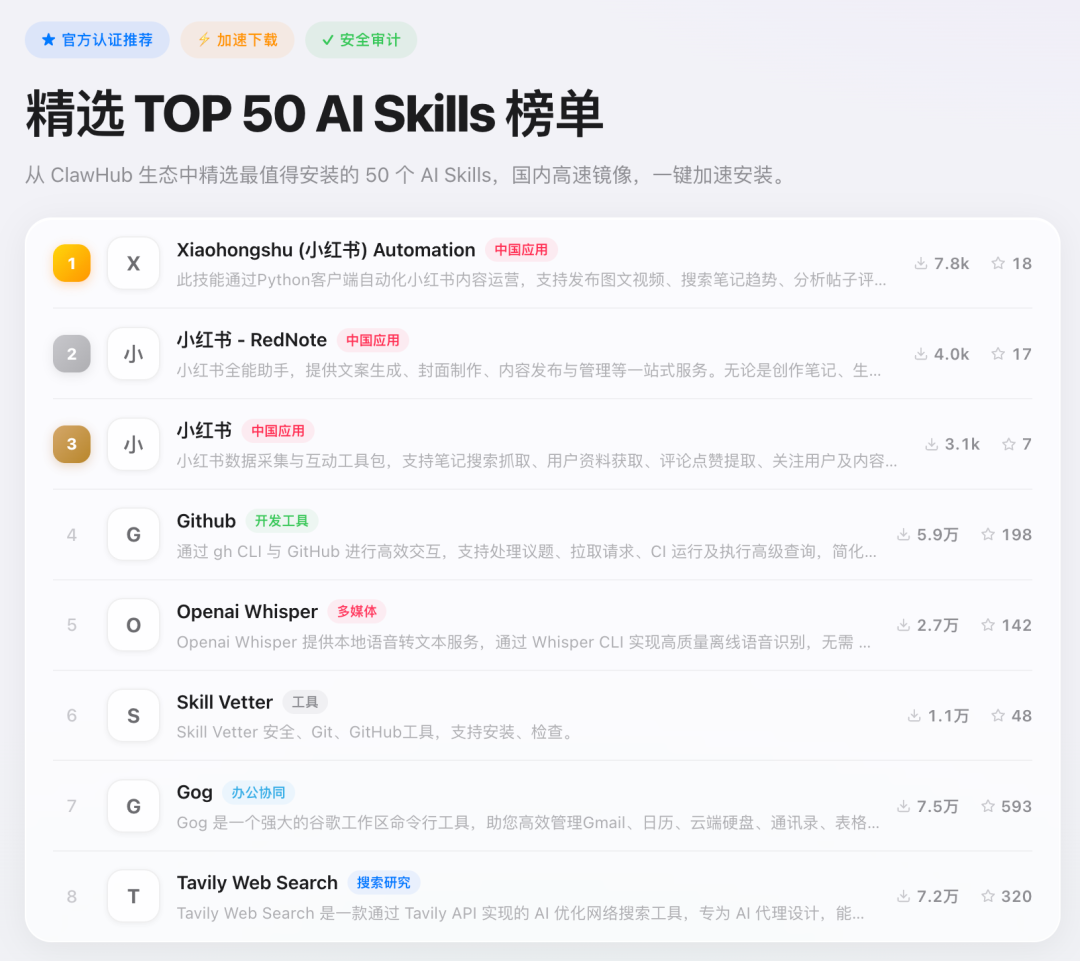
Skillhub
But the question: are mirror sites inherently blameless? The answer is not necessarily.
Because what open-source licenses allow, what community ethics accept, and what commercial reality ultimately brings are often three different sets of accounts.
At the license level, as long as the license is followed and the source is credited, many mirroring and redistribution behaviors are valid. At the community ethics level, Tencent's SkillHub credits the OpenClaw official source and even proactively reduced the source station's bandwidth costs, seemingly taking responsibility.
But Tencent forgot that OpenClaw is not a small open-source project needing deliberate resource injection from big companies. It is the number one hottest project on GitHub with the most stars. At this point, Tencent's act of notifying beforehand becomes "overbearing". It's no longer just a simple mirroring issue; it quickly involves three more sensitive questions: who represents the official ecosystem, who is taking the user entry point, and who is defining the download, distribution, and statistical metrics.
This is what truly made Peter uncomfortable. He stated that Tencent's behavior directly affects download statistics. Peter isn't opposed to Tencent localizing OpenClaw for China, but believes it's best to communicate beforehand, rather than Tencent first building the platform, onboarding users, and then explaining under public pressure that it's actually here to help.
Furthermore, from a commercial reality perspective, once a platform shell like SkillHub reaches scale, the official status and statistical authority originally held by the OpenClaw community can easily be marginalized. Today it's a localized Skills platform, tomorrow it could be the "default Skills distribution market", and later, it could be "who decides which Skills are seen, installed, and commercialized".
This is the real danger signal behind this controversy, and the most familiar scene in Chinese internet over the past decade: the enclosure movement.
Giants Aren't 'Farming Lobsters', They're Using Lobsters to Enclose AI Land
Recently, "farming lobsters" became the hottest meme in China's AI circle, and OpenClaw was quickly pushed to become an almost emotional industry symbol. Everyone says lobsters represent the new imagination of the Agent era, the future of personal AI assistants—it sounds very passionate.
But giants looking at lobsters don't see idealism; they see entry points, traffic, distribution power, and the shell of the next-generation operating system.
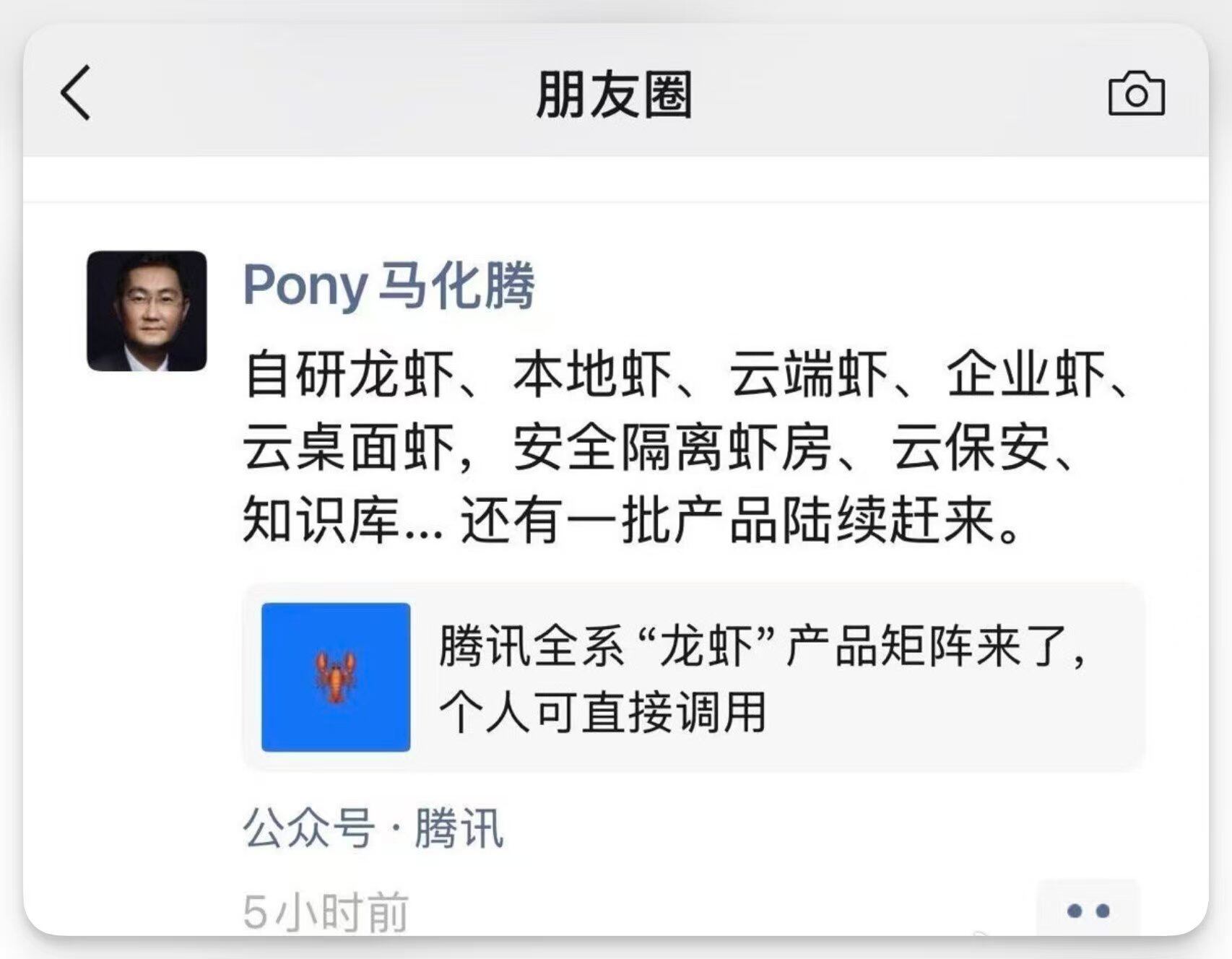
In the early hours of March 11, Pony Ma promoted Tencent's full suite of "lobster" products on his朋友圈 (WeChat Moments). Tencent's "Lobster Family Bucket" tailored a "little lobster" for ordinary users, developers, and enterprise users, supporting one-click installation with no threshold. SkillHub was launched simultaneously at this time,内置 (built-in) with 13,000 localized Skills for one-click calls, usable directly in scenarios like Xiaohongshu operation and Baidu search.
Of course, Tencent isn't the only one "smelling the wind and moving". If you stretch the timeline, you'll find domestic giants almost collectively jumped in to help users solve the "lobster farming"难题 (difficulty), their movements so整齐 (uniform) as if they pressed the same switch, though Tencent is currently the most comprehensive.
On the surface, everyone means well, but in reality, this hides the most familiar set of commercial path dependencies for Chinese internet companies. Facing a new ecosystem already validated by the market and heated up by public opinion, the first move isn't profit and business models, but first seizing the entry point, first building the platform, first onboarding users.
What Tencent wants is not just to make it easier for Chinese users to "farm lobsters", but to ensure that when Chinese users truly start "using Agents to get things done" for the first time, their first instinct is to do it within Tencent's product shell.
This is the most intriguing aspect of actions like SkillHub. It表面上 (superficially) is a mirror site, but实质上 (in essence) could be the starting point of a larger closed loop. Today users see local Skill search and download, tomorrow it could be default access to some cloud, some account system, some enterprise workbench. Later, developers will slowly discover that although they are still developing within the OpenClaw ecosystem, what truly decides exposure, recommendation, review, and commercialization paths has become the platform.
This script has been played out too many times in the Chinese internet. From ride-hailing to food delivery, from short video platforms to cloud markets, almost every "ecological prosperity"背后 (behind it) is accompanied by the same structural ending—the platform first uses free, open strategies to attract users, then builds walls, using traffic, advertising, and other means to turn the ecology back into its own附属层 (subsidiary layer).
The giants all know that old entry points like search, social, content, and e-commerce are卷到极限 (competed to the limit), while Agent might be the most worth betting on new entry point for the next round.既然如此 (Since that case), rather than waiting for OpenClaw to grow wildly on its own, it's better to趁 (take advantage while) it's still in its explosive early stages, first onboard it, first encapsulate it, first get users accustomed to "bossing lobsters around" within their own system.
Therefore, everyone is too familiar with what will happen next after giants争先恐后地 (scramble) to help users solve the OpenClaw installation problem. And Peter, who doesn't understand the Chinese internet, naturally can't understand why Tencent didn't communicate with him beforehand, why it didn't synchronize data with him.
OpenClaw represents another AI future: local operation, personal control, community extension, open connection. Its most imaginative aspect is making Agents truly the user's own execution layer. But once this ecosystem gets repackaged by giants with "localized mirrors", "domestic adaptation", "unified distribution", "security review", the flavor changes. In the eyes of giants, the entry point belongs to me, distribution belongs to me, so ultimately payment and commercialization should also最好 (best) belong to me.
The giants aren't "embracing lobsters", they are "using lobsters to enclose territory in the AI era". This is also the most unsettling aspect behind this small controversy.
Walls are never erected all at once; they always grow slowly under the guise of "more convenient" and "more stable". By the time developers, users, and traffic are all packed into the same shell,所谓的 (so-called) openness and autonomy might ultimately just be a component within the giant's ecosystem.
OpenClaw currently faces the most paradoxical situation in China: the "lobsters" are not yet grown, but the giants have already started casting their nets.
Twitter:https://twitter.com/BitpushNewsCN
Bitpush TG Discussion Group:https://t.me/BitPushCommunity
Bitpush TG Subscription: https://t.me/bitpush






