Lobsters Not Yet Grown, Giants Already Casting Nets: OpenClaw Ecosystem Faces Enclosure Crisis

比推Опубліковано о 2026-03-13Востаннє оновлено о 2026-03-13

Анотація

The article discusses the controversy surrounding Chinese tech giant Tencent's launch of SkillHub, a localized platform for the OpenClaw ecosystem. OpenClaw founder Peter Steinberger publicly accused Tencent of copying the project without providing support, specifically criticizing its impact on official download statistics. Tencent responded that SkillHub is a mirror site designed to serve Chinese users, citing reduced bandwidth strain on the official source and offering sponsorship. Steinberger countered that the core issue was not technical but a lack of prior communication and the risk of Tencent controlling user access and data. The author argues that the incident reflects a broader pattern of major Chinese tech companies exploiting open-source ecosystems for market dominance. While mirror sites are common in China, Tencent’s move is seen as an attempt to capture the user entry point and potential future commercialization of the Agent-based AI ecosystem represented by OpenClaw. The article warns that such platforms, under the guise of localization and convenience, may eventually lead to walled gardens where Tencent controls distribution, visibility, and monetization—echoing past strategies in sectors like ride-hailing and short-video platforms. The piece concludes that OpenClaw’s open, community-driven vision is at risk of being co-opted by corporate interests before it fully matures.

Author: Golem

Original Title: Free Mirror or Enclosure as King? OpenClaw Founder Slams Tencent for Copying


When domestic tech giants rushed to launch "one-click install OpenClaw", controversy followed.

On March 12, OpenClaw founder Peter Steinberger publicly questioned Tencent's creation of Skillhub on X, accusing it of reducing official speeds causing inability to fetch data quickly, and stating "they copy but do not support the project in any way".

Facing the controversy, Tencent quickly responded, expressing understanding of Peter Steinberger's concerns, stating that SkillHub is a localized Skills platform built by Tencent based on the OpenClaw ecosystem. As a local mirror site, it always credits ClawHub as the data source, and in its first week, handled 180GB of traffic (870,000 downloads) for users, pulling only 1GB of non-concurrent requests from the official source. Tencent also expressed willingness to become a sponsor.

Logically, Tencent's response should have clarified the issue most likely to cause public backlash—"whether it is excessively consuming the source station". But Peter was not satisfied after reading it, stating this was not the point. He could make SkillHub the official fifth mirror, synchronizing download statistics, but Tencent should have proactively communicated with him beforehand.

Although the matter ended here, understanding it merely as "the OpenClaw founder emotionally lashing out" or "a big company being misunderstood while doing normal localization" would be a shallow interpretation.

The Problem Isn't the Mirror, It's the Giants' 'Overbearingness'

If you only look at the technical actions, this is not unusual.

In China's developer ecosystem, mirroring open-source projects is a common practice. International open-source infrastructures like npm, PyPI, and Docker Hub all have numerous local mirrors in China. Precisely because of this, Tencent denied that its creation Skillhub was copying, but rather a localized Skills platform. It explained that it was not free-riding or draining the official site, but rather providing distribution, acceleration, and adaptation, helping OpenClaw land in China.

In a sense, Tencent's approach确实切中了 (indeed hit) the most practical needs of Chinese "lobster farmers". OpenClaw is unrealistically popular in China, but not everyone is willing or able to stably access the original community, let alone the fact that the installation, discovery, and retrieval experience for many Skills is still quite primitive.
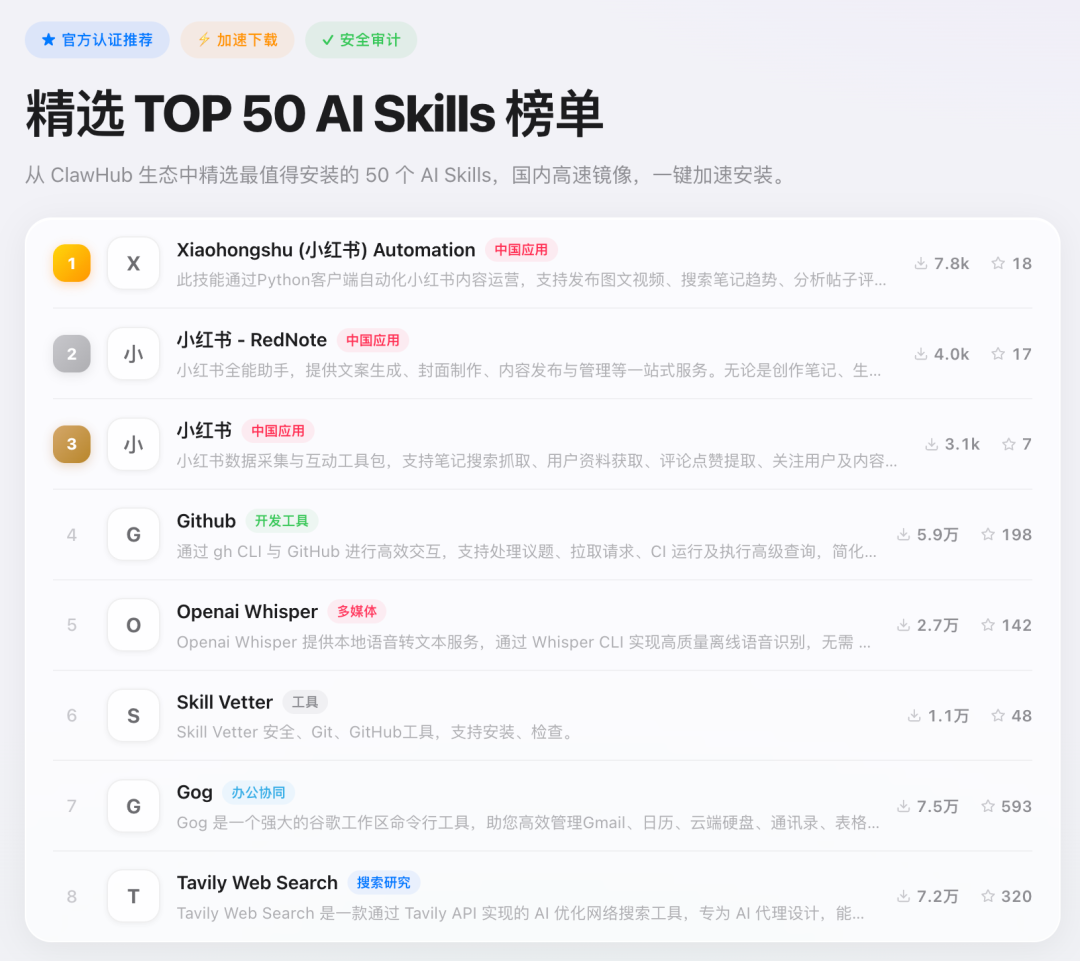
Skillhub

But the question: are mirror sites inherently blameless? The answer is not necessarily.

Because what open-source licenses allow, what community ethics accept, and what commercial reality ultimately brings are often three different sets of accounts.

At the license level, as long as the license is followed and the source is credited, many mirroring and redistribution behaviors are valid. At the community ethics level, Tencent's SkillHub credits the OpenClaw official source and even proactively reduced the source station's bandwidth costs, seemingly taking responsibility.

But Tencent forgot that OpenClaw is not a small open-source project needing deliberate resource injection from big companies. It is the number one hottest project on GitHub with the most stars. At this point, Tencent's act of notifying beforehand becomes "overbearing". It's no longer just a simple mirroring issue; it quickly involves three more sensitive questions: who represents the official ecosystem, who is taking the user entry point, and who is defining the download, distribution, and statistical metrics.

This is what truly made Peter uncomfortable. He stated that Tencent's behavior directly affects download statistics. Peter isn't opposed to Tencent localizing OpenClaw for China, but believes it's best to communicate beforehand, rather than Tencent first building the platform, onboarding users, and then explaining under public pressure that it's actually here to help.

Furthermore, from a commercial reality perspective, once a platform shell like SkillHub reaches scale, the official status and statistical authority originally held by the OpenClaw community can easily be marginalized. Today it's a localized Skills platform, tomorrow it could be the "default Skills distribution market", and later, it could be "who decides which Skills are seen, installed, and commercialized".

This is the real danger signal behind this controversy, and the most familiar scene in Chinese internet over the past decade: the enclosure movement.

Giants Aren't 'Farming Lobsters', They're Using Lobsters to Enclose AI Land

Recently, "farming lobsters" became the hottest meme in China's AI circle, and OpenClaw was quickly pushed to become an almost emotional industry symbol. Everyone says lobsters represent the new imagination of the Agent era, the future of personal AI assistants—it sounds very passionate.

But giants looking at lobsters don't see idealism; they see entry points, traffic, distribution power, and the shell of the next-generation operating system.

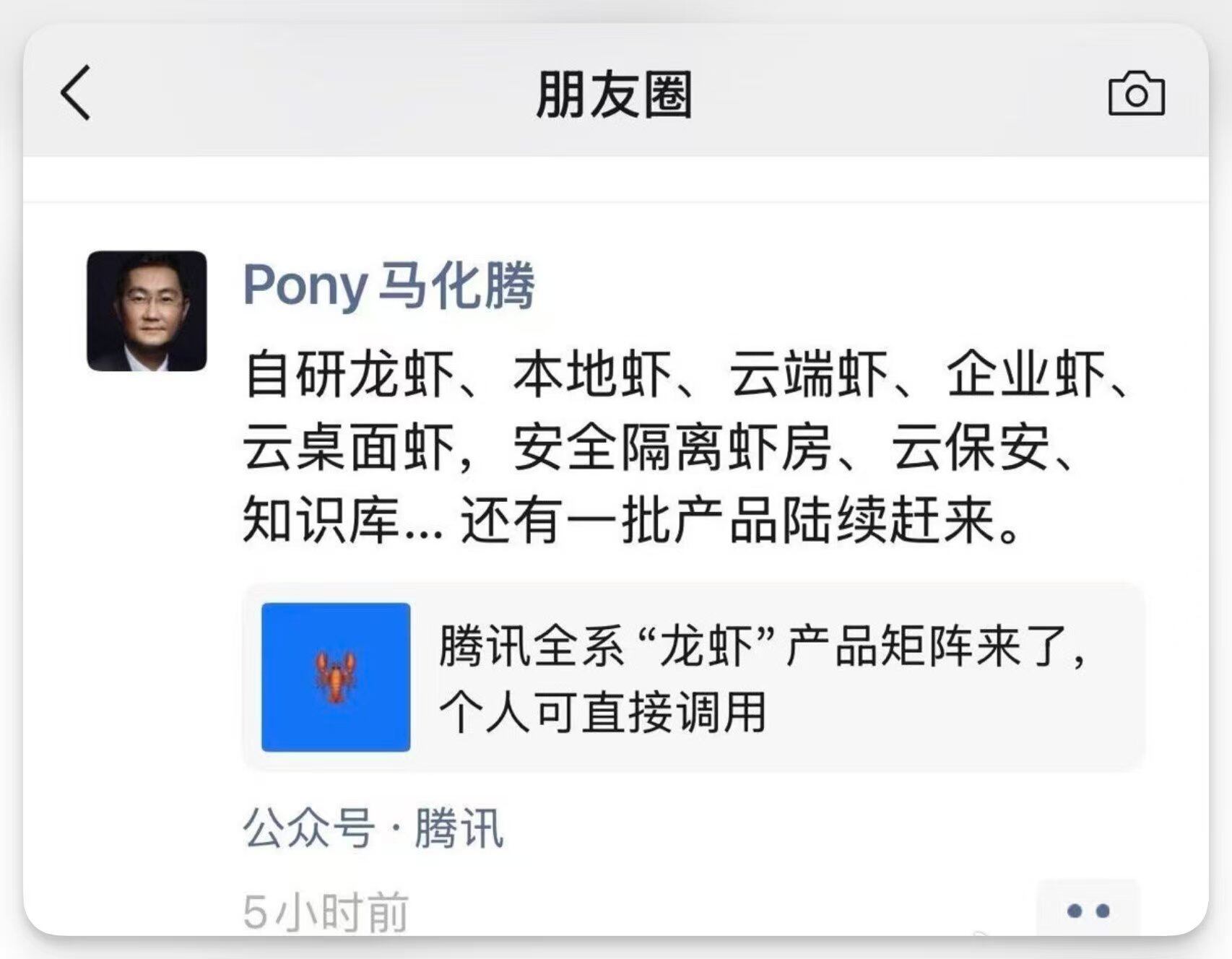
In the early hours of March 11, Pony Ma promoted Tencent's full suite of "lobster" products on his朋友圈 (WeChat Moments). Tencent's "Lobster Family Bucket" tailored a "little lobster" for ordinary users, developers, and enterprise users, supporting one-click installation with no threshold. SkillHub was launched simultaneously at this time,内置 (built-in) with 13,000 localized Skills for one-click calls, usable directly in scenarios like Xiaohongshu operation and Baidu search.
Of course, Tencent isn't the only one "smelling the wind and moving". If you stretch the timeline, you'll find domestic giants almost collectively jumped in to help users solve the "lobster farming"难题 (difficulty), their movements so整齐 (uniform) as if they pressed the same switch, though Tencent is currently the most comprehensive.

On the surface, everyone means well, but in reality, this hides the most familiar set of commercial path dependencies for Chinese internet companies. Facing a new ecosystem already validated by the market and heated up by public opinion, the first move isn't profit and business models, but first seizing the entry point, first building the platform, first onboarding users.

What Tencent wants is not just to make it easier for Chinese users to "farm lobsters", but to ensure that when Chinese users truly start "using Agents to get things done" for the first time, their first instinct is to do it within Tencent's product shell.

This is the most intriguing aspect of actions like SkillHub. It表面上 (superficially) is a mirror site, but实质上 (in essence) could be the starting point of a larger closed loop. Today users see local Skill search and download, tomorrow it could be default access to some cloud, some account system, some enterprise workbench. Later, developers will slowly discover that although they are still developing within the OpenClaw ecosystem, what truly decides exposure, recommendation, review, and commercialization paths has become the platform.

This script has been played out too many times in the Chinese internet. From ride-hailing to food delivery, from short video platforms to cloud markets, almost every "ecological prosperity"背后 (behind it) is accompanied by the same structural ending—the platform first uses free, open strategies to attract users, then builds walls, using traffic, advertising, and other means to turn the ecology back into its own附属层 (subsidiary layer).

The giants all know that old entry points like search, social, content, and e-commerce are卷到极限 (competed to the limit), while Agent might be the most worth betting on new entry point for the next round.既然如此 (Since that case), rather than waiting for OpenClaw to grow wildly on its own, it's better to趁 (take advantage while) it's still in its explosive early stages, first onboard it, first encapsulate it, first get users accustomed to "bossing lobsters around" within their own system.

Therefore, everyone is too familiar with what will happen next after giants争先恐后地 (scramble) to help users solve the OpenClaw installation problem. And Peter, who doesn't understand the Chinese internet, naturally can't understand why Tencent didn't communicate with him beforehand, why it didn't synchronize data with him.

OpenClaw represents another AI future: local operation, personal control, community extension, open connection. Its most imaginative aspect is making Agents truly the user's own execution layer. But once this ecosystem gets repackaged by giants with "localized mirrors", "domestic adaptation", "unified distribution", "security review", the flavor changes. In the eyes of giants, the entry point belongs to me, distribution belongs to me, so ultimately payment and commercialization should also最好 (best) belong to me.

The giants aren't "embracing lobsters", they are "using lobsters to enclose territory in the AI era". This is also the most unsettling aspect behind this small controversy.

Walls are never erected all at once; they always grow slowly under the guise of "more convenient" and "more stable". By the time developers, users, and traffic are all packed into the same shell,所谓的 (so-called) openness and autonomy might ultimately just be a component within the giant's ecosystem.

OpenClaw currently faces the most paradoxical situation in China: the "lobsters" are not yet grown, but the giants have already started casting their nets.


Twitter:https://twitter.com/BitpushNewsCN

Bitpush TG Discussion Group:https://t.me/BitPushCommunity

Bitpush TG Subscription: https://t.me/bitpush

Original link:https://www.bitpush.news/articles/7619504

Пов'язані питання

QWhat was the main criticism that OpenClaw founder Peter Steinberger raised against Tencent's SkillHub?

APeter Steinberger criticized Tencent for creating SkillHub without prior communication, which he viewed as copying the OpenClaw ecosystem. He was particularly concerned that it affected official download statistics and that Tencent did not support the project in any way despite using its resources.

QHow did Tencent respond to the allegations made by the OpenClaw founder?

ATencent responded by stating that SkillHub is a localized Skills platform based on the OpenClaw ecosystem, acting as a mirror site that always credited ClawHub as the data source. They claimed to have handled 180GB of traffic for users in the first week while only pulling 1GB of non-concurrent requests from the official source. Tencent also expressed willingness to become a sponsor.

QAccording to the article, what is the deeper concern beyond the technical aspects of mirroring OpenClaw?

AThe deeper concern is that large companies like Tencent are not just mirroring OpenClaw but are engaging in a 'land grab' for the AI ecosystem. This involves controlling user entry points, distribution channels, and eventually commercialisation, which could marginalise the original OpenClaw community's authority and statistics.

QWhat does the article suggest about the ultimate goal of Chinese tech giants in adopting OpenClaw?

AThe article suggests that Chinese tech giants are using OpenClaw to secure entry points, traffic, distribution rights, and the framework for the next-generation operating system. Their goal is to integrate users into their own ecosystems early on, potentially leading to control over exposure, recommendations, and commercialisation paths in the future.

QWhat historical pattern in Chinese internet companies does the article reference to explain the current situation with OpenClaw?

AThe article references a historical pattern where Chinese internet companies first attract users with free and open services, then gradually build walls around the ecosystem using traffic and advertising to turn it into their subsidiary layer. This has been seen in sectors like ride-hailing, food delivery, short-video platforms, and cloud markets.

Пов'язані матеріали

Apple Also Has to Pay Rent Now

Apple Pays Rent Too: The Two-Way Flow of "Traffic Tax" and "AI Capability Rent" Between Tech Giants For over two decades, Google has paid Apple an estimated $20 billion annually to remain the default search engine on Safari, a "traffic tax" for a critical user entry point. However, in 2026, the direction of this cash flow partially reversed. Apple agreed to pay Google roughly $1 billion per year to license its Gemini AI models, as Apple's own models reportedly struggled with complex tasks. This creates a unique dynamic: Apple acts as the "landlord" in the established search ecosystem, collecting rent from Google for access. Simultaneously, in the emerging AI arena, Apple becomes the "tenant," paying Google for access to cutting-edge AI capabilities it cannot currently match internally. While Apple claims its new models are "distilled" from Gemini outputs and contain "not a drop" of Google's original code, core dependencies remain. Its knowledge base is refined using Gemini's outputs, and its most powerful cloud model runs on Google's infrastructure. Apple has structured the deal as non-exclusive, allowing it to theoretically switch AI suppliers—a hedge against over-reliance. The future hinges on whether advanced AI models become a commodity (cheap and abundant) or remain a concentrated, scarce resource (expensive and controlled by few). Apple is betting on the former, leveraging its massive device ecosystem to be a powerful, choosy customer. If the latter proves true, its bargaining power could erode. This power dynamic is extending to developers. Apple, Google, and WeChat are all pushing for apps to expose their core functions as standardized "actions" or "intents" that their respective AI assistants (Siri, Gemini, WeChat AI) can directly call. The new scarce resource is no longer just app store visibility, but "being selected by the AI." The currency of "rent" has changed from a 30% revenue share to ceding control over how users interact with an app's functions.

marsbit5 хв тому

Apple Also Has to Pay Rent Now

marsbit5 хв тому

Missed the SpaceX IPO? WEEX's "First Trade Protection" Lets You Experience US Stock Trading Risk-Free.

With the excitement around SpaceX's recent public listing reigniting interest in the US stock market, Chinese investors face significant challenges accessing compliant and convenient trading channels following regulatory actions against major online brokers. This article explores the available options, highlighting their risks and limitations. Traditional paths for US stock investments remain problematic. Qualified Domestic Institutional Investor (QDII) and Listed Open-Ended Fund (LOF) products, while compliant, suffer from high fees, significant purchase premiums, and a very limited selection of assets. Small, unregulated offshore brokers pose substantial risks, including potential insolvency. While secure, VIP accounts at banks in Hong Kong or Singapore require high minimum deposits (often 1-2 million RMB) and in-person visits, placing them out of reach for most retail investors. The article positions cryptocurrency exchanges, specifically their TradFi (traditional finance on-chain) offerings, as a compelling alternative. Platforms like WEEX are noted for providing access to a wide range of US stocks and ETFs, including SpaceX (SPCXON), through tokenized assets. This method offers advantages such as a single account for both crypto and traditional assets, USDT-based settlement avoiding fiat complexities, flexible leverage, and robust risk management. To attract users, WEEX is promoting a "First Trade Guarantee" campaign. Running from June 15 to July 8 (UTC+8), it features a $30,000 prize pool. Users who trade $500 worth of US stock contracts can qualify for a guarantee on their first eligible trade: 100% loss coverage up to $30 or a 20% bonus on profits up to $30. The campaign is presented as a low-risk opportunity for both crypto natives and traditional investors to experience US stock trading.

marsbit7 хв тому

Missed the SpaceX IPO? WEEX's "First Trade Protection" Lets You Experience US Stock Trading Risk-Free.

marsbit7 хв тому

How Difficult is Chip Making? A Division Error Costs 475 Million Dollars

How Hard Is It to Make a Chip? A Division Error Cost $475 Million Chip expert Shi Kan, a researcher at the Chinese Academy of Sciences and a popular tech creator, explains the immense challenges of chip development. Chips are foundational to modern technology, but their creation is extraordinarily difficult. The journey from sand to a functional chip involves complex design and manufacturing, but a critical bottleneck is verification—ensuring the design works flawlessly before costly production. A single, undetected bug can have catastrophic consequences, as illustrated by the infamous 1994 Intel Pentium FDIV bug. A flaw in the floating-point division unit forced a recall costing $475 million. Unlike software, chips cannot be easily patched after manufacture, making "first-time success" paramount. However, industry surveys show only 24% of chip projects achieve this; over three-quarters require at least one costly re-spin due to design flaws. Verification has thus become the dominant phase, consuming up to 70% of the design cycle. The core challenge is a "verification impossible triangle" between high performance, good debuggability, and low cost. Exhaustively verifying a modern CPU core could take 15,000 years with software simulation, or 30 years with advanced hardware emulation—timeframes utterly impractical for development. Despite being essential, verification is often seen as unglamorous "dirty work," receiving less academic attention than fields like AI. Shi and his team are tackling this by developing an agile verification research framework called ENCORE, based on FPGA technology, to improve verification efficiency and debug capability. Beyond research, Shi engages in public science communication through long-form video content, aiming to demystify chip technology, AI, and computer science. He argues for the value of pursuing "hard and long-term" endeavors, whether in the meticulous world of chip verification or in creating substantive educational content, believing such sustained effort is likely the right path forward.

marsbit16 хв тому

How Difficult is Chip Making? A Division Error Costs 475 Million Dollars

marsbit16 хв тому

Blockchain Has Finally Started to Sail into the Mainstream After 18 Years

Blockchain Finds Its True Path After 18 Years: Becoming the Financial Backbone for AI Agents and Autonomy This analysis explores a pivotal shift in the blockchain and crypto investment landscape, driven by the dominance of AI. Major venture capital firms, including Variant, Paradigm, Haun Ventures, and YZi Labs, are moving beyond pure "crypto" investment theses. They are expanding their focus to AI, robotics, and frontier tech, signaling that blockchain is no longer seen as a standalone sector but as an underlying infrastructure layer. The core argument is that blockchain's killer application may not be user-facing apps, but rather providing the economic rails for the coming wave of AI agents, autonomous robots, and automated systems. Key capabilities like self-custody wallets, programmable stablecoins for micropayments, on-chain identity, and verifiable smart contracts are positioned as essential for a future where machines conduct economic activity. The recent $1.4 billion investment by Tether (via its venture arm) in German robotics company NEURA Robotics exemplifies this, aiming to embed Tether's wallet tools directly into robots for autonomous transactions. While many "AI + Crypto" projects remain superficial, the article concludes that true value lies where crypto is a necessary component—enabling machine-to-machine payments, agent autonomy, verifiable data provenance, and open financial settlement for the AI era. For crypto venture capital, this convergence with AI represents both an adaptation to shifting capital flows and a potential path to unlocking the large-scale, non-speculative utility the industry has long sought.

marsbit37 хв тому

Blockchain Has Finally Started to Sail into the Mainstream After 18 Years

marsbit37 хв тому

Торгівля

Спот
Ф'ючерси
活动图片