LEO crypto slides 25%, nears 2-year low: Rebound possible ONLY IF…

ambcryptoОпубліковано о 2025-12-18Востаннє оновлено о 2025-12-18

Анотація

LEO has plummeted 25% in 24 hours, erasing its yearly gains and nearing a critical two-year low. With its market cap at $6.26 billion, the token faces intense selling pressure as bearish sentiment surged from 28% to 86% among investors. A key demand zone from mid-2024 is the next major support level. If broken, prices could fall to 2022 lows. However, technical indicators like the positive Accumulation Distribution and oversold Money Flow Index suggest the sell-off may be corrective. This hints at a potential rebound once selling pressure subsides, though the timing remains uncertain.

Unus Sed Leo [LEO] has emerged as the biggest loser in the market over the past 24 hours. The token, with a market capitalization of $6.26 billion, saw its value drop by 25% at press time.

Market sentiment suggests that the current outlook could further accelerate the decline, with the asset at risk of falling well below levels established over the past 730 days.

LEO wipes out gains

LEO has wiped out its accumulated gains from the past year and has now turned negative, posting a notable deficit.

The decline became more pronounced over the past 48 hours, as investors positioned against a potential rally and broadly shifted to a bearish stance.

Community sentiment data shows that among 30,200 investors, bullish sentiment dropped sharply from 72% on the 15th of December to just 14% at the time of writing.

With a significant 58% of investors selling, the impact has been far from negligible. This pressure has already been reflected in the spot market, which has seen minimal activity over time but still recorded a $47,000 sell-off.

A further decline could take shape if more investors turn bearish on the chart.

How deep could the decline go?

Despite the recent drop wiping out its entire 2025 gains, market analysis shows that LEO’s 2024 gains are now also at risk.

The chart shows that LEO is only one demand zone away from retesting its 2024 price level.

This demand zone, highlighted by a blue rectangle, acted as a consolidation area between March and November 2024. After that period of consolidation, the asset eventually broke out.

Typically, unfilled orders tend to remain within such zones, which could act as a potential catalyst if price retraces into this area.

However, if selling momentum intensifies, LEO could extend its decline beyond this level, placing 2024 prices as the next phase, with a revisit of the 2022 low not ruled out.

Cautious, but not fully bearish

To assess the likelihood of a move into the previously identified demand zone, AMBCrypto examined trends across key technical indicators.

The indicators suggest that the market remains cautious rather than outright bearish, leaving room for a potential rebound.

The Accumulation Distribution (AD) indicator has declined over the past day, slipping to 6.68 million, as of writing, its lowest level since the 16th of June.

Despite the dip, the indicator remains in positive territory, suggesting that the current selling phase appears corrective and that bulls still maintain overall control.

Further clarity comes from the Money Flow Index (MFI), which measures whether liquidity inflows signal buying or whether outflows indicate selling pressure.

The MFI has dropped into oversold territory, falling below the 20 mark. Historically, this level signals seller exhaustion and has often preceded market rebounds.

While the chart does not point to a specific rebound timeline and prices could still trend lower, the indicators suggest an increased likelihood of a faster recovery once selling pressure eases.


Final Thoughts

  • LEO investors have begun backing out as a majority turn bearish and place sell pressure on the asset.
  • Technical structures show that LEO is one key support zone away from marking a two-year low, as bearish sentiment continues to build.

Пов'язані питання

QWhat was the percentage drop in LEO's value over the past 24 hours, and what is its current market capitalization?

ALEO's value dropped by 25% over the past 24 hours, and its current market capitalization is $6.26 billion.

QAccording to community sentiment data, what was the change in bullish sentiment from December 15th to the time of writing?

ABullish sentiment among investors dropped sharply from 72% on December 15th to just 14% at the time of writing.

QWhat is the current level of the Accumulation Distribution (AD) indicator, and what does its positive value suggest?

AThe Accumulation Distribution (AD) indicator has declined to 6.68 million, its lowest level since June 16th. However, it remains in positive territory, suggesting the selling is corrective and that bulls still maintain overall control.

QWhat does the Money Flow Index (MFI) falling below the 20 mark historically signal for the market?

AThe Money Flow Index (MFI) falling below the 20 mark indicates the market is in oversold territory. Historically, this level signals seller exhaustion and has often preceded market rebounds.

QWhat is the key factor that could act as a potential catalyst for LEO's price if it retraces into the blue rectangle demand zone?

AThe key factor is that unfilled orders tend to remain within such consolidation zones, which could act as a potential catalyst for the price if it retraces into that area.

Пов'язані матеріали

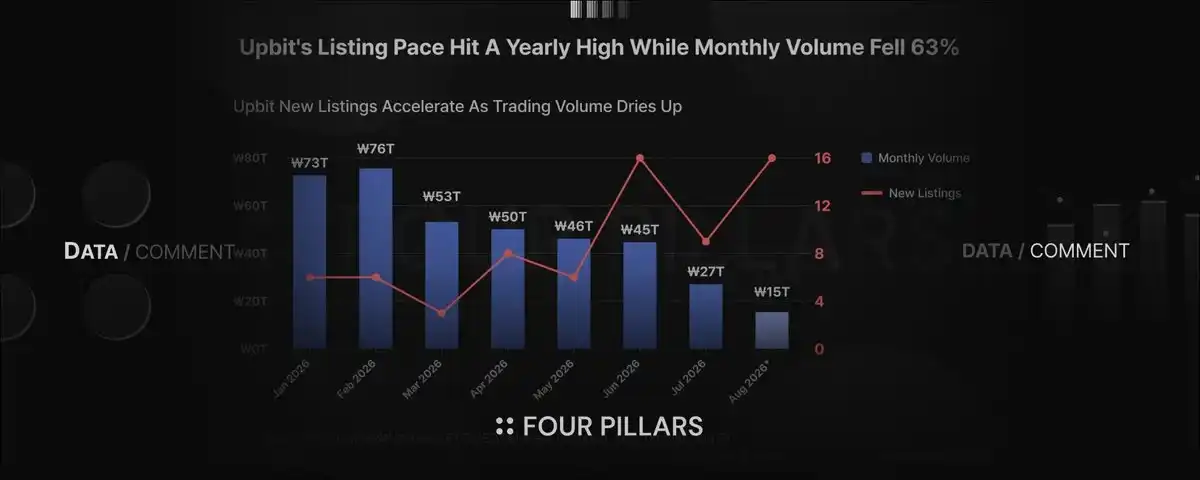
Upbit Accelerates Token Listings: Total Trading Volume Halved, New Tokens Support Nearly 30% Share

In the second half of 2026, Upbit significantly accelerated its pace of listing new cryptocurrencies, even as the overall Korean won-denominated trading market cooled rapidly. Monthly trading volume on Upbit plunged 63%, from KRW 72.7 trillion in January to KRW 27.1 trillion in July, with Bitcoin prices also falling. Contrary to the conventional logic of listing more during bull markets, Upbit intensified new listings during this downturn. New listings have become a crucial lever for Upbit to sustain trading activity in a bear market. By August, 61 new tokens listed in 2026 were collectively contributing nearly 30% of Upbit's total won trading volume, up from just 5% in January. This means roughly a quarter of the platform's fee revenue now comes from these newly listed assets. Standout performers like CHIP, RE, SLX, and CAP achieved significant individual market share shortly after listing, while new stablecoin listings contributed negligible volume. This strategy highlights a shift: the "Upbit listing premium," once a sought-after event to attract new capital, is increasingly used as a defensive tool to stabilize fee income amid shrinking overall volume. While the premium effect persists, indicating remaining genuine demand, its frequent use risks diluting the long-term strategic value and scarcity of Korean won liquidity access. Upbit's approach reflects a broader challenge for Asian centralized exchanges: relying on short-term listing tools to maintain operations during macro weakness, potentially at the cost of eroding long-term competitive foundations.

marsbit14 хв тому

Upbit Accelerates Token Listings: Total Trading Volume Halved, New Tokens Support Nearly 30% Share

marsbit14 хв тому

Торгівля

Спот
活动图片