Lens and Farcaster "Change Hands": Can the Second Venture of On-Chain Social Break Through?

比推Опубліковано о 2026-01-23Востаннє оновлено о 2026-01-23

Анотація

Two leading decentralized social protocols, Lens and Farcaster, have both undergone significant leadership changes this week. Lens, originally developed under Avara (Aave’s parent company), has transitioned to Mask Network, which aims to usher in a “product-centric” era for the protocol. Shortly after, Farcaster’s co-founder announced that infrastructure provider Neynar is acquiring Farcaster’s apps, protocol, and tech stack, with a renewed “developer-first” focus. While both Mask and Neynar possess deep expertise in their respective protocols, the broader challenge remains: achieving mass adoption and sustainable user engagement. Ethereum co-founder Vitalik Buterin commented on the shift, emphasizing the need for social tools that serve long-term user interests rather than short-term engagement. He advocates for decentralized social networks built on shared data layers with diverse clients and cultures. The success of these platforms hinges on creating overlapping “public squares” that foster innovation, community, and user agency. The new stewards now face the task of turning decentralized social ideals into engaging, daily-use realities—moving from theoretical potential to practical, culturally-rich ecosystems.

Source: Bankless

Author: William M. Peaster

Compilation and arrangement: BitpushNews


The landscape of Web3 consumer applications is undergoing dramatic changes.

Over the past few years, the two flagship on-chain social projects—Farcaster and Lens—both experienced a change in "leadership" this week.

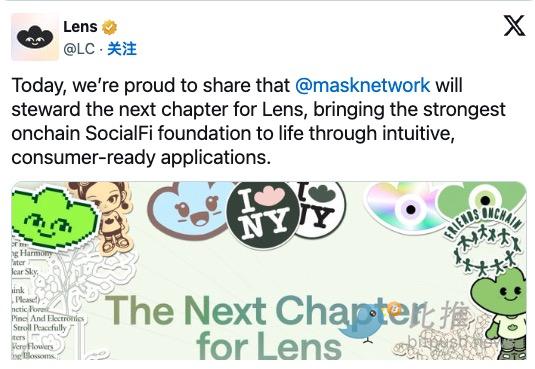
A New Chapter for Lens

Avara (the parent company of Aave and Lens) just announced the transfer of the Lens protocol's management rights to Mask Network. The Mask team, with its rich experience, has previously developed on-chain social applications like Firefly and Orb. Avara will now focus entirely on DeFi business, while Mask's goal is to usher in a "product-centric" new era for Lens.
Farcaster Follows Suit

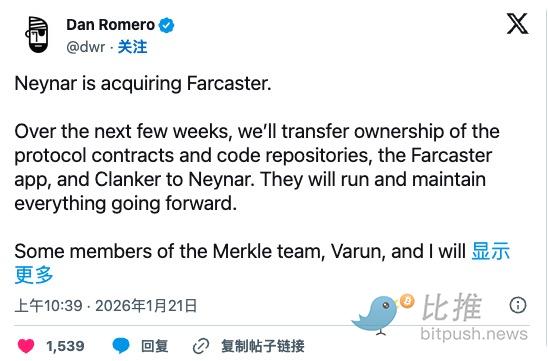
Just a day after the Lens news broke, Farcaster co-founder Dan Romero announced that Neynar, an infrastructure provider for Farcaster, is acquiring Farcaster's applications, protocol, and the Clanker tech stack. The original startup leadership team of Farcaster will not be joining the new company, but Neynar stated they are committed to reshaping the project into a "developer-first" social network.
Weighing the Pros and Cons

Mask knows Lens inside and out, and Neynar understands every detail of Farcaster. These two teams are undoubtedly among the top developers and thinkers in the on-chain social space. In the long run, Lens and Farcaster seem to be in the most capable hands.

However, the road ahead is far from smooth.

So far, on-chain social projects have struggled to become mass social networks with "gravitational mass." If this goal had been achieved, today's change of hands wouldn't have happened. Clearly, there are still some elements missing in the underlying structure, making some degree of "reboot" inevitable. Whether these changes can break through the bottlenecks and achieve lasting user retention remains to be seen.

Regarding the news of Lens's change of hands, Ethereum founder Vitalik Buterin (V God) shared his perspective. He wrote:

"What we need are social tools that serve the long-term interests of users, not just extract short-term engagement. [...] Decentralization is the way to achieve this: through a shared data layer, anyone can build their own client on top of it."

"But crypto social projects have tended to go the wrong way in the past. [...] Mixing 'money' and 'social' isn't inherently wrong: Substack has proven it's possible to build an economic system that supports high-quality content. But Substack's core is about subscribing to creators, not creating price bubbles around them."

"Decentralized social should be run by people who deeply believe in the essence of 'social' and are primarily driven by solving social problems. [...] I'm excited about Lens's development next year because I think the new team taking over is genuinely interested in 'social' itself."

"I encourage everyone to invest more time this year in Lens, Farcaster, and the broader decentralized social world. We need to move beyond the state where everyone is constantly tweeting in a global 'information war zone' and enter a reopened frontier where better, more novel forms of interaction become possible."

The Bigger Picture

For Lens and Farcaster, the key to this game lies in cultivating multiple overlapping "public squares"—connected by shared data but differentiated by different clients and cultures.

This diversity can foster innovation, innovation leads to more social interaction, social interaction attracts more users, which in turn drives more innovation, creating a virtuous cycle. Getting this "flywheel" spinning remains the core challenge.

Mask and Neynar seem ready to take on this task, and I am optimistic about their performance in their new roles. If you want to support their second launch and heed Vitalik's call, a great starting point is to try the Firefly application developed by Mask. It allows you to access platforms like X (Twitter), Farcaster, and Lens simultaneously without manually republishing content.

Looking Ahead

Crypto social is not dead. However, for the leaders of this new phase to successfully open a second chapter, they need to reflect on what worked and what didn't in the first chapter and iterate continuously based on that.

Overall, we have moved from the "what if" stage to the "what now" stage. In this sense, what Mask and Neynar have taken over is not just protocols, but also a mission: to transform decentralization from an abstract ideal into something many people are truly willing to spend time immersed in.

This is no easy task. But if these teams can continue to nurture lasting communities with unique cultures while empowering users with more agency in new ways, they have a chance to go far. Now, let's wait and see if they can truly realize this vision.


Twitter:https://twitter.com/BitpushNewsCN

Bitpush TG Discussion Group:https://t.me/BitPushCommunity

Bitpush TG Subscription: https://t.me/bitpush

Original link:https://www.bitpush.news/articles/7605336

Пов'язані питання

QWhat major changes occurred in the management of Lens and Farcaster this week?

AAvara, the parent company of Aave and Lens, transferred the governance of the Lens protocol to Mask Network. Simultaneously, Farcaster's infrastructure provider Neynar acquired Farcaster's applications, protocol, and the Clanker tech stack, with the original founding team stepping down.

QAccording to Vitalik Buterin, what is the core problem with past crypto social projects?

AVitalik Buterin stated that past crypto social projects often went wrong by mixing 'money' and 'social' in a way that created price bubbles around creators, rather than focusing on building an economic system that supports high-quality content, similar to Substack's subscription model.

QWhat is the key challenge for Lens and Farcaster in their new phase of development?

AThe core challenge is to get the 'flywheel' effect spinning: cultivating multiple overlapping 'public squares' connected by shared data but differentiated by different clients and cultures, which can drive innovation, more social interaction, user growth, and further innovation.

QWhich application is recommended as a good starting point to support the new initiatives of Mask and Neynar?

AMask's Firefly application is recommended, as it allows users to access platforms like X (Twitter), Farcaster, and Lens simultaneously without manually reposting content.

QWhat overall shift in phase does the article describe for crypto social projects?

AThe article describes a shift from the 'what if' phase to the 'what now' phase, where the new leaders must reflect on what worked and what didn't in the first chapter, iterate continuously, and transform decentralization from an abstract ideal into something people genuinely want to immerse their time in.

Пов'язані матеріали

Winter for Crypto IPOs: Consensys and Ledger Withdraw Applications

The crypto IPO window is tightening significantly in 2026, marked by prominent companies delaying or pausing their public listing plans. Following a successful 2025 "harvest year" that saw Circle, Bullish, and Gemini go public amidst a bull market, the tide has turned. Consensys, developer of MetaMask, recently postponed its IPO until at least fall 2026. Hardware wallet leader Ledger also suspended its planned US listing due to unfavorable market conditions, with Kraken having previously delayed its own plans. This shift is driven by a cooling market in 2026, characterized by a significant Bitcoin price correction, declining trading volumes, and reduced investor risk appetite for crypto stocks. The poor post-IPO performance of 2025 listings like Circle and Bullish, which saw major share price declines, has heightened investor caution. This contrasts sharply with the current AI sector, where companies like SpaceX, OpenAI, and Anthropic are commanding massive valuations and investor enthusiasm based on narratives of stable, exponential growth. Crypto companies now face pressure to transition from hype-driven models to demonstrating reliable cash flows and robust compliance. While the paused IPO plans may lead to valuation resets and affect ecosystem liquidity, they also accelerate industry consolidation toward stronger, more compliant infrastructure players. A potential recovery in Bitcoin's price and clearer regulations could reopen the IPO window in the latter half of 2026.

marsbit1 год тому

Winter for Crypto IPOs: Consensys and Ledger Withdraw Applications

marsbit1 год тому

ChatGPT Can Manage Your Money for You. Would You Trust It with Your Bank Account?

OpenAI has launched a personal finance tool for ChatGPT, currently in preview for US-based ChatGPT Pro users. This feature allows users to connect their bank and investment accounts (via Plaid, supporting over 12,000 institutions) directly to ChatGPT. It analyzes transactions, generates visual dashboards, and offers conversational financial advice—such as budgeting or planning for major purchases—based on the user's actual data. This move follows OpenAI's acquisitions of fintech startups Roi and Hiro Finance, signaling a strategic push into vertical "super assistant" applications, similar to its earlier health-focused feature. However, the launch has sparked significant privacy concerns. Critics question the safety of granting such sensitive financial access to an AI, especially amid ongoing lawsuits alleging OpenAI shared user chat data with third parties like Meta and Google. OpenAI emphasizes that ChatGPT only reads data (no transaction capabilities), deletes it within 30 days if disconnected, and offers opt-out options for model training. Yet, trust remains a major hurdle. The trend reflects a broader industry shift: AI companies like Anthropic and Perplexity are also targeting high-value, data-rich domains like finance and health. While technically promising, the tool operates in a regulatory gray area—it provides personalized guidance but disclaims formal financial advice or liability. Ultimately, OpenAI's challenge is convincing users to trust an AI with their most private financial information.

marsbit1 год тому

ChatGPT Can Manage Your Money for You. Would You Trust It with Your Bank Account?

marsbit1 год тому

Торгівля

Спот
Ф'ючерси
活动图片