Lazy Person's Guide to Wealth Management|Cap Announces Stablecoin Airdrop, New Pool APY Rises; hyENA Increases LP Quota (January 22)

Odaily星球日报Опубліковано о 2026-01-22Востаннє оновлено о 2026-01-22

Анотація

Lazy Investor's Guide: Cap Announces Stablecoin Airdrop, New Pools Offer High APY; hyENA Increases LP Quota (Jan 22) This article covers low-risk, stablecoin-focused yield opportunities for crypto investors. Key updates include: - **Exchange-based options**: Binance’s USD1 deposit campaign is ending, but Bitget’s collaboration with Arbitrum Morpho offers 9.2% APY on USDC/USDT with high liquidity (up to $400k per user). Limited-time high-yield campaigns like Unitas (37.04% APY) are also noted. - **On-chain Strategy 1: Pendle Cap LP**: Following Cap’s announcement of a cUSD stablecoin airdrop (Stabledrop) and new Homestead incentives, Pendle pools offer high yields. The cUSD LP yields up to 24.73% APY (with PENDLE staking) and 20x Cap points. The stcUSD LP offers up to 123% APY (likely to decay) and 5x points. - **On-chain Strategy 2: Exponent & RateX ONyc LP**: Onre’s insured stablecoin ONyc offers ~30.89% APY on Exponent (with Onre incentives, may drop to ~20%) and ~25% on RateX (with RTX rewards). Both offer bonus积分 multipliers. - **On-chain Strategy 3: hyENA LP**: Ethena’s hyENA increased its LP cap to $40M. While base APY is modest (~4.86%), it offers 70x Ethena points and 5x Upshift points, appealing for long-term Ethena supporters. Always consider smart contract and platform risks when participating in DeFi strategies.

Original | Odaily Planet Daily (@OdailyChina)

Author | Azuma (@azuma_eth)

This column aims to cover low-risk yield strategies in the current market, primarily involving stablecoins (and their derivative tokens) (Odaily Note: code risk can never be eliminated), to help users who wish to gradually grow their capital through U-based wealth management find relatively ideal interest-earning opportunities.

  • Odaily Note: For past records, please refer to "Lazy Person's Wealth Management Restart|Ethereal Earns 27% APR While Farming Points; Huma Opens New 28% APY God Pool (January 6)".

Exchange Wealth Management

The previous issue mentioned Binance's USD1 deposit event and OKX Pay's USDG holding interest event. The former is about to end, while the latter has relatively limited capacity (capped at 10,000 USDG).

For friends who still wish to manage wealth directly on exchanges, consider Bitget's collaboration with Arbitrum Morpho for the on-chain earn event. With platform subsidies, the flexible APY for USDC and USDT can reach 9.2%. The advantage of this event is its large capacity (single account, single currency up to $400,000, with deposits and withdrawals at any time). The drawback is the additional layer of security risk from on-chain protocols. Participate based on your risk tolerance.

Another popular wealth management opportunity is various deposit events in the Binance Wallet, such as yesterday's Unitas (real-time APY 37.04%). However, these usually have limits, and slots are highly competitive. It is recommended to keep an eye on announcements and set reminders to participate.

On-Chain Strategy One: Pendle Cap LP (Up to 123% APY + Points)

On January 19, the stablecoin project Cap announced its 1CO and Stabledrop plan. The so-called Stabledrop means Cap will airdrop users who participated in the first season points event, Frontier, in the form of the stablecoin cUSD.

At the same time, Cap also announced that the Frontier program will end on January 29, followed immediately by the launch of the next season points program, Homestead. The relevant liquidity pools for the Homestead program have already been deployed on Pendle and will continue to accumulate first-season points (Caps) rewards until Frontier ends.
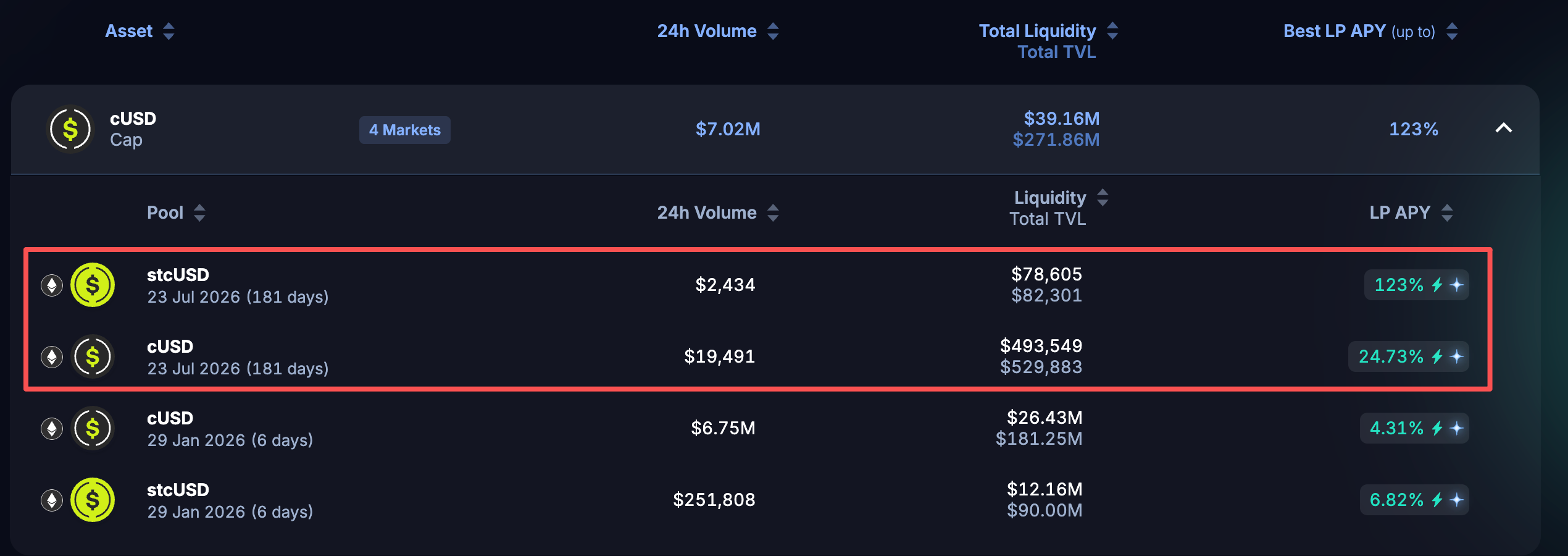
Stimulated by the innovative mechanism of the stablecoin airdrop, the current yields for the Homestead-related liquidity pools on Pendle are very attractive. Among them, the base APY for the cUSD LP is 11.33%, which can be amplified to 24.73% with sufficient PENDLE staking, along with a 20x points efficiency multiplier; the base APY for the stcUSD LP is 52.9%, which can be amplified to 123% with sufficient PENDLE staking (the pool is new and small, so the yield is expected to decay quickly), along with a 5x points efficiency multiplier.

On-Chain Strategy Two: Exponent and RateX ONyc LP (Up to 30.89% APY)

On January 20, Onre, an on-chain reinsurance protocol backed by Solana Ventures and Ethena Labs, renewed the liquidity for ONyc (Onre's yield-bearing stablecoin) expiring in May on Exponent and RateX.

Currently, with additional incentives from Onre, the real-time APY for providing ONyc LP on Exponent is as high as 30.89% — the total pool quota is $3.5 million, which is not very large. Only 25.76% is currently deposited, and the overall APY is expected to dilute to around 20% once full (currently, 14.44% of the yield comes from additional incentives, which will be significantly affected by dilution). In addition to the yield, LPs can also receive 8x Onre points rewards until January 31, after which it will drop to the regular 5x multiplier.
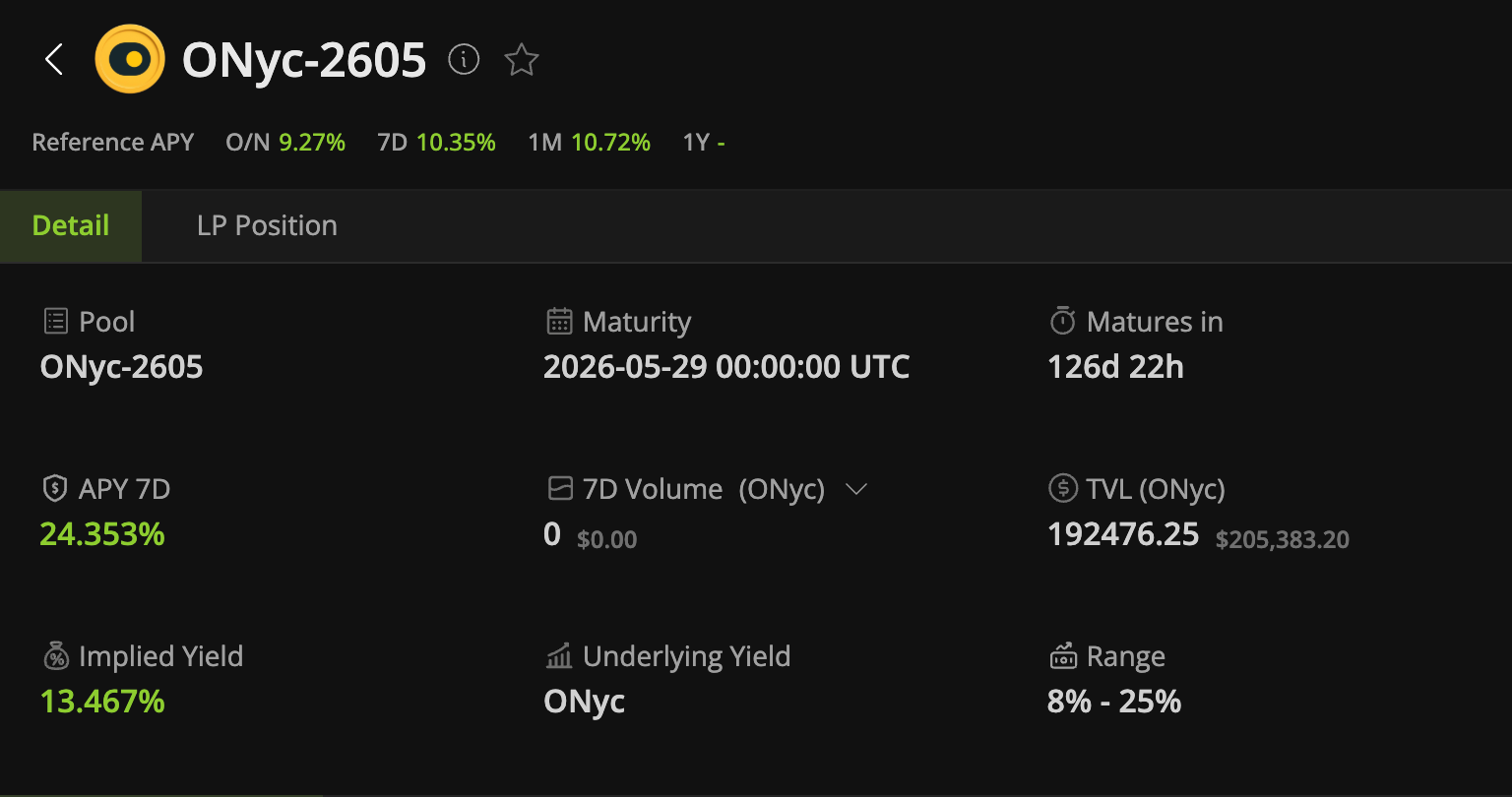
The ONyc LP pool on RateX does not have Onre incentives, but RateX itself subsidizes RTX incentives, with an overall APY of around 25%. The Onre points are the same as on Exponent, but it also earn 8x RateX points.

The project is relatively niche, so it is recommended to participate with small amounts.

On-Chain Strategy Three: hyENA LP (4.86% APY + 70x Ethena Points Multiplier)
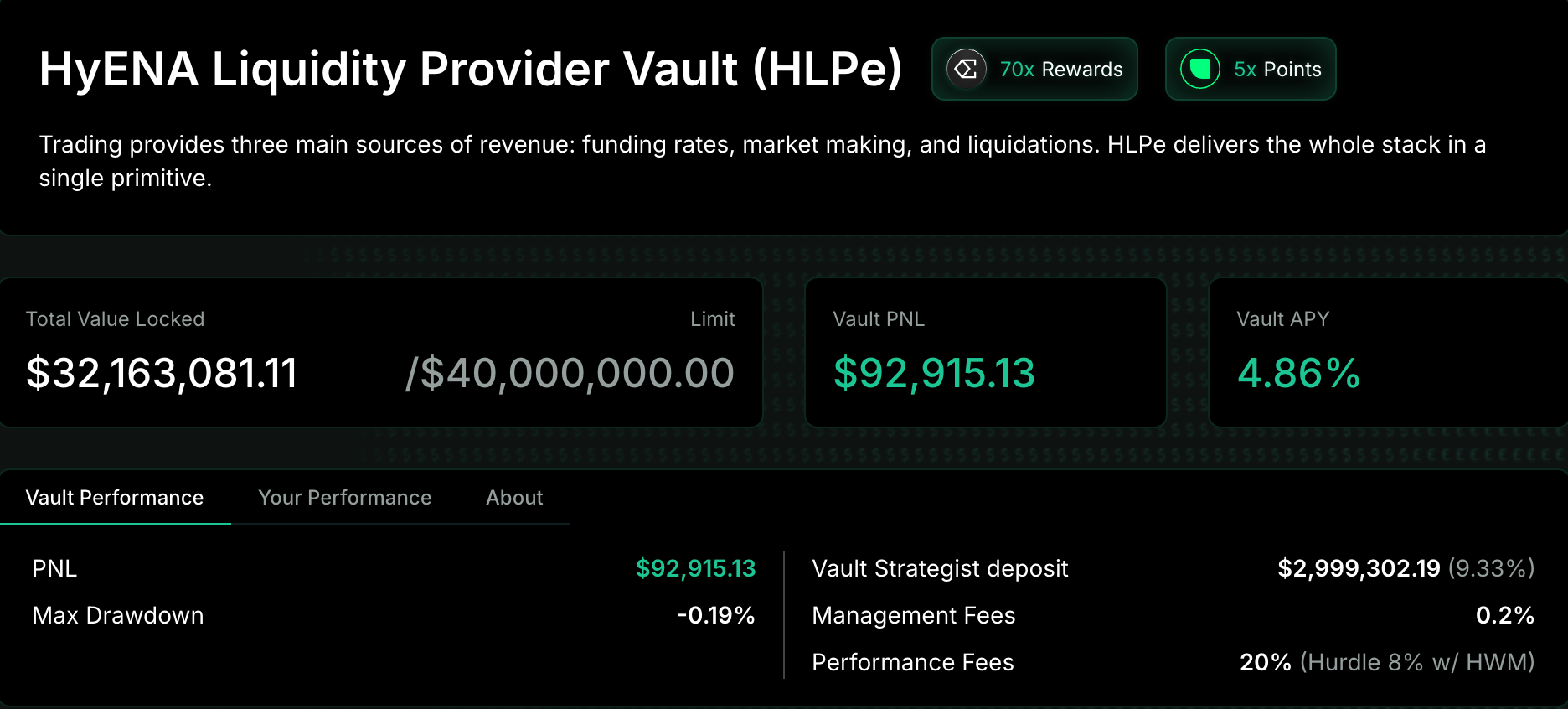
hyENA, the decentralized contract exchange and "son" of Ethena, recently increased the LP deposit limit again. The current quota is $40 million, with about $8 million space remaining.

Currently, the LP APY for hyENA is about 4.86%. The base yield is not ideal, but it also offers a 70x Ethena points multiplier (currently the most efficient points channel besides YT) and a 5x Upshift points multiplier. Consider participating if you are optimistic about Ethena's future development.


Пов'язані питання

QWhat is the APY for the Bitget and Arbitrum Morpho on-chain earning event for USDC and USDT?

AThe APY for USDC and USDT in the Bitget and Arbitrum Morpho on-chain earning event is 9.2%.

QWhat is the name of Cap's airdrop program and what token will be used for the airdrop?

ACap's airdrop program is called Stabledrop, and it will distribute the airdrop in the form of their stablecoin, cUSD.

QWhat is the maximum amplified APY for the stcUSD LP pool on Pendle with full PENDLE staking, and what is its current status?

AThe maximum amplified APY for the stcUSD LP pool is 123% with full PENDLE staking. The pool is new and relatively small, so the yield is expected to decay quickly.

QWhat is the current total capacity and the remaining available space for the hyENA LP pool after the recent increase?

AThe total capacity for the hyENA LP pool is $40 million, and there is approximately $8 million of space remaining available.

QWhich two platforms offer ONyc LP pools with additional incentives from Onre and what are the approximate APYs?

AExponent and RateX offer ONyc LP pools. The APY on Exponent is approximately 30.89% with Onre incentives, while the APY on RateX is approximately 25% with their native RTX token incentives.

Пов'язані матеріали

Global Stock Market's Storm Center: South Korea's Stock Market De-leveraging Is Largely Complete

Storm's Eye: South Korean Market De-leveraging Nears Completion The recent sharp correction in South Korean equities, with the KOSPI index dropping 32% from its June high, has been a key trigger for global tech stock volatility. The core driver was not a fundamental shift but a forced de-leveraging process within the market's unique structure, which is now largely complete. Two main leverage channels amplified the sell-off: 1. **Leveraged ETFs:** Their size, proportionally four times larger than in the U.S., peaked near $50 billion. Their mandatory daily rebalancing mechanism created a vicious cycle of "price drop → forced selling → further drop." Approximately 75% of this excess has been unwound, shrinking to $26 billion, with regulatory curbs now blocking new inflows. 2. **Hedge Fund Leverage:** Using swaps to magnify exposure, hedge funds saw their net long positioning fall by over 50% from peak levels. The most intense phase of this institutional de-leveraging is over. In contrast, **retail margin debt** poses minimal systemic risk. At 0.5% of market cap, it is far lower than in the U.S. or China, lacks automatic triggers, and is concentrated in smaller stocks. The conclusion: the high-leverage structures most prone to "chain-reaction selling" have been substantially cleared. The market is transitioning from a liquidity-driven crash to one priced more on fundamentals. The article argues that the AI trend—centered on Korean memory chips—remains intact. This episode represents a painful but necessary clearing of crowded trades, not the end of the AI revolution. For investors, the key question is conviction in the long-term AI direction; if the trend is real, current volatility is a cost of entry, not a terminal risk.

链捕手54 хв тому

Global Stock Market's Storm Center: South Korea's Stock Market De-leveraging Is Largely Complete

链捕手54 хв тому

The Eternal Fragments of Money: Third-Party Payment Has No First Principle

"The Enduring Fragments of Money: Third-Party Payments Lack a First Principle" Stripe is reportedly attempting to acquire PayPal, marking a significant shift reminiscent of PayPal's merger with the original X.com 30 years ago. The article analyzes Stripe's strategic challenges and the broader payments industry landscape. Despite its initial success with a developer-friendly API model, Stripe missed its optimal IPO window during the pandemic and has since seen its valuation decline. Its attempts to expand through acquisitions and new ventures, particularly in stablecoins (like its OUSD project) and Agent-focused payments (ACP/MPP protocols), have faced headwinds. The author argues that the payment industry remains highly fragmented and is ultimately an adjunct to the traditional banking system. This structure limits the potential for any single player, including Stripe, to achieve complete dominance. While stablecoins and the future rise of autonomous Agent economies present potential growth avenues, they are not yet mainstream and still require integration with the existing financial system. For now, Agent-based transactions are largely used for speculative "volume boosting" rather than substantive business applications. Stripe's current move to acquire PayPal is seen as an attempt to bolster its weak consumer-facing (C-side) business after its stablecoin-focused strategies faltered. Meanwhile, PayPal is described as structurally outdated, unable to revive itself through new products like Venmo or PYUSD. The future of payments may lie not in payments themselves but in value-added services like more efficient settlement networks. The author suggests that companies like Stripe and Circle, which are building their own blockchains (Tempo, Arc) and stablecoins, are positioning themselves to eventually profit from high-efficiency settlement systems. These new networks could potentially bypass some traditional banking layers. In conclusion, the article posits that third-party payment is a perpetually fragmented battlefield where scale alone cannot ensure victory. Players must find new models, focusing on efficiency to compete with the entrenched banking system. Stripe's acquisition of PayPal represents a bet on this uncertain future.

链捕手1 год тому

The Eternal Fragments of Money: Third-Party Payment Has No First Principle

链捕手1 год тому

Торгівля

Спот
活动图片




