By | Jinduan
On April 10, 2026, Anthropic officially integrated Claude into the Microsoft Word sidebar, completing its full penetration of the Excel, PowerPoint, and Word trifecta.
In fact, Microsoft had already handed over the "key" to Word in the cooperation agreement last November.
This landmark event may signify that as model capabilities surpass platform loyalty, and as the best tenants begin to challenge the authority of landlords, the enterprise software world is undergoing a power shift concerning technological generations.
A Quiet Entry
On April 10, Anthropic announced the beta launch of Claude for Word, available to Team and Enterprise subscribers. This is an intelligent assistant residing in the Word sidebar; it reads contracts, marks deletions in red and insertions in green, and directly presents the modification results in Word's native revision pane.
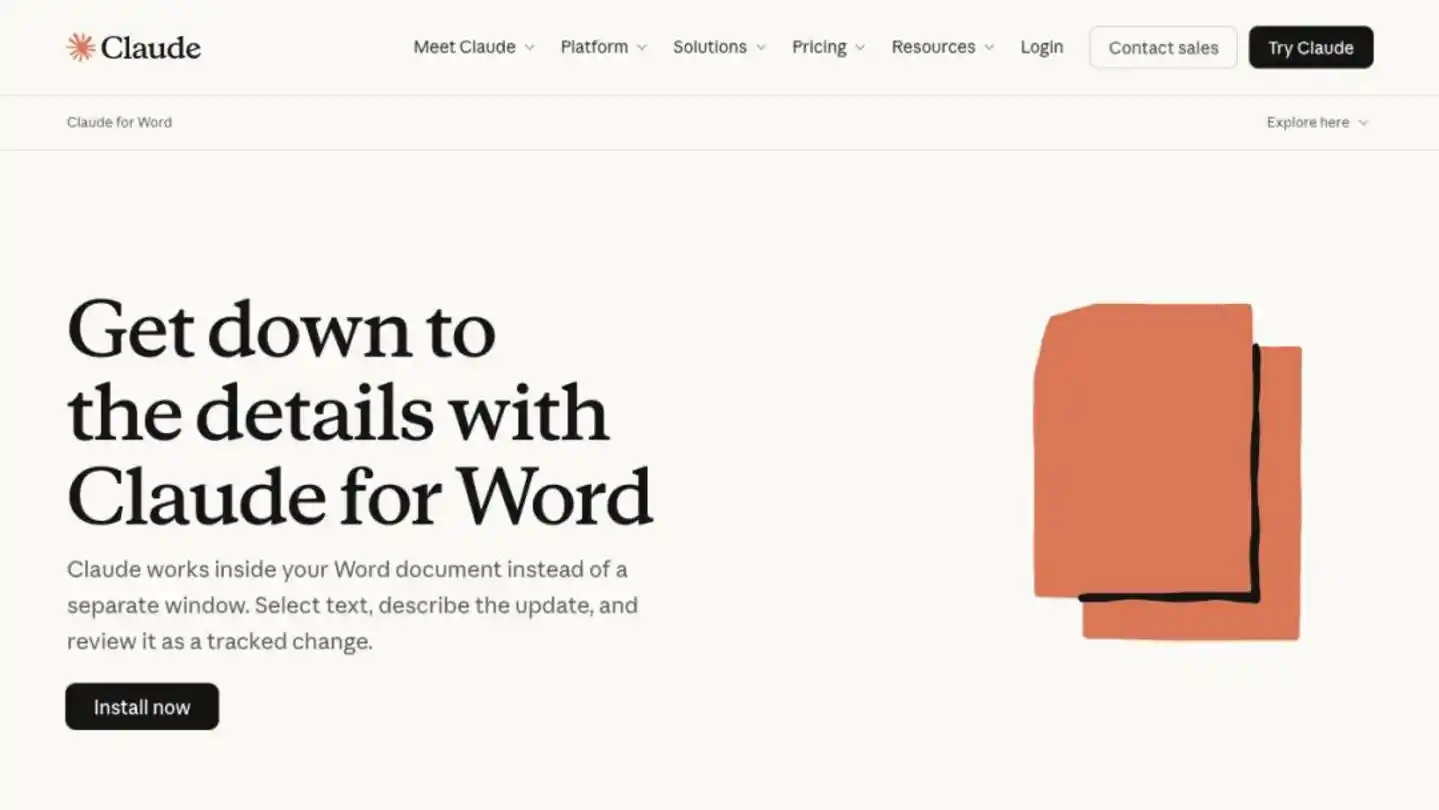
The first example prompt on the Claude for Word product page precisely reveals the target user group: "Mark clauses that deviate from market standard terms, sorted by severity." This is a typical work scenario for junior lawyers. Anthropic did not attempt to build a new legal tech platform but directly entered the space where lawyers already operate.
Prior to this, Claude for Excel was launched in October 2025, followed by Claude for PowerPoint in February 2026. With the addition of Word, Claude has achieved comprehensive coverage of the core Office trio.
More importantly, the context between these three applications is interconnected: conversations started in Excel can directly import data into Word documents without copy-pasting; contract analysis in Word can generate PowerPoint summary slides with one click.
Anthropic first built a cross-application context layer and then filled in the applications one by one. This sequence itself speaks to the strategic intent.
The technical implementation of Claude for Word is worth examining. Every modification it generates is a Word-native "tracked change": deletions in red, insertions in green, and comments anchored to specific clauses. Reviewers can accept or reject each item one by one, exactly as partners have reviewed junior lawyers' work for forty years.
A practitioner named Stephen Smith, after actual use, commented that Claude's revision functionality is "cleaner and more reliable than the current version of Copilot." He was comparing Anthropic's beta with Microsoft's officially released product.
This comment touches the core of the issue: Microsoft has fifteen years of AI integration experience in Word, yet Anthropic, on its first entry into this application, surpassed the native player in core functionality.
Claude for Word does not attempt to change lawyers' work habits but precisely integrates into them. It does not require users to learn new tools or migrate to a new platform; it simply makes existing workflows more efficient. The migration cost is zero, drastically lowering the threshold for willingness to switch.
Why Microsoft Opened the Door
On the surface, Microsoft's stance is the most puzzling.
Claude for Word runs inside Microsoft's application, is distributed through Microsoft's AppSource, and relies on Microsoft's management tools for deployment. Microsoft is the landlord, Anthropic is the tenant. But Microsoft not only allowed this tenant to move in but also proactively handed over the keys in last November's cooperation agreement.
The answer lies in Microsoft's strategic judgment: owning the interface is more important than owning the model.
This judgment did not come out of thin air. In September 2025, Microsoft began integrating Claude Sonnet 4 into Word, Excel, Outlook, and PowerPoint, presented under the Copilot brand. Internal testing found that Claude outperformed OpenAI's model in automating Excel financial functions and was also clearer in drafting memorandum prose.
Microsoft deemed this gap significant enough to be willing to pay its cloud competitor Amazon Web Services, just to provide Claude to its own customers.
In November of the same year, the cooperation was formalized. Sonnet 4.5, Haiku 4.5, and Opus 4.1 entered Microsoft Foundry. Excel's Agent Mode listed Claude as an optional model. Claude powers the Researcher agent within Copilot.
Microsoft's bet is: models will commoditize, distribution channels will not.
GitHub Copilot already allows developers to freely choose models from OpenAI, Anthropic, Google, and xAI. Office 365 is evolving in the same direction. If Claude is the best model for a specific task, Microsoft would rather host it and collect Azure fees than lose the entire user. The latter might be taken by a competitor that completely removes the user from Word.
For now, this is a rational strategy. But it implies a risk that Microsoft may not have fully assessed: when the tenant's service quality significantly surpasses the landlord's own product, users will begin to question why they need to pay for both.
Winners and Losers
When Anthropic released the legal plugin for Claude Cowork in February 2026, the market's reaction was violent. Thomson Reuters fell 16% in a single day, RELX dropped 14%, and Wolters Kluwer declined 13%. Three legal data and tech giants lost approximately $285 billion in market value in one trading day.
The investors' message was unmistakable: a general AI with strong legal skills poses an existential threat to professional service providers who have charged lawyers for decades.
Claude for Word is the sequel to this logic. The plugin proved the capability; the plugin *is* the capability; and the significance of the Word plugin lies in distribution. The February event was a warning; the April release is the formal landing.
The reaction in the legal tech sphere is intriguing. Harvey (which itself runs on Claude), valued at around $8 billion, saw its CEO Winston Weinberg state this week that Anthropic "remains one of the models Harvey's customers benefit from using."
This is a nuanced phrasing: someone who just noticed the landlord opening a competing lemonade stand next to theirs hasn't yet decided how angry to be. Harvey and Legora both stated they would not adopt this Word plugin.
LexisNexis made a more peculiar choice: it packaged Anthropic's legal plugin into its own Protégé product, rather than fighting it. One could call it cooperation, or one could call it being co-opted.
When core document review and drafting capabilities are commoditized at a price of $25 per month, the operating logic is vastly different.
The short-term winners are clear. Anthropic gains a direct channel to all document-intensive professionals in the English-speaking world without building its own platform. Microsoft gets the Azure consumption from the Claude workloads it was going to host anyway. Small and medium-sized law firms get junior lawyer-level contract review capability for $25 a month without switching applications.
The losers are equally clear. Pure legal tech vendors whose core selling point was "we are good at document review" lose their core argument. They need to find things Claude in Word cannot do, and they need to do it fast. Harvey and Legora can fall back on deep workflow and firm-specific training, but second-tier players lack this buffer.
OpenAI is another loser. Its cloud partnership with Microsoft long protected its position at the top of the Office stack. That position is now being eroded in real-time. Copilot, despite its vast number of licenses, must explain to its own customers why they should retain a product rated lower by users than the beta version next to it.
Three groups, three sentiments, the temperature felt by each party in the room is different.
Conclusion: What Disrupts You Is Never the Next You
Claude for Word offers a perspective that transcends specific business analysis. It demonstrates a specific form of disruption: not building a replacement, but entering the existing system and becoming a tenant better than the native inhabitant.
Traditionally, challenging a monopolist required building an alternative platform. You needed to persuade users to leave their familiar environment, migrate to a new interface, and learn new habits. This migration cost was the incumbent's strongest moat.
But Anthropic chose a different path. It did not build a Word replacement. It rented space within the application every knowledge worker already uses, then provided service at a lower price and better quality. Users don't need to leave Word. They just need to switch from Copilot to Claude.
This strategy poses a prisoner's dilemma for the platform: if you don't allow the better tenant in, you are depriving users of access, and they will find another way to leave your platform. If you allow the better tenant in, you are cultivating a replacement on your own turf. Either choice puts you in a bind.
Anthropic did not build a Word competitor. It rented space inside the application every knowledge worker already uses and set a new standard with better service. Clearly, the way to break a monopoly is not necessarily to build a replacement externally. Sometimes, the way is to stand inside it, offer a better service at a lower price, and wait for users to make the choice themselves.