Krypto News: Coinbase and Crypto.com Launch Prediction Markets

bitcoinistОпубліковано о 2026-02-04Востаннє оновлено о 2026-02-04

Анотація

Major cryptocurrency exchanges Coinbase and Crypto.com have recently launched prediction market platforms, expanding their offerings beyond traditional crypto trading. Coinbase activated its "Coinbase Predict" feature across all 50 U.S. states in partnership with regulated provider Kalshi. This allows users to trade binary event contracts on real-world outcomes in sports, politics, and economics, settled in USD or USDC. The platform operates under CFTC oversight, creating a regulatory distinction from gambling. Simultaneously, Crypto.com introduced its standalone prediction market app, "OG," operated by its CFTC-registered derivatives division. A key differentiator is its planned offering of margined, leveraged positions on prediction contracts, alongside social features and user incentives. The article highlights the growing interest in event-based trading and questions which infrastructure can best support it. It points to Bitcoin Layer-2 solutions, like the project "Bitcoin Hyper," as a potential foundation for building scalable, decentralized prediction markets. The project's ongoing presale, having raised over $31 million, is cited as evidence of significant market interest in expanding Bitcoin's use cases beyond a store of value.

Since the beginning of the year, major crypto exchanges have been diving deep into the prediction and event trading market. In quick succession, both Coinbase and Crypto.com have announced and launched new platform offerings that allow private users to bet on the outcome of real-world events—from sports events to politics and cultural developments. This development is part of a broader trend where established trading platforms are expanding their product portfolios far beyond classic crypto trading.

Coinbase Expands Nationwide Prediction Markets

At the end of January, the US exchange Coinbase activated its prediction market offering across all 50 US states. The feature was introduced in collaboration with the regulated US provider Kalshi and enables customers to trade so-called event contracts directly via the Coinbase app. These are binary markets where the contract settles based on a yes/no outcome of an event, such as "Will Team X win the game?" or "Will US GDP exceed expectations?".

Pricing is determined by supply and demand in the market, not by odds set by the platform.

The full national release follows an earlier, limited availability in select regions. Coinbase itself describes the product as an opportunity to "hedge" on real-world events and convert predictions into tradable market prices, similar to established prediction markets like Polymarket or Kalshi itself. Wagers can be placed in US dollars or via stablecoin balances in USDC, which is already familiar to Coinbase customers.

Regulatorily, the offering is significant in the US as it falls under the supervision of the Commodity Futures Trading Commission (CFTC), which allows for a different classification than classic sports betting or gambling. This regulatory classification is not without controversy: in several states, there have already been disputes over whether prediction markets should instead fall under state gambling laws.

Crypto.com Launches Standalone Platform "OG"

Simultaneously, Crypto.com has launched its own prediction market platform called OG, which initially focuses on the US market and went live just before one of the biggest sporting events of the year. OG is operated by Crypto.com | Derivatives North America (CDNA), a registered CFTC clearing and trading venue, and also offers users the ability to trade event contracts on topics such as sports, politics, finance, and entertainment.

A key distinguishing feature of OG is the planned offering of margin or leveraged positions on prediction contracts, which is intended to set it apart from previous platform formats—an approach that, however, also implies higher risks for users. Additionally, OG integrates social elements such as leaderboards and rewards, including up to $500 for the first million registered users.

The launch as a standalone app rather than an integrated feature signals that Crypto.com views the prediction market as its own growth area that generates strong user interest. According to the company, demand for such contract types has increased significantly in recent months, which favored the decision to spin off a dedicated product.

Are Decentralized Prediction Markets Coming to Bitcoin?

The recent moves by major exchanges into regulated prediction markets highlight how much interest in event-based trading has grown. At the same time, this brings a fundamental question into focus: On which infrastructure can such applications be mapped in a scalable, transparent, and as neutral as possible manner in the long term?

While many of the platforms used today are built on existing smart contract networks, there is a parallel growing interest in solutions that enable these concepts on a Bitcoin basis as well. A prerequisite for this is powerful Layer-2 structures that open up new use cases beyond pure value storage.

Against this backdrop, one project is currently coming more into view that aims to address exactly this gap.

Bitcoin Hyper positions itself as a Layer-2 solution for the Bitcoin ecosystem, with the goal of enabling more complex applications directly at Bitcoin's security level. These explicitly include decentralized prediction markets, which have so far been implemented primarily on Ethereum- or Solana-based networks. The project pursues the approach of combining Bitcoin's liquidity and trust base with a high-performance execution layer to enable applications that were previously considered technically unfeasible.
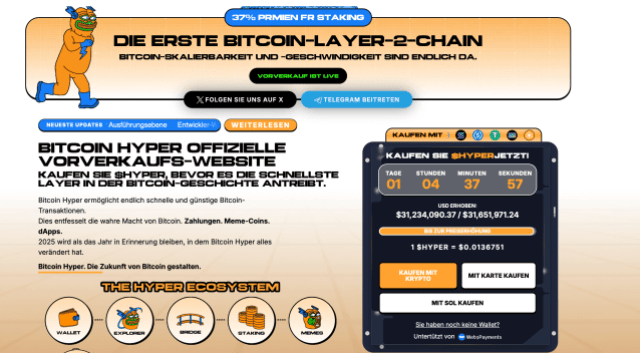
The current market interest is reflected primarily in the ongoing presale. According to project reports, over $31 million has already been raised, indicating unusually high attention in a phase where many investors are acting more selectively. Observers attribute this in part to the overarching narrative: Bitcoin not just as a passive store of value, but as a foundation for new financial and information markets. Prediction markets are considered a particularly sensitive use case, as they require both scalability and security.

Bitcoin Hyper attempts to differentiate itself in this environment through a clear focus on Bitcoin Layer-2 infrastructure. If the adoption of such Layer-2 networks continues to accelerate, applications like decentralized prediction markets on Bitcoin could also become realistic.

The presale is divided into several price tiers, allowing early participants to achieve book gains. Acquisition is done via the project website by connecting a compatible wallet and executing the token swap.

Go to the Bitcoin Hyper Presale

Пов'язані питання

QWhat new type of trading platforms have Coinbase and Crypto.com recently launched?

ACoinbase and Crypto.com have launched prediction market platforms, allowing users to trade on the outcome of real-world events such as sports, politics, and cultural developments.

QHow does Coinbase's prediction market, Coinbase Predict, function and what is it regulated under?

ACoinbase Predict functions as a binary market where contracts settle based on a yes/no outcome of an event. It is regulated under the oversight of the U.S. Commodity Futures Trading Commission (CFTC).

QWhat is the name of Crypto.com's new prediction market platform and what is one of its key differentiating features?

ACrypto.com's new platform is called OG. A key differentiating feature is its planned offering of margin or leveraged positions on prediction contracts.

QAccording to the article, which blockchain is being positioned as a potential new base for decentralized prediction markets through Layer-2 solutions?

ABitcoin is being positioned as a potential new base for decentralized prediction markets through Layer-2 solutions like Bitcoin Hyper, which aims to enable more complex applications on Bitcoin's security level.

QHow much funding has the Bitcoin Hyper project reportedly raised in its ongoing presale, according to the article?

AThe Bitcoin Hyper project has reportedly raised more than $31 million in its ongoing presale.

Пов'язані матеріали

Soaring 20% Then Dropping 5%: When Will the Bottom of the Korean Stock Market Be?

"South Korean stocks face a turbulent period as the KOSPI index, after a 20% surge, fell 5% to 6257 points. The market is grappling with severe issues: over 500,000 leveraged retail accounts have been liquidated, and more than 24 trillion won has flowed from stocks into bank deposits for safety. This reflects a significant loss of market liquidity and shaken investor confidence. In response, Korean financial regulators are taking action. They have tripled the minimum保证金 (margin) requirement for single-stock leveraged ETF trades to 30 million won and are considering granting themselves "emergency intervention" powers. These could include capping leverage ratios and setting investment limits on these ETFs, seen by many as amplifying market volatility. Initial results show a 75% drop in these products' trading volume post-regulation. The market downturn has political repercussions, pushing President Yoon Suk-yeol's approval rating to a new low. Meanwhile, foreign investors made a record net purchase of 7.18 trillion won during a recent rebound, while domestic retail investors sold off massively. Morgan Stanley has upgraded South Korean stocks to "overweight," citing the ongoing "leverage unwinding" and potential for a 36% upside, with giants like Samsung Electronics and SK Hynix providing valuation support. However, analysts caution that the market's structure remains vulnerable to foreign capital flows, and the current low may not be the bottom."

marsbit12 хв тому

Soaring 20% Then Dropping 5%: When Will the Bottom of the Korean Stock Market Be?

marsbit12 хв тому

Goldman Sachs Stakes a Clear Position: This Is the Largest Capital Demand Cycle in Human History, and the Fed Is Just an Observer

Goldman Sachs argues that the world is entering the most capital-intensive investment cycle in history, driven by concurrent massive demands from AI infrastructure, reindustrialization, defense reinvestment, power grid rebuilding, supply chain realignment, and sovereign debt financing. This structural competition for capital is pushing its cost higher, fundamentally altering investment paradigms. Goldman's Mark Wilson states that the Federal Reserve is merely a "passenger, not the driver" in this shift, with rising yields rooted in these real economy demands rather than just monetary policy. While major indices appeared calm in July, underlying market movements were historic, featuring extreme stock dispersion and a severe momentum factor crash, leading to significant de-risking by fund managers. Wilson cautions against expecting a quick reversal in August, citing ongoing digestion of higher rates, disrupted risk models, and typically muted market performance ahead of US midterm elections. Corporate fundamentals remain robust with strong earnings, though growth rates are peaking in the US while accelerating in Europe. Notably, hyperscale cloud companies like Amazon and Microsoft are announcing staggering capital expenditure projections for 2027-2028, justified by explosive AI-related revenue growth and high returns. Amazon revealed its AI revenue run-rate exceeds $25 billion, growing triple-digits annually, and expressed confidence that AWS could become a trillion-dollar revenue business. The report concludes that a transitional period is underway, marked by a growing tension between aggressively investing private tech giants and increasingly capital-constrained sovereign governments. The AI super-cycle continues, with August likely being a consolidation phase.

marsbit17 хв тому

Goldman Sachs Stakes a Clear Position: This Is the Largest Capital Demand Cycle in Human History, and the Fed Is Just an Observer

marsbit17 хв тому

Outflow of Stablecoins from South Korea Continues for 18 Consecutive Months, Exceeding $360 Million in June

In June 2026, South Korea experienced a net outflow of stablecoins to overseas crypto exchanges, amounting to 560.3 billion won ($367 million). This represents approximately 78% of the net value of foreign stocks purchased by Korean investors in the same period. According to the Financial Supervisory Service (FSS), this marks the 18th consecutive month of net outflows, a trend ongoing since January 2025. The FSS reported that 2.76 trillion won ($1.8+ billion) in stablecoins were withdrawn from the country's five major exchanges to foreign platforms in June, while 2.2 trillion won ($1.4 billion) flowed back in. The second quarter of 2026 saw a significant net outflow of 1.69 trillion won (~$1.1 billion), surpassing net sales of foreign stocks in the same period. Analysts cite access to unavailable domestic financial instruments as a primary driver. Foreign platforms offer crypto derivatives, spot and futures products tied to major Korean stocks like Samsung and Hyundai, along with RWA tokenization, DeFi, staking, and leveraged products. Lawmaker Lee Jong-wook warned that the stablecoin outflows constitute capital flight, exposing investors to risks on unregulated foreign platforms. He called for accelerated regulatory reform and enhanced investor protection measures. The government is reportedly working on a digital assets law to foster the blockchain sector.

cryptonews.ru22 хв тому

Outflow of Stablecoins from South Korea Continues for 18 Consecutive Months, Exceeding $360 Million in June

cryptonews.ru22 хв тому

Торгівля

Спот
活动图片