Kraken Partners With Nasdaq In New Tokenized Stocks Move

bitcoinistОпубліковано о 2026-03-10Востаннє оновлено о 2026-03-10

Анотація

Kraken's parent company Payward has partnered with Nasdaq to develop an "equities transformation gateway," a new infrastructure layer connecting regulated tokenized equity markets with permissionless blockchain networks. The collaboration centers on Kraken's xStocks product, which has surpassed $25 billion in transaction volume with over $4 billion settled on-chain. Scheduled to become operational in H1 2027, Nasdaq's equity token design will use xStocks as its permissionless infrastructure layer, maintaining issuer control and regulatory compliance while enabling interoperability with DeFi environments. The gateway will allow seamless movement of tokenized equities between traditional markets and blockchain networks, with Kraken handling KYC/AML requirements. Payward's co-CEO Arjun Sethi emphasized that tokenization transforms equities into programmable instruments capable of serving as cross-platform collateral for trading, margin, derivatives, and lending—significantly enhancing capital efficiency beyond traditional brokerage limitations.

Kraken parent Payward has partnered with Nasdaq to build what the companies describe as an “equities transformation gateway,” a new infrastructure layer designed to connect regulated tokenized equity markets with permissionless blockchain networks. For crypto markets, the significance is clear: one of the largest traditional market operators is now working directly with a crypto-native tokenization framework to move equities between institutional rails and DeFi environments.

The partnership centers on xStocks, Kraken’s tokenized equities product, which Payward said has surpassed $25 billion in total transaction volume less than a year after launch. More than $4 billion of that volume has been settled on-chain, and the framework now counts over 85,000 unique holders across supported networks, giving Kraken a sizable footprint as tokenized stocks move from concept toward market structure.

Nasdaq And Kraken Join Forces

Under the proposed setup, xStocks will power the permissionless infrastructure layer for Nasdaq’s upcoming issuer-sponsored equity token design. That design, which Nasdaq expects to become operational starting in the first half of 2027, is meant to preserve issuer control, existing regulatory frameworks, and the rights attached to the underlying shares while still allowing those assets to interact with blockchain-based financial systems.

In practical terms, the gateway is supposed to let eligible users swap tokenized equities between a regulated, permissioned market environment and open on-chain ecosystems. Payward said this would allow assets to move “fluidly” between institutional trading infrastructure and decentralized financial networks, while Payward Services handles KYC and AML onboarding for participants accessing the bridge through Kraken.

Arjun Sethi, co-CEO of Payward and Kraken, framed the effort as a structural change to how equities can be used once they are placed on programmable rails. “Tokenization upgrades market infrastructure at the asset layer by allowing equities to exist as programmable financial instruments that can operate across both regulated capital markets and open blockchain networks,” he said. “Today most equities sit inside brokerage systems where their utility is largely limited to directional exposure and, in some cases, broker-specific margin arrangements.”

He argued that the current model leaves capital trapped inside siloed venues. “That structure fragments liquidity across venues and leaves a meaningful amount of capital static relative to its potential utility,” Sethi said. “With xStocks, our goal is to make equities natively interoperable across trading venues, financial applications and blockchain networks while preserving issuer rights, regulatory protections and price integrity.”

Sethi went further, tying tokenized equities to a broader capital-efficiency thesis that will be familiar to crypto derivatives traders. “Bringing equities onto programmable infrastructure expands how they can function within a portfolio,” he said. “Instead of simply representing exposure to a company, tokenized equities can operate as collateral within unified trading systems that support spot markets, cross-margin trading, derivatives, perpetual futures, and financing environments.”

That point sits at the heart of the announcement. Payward is not pitching tokenized stocks merely as wrappers for traditional shares, but as collateral that can move across trading, lending and hedging systems under a unified margin framework. In jurisdictions where xStocks are already available, Payward will also serve for an initial period as the primary settlement layer for transactions tied to Nasdaq’s equity token design.

At press time, the total crypto market cap stood at $2.32 trillion.
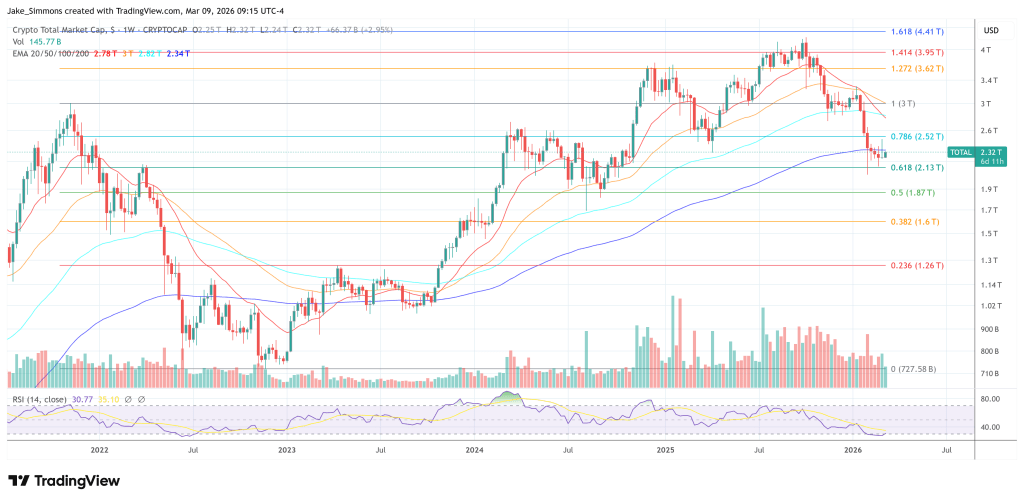
Total crypto market cap, 1-week chart | Source: TOTAL on TradingView.com

Пов'язані питання

QWhat is the main purpose of the partnership between Kraken's parent company Payward and Nasdaq?

AThe partnership aims to build an 'equities transformation gateway,' a new infrastructure layer designed to connect regulated tokenized equity markets with permissionless blockchain networks, allowing equities to move between institutional rails and DeFi environments.

QWhat is xStocks and what milestone has it achieved according to the article?

AxStocks is Kraken's tokenized equities product, which has surpassed $25 billion in total transaction volume less than a year after launch, with over $4 billion settled on-chain and more than 85,000 unique holders.

QWhen does Nasdaq expect its issuer-sponsored equity token design to become operational?

ANasdaq expects its issuer-sponsored equity token design to become operational starting in the first half of 2027.

QHow does Arjun Sethi describe the current limitation of traditional equities in brokerage systems?

AArjun Sethi states that in traditional brokerage systems, equities' utility is largely limited to directional exposure and some broker-specific margin arrangements, which fragments liquidity and leaves capital trapped in siloed venues.

QWhat broader function does Payward envision for tokenized equities beyond being wrappers for traditional shares?

APayward envisions tokenized equities functioning as collateral within unified trading systems that support spot markets, cross-margin trading, derivatives, perpetual futures, and financing environments, enhancing capital efficiency and interoperability.

Пов'язані матеріали

Understanding Hash in One Article: The "Browser Miner" on Ethereum

Hash is an Ethereum-based ERC-20 token described as a "browser-minable post-quantum token." Its key features include enabling browser-based GPU mining without specialized hardware, a fixed supply cap of 21 million tokens, immutable and permissionless smart contracts with no team allocation or pre-mining, and an emphasis on post-quantum security using Keccak256 hashing. The mining mechanism is a simplified on-chain proof-of-work where miners solve unique challenges tied to their wallet address. Key design elements prevent answer theft, with epochs resetting every 100 blocks (~20 minutes) and a per-block minting limit. Emission follows a Bitcoin-like halving schedule every 100,000 mints, starting at 100 tokens per mint. Projections suggest all tokens could be mined within approximately 294 days if a target rate of one mint per minute is sustained. Hash emphasizes "post-quantum" security by leveraging hash-based primitives like Keccak256, which are considered more resistant to quantum attacks compared to elliptic-curve cryptography. While not a fully post-quantum asset, it aligns with Ethereum's broader post-quantum research narrative. The project completed its Genesis sale at $0.03 and began trading on Uniswap, with its price reaching around $0.19. The initial circulating supply is small, with 5% sold in Genesis and 5% allocated to liquidity. The majority (47.6% of total supply) is allocated to early-stage mining, leading to a front-loaded emission schedule. This structure, combined with low initial liquidity, makes Hash a high-volatility, high-risk project dependent on sustained miner participation and market demand to absorb new supply.

marsbit4 хв тому

Understanding Hash in One Article: The "Browser Miner" on Ethereum

marsbit4 хв тому

OpenAI's Largest Internal Wealth Creation: 600 People Cash Out a Total of $6.6 Billion, 75 Take Home the Maximum $30 Million Each

A Wall Street Journal report reveals OpenAI's unprecedented pre-IPO wealth creation. In a single employee stock sale last October, over 600 current and former employees sold shares, collectively cashing out approximately $6.6 billion. Due to high investor demand, the company tripled the individual sale cap to $30 million, with about 75 employees selling the maximum amount. This event represents the largest such transaction in tech industry history for a private company. OpenAI's valuation was $500 billion for this tender offer. Employees with over two years of tenure were eligible, allowing many post-ChatGPT hires their first liquidity event. The company's stock has reportedly grown over 100-fold in seven years. Following a restructuring, employees collectively hold about 26% of OpenAI. The scale of executive wealth is also staggering. In court testimony related to Elon Musk's lawsuit, President and co-founder Greg Brockman confirmed his OpenAI stake is worth around $30 billion. Analysis indicates about 165 current and former employees hold a combined ~$164.9 billion in equity, averaging nearly $1 billion per person in paper wealth. OpenAI's per-employee stock-based compensation is estimated to be 34 times the average of major tech firms before their IPOs. OpenAI continues its rapid ascent, closing a $122 billion funding round at an $852 billion valuation in March. With monthly revenue hitting $2 billion, over 900 million weekly ChatGPT users, and plans for a potential trillion-dollar IPO in late 2026, this wealth-creation engine shows no signs of stopping.

链捕手27 хв тому

OpenAI's Largest Internal Wealth Creation: 600 People Cash Out a Total of $6.6 Billion, 75 Take Home the Maximum $30 Million Each

链捕手27 хв тому

Торгівля

Спот
Ф'ючерси
活动图片





