Author: Budongjing
I. The Only True Leverage in the Post-Scarcity Era
Khamenei died, and with him died thirty thousand articles capitalizing on the hot topic.
Within minutes of the event, our social platforms, social media feeds, and information streams were flooded with thousands of "seemingly highly professional" in-depth analyses. These articles explored "In-Depth Analysis of the Middle East Situation," "Projections for the Future of the Iranian Regime," "Impact on Global Oil Prices and Asset Allocation"......
These articles are neatly structured, diplomatically opinionated, fully data-supported, and densely packed with quotable phrases. They feature quick-read "event timelines," three-part "geopolitical cause analyses," five-point list-style "projections of global economic impacts," and even ten pieces of practical advice on "how ordinary people can protect their wallets." Each one sounds thoroughly reasoned and highly insightful.
But the result? After quickly scrolling through three screens, you can hardly remember the core argument of any single article, let alone have your cognition changed by this information.
Recall, just a month ago, the US跨国 captured Maduro. For one country to directly send troops across a border to capture the sovereign leader of another country is an extremely rare and explosive, historically significant event in modern human history.
The internet was equally ablaze at that time, with all kinds of "in-depth analyses" flooding the scene. But how long did the热度 (heat) of this event last? Three days, a week at most, and people had already forgotten, swept away by the next hot topic.
In this era of information tsunamis, human attention is being sliced into ever-shorter fragments. Vast amounts of rapidly produced information and content are like stones dropped into the deep sea, leaving no substantial trace in the world.
This is one of the greatest paradoxes of contemporary existence.
More and more information, shallower and shallower understanding.
Denser and denser content, shorter and shorter memory.
Richer and richer explanation, scarcer and scarcer meaning.
You think you are "receiving knowledge," but it's closer to "swallowing noise." You think you are "consuming viewpoints," but you are passively accepting round after round of attention harvesting.
But at the same time, the producers of this content are also acutely aware that these words are unlikely to have any real impact, form genuine chains of传播 (dissemination), or bring the creators any long-term economic gain.
All this points to a冷酷的现实 (cold, hard reality): Knowledge is becoming an extremely cheap public good, even a public good in the form of noise. The more content there is, the scarcer meaning becomes; everyone can produce "knowledge" at low cost, and the ultimate result is the systematic zeroing out of the premium for knowledge as a commodity.
This is much like the old saying about the Soviet Union: We know they are lying, they know they are lying, they even know we know they are lying, we know they know we know they are lying.
This is why you always see the same titles, the same views, the same structures. We are trapped; junk content doesn't follow any story arc. In the junk world, there is no climax and no ending, only junk and more junk. Endless unfolding, forever on the road.
In a "post-scarcity" world, what is scarce? Not information, not content, not knowledge. AI can generate endless content. Blog posts, social media posts, summaries, sharp commentary, supplied in unlimited quantities.
We once lived in the information economy era. Now we live in the narrative economy era, a narrative world. You could call it the "post-post-truth world."
Most people are about to learn a brutal lesson about "leverage."
For the past half-century, or even longer, the enormous commercial value of knowledge essentially came from an "arbitrage structure." The emergence of AI has almost been like a dimensional打击 (attack/strike), piercing through these four price differentials one by one.
For 30 years, "work in front of a screen" paid a salary because humans were the only interface between messy reality and final decisions. You were responsible for converting ambiguous information into action. You were the bottleneck.
AI removes this bottleneck. Not on some future day, not waiting for Artificial General Intelligence (AGI). Right now, through systems that are "just good enough" and are integrating into every workflow.
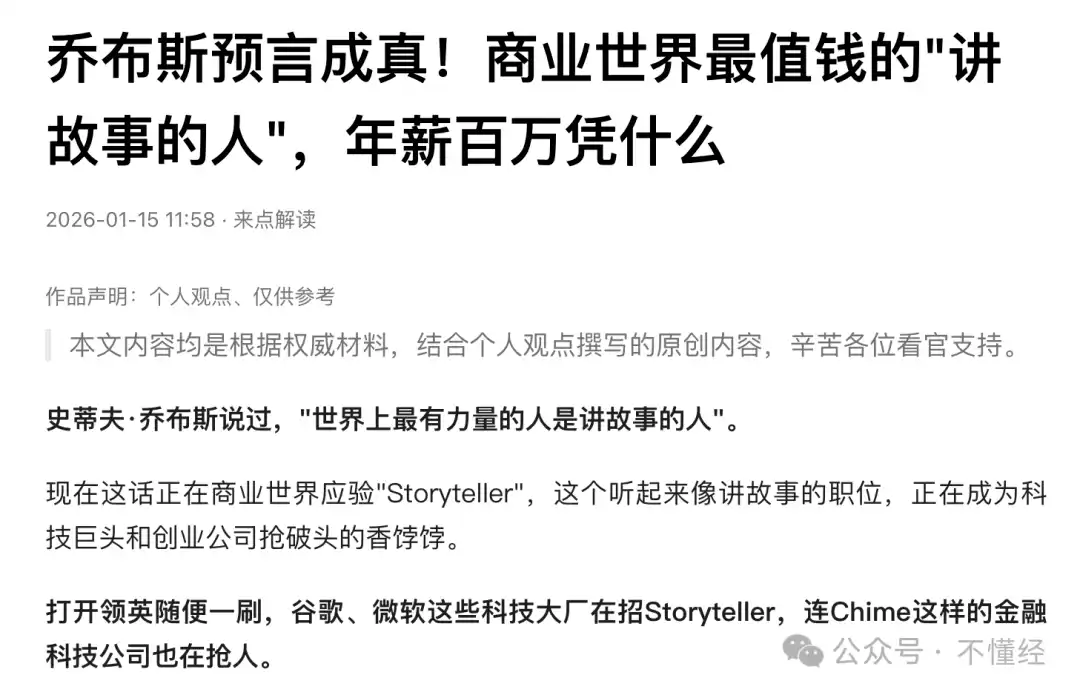
In the post-scarcity world, the only real leverage left—is narrative. The value and importance of "narrative" are skyrocketing.
Narrative is by no means simply a "storytelling skill"; it is the only mechanism for humans to reconstruct meaning and order in a chaotic environment of information surplus, choice surplus, and explanation surplus. It determines what can be seen, what can be believed, what can trigger action, and what can truly穿透周期 (pierce through cycles/persist).
Knowledge arbitrage is dead, long live narrative.
This article will do three things:
- First, deconstruct why "knowledge and knowledge arbitrage" are dying, and what exactly is dying.
- Second, dig deep into the definition, structure, and anthropological roots of narrative, explaining why it will "live forever," why it is the true leverage in the AI era.
- Third, provide practical strategies for the AI era, offering an executable "narrative gravity" framework for all creators, entrepreneurs, and spectators.
II. The Disenchantment of Knowledge and the Total Collapse of the Arbitrage Model
Many content creators and knowledge workers have recently felt a vague sense of崩溃 (collapse/breakdown): "I've produced so much content, I've worked so hard, I even write better than professional authors used to, so why is there no return?"
The answer is残酷 (cruel): Because you are chasing hot topics, because you are producing "content in the form of explicit knowledge," and these commodities are either disposable consumables or are entering the final stage of their lifecycle.
1. The Fate of Hot-Topic Content: Increasingly Like Disposable Consumables
In the phase where AI-generated content is fully deployed, the standard production process for a hot topic is almost fixed.
Step one, scrape materials.
Step two, stitch together a timeline.
Step three, fit into a common geopolitical or economic impact template.
Step four, offer a few risk-free suggestions.
Step five, create a clickbait headline variant.
This process used to require manpower and time; now it's more like pressing a button. The marginal cost approaches zero, so supply is naturally infinite. The vast sea of "in-depth interpretations" you see, a large portion does not come from the long-term research accumulation of a specific author; it's more like a quick rearrangement of public language material.
This is the first layer of meaning behind "knowledge is dead."
What died is not the facts themselves, nor truth itself. What died is the premium for explicit knowledge as a commodity. The part of knowledge that is codifiable, replicable, retrievable, and quickly outsourced is degenerating from an asset into background noise. No matter how correctly you write, it's hard to win the attention dividend, because being correct has become the最低门槛 (minimum threshold).
You will soon discover an awkward reality.
When everyone can use tools to produce "decent content," content in the market becomes more like generic parts. The price of generic parts will only be driven down to near cost by competition, and AI drives the cost down to almost zero.
Thus, content slides from asset to liability. The more you post, the more fatigued readers become. The more diligently you explain, the more the world seems like a mess.
This is what is often called "AI slop" in the English-speaking world recently, referring to large quantities of low-quality or highly homogeneous AI-generated material used to capture traffic and attention, with platform mechanisms pushing it to new users.
Its harm lies not in how bad any single article is, but in how it raises the entropy of the entire information environment, making it harder for you to extract order from the environment.
2. Why Does the Content You Produce Have No Impact?
Impact, what does it mean?
Impact means that an article, a viewpoint, changed someone's judgment, reshaped the emotional structure of a group,扭转 (reversed/turned around) the decision-making direction of an organization, or altered the probability of an action occurring. Impact means that after you express something, some corner of the world becomes different because of you.
The vast majority of AI-generated or "AI-like" generated content cannot achieve this. The reason is not mysterious:
· It lacks an agent that bears the cost: The machine does not bear the risk of saying something wrong; it has no "Skin in the game."
· It lacks a verifiable source of experience: It describes 100 pitfalls to avoid in entrepreneurship, but it has never truly experienced the深夜 (late night)濒临破产 (on the verge of bankruptcy).
· It rarely provides "new" questions or "new" explanatory structures: It is only good at rearranging and combining old explanations that already exist among humans, using more perfect grammar.
You can certainly use it to "summarize" an earnings report, but it's hard to use it to "found a nation"; you can use it to "polish" an email, but it's hard to use it to "establish a life's purpose." It is always correct, always complete, but also always risk-free, soulless.
When "generation" becomes extremely cheap, the supply of content expands geometrically. But human attention does not expand; you still only have 24 hours in a day. The inevitable consequence is: the market switches from "information scarcity" to "attention scarcity," and is rapidly falling into the black hole of "meaning scarcity."
3. The Four Pillars of the Knowledge Arbitrage Structure Are Being Ruthlessly Shattered
For the past half-century, or even longer, the enormous commercial value of knowledge essentially came from an "arbitrage structure." Consulting firms, media, analysts, and even most of the education system made money from the following four types of differentials:
- Acquisition Differential: Whoever could利用信息不对称 (leverage information asymmetry) to obtain information earlier or more exclusively had privilege.
- Translation Differential: Whoever could translate obscure professional jargon, academic黑话 (black talk/cant) into language the public or bosses could understand, could make money.
- Synthesis Differential: Whoever could piece together and refine vast, scattered information into an executable plan (like a million-dollar consulting PPT) had an advantage.
- Authority Differential: Whoever could speak in the name of an "expert" through titles and packaging could obtain a trust premium.
However, the emergence of AI has almost been like a dimensional strike, piercing through these four differentials one by one:
The vast amounts of data you can acquire early, large model systems can crawl in seconds; the code or foreign language you can translate, AI can convert in real-time seamlessly; the industry research frameworks you can piece together, AI's deep research mode can do it more thoroughly; as for the authoritative posture, when clients find that the advice given by AI is more comprehensive than that from heavily paid consultants, the "illusion of control by static experts" is彻底破灭 (completely shattered).
When these differentials are leveled, the premium for knowledge as a commodity is flattened, until it approaches zero. This is the second layer of meaning behind "knowledge is dead."