KITE under pressure: 1.8B supply meets falling demand and rising shorts

ambcryptoОпубліковано о 2026-03-27Востаннє оновлено о 2026-03-27

Анотація

KITE remains in a bearish phase with weakening fundamentals and negative market sentiment. The number of holders has declined from 105,420 to 104,780 since March 24, while market capitalization dropped by $57 million. Despite a high circulating supply of 1.8 billion tokens, demand is shrinking. The price fell 11% in 24 hours, with rising volume indicating strong bearish momentum. Perpetual traders are increasing short exposure, pushing the funding rate to a deeply negative -1.2420%, similar to levels preceding a previous sharp decline. Liquidity analysis suggests a potential drop toward $0.175, with further downside risk likely due to persistent selling pressure and dominant short positioning.

Kite [KITE] remains in a bearish phase as market sentiment continues to weaken. The recent decline reflects underlying structural shifts that could push prices lower in the near term.

Perpetual traders are capitalizing on this trend, increasing short exposure in ways that may exert additional downward pressure in upcoming trading sessions.

KITE fundamentals weaken as holder count drops

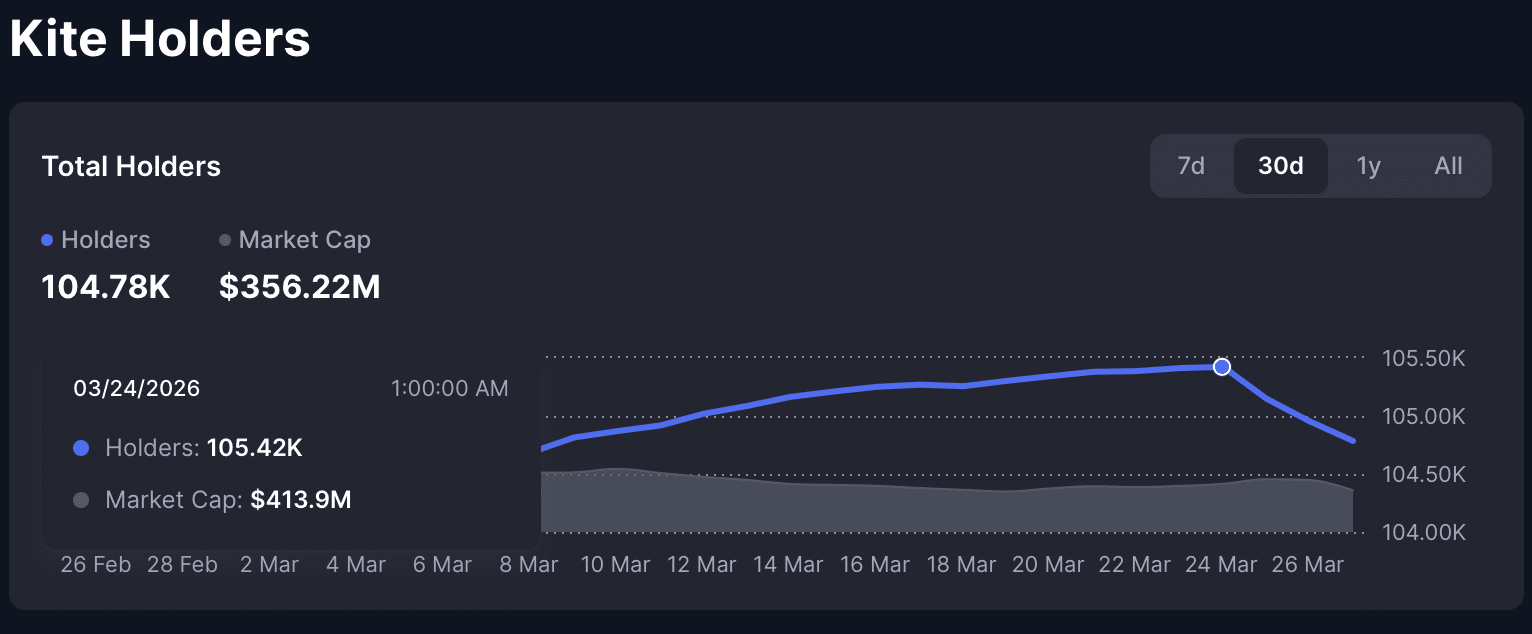
A key driver behind KITE’s recent decline lies in deteriorating fundamentals. The number of holders has dropped sharply after peaking at 105,420 on the 24th of March, when market capitalization reached $413.9 million.

At press time, the holder count has fallen to 104,780, while market capitalization has declined by $57 million, according to CoinMarketCap.
Source: CoinMarketCap

Despite the drop in participation, KITE’s circulating supply remains elevated at 1.8 billion tokens. This imbalance between supply and shrinking holder demand continues to weigh on sentiment.

At the same time, price action has weakened, with KITE posting a double-digit loss of 11% over the past 24 hours as of writing. Trading volume, however, has increased. Historically, rising volume alongside falling prices signals strong bearish momentum, suggesting the downtrend may extend.

Perpetual market signals growing short dominance

The perpetual futures market adds further downside risk.

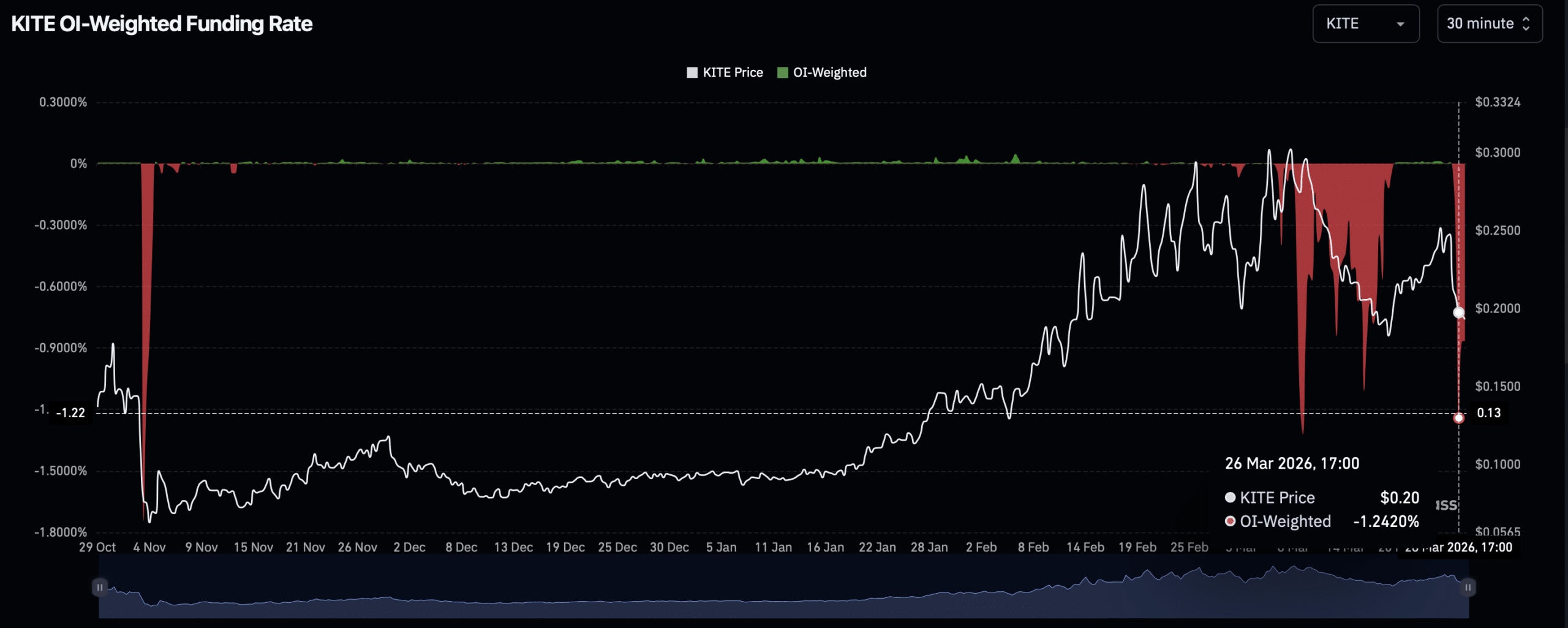
Short traders have increased their dominance across KITE contracts. Over the past 24 hours, the Open Interest Weighted Funding Rate, which measures whether longs or shorts control the market, has turned sharply negative, at press time, reinforcing bearish sentiment.

The Funding Rate dropped to -1.2420%, the steepest drop since the 9th of March. On the 19th of March, a similar decline occurred, resulting in a sharp price drop from $0.29 to $0.18, indicating potential downside pressure.
Source: CoinGlass

Notably, capital inflows into the perpetual market have risen even as short positioning intensifies. Open Interest has increased by nearly 1% to $50.54 million, suggesting that traders are adding liquidity primarily to build short exposure.

Liquidity points to further downside risk

Liquidity data indicates that KITE may still have room to decline.

Current liquidity clusters indicate a potential move toward $0.175, where a concentration of unfilled orders exists. With minimal liquidity below this level, price may gravitate toward this zone in the short term.
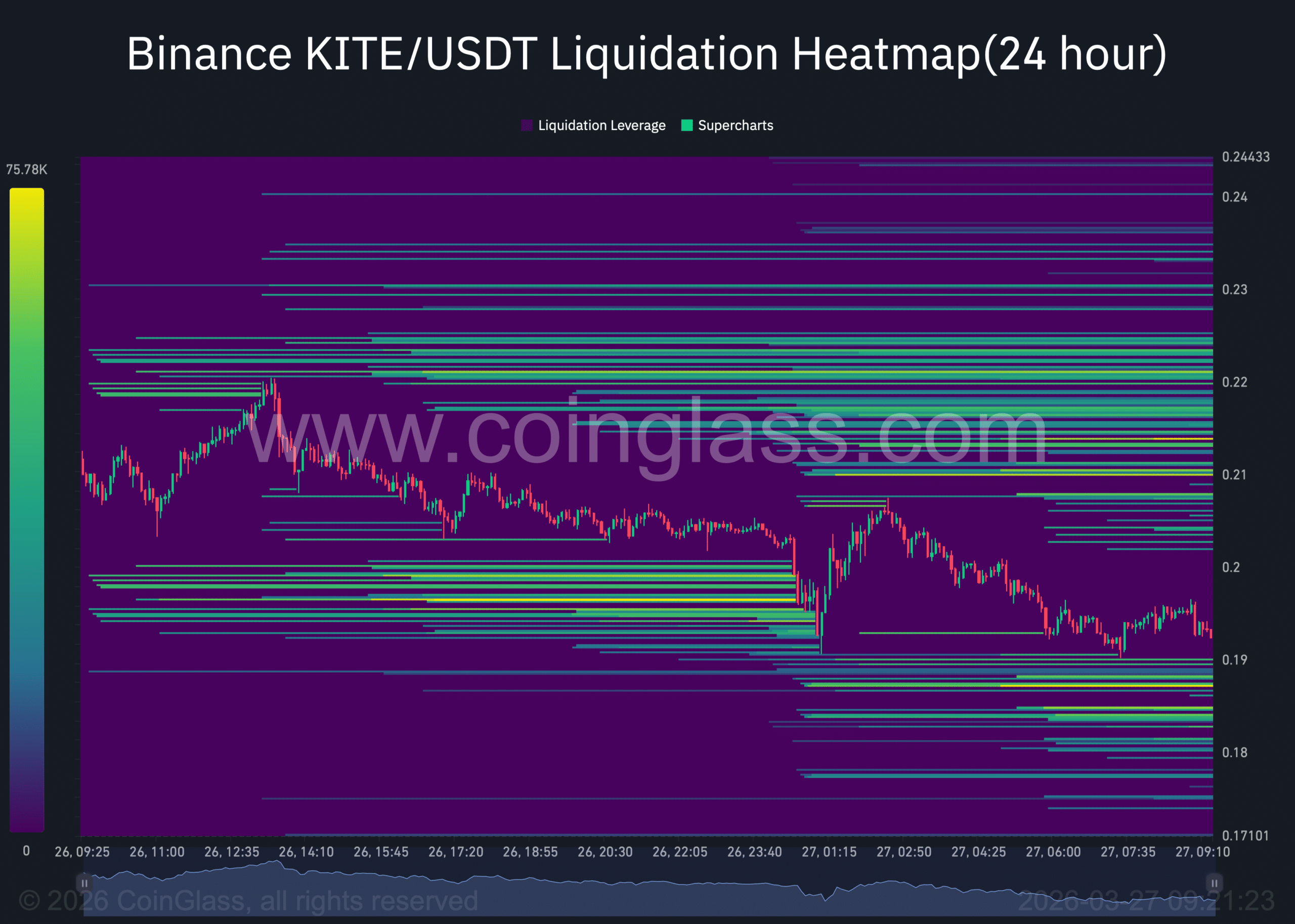
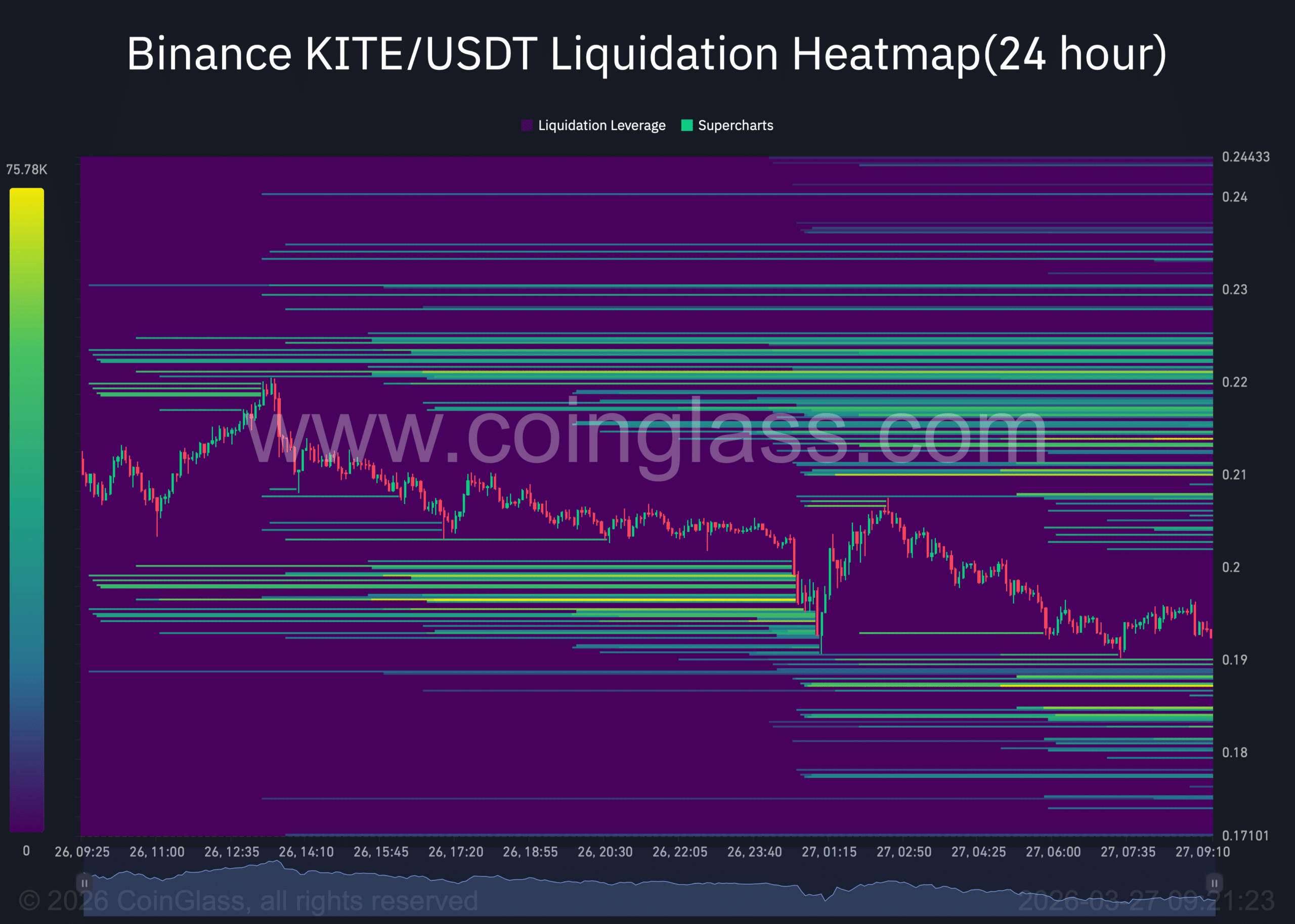
Source: CoinGlass

If KITE stabilizes and rebounds from this region, it could target a recovery toward the $0.23–$0.24 range. However, given the prevailing bearish momentum and increasing short pressure, the probability of further downside remains higher for now.


Final Summary

  • KITE’s holder count continues to decline after reaching an all-time high on March 24, coinciding with a $57 million drop in market capitalization.
  • Perpetual traders are reinforcing the downtrend, with short contracts rising to levels last seen weeks ago.


Пов'язані питання

QWhat is the main reason behind KITE's recent price decline according to the article?

AThe main reason is deteriorating fundamentals, including a sharp drop in holder count and an imbalance between the elevated circulating supply of 1.8 billion tokens and shrinking holder demand.

QHow has the number of KITE holders changed since its peak on March 24th?

AThe holder count has dropped from a peak of 105,420 on March 24th to 104,780 at the time of writing.

QWhat does the negative Open Interest Weighted Funding Rate indicate for the perpetual futures market?

AA sharply negative funding rate of -1.2420% indicates that short traders are dominant and paying long traders, reinforcing bearish sentiment in the market.

QWhat price level does liquidity data suggest KITE gravitate towards in the short term?

ALiquidity data suggests a potential move toward $0.175, where a concentration of unfilled orders exists.

QWhat was the percentage loss in KITE's price over the 24 hours preceding the article?

AKITE posted a double-digit loss of 11% over the past 24 hours as of writing.

Пов'язані матеріали

In Jinjiang, Fujian, a Storage Super Unicorn Lies Quiet

In Fujian's Jinjiang, a city known for sportswear, lies a quiet semiconductor giant: Fujian Jinhua Integrated Circuit Co. (JHICC). Once a promising domestic DRAM manufacturer alongside Yangtze Memory and ChangXin Memory Technologies (CXMT), its journey was derailed in 2018 when the U.S. placed it on an Entity List and filed criminal charges for alleged trade secret theft. This halted production for years. A turning point came in February 2024 when a U.S. federal court found JHICC not guilty. However, it had lost crucial time. While CXMT soared to become a top-valued A-share company in 2024, JHICC, with an estimated valuation of 80 billion RMB, was just restarting. Its current output is primarily customized DDR4 chips, not the advanced DDR5/HBM demanded for AI, but it still benefits from the broader memory chip upcycle. JHICC's story is tied to Chen Zhengkun, a veteran engineer who left Micron to lead the venture. Founded in 2016 with state-backed funding, JHICC partnered with Taiwan's UMC to develop DRAM technology. Rapid progress was cut short by the U.S. actions, which Micron initiated, partly due to its heavy reliance on the Chinese market. Post-sanctions, Chen's team worked to rebuild the production line with reduced reliance on U.S. technology. According to its records, JHICC achieved small-scale production and revenue growth under immense pressure. It now focuses on the stable "niche" DRAM market (e.g., TVs, routers) with a monthly capacity of ~40,000 wafers, aiming for 60,000 by 2026. It holds over 1,000 patents but remains on the Entity List. For Jinjiang, investing in JHICC was a bold industrial leap. The local government provided unwavering financial and logistical support during the crisis, helping the company survive. JHICC has become the anchor for a growing local semiconductor cluster. Though its scale lags behind domestic peers, JHICC's persistence symbolizes a hard-won foothold in a global market long dominated by Samsung, SK Hynix, and Micron. Having missed one boom, it seeks a place in the new AI-driven memory supercycle.

marsbit1 год тому

In Jinjiang, Fujian, a Storage Super Unicorn Lies Quiet

marsbit1 год тому

Торгівля

Спот
活动图片




