Kelp DAO Hack: Aave DAO Proposes To Contribute 25,000 ETH To Recovery Efforts

bitcoinistОпубліковано о 2026-04-25Востаннє оновлено о 2026-04-25

Анотація

Aave DAO has proposed contributing 25,000 ETH from its treasury to a coordinated recovery effort following a major exploit on Kelp DAO. The attack, which occurred on April 18, targeted Kelp's rsETH Ethereum LayerZero adapter, resulting in a loss of approximately 163,183 ETH. Through frozen assets, recovered funds, and expected liquidations, over half the deficit has been covered, but a gap of roughly 75,081 ETH remains. A coalition named "DeFi United," including pledges from EtherFi, Lido, Ethena, and a credit line from Mantle, is mobilizing to restore the system. Aave's anchored contribution is a key part of this effort to reintroduce liquidity and fully back the affected tokens.

Aave DAO has unveiled a proposal to deploy 25,000 ETH from its treasury to support a coordinated recovery effort following the recent Kelp DAO exploit. The move forms part of a broader “DeFi United” initiative aimed at restoring user funds and stabilizing affected lending markets.

On April 18, KelpDAO suffered a major attack targeted at its rsETH Ethereum LayerZero adapter, allowing a hacker to drain assets and break the backing relationship between locked ETH collateral and minted tokens across chains. The breach triggered a cascading liquidity and solvency challenge across DeFi platforms that integrated rsETH and its wrapped variant.

Over $160,000 ETH Gap Remains As Exploit Recovery Efforts Gain Traction

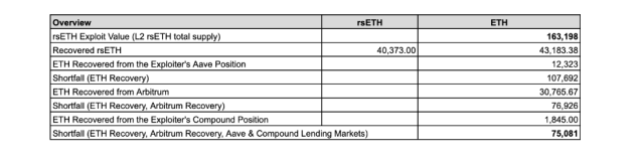
According to the Aave DAO governance proposal, the attacker stole 152,577 rsETH, which is approximately 163,183 ETH based on prevailing conversion rates. Since then, coordinated intervention by ecosystem participants has substantially reduced the gap. Kelp DAO managed to freeze 40,373 rsETH, equivalent to roughly 43,168 ETH. Additionally, the Arbitrum Security Council recovered 30,766 ETH that the attacker still held on its platform.
Source: Aave DAO

Notably, further recoveries are expected through liquidation processes on lending platforms. The attacker’s positions on Aave could yield up to 12,323 ETH, while an additional 1,845 ETH may be recovered from positions on Compound. In total, these efforts account for approximately 87,955 ETH, i.e, just over half of the original deficit. Despite this progress, a funding gap of roughly 75,081 ETH remains, resulting in a further coordinated capital injection to fully restore backing.

Aave DAO Steps In With 25,000 ETH Commitment As Coalition Mobilizes

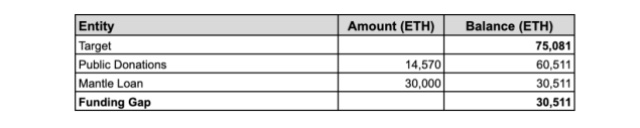
To bridge the remaining deficit, the DeFi United coalition is combining donations, credit facilities, and treasury support. So far, ecosystem contributors including EtherFi, Lido, and Ethena have pledged 14,570 ETH, while Mantle has extended a credit facility of up to 30,000 ETH.
Source: Aave DAO

Aave DAO’s proposal to contribute 25,000 ETH represents a cornerstone of this recovery stack. Notably, the contribution is “anchored,” meaning it will not be reduced by future donations. Instead, any additional funds raised will be used to repay borrowed capital, thereby limiting Aave’s long-term exposure.

The plan requires approximately 120,015 ETH (excluding 43,168 ETH immediately frozen by Kelp DAO) to be reintroduced into the LayerZero lockbox to fully restore system integrity. However, a portion of expected recoveries remains illiquid, prompting the need for short-term loan financing from ecosystem partners.

Total crypto market cap valued at $2.57 trillion on the daily chart | Source: TOTAL chart on Tradingview.com

Пов'язані питання

QWhat is the total amount of ETH that was stolen in the Kelp DAO exploit, and what is the remaining funding gap after recovery efforts?

AThe attacker stole 152,577 rsETH, which is approximately 163,183 ETH. After recovery efforts, including frozen funds and liquidations, a funding gap of roughly 75,081 ETH remains.

QWhat is the role of the 'DeFi United' initiative mentioned in the proposal?

AThe 'DeFi United' initiative is a coordinated effort aimed at restoring user funds and stabilizing affected lending markets by combining donations, credit facilities, and treasury support from various ecosystem participants.

QHow much ETH has Aave DAO specifically proposed to contribute, and what is the nature of this contribution?

AAave DAO has proposed to contribute 25,000 ETH from its treasury. This contribution is 'anchored,' meaning it will not be reduced by future donations and any additional funds raised will be used to repay borrowed capital to limit Aave's long-term exposure.

QWhich other major ecosystem participants have pledged support, and what are their contributions?

AEcosystem contributors including EtherFi, Lido, and Ethena have collectively pledged 14,570 ETH. Additionally, Mantle has extended a credit facility of up to 30,000 ETH.

QWhat specific mechanism of the KelpDAO protocol was targeted in the attack on April 18?

AThe attack targeted KelpDAO's rsETH Ethereum LayerZero adapter, which allowed the hacker to drain assets and break the backing relationship between locked ETH collateral and minted tokens across chains.

Пов'язані матеріали

OpenAI Post-Training Engineer Weng Jiayi Proposes a New Paradigm Hypothesis for Agentic AI

OpenAI engineer Weng Jiayi's "Heuristic Learning" experiments propose a new paradigm for Agentic AI, suggesting that intelligent agents can improve not just by training neural networks, but also by autonomously writing and refining code based on environmental feedback. In the experiment, a coding agent (powered by Codex) was tasked with developing and maintaining a programmatic strategy for the Atari game Breakout. Starting from a basic prompt, the agent iteratively wrote code, ran the game, analyzed logs and video replays to identify failures, and then modified the code. Through this engineering loop of "code-run-debug-update," it evolved a pure Python heuristic strategy that achieved a perfect score of 864 in Breakout and performed competitively with deep reinforcement learning (RL) algorithms in MuJoCo control tasks like Ant and HalfCheetah. This approach, termed Heuristic Learning (HL), contrasts with Deep RL. In HL, experience is captured in readable, modifiable code, tests, logs, and configurations—a software system—rather than being encoded solely into opaque neural network weights. This offers potential advantages in explainability, auditability for safety-critical applications, easier integration of regression tests to combat catastrophic forgetting, and more efficient sample use in early learning stages, as demonstrated in broader tests on 57 Atari games. However, the blog acknowledges clear limitations. Programmatic strategies struggle with tasks requiring long-horizon planning or complex perception (e.g., Montezuma's Revenge), areas where neural networks excel. The future vision is a hybrid architecture: specialized neural networks for fast perception (System 1), HL systems for rules, safety, and local recovery (also System 1), and LLM agents providing high-level feedback and learning from the HL system's data (System 2). The core proposition is that in the era of capable coding agents, a significant portion of an AI's learned experience could be maintained as an auditable, evolving software system.

marsbit30 хв тому

OpenAI Post-Training Engineer Weng Jiayi Proposes a New Paradigm Hypothesis for Agentic AI

marsbit30 хв тому

Your Claude Will Dream Tonight, Don't Disturb It

This article explores the recent phenomenon of AI companies increasingly using anthropomorphic language—like "thinking," "memory," "hallucination," and now "dreaming"—to describe machine learning processes. Focusing on Anthropic's newly announced "Dreaming" feature for its Claude Agent platform, the piece explains that this function is essentially an automated, offline batch processing of an agent's operational logs. It analyzes past task sessions to identify patterns, optimize future actions, and consolidate learnings into a persistent memory system, akin to a form of reinforcement learning and self-correction. The article draws parallels to similar features in other AI agent systems like Hermes Agent and OpenClaw, which also implement mechanisms for reviewing historical data, extracting reusable "skills," and strengthening long-term memory. It notes a key difference from human dreaming: these AI "dreams" still consume computational resources and user tokens. Further context is provided by discussing the technical challenges of managing AI "memory" or context, highlighting the computational expense of large context windows and innovations like Subquadratic's new model claiming drastically longer contexts. The core critique argues that this strategic use of human-centric vocabulary does more than market products; it subtly reshapes user perception. By framing algorithms with terms associated with consciousness, companies blur the line between tool and autonomous entity. This linguistic shift can influence user expectations, tolerance for errors, and even perceptions of responsibility when systems fail, potentially diverting scrutiny from the companies and engineers behind the technology. The article concludes by speculating that terms like "daydreaming" for predictive task simulation might be next, continuing this trend of embedding the idea of an "inner life" into computational processes.

marsbit32 хв тому

Your Claude Will Dream Tonight, Don't Disturb It

marsbit32 хв тому

Торгівля

Спот
Ф'ючерси

Популярні статті

Як купити DAO

Ласкаво просимо до HTX.com! Ми зробили покупку DAO Maker (DAO) простою та зручною. Дотримуйтесь нашої покрокової інструкції, щоб розпочати свою криптовалютну подорож.Крок 1: Створіть обліковий запис на HTXВикористовуйте свою електронну пошту або номер телефону, щоб зареєструвати обліковий запис на HTX безплатно. Пройдіть безпроблемну реєстрацію й отримайте доступ до всіх функцій.ЗареєструватисьКрок 2: Перейдіть до розділу Купити крипту і виберіть спосіб оплатиКредитна/дебетова картка: використовуйте вашу картку Visa або Mastercard, щоб миттєво купити DAO Maker (DAO).Баланс: використовуйте кошти з балансу вашого рахунку HTX для безперешкодної торгівлі.Треті особи: ми додали популярні способи оплати, такі як Google Pay та Apple Pay, щоб підвищити зручність.P2P: Торгуйте безпосередньо з іншими користувачами на HTX.Позабіржова торгівля (OTC): ми пропонуємо індивідуальні послуги та конкурентні обмінні курси для трейдерів.Крок 3: Зберігайте свої DAO Maker (DAO)Після придбання DAO Maker (DAO) збережіть його у своєму обліковому записі на HTX. Крім того, ви можете відправити його в інше місце за допомогою блокчейн-переказу або використовувати його для торгівлі іншими криптовалютами.Крок 4: Торгівля DAO Maker (DAO)Легко торгуйте DAO Maker (DAO) на спотовому ринку HTX. Просто увійдіть до свого облікового запису, виберіть торгову пару, укладайте угоди та спостерігайте за ними в режимі реального часу. Ми пропонуємо зручний досвід як для початківців, так і для досвідчених трейдерів.

166 переглядів усьогоОпубліковано 2024.12.11Оновлено 2025.03.21

Як купити DAO

Обговорення

Ласкаво просимо до спільноти HTX. Тут ви можете бути в курсі останніх подій розвитку платформи та отримати доступ до професійної ринкової інформації. Нижче представлені думки користувачів щодо ціни DAO (DAO).

活动图片