KBank Signals Major Crypto Push With Stablecoin Wallet Trademarks as $SUBBD Reshapes Creator Economy

bitcoinistОпубліковано о 2026-02-03Востаннє оновлено о 2026-02-03

Анотація

Thailand's Kasikornbank (KBank) is strengthening its digital asset infrastructure by filing trademarks for digital wallets and stablecoin solutions, signaling a major institutional push into blockchain. This move aims to modernize payments and capture digital capital flows in Southeast Asia. Simultaneously, the $85 billion creator economy is shifting toward decentralization. SUBBD Token ($SUBBD) is highlighted as an AI-powered platform built on Ethereum that reduces fees and gives creators more control. It integrates AI tools for content generation and community management, alongside a staking system offering 20% APY to incentivize holders. The project has raised over $1.4 million in its presale, reflecting strong demand for utility-driven Web3 applications.

Thailand’s second-largest lender, Kasikornbank (KBank), is quietly fortifying its digital asset infrastructure.

The banking giant isn’t just tinkering; trademark filings show they are securing IP rights for digital wallets and stablecoin solutions right before the anticipated IPO of their asset management arm. This isn’t just a technical upgrade; it’s a signal that institutional banking is finally getting serious about integrating blockchain rails.

KBank seems to be prepping for a future where crypto is a daily medium of exchange, not just a speculative toy. By locking down these trademarks now, the bank is effectively hedging against the slow death of legacy SWIFT systems to capture digital capital flows across Southeast Asia.

Why does that matter? Simple: institutional validation usually precedes mass utility. When banks build the wallet infrastructure, they’re essentially rolling out the red carpet for the applications built on top of it.

But while banks focus on the ‘rails’, the actual movement of money, the real innovation is happening at the application layer. Specifically, where AI meets decentralized finance. The $85B content creation industry is undergoing a similar overhaul.

Just as KBank wants to bypass legacy payment friction, new ecosystems are cutting out the restrictive fee structures of Web2 platforms. This shift from centralized control to decentralized utility is bridging the gap between institutional adoption and retail use. That’s why investors are looking closely at AI-powered challengers like SUBBD Token ($SUBBD).

AI-Driven Platforms Decentralize The $85B Creator Economy

While giants like KBank modernize the back end, the front-end user experience is shifting toward creator sovereignty. Frankly, the current model looks predatory. Legacy platforms often extract fees ranging from 20% to 70% of a creator’s earnings while retaining the right to de-platform users on a whim. The inefficiency is glaring: intermediaries are extracting massive value without contributing proportional utility.

SUBBD Token ($SUBBD) tackles this by merging the Ethereum blockchain with advanced AI tools. The goal?

Return control to the creators. By using an ERC-20 token for transactions, the ecosystem cuts out high banking fees and payment processor delays—the very friction points KBank’s stablecoin initiatives aim to solve institutionally.

But SUBBD goes beyond payments. It integrates proprietary AI models for content generation (think AI Voice Cloning and AI Influencer Creation), allowing creators to scale their output without exploding their labor costs.

The addition of an AI Personal Assistant for automated interactions signals a major shift in how influencers manage community engagement. Instead of manual replies, AI tools handle the grunt work, optimizing revenue streams through subscriptions, pay-per-view (PPV), and NFT sales. (For creators, this means transforming a passive audience into an active, token-gated economy.)

Governance rights further distinguish this model. Token holders vote on feature rollouts and community events, ensuring the platform evolves based on user needs rather than shareholder mandates.

LEARN MORE ABOUT $SUBBD WITH OUR ‘WHAT IS SUBBD TOKEN?’ GUIDE.

$SUBBD Presale Momentum Highlights Demand For Yield-Bearing Web3 Utilities

The market’s appetite for utility-driven AI projects is obvious in recent capital inflows. Smart money is watching early-stage valuations closely, hunting for assets that offer both technological innovation and incentives for long-term holding. SUBBD has already secured over $1.4M in its ongoing presale, a figure that suggests robust confidence in the roadmap, even with broader market volatility.

Currently priced at $0.05749, the token offers an entry point that contrasts sharply with the saturated valuations of established AI cryptos. The project’s economic model is built for retention.

To mitigate the volatility often seen with new utility tokens, SUBBD offers a staking protocol with a fixed 20% APY for the first year. This high-yield structure does double duty: it rewards early adopters for locking liquidity and stabilizes the token’s circulating supply during the critical initial growth phase.
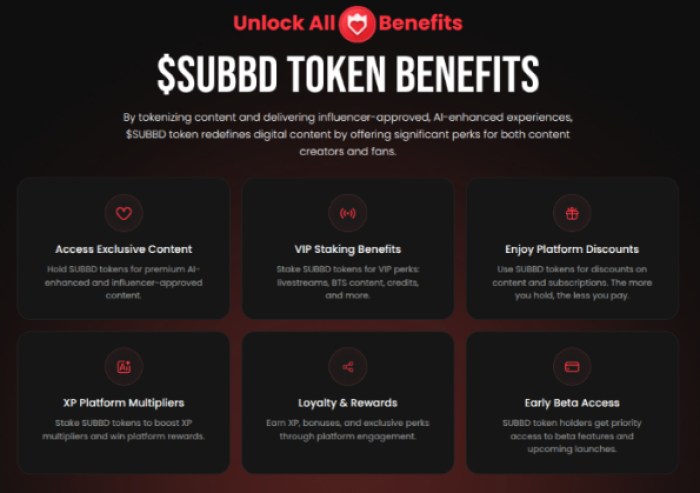
Source: SUBBD Token

But it’s not just about yield. For fans, staking unlocks tiered platform benefits, including access to exclusive livestreams and ‘HoneyHive’ membership. This gamification of finance, where holding a token grants both interest and experiential access, is fast becoming the standard for successful Web3 launches.

As institutional giants like KBank build the stablecoin highways, projects like SUBBD are building the high-speed vehicles that give users a reason to drive on them.

VISIT THE OFFICIAL $SUBBD PRESALE SITE.

This article is not financial advice. Cryptocurrency investments, including presales and AI tokens, carry inherent risks. Always conduct independent research before making investment decisions.


Трендові криптовалюти

Пов'язані питання

QWhat is Kasikornbank (KBank) doing to strengthen its position in the digital asset space according to the article?

AKasikornbank (KBank) is fortifying its digital asset infrastructure by filing trademarks for digital wallets and stablecoin solutions, signaling a serious institutional push to integrate blockchain technology and capture digital capital flows in Southeast Asia.

QHow does the SUBBD Token ($SUBBD) aim to benefit content creators?

ASUBBD Token ($SUBBD) aims to return control to creators by using an ERC-20 token to cut out high banking fees and payment processor delays. It also integrates AI tools for content generation and community management, and allows token holders to participate in governance.

QWhat specific AI tools does the SUBBD ecosystem integrate for creators?

AThe SUBBD ecosystem integrates proprietary AI models for AI Voice Cloning and AI Influencer Creation, as well as an AI Personal Assistant for automated interactions to help creators scale their output and manage community engagement.

QWhat financial incentive does SUBBD offer to early token holders?

ASUBBD offers a staking protocol with a fixed 20% APY for the first year to reward early adopters, lock liquidity, and stabilize the token's circulating supply during its initial growth phase.

QHow much funding has SUBBD secured in its ongoing presale, and what does this indicate?

ASUBBD has secured over $1.4 million in its ongoing presale, indicating robust market confidence in its roadmap and demand for utility-driven AI projects despite broader market volatility.

Пов'язані матеріали

From South Korea to the United States: Blue-Collar Jobs Are Becoming Increasingly Popular, Thanks to AI

AI is reshaping the labor market's value proposition. The traditional four-year college degree is losing its appeal as a guaranteed career path, while skilled blue-collar trades like electricians, welders, and plumbers are experiencing historic demand and wage premiums. This shift is driven by dual pressures: AI's displacement of certain white-collar roles and a booming need for physical infrastructure and data center construction. Data confirms the trend. In the U.S., vocational school revenue surged, and a significant portion of recent layoffs are AI-related. Surveys show a majority of Gen Z adults plan to pursue blue-collar work, citing better job security against AI automation. Vocational education interest has exploded recently. Experts cite a psychological shift as younger generations seek tangible, AI-resistant careers and avoid high student debt. In many cases, salaries for skilled trades now match or exceed those requiring a bachelor's degree. In South Korea, semiconductor vocational high schools boast near-total employment, with graduates securing high-paying roles at companies like Samsung. The shortage is structural, exacerbated by a retiring baby boomer workforce and massive infrastructure projects. Companies like JPMorgan Chase, Meta, and Lowe's are investing heavily in training programs. However, overcoming historical stigma and a "perception gap" around trade careers remains a key challenge to closing the talent gap.

marsbit30 хв тому

From South Korea to the United States: Blue-Collar Jobs Are Becoming Increasingly Popular, Thanks to AI

marsbit30 хв тому

Qualcomm: AI Hype Subsides, When Will Smartphones Emerge from the Gloom?

Qualcomm reported its Q3 FY2026 results (ending June 2026), with revenue of $9.95B, down 4% YoY but above expectations. Gross margin declined to 53.1%, pressured by rising costs across manufacturing and memory. Key business segments showed mixed performance: Handset revenue fell 19.6% YoY to $5.09B, dragged by an 11% decline in non-Apple Android shipments and weaker high-end mix. Conversely, Automotive revenue surged 61% to $1.59B, and IoT grew 9% to $1.83B. Core operating profit dropped 41% YoY due to margin compression and higher expenses. Management's Q4 FY2026 guidance projects revenue of $9.7B-$10.5B, in line with consensus, but Non-GAAP EPS guidance of $2.05-$2.25 fell short of expectations. Amidst persistent weakness in its core handset market, Qualcomm is pursuing growth in AI, focusing on Edge AI (smartphones, PCs, automotive) and Data Center AI. Its data center strategy includes four pillars: AI accelerators (e.g., AI200), commercial CPUs (Dragonfly C1000), custom silicon, and connectivity solutions. While these initiatives initially boosted its stock, concerns over AI capital expenditure sustainability have since erased those gains. The company targets $5B in data center revenue for FY2027 and $15B for FY2029. The report concludes that with the traditional handset business still under pressure, the data center opportunity is currently viewed as a longer-term option, and a more conservative valuation based on core operations may be warranted until AI contributions materialize.

marsbit34 хв тому

Qualcomm: AI Hype Subsides, When Will Smartphones Emerge from the Gloom?

marsbit34 хв тому

From TPU to Self-Evolving Agents: How Jeff Dean Predicts the Next Step in AI

At the 2026 YC Startup School, Jeff Dean outlined his vision for AI's next phase, shifting focus from simply scaling models to building intelligent, autonomous systems. He believes AI's progress is no longer just about creating smarter models, but about integrating them into systems capable of long-term, iterative work, automated experimentation, and continuous learning. This evolution moves the competition from "who has the bigger model" to "who can best organize intelligence." Dean suggests AI capabilities are now comparable to a junior engineer, enabling the automation of complex workflows. However, the true challenge and opportunity lie in managing these AI "workers" at scale. He emphasizes the importance of **context engineering**—structuring tools, memory, and feedback loops—over raw model power. For startups, this means building deep expertise in niche domains where general models currently fail (near 0-1% success rates), leveraging proprietary data, specialized tools, and domain-specific evaluators. A recurring theme is re-examining fundamental constraints. Dean's past work, like moving Google's search index to memory or creating the TPU, stemmed from questioning outdated assumptions about hardware and cost. He sees similar inflection points today, particularly in **specialized inference hardware** to drastically reduce latency and energy consumption for real-time Agent operation. Notably, he points out that in modern AI systems, the dominant cost is often not computation but **data movement**. Reliable, long-running Agents require robust system design, borrowing concepts from distributed computing like checkpointing, state management, and parallel exploration to handle failures and maintain progress over days or weeks. As AI automates execution, the scarcest human skills will shift to **defining clear specifications**, **judging what problems are worth solving** (taste), and designing effective feedback loops. Ultimately, Dean's framework prioritizes understanding the problem deeply, identifying the true bottlenecks, and systematically building closed-loop systems where AI can not only perform tasks but also improve AI itself.

marsbit34 хв тому

From TPU to Self-Evolving Agents: How Jeff Dean Predicts the Next Step in AI

marsbit34 хв тому

Торгівля

Спот

Популярні статті

Як купити PUSH

Ласкаво просимо до HTX.com! Ми зробили покупку Push Protocol (PUSH) простою та зручною. Дотримуйтесь нашої покрокової інструкції, щоб розпочати свою криптовалютну подорож.Крок 1: Створіть обліковий запис на HTXВикористовуйте свою електронну пошту або номер телефону, щоб зареєструвати обліковий запис на HTX безплатно. Пройдіть безпроблемну реєстрацію й отримайте доступ до всіх функцій.ЗареєструватисьКрок 2: Перейдіть до розділу Купити крипту і виберіть спосіб оплатиКредитна/дебетова картка: використовуйте вашу картку Visa або Mastercard, щоб миттєво купити Push Protocol (PUSH).Баланс: використовуйте кошти з балансу вашого рахунку HTX для безперешкодної торгівлі.Треті особи: ми додали популярні способи оплати, такі як Google Pay та Apple Pay, щоб підвищити зручність.P2P: Торгуйте безпосередньо з іншими користувачами на HTX.Позабіржова торгівля (OTC): ми пропонуємо індивідуальні послуги та конкурентні обмінні курси для трейдерів.Крок 3: Зберігайте свої Push Protocol (PUSH)Після придбання Push Protocol (PUSH) збережіть його у своєму обліковому записі на HTX. Крім того, ви можете відправити його в інше місце за допомогою блокчейн-переказу або використовувати його для торгівлі іншими криптовалютами.Крок 4: Торгівля Push Protocol (PUSH)Легко торгуйте Push Protocol (PUSH) на спотовому ринку HTX. Просто увійдіть до свого облікового запису, виберіть торгову пару, укладайте угоди та спостерігайте за ними в режимі реального часу. Ми пропонуємо зручний досвід як для початківців, так і для досвідчених трейдерів.

628 переглядів усьогоОпубліковано 2024.12.13Оновлено 2026.06.02

Як купити PUSH

Обговорення

Ласкаво просимо до спільноти HTX. Тут ви можете бути в курсі останніх подій розвитку платформи та отримати доступ до професійної ринкової інформації. Нижче представлені думки користувачів щодо ціни PUSH (PUSH).

活动图片












