Kalshi's Pre-IPO Stock Price Soars, Is It Still Time to Buy?

marsbitОпубліковано о 2026-01-29Востаннє оновлено о 2026-01-29

Анотація

Kalshi, a leading US-regulated prediction market platform, has seen its pre-IPO stock price surge by 21.7% in the past 30 days, significantly outperforming major cryptocurrencies like BTC and ETH. The prediction market sector is experiencing explosive growth, with total trading volume exceeding $50 billion in 2025. Kalshi reported a record $23.8 billion in annual trading volume for 2025, a 12x year-over-year increase, and is projected to reach a monthly trading volume of $9.1 billion in January 2026. The platform's rapid growth has attracted significant capital, including a $1 billion funding round led by Paradigm, valuing the company at $11 billion. Pre-IPO share prices for Kalshi vary across platforms, ranging from $307 on Nasdaq Private Market to $450 on crypto-native marketplaces. The article analyzes whether investing in Kalshi's pre-IPO shares remains a viable opportunity given its meteoric rise and market dominance.

Original|Odaily Planet Daily(@OdailyChina)

Author|Wenser(@wenser 2010)

The scale, trading volume, and other data of the prediction markets continue to grow rapidly. The pre-IPO markets of leading platforms like Kalshi and Polymarket have also attracted significant market attention and liquidity. According to data from the PreStocks platform, Kalshi's pre-IPO stock price has surged 21.7% in the past 30 days, far exceeding the gains of mainstream cryptocurrencies like BTC and ETH over the past month.

Before the IPO cake is served, the Pre-IPO sector might be the battleground suitable for more people to participate in early. This article by Odaily Planet Daily will analyze whether the pre-IPO market for prediction market stocks is worth a heavy bet from the perspectives of industry track, platform data, and capital valuation.

Behind the Judgment "Prediction Markets Still Have 100x Upside Potential": Total Trading Volume Exceeds $50 Billion in 2025

Last August, 1confirmation founder Nick Tomaino boldly claimed that "prediction market trading volume will grow 100 times."

At that time, the "twin stars of prediction markets," Polymarket and Kalshi, had not yet secured financing above the $1 billion level, their valuations were far from the $10 billion scale, and the overall trading volume of prediction markets in July was less than $2 billion, nearly halved compared to the historical high of over $4 billion in October 2024. The judgment of 100x growth space seemed like nonsense.

But soon, in October 2025, Polymarket officially announced a $20 billion investment from ICE Group, the parent company of the NYSE, skyrocketing its valuation to $9 billion, and later sought a new round of financing at $12-15 billion; Kalshi completed 2 rounds of financing between October and December, with the latest round reaching $1 billion, surging its valuation to $11 billion, led by Paradigm, with participation from Sequoia, a16z, Meritech Capital, IVP, ARK Invest, Anthos Capital, CapitalG, and Y Combinator.

Behind the capital's fervent pursuit is the rapid and vigorous development of prediction markets.

According to data from our previously published article "2025 Prediction Market Review: Total Trading Volume Exceeds $50 Billion, Dual Giants Account for Over 97.5% Market Share":

  1. In September 2025, the combined trading volume of Kalshi and Polymarket reached $1.44 billion;
  2. In October 2025, prediction market trading volume reached $8.7 billion, with Kalshi leading and Polymarket following;
  3. In November 2025, the combined trading volume of Kalshi and Polymarket approached $10 billion, with Kalshi's trading volume reaching $5.8 billion, a 32% month-on-month increase; Polymarket's trading volume reached $3.74 billion, a 23.8% month-on-month increase.
  4. In December 2025, analyst Patrick Scott stated that prediction market trading volume exceeded $13 billion in November 2025, more than three times the trading volume during the peak of the 2024 election.

Thus, in just a few months, the overall monthly trading volume of prediction markets increased about 6 times. From this perspective, 100x growth is not out of reach.

After all, 100 times $2 billion is only $200 billion. Compared to the total trading volume of over $50 billion in prediction markets in 2025, it only requires a 4x growth. Behind such rapid growth is the frenzied advancement of Kalshi, this US-compliant prediction market platform.

Kalshi Aims to Become the "Leading Stock in Prediction Markets": 2025 Trading Volume Nearly $24 Billion, January Volume Expected to Reach $9 Billion

The emphasis on Kalshi's "compliant status in the US market" is because, based on its various licenses and compliance preparations, the door to an IPO is easier for Kalshi to push open. Furthermore, as a pioneer in the prediction market platform founded in 2018 (Odaily Planet Daily Note: The platform officially launched in July 2021, slightly later than Polymarket), Kalshi's business growth in recent years has been extremely impressive.

Kalshi's 2025 Report Card: Annual Trading Volume $23.8 Billion, Number of Trades Reached 97 Million

KalshiData previously stated that in 2025, all of Kalshi's metrics achieved record growth.

  • In terms of nominal trading volume, the annual total reached $23.8 billion, a year-on-year increase of 1108%, approximately 12.1 times. December set a monthly historical high of $6.38 billion, the 4th week of December set a weekly historical high of $1.7 billion, and December 21st set a daily historical high of $381.7 million.
  • In terms of the number of trades, the annual total reached 97 million, a year-on-year increase of 1680%, approximately 17.8 times. December saw 27.67 million trades, the 4th week of December had 7.6 million trades, and December 21st had 1.5 million trades, all setting historical highs.

As we entered 2026, the growth of Kalshi's business data can be described as terrifying.

Kalshi's Business Surge: January 2026 Nominal Trading Volume Expected to Exceed $9 Billion

On December 16, 2025, Kalshi CEO Tarek Mansour stated that with the launch of the Combo feature, the platform's single-day trading volume hit a historical high of $340 million;

On January 12, 2026, the single-day trading volume of prediction markets grew to approximately $702 million, setting a new historical high; among which, Kalshi accounted for approximately $465 million, about two-thirds of the total, while Polymarket and Opinion collectively contributed about $100 million in trading volume.

On January 26, KalshiData stated that as of January 23, Kalshi's monthly nominal trading volume was approximately $6.7 billion, with a daily average trading volume of approximately $293 million. If the current pace is maintained, Kalshi's nominal trading volume in January is expected to reach approximately $9.1 billion.

It is worth mentioning that last October, the overall trading volume of prediction markets was $8.7 billion, with Kalshi's market share around 45%-55% ; now, the monthly trading volume of just the Kalshi platform exceeds the overall market size at that time. This reflects both the红利期 (dividend period) of the prediction market整体 being in a时代风口 (era wind vent), and also shows the可怕 (terrifying) business growth rate of Kalshi.
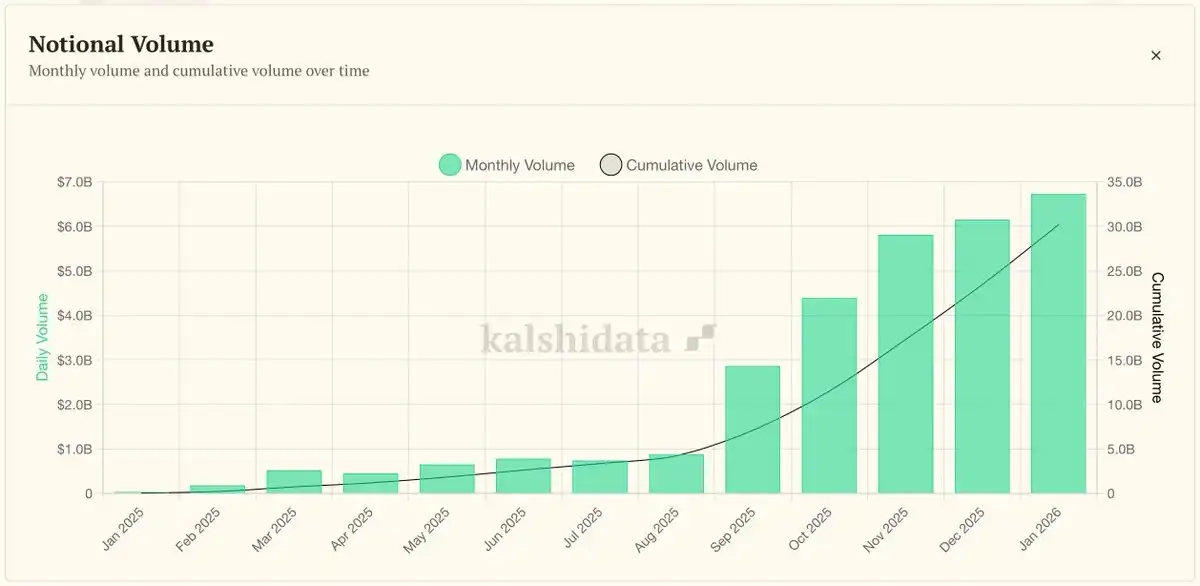
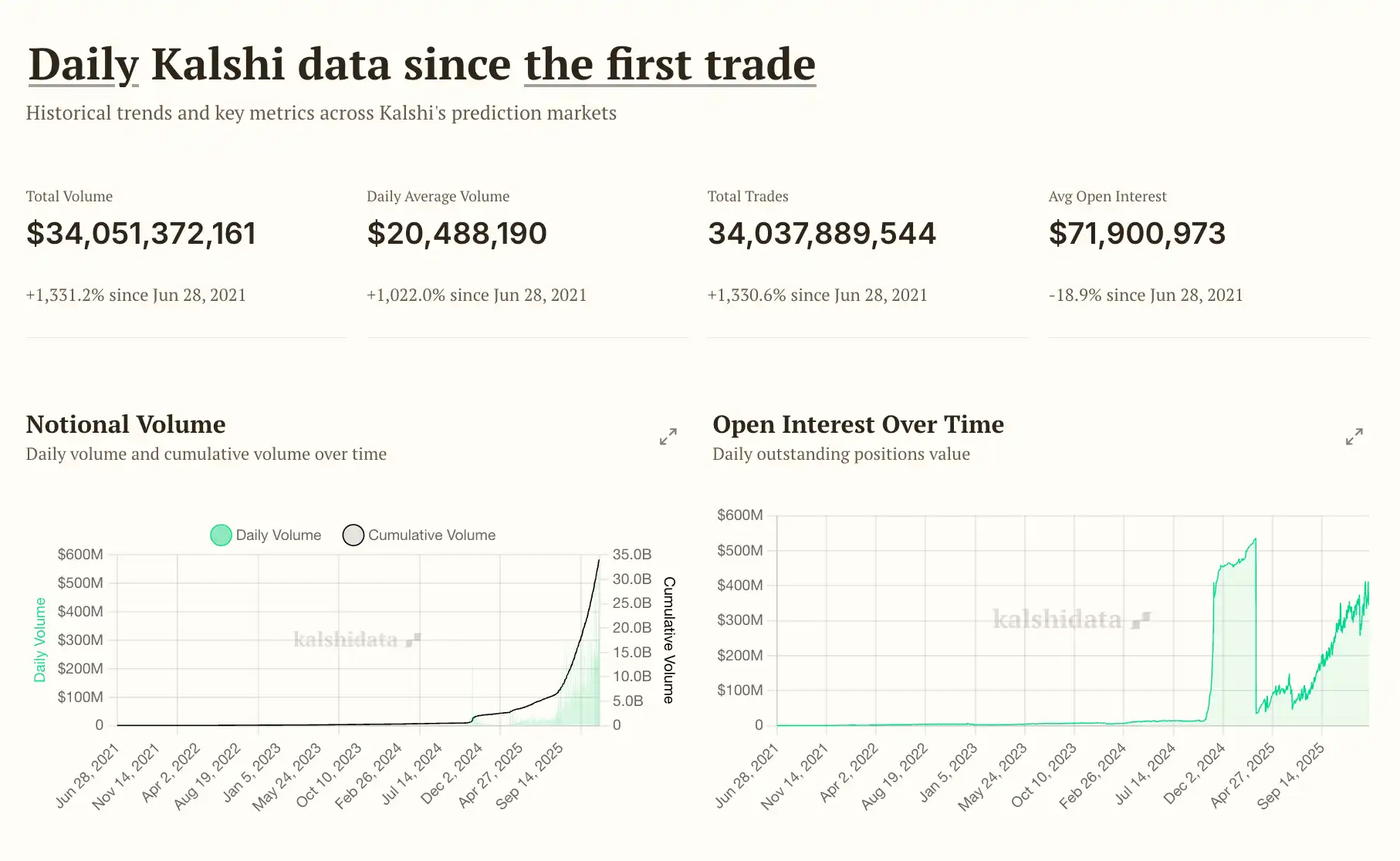
According to data from the KalshiData website, as of January 29, Kalshi's historical total trading volume exceeded $34.05 billion, with a daily average trading volume exceeding $20.48 million; looking at its nominal trading volume K-line chart, it has grown almost exponentially since September 2025.
Capital Market Pricing Range: Kalshi Single Share Price is $300-$450

Finally, as the current number one prediction market platform, although Kalshi's specific IPO time and number of shares issued have not been determined,结合 (combining) its previous financing news and external statements, an IPO is a certainty. Currently, there are many divergences in the pre-IPO market pricing of its stocks between traditional financial markets and cryptocurrency markets:

The pre-IPO market in traditional financial markets prices Kalshi's stock relatively lower——

  • On Nasdaq Private Market, Kalshi's single share is priced around $307;
  • On Hiive, Kalshi's single share is priced around $357.

The pre-IPO market in cryptocurrency markets prices Kalshi's stock relatively higher——

  • On PreStocks, Kalshi's implied market capitalization is approximately $14 billion, with a single share price of about $407;
  • On Jarsy, Kalshi's market valuation is $11 billion, with a单独 (separate) pricing of $450 per share.

In the next article, Odaily Planet Daily will analyze in detail the price range worth buying for Kalshi's pre-IPO stock market, dissecting the investment opportunities in prediction market stocks from the perspective of the pre-IPO market.


Пов'язані питання

QWhat is the recent pre-market stock price performance of Kalshi, and how does it compare to major cryptocurrencies?

AAccording to PreStocks platform data, Kalshi's pre-market stock price has surged by 21.7% in the last 30 days, significantly outperforming the gains of major cryptocurrencies like BTC and ETH over the same period.

QWhat was the total trading volume for the prediction market in 2025, and what growth does this represent?

AThe total trading volume for the prediction market in 2025 exceeded $50 billion. This represents a period of rapid, explosive growth for the sector.

QWhat are the key business metrics that demonstrate Kalshi's rapid growth in 2025?

AIn 2025, Kalshi's annual trading volume reached $23.8 billion, a 1108% year-over-year increase. The platform also processed 97 million trades, a 1680% increase from the previous year.

QWhat is the projected trading volume for Kalshi in January 2026, and what record did it recently set?

AKalshi is projected to reach a monthly nominal trading volume of approximately $9.1 billion in January 2026. The platform recently set a new single-day trading volume record of approximately $465 million on January 12th, 2026.

QWhat is the current pre-IPO valuation and share price range for Kalshi across different markets?

AKalshi's pre-IPO valuation and share price vary by market. On traditional financial platforms like Nasdaq Private Market and Hiive, the share price is around $307 and $357, implying a lower valuation. On crypto-native platforms like PreStocks and Jarsy, the implied valuation is higher, with share prices around $407 (implied $14B valuation) and $450 (implied $110B valuation), respectively.

Пов'язані матеріали

9.42 Million Retail Investors Compete for Changxin Technology, Who Got Allotted?

Evergreen Technology's IPO subscription results are now available. On July 20, the domestic memory chip giant announced the offline preliminary allotment results and online lottery results for its IPO. A total of approximately 9.43 million retail investors participated in the online subscription, generating 770,000 winning lots with a final winning rate of about 0.4714%, setting a record for new shares on the STAR Market. After triggering a clawback mechanism from institutional to retail investors, the online retail allocation was significantly increased to 3.851 billion shares. Simultaneously, 285 institutional investors participated in the offline subscription, ultimately receiving 2.173 billion shares at an allotment rate of approximately 0.1756%. Leading insurers and public funds were among the major recipients. Notably, Liang Wenfeng, founder of the major AI model company DeepSeek, through his quantitative investment firms Ningbo Huanfang Quantitative and Zhejiang Jiuzhang Asset, secured the largest share among private funds, with a total allotment worth approximately 175 million yuan. Estimates suggest potential profits could reach 730 million yuan if Evergreen Technology's market capitalization reaches 3 trillion yuan post-listing. The company is expected to list on July 27 and could become the highest-valued tech stock on the A-share market, with various brokerages providing valuations ranging from 1 trillion to over 4 trillion yuan. However, recent significant corrections in global tech stocks may impact its post-listing performance. (Character count: 1,196)

marsbit47 хв тому

9.42 Million Retail Investors Compete for Changxin Technology, Who Got Allotted?

marsbit47 хв тому

3 Million-Follower Goddess Fully AI-Synthesized, Fake Orphanage, Cross-Border ‘Fake Charity’ Collapses Overnight

An Australian influencer named Lily Jay, with nearly 3 million Instagram followers, is at the centre of a major AI-fueled charity scam. Her 'Lily Jay Foundation' claimed to build orphanages, mosques, and deliver aid in places like Uganda and Gaza, using emotionally powerful videos of herself with children. However, an investigation by ABC NEWS Verify revealed these scenes—including a key video announcing an orphanage's opening—were entirely AI-generated, complete with telltale flaws like garbled text on clothing. The foundation's 'humanitarian award' was also faked using AI images. The foundation admitted in small print on its website that it is not a registered charity, avoiding financial transparency laws. While based in Kosovo, its operations and the influencer's lavish personal lifestyle raised further red flags. Following media inquiries, the foundation selectively hid donation buttons and removed fraudulent content for Australian visitors, but kept them active internationally. Experts warn this case is a textbook example of how AI can be weaponized to exploit public trust and generosity, creating believable but entirely fabricated narratives of aid. The incident highlights the growing danger of deepfakes in eroding trust within the charitable sector, urging donors to critically verify causes before giving.

marsbit1 год тому

3 Million-Follower Goddess Fully AI-Synthesized, Fake Orphanage, Cross-Border ‘Fake Charity’ Collapses Overnight

marsbit1 год тому

L2 'Recalibration': When L1 Becomes Its Own Rollup, What Is Ethereum's Endgame?

The article discusses the evolving relationship between Ethereum's Layer 1 (L1) and Layer 2 (L2) solutions, moving beyond the initial "L2 for scaling" model. As Ethereum L1 itself scales (increasing Gas Limit, statelessness, zkEVM), the unique value proposition of L2s shifts from merely providing cheap execution to offering differentiated features like application-specific optimization, privacy, and flexible governance. The piece explores three key themes: 1. **L2's New Role:** L2s are transitioning from a pure scaling technology to a spectrum of execution environments with varying degrees of security inheritance from Ethereum L1. 2. **Interoperability as State Trust:** Solving L2 fragmentation is less about cross-chain bridges and more about enabling faster, trust-minimized state verification between environments. This involves initiatives like faster L1 finality, intent-based architectures (Open Intents Framework), and native account abstraction. 3. **Blurring Layers:** With the potential integration of zk-proofs into L1 validation (making L1 akin to its own "Rollup") and the concept of "Native Rollups," the rigid boundary between L1 and L2 may fade. The future could be a unified system with multiple execution domains (for DeFi, gaming, privacy, etc.) sharing a common security, settlement, and state framework. In conclusion, Ethereum's goal is not to abandon L2s or re-centralize everything on L1, but to re-integrate the fragmented user experience—liquidity, accounts, applications—while preserving the scaling benefits of a multi-environment ecosystem. The endgame is a cohesive "one chain" feeling for users, powered by diverse but securely interconnected execution layers.

marsbit1 год тому

L2 'Recalibration': When L1 Becomes Its Own Rollup, What Is Ethereum's Endgame?

marsbit1 год тому

Торгівля

Спот
活动图片