Kalshi Trading Volume Continues to Break Records, What Is the Reasonable Pre-Market Stock Price?

marsbitОпубліковано о 2026-02-11Востаннє оновлено о 2026-02-11

Анотація

Amidst a declining crypto market, prediction markets have emerged as a standout sector. Kalshi, the largest regulated prediction market platform in the U.S., reached a record monthly trading volume exceeding $9.5 billion in January, sparking renewed interest in its pre-IPO stock pricing. Current pre-IPO share prices for Kalshi show significant discrepancies across platforms. On PreStocks, prices are around $369 (implied market cap) and $364 (capitalization-based). In contrast, Jarsy lists a price of approximately $504 per share. Meanwhile, traditional financial markets like Nasdaq Private Market and Hiive show prices around $320 and $358, respectively. Kalshi completed a Series E funding round last year at an $11 billion valuation. Based on this, a reasonable pre-IPO share price range is estimated to be $320–$358. However, considering its surging trading volume and a projected market capitalization of at least $15 billion, a more optimistic price range of $358–$423 is plausible. This suggests Jarsy's current pricing may be high, while PreStocks might present an arbitrage opportunity. With major sporting events in 6 expected to boost activity, Kalshi's annual revenue potential is significant, potentially exceeding earlier estimates for competitor Polymarket, which could further drive up its pre-IPO valuation.

Original|Odaily Planet Daily(@OdailyChina)

Author|Wenser(@wenser 2010)

During the market downturn, prediction markets have become the most eye-catching sector in the crypto market. In early February, when the market plummeted, BTC and ETH once fell by more than 10%, but prediction market trading remained active, with weekly transactions reaching 26.39 million, a record high. At the same time, as the largest compliant prediction market platform in the United States, Kalshi also surged to the top of the sector with over $9.5 billion in trading volume in January, setting a new historical high for monthly trading volume. This has led to a new round of market pricing for Kalshi's pre-market stock.

Today, the question we are discussing is—what should be the reasonable price range for the pre-market stock of Kalshi, which is expected to become the "first stock in the prediction market"?

Overview of Current Pricing on Tokenized Stock Trading Platforms: PreStocks, Jarsy

As of the time of writing, there is a significant price difference for Kalshi's pre-market stock on two major tokenized stock trading platforms:

On the PreStocks platform, the pre-market pricing for Kalshi stock includes two prices—

One price is the token price under the implied market capitalization (market liquidity pricing level), with a per-share price of around $369;

The other price is the marked price under the capital market capitalization (existing financing pricing level), with a per-share price of around $364.
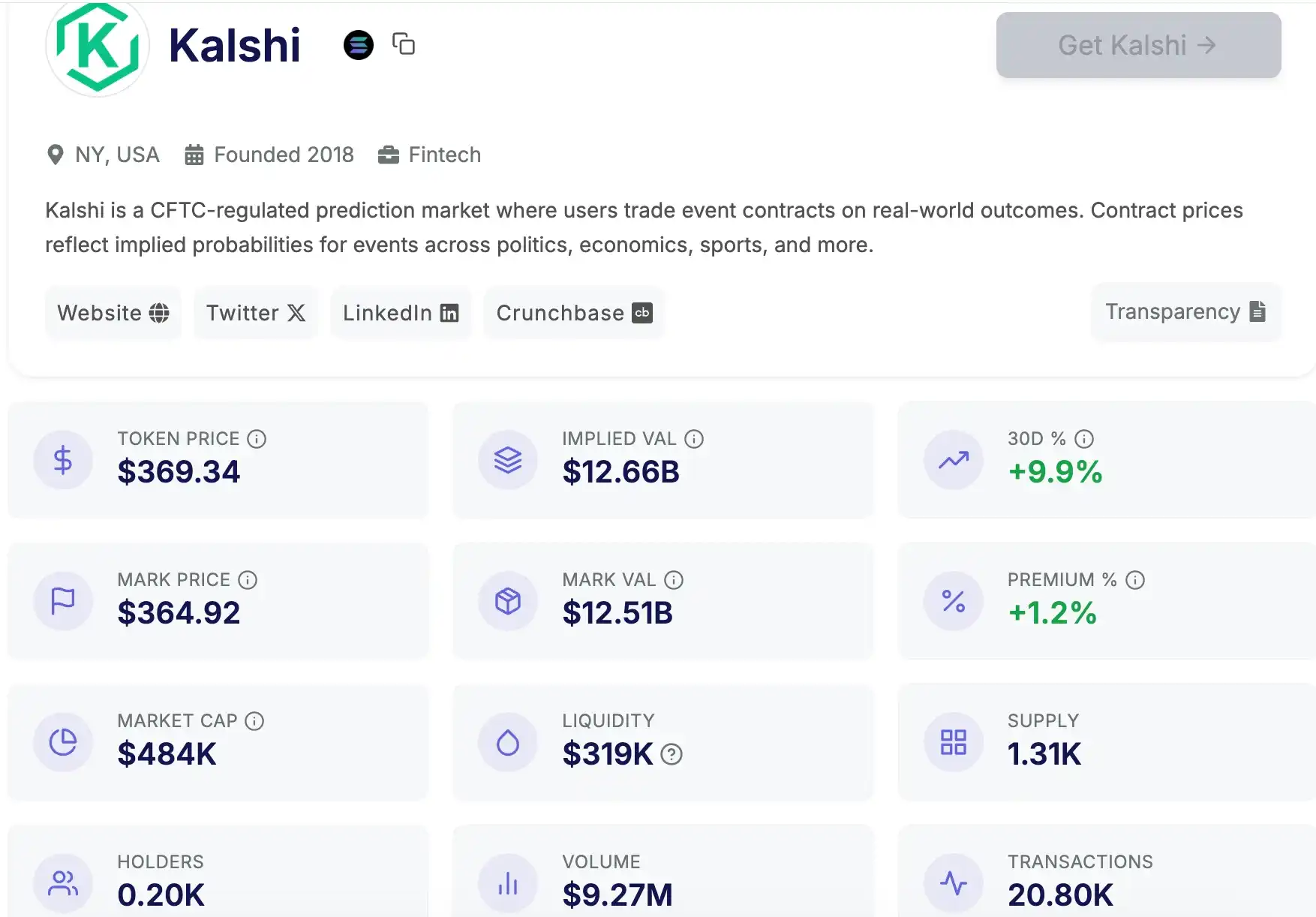
On the Jarsy platform, the pre-market per-share price for Kalshi has already risen to around $504.

It is worth mentioning that compared to the time when we previously wrote the article "Kalshi's Pre-Market Stock Price Soars, Is It Still Worth Buying Now?", the pre-market prices for Kalshi stock on both platforms have experienced varying degrees of increases and decreases. The price situation at that time was as follows:

  • On PreStocks, Kalshi's implied market capitalization was approximately $14 billion, with a per-share price of around $407;
  • On Jarsy, Kalshi's market valuation was $11 billion, with a per-share price of $450.

In other words, the price on the PreStocks platform dropped from $407 to around $369; while the price on the Jarsy platform rose from $450 to around $504.

For comparison, the pre-market pricing for Kalshi stock in traditional financial markets has also changed—

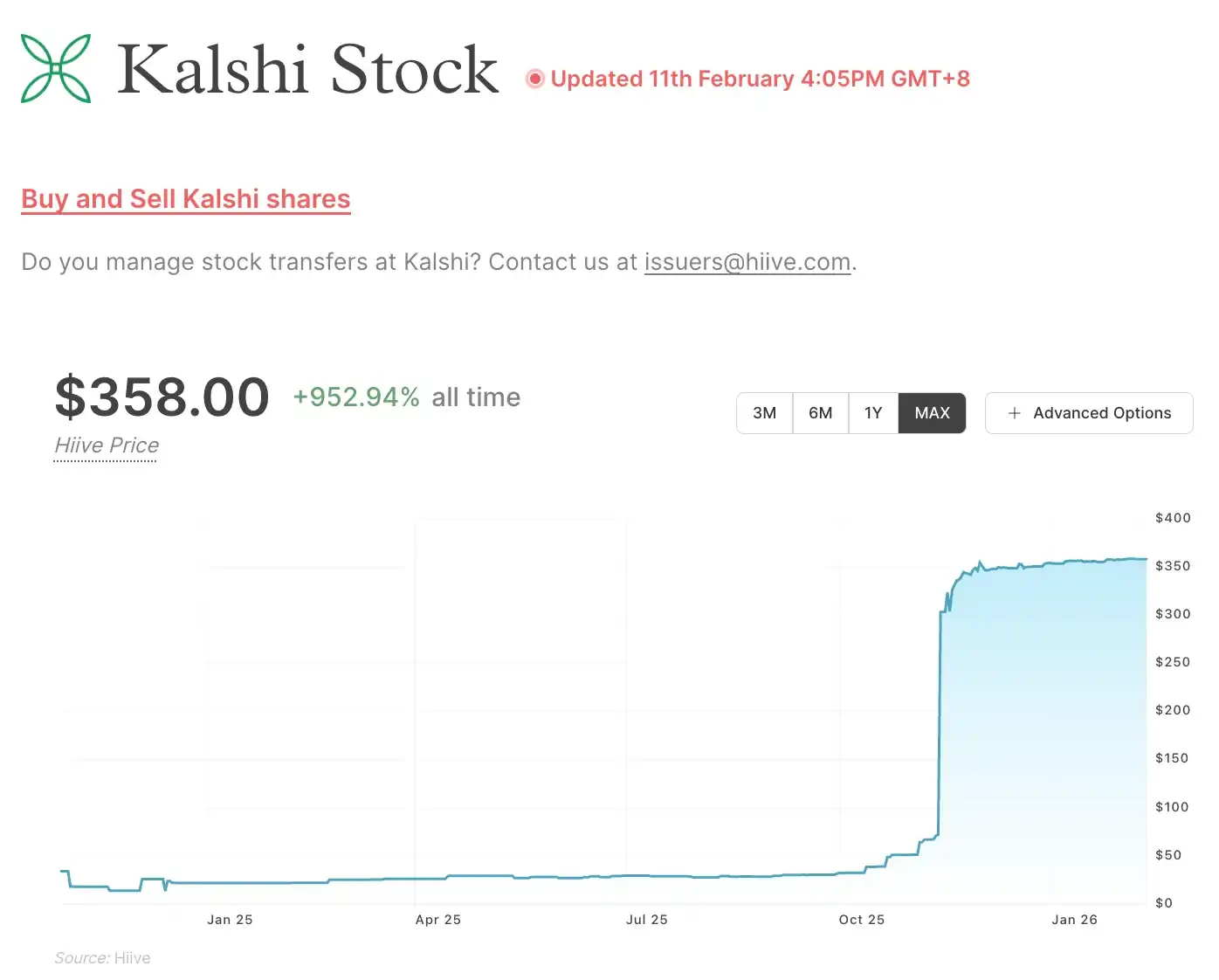
  • On Nasdaq Private Market, Kalshi's per-share price rose from around $307 to around $320;
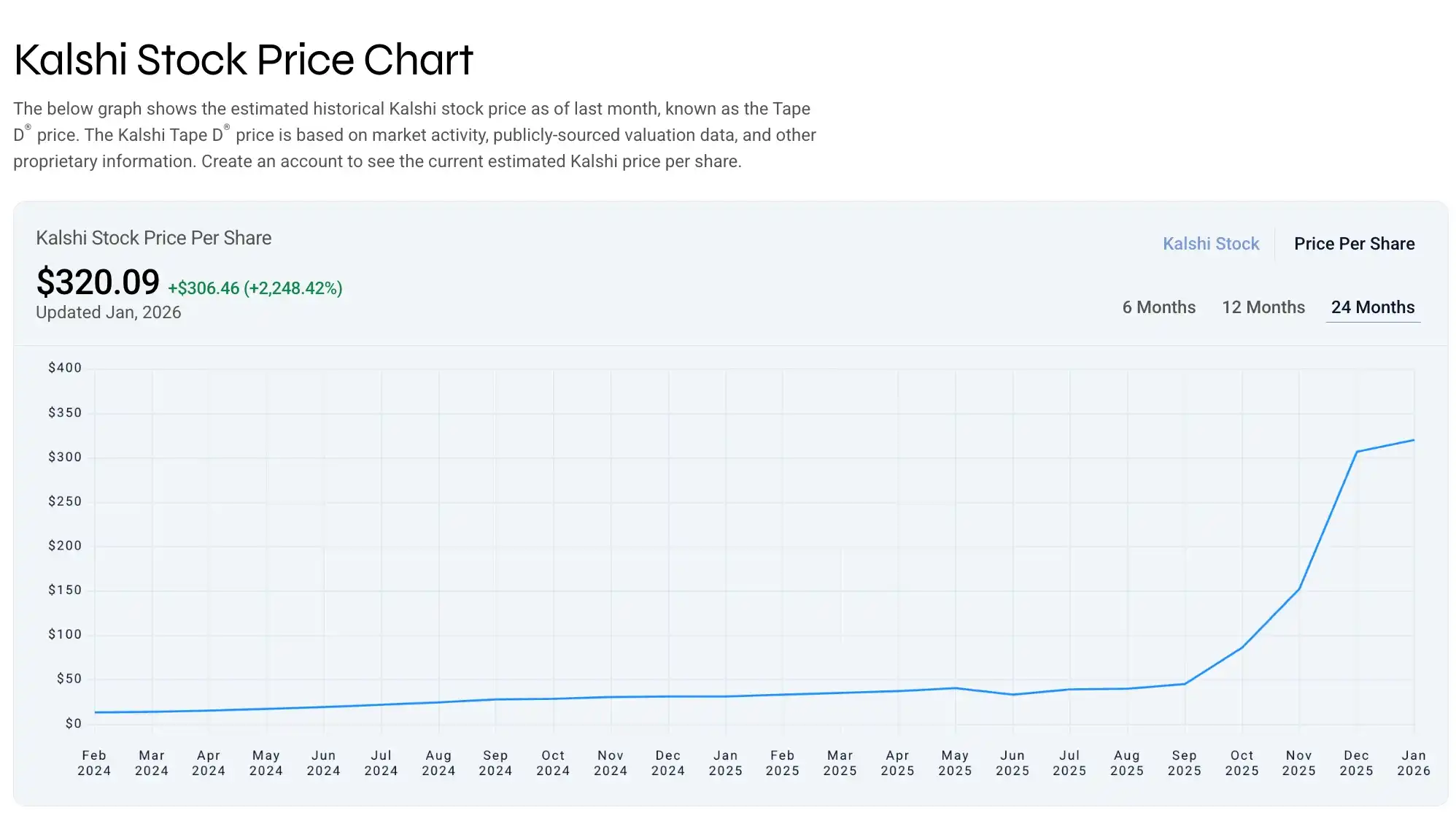
  • On Hiive, Kalshi's per-share price increased by $1 from around $357 to around $358.
Reasonable Pre-Market Pricing Range for Kalshi Stock: Around $320~$423

Last year, Kalshi completed a $1 billion Series E financing round with a valuation of $11 billion.

Based on the market capitalization and corresponding stock prices mentioned above, the number of Kalshi shares is approximately between 30.72 million and 34.30 million.

Specifically, the number of shares is calculated as follows—
Based on a $11 billion market capitalization corresponding to the traditional financial market pre-market prices of $320 and $358, the number of Kalshi shares is approximately 30.72 million to 34.37 million;
Based on the implied market capitalization/token price and capital market capitalization/marked price on the PreStocks platform, the number of Kalshi shares is approximately 34.27 million to 34.30 million;
Based on the pre-market purchase price per share on the Jarsy platform, Kalshi's market capitalization is capped at $18.665 billion, with a per-share price of $604.84, and the number of shares is approximately 30.86 million.

Based on the above information, we can make the following deductions:

First, based on the $11 billion valuation, the reasonable pre-market pricing range for Kalshi stock is approximately $320-$358. In other words, the current pricing on crypto market tokenized stock trading platforms such as PreStocks and Jarsy is relatively high;

Second, Kalshi's trading volume in January reached $9.5 billion, close to the overall prediction market size of about $10 billion in October last year; in October last year, its market share was about 50% of the prediction market. From this perspective, Kalshi's current capital market valuation is at least above $15 billion.

Third, based on a $15 billion valuation and combined with data such as the range of Kalshi's share count, the pre-market pricing range for Kalshi stock is approximately $436~$488.

Thus, if the number of Kalshi shares meets expectations, and under the premise of a $15 billion implied market capitalization, conservatively estimated, the reasonable pre-market pricing range for Kalshi stock may be $320~$378 (calculated based on the average of the lowest prices in the pricing range); optimistically estimated, the reasonable pre-market pricing range for Kalshi stock may be $358~$423 (calculated based on the average of the highest prices in the pricing range).

Based on the above data conclusions, the pre-market pricing for Kalshi stock on the Jarsy platform is relatively high, while the PreStocks platform offers some arbitrage opportunities.

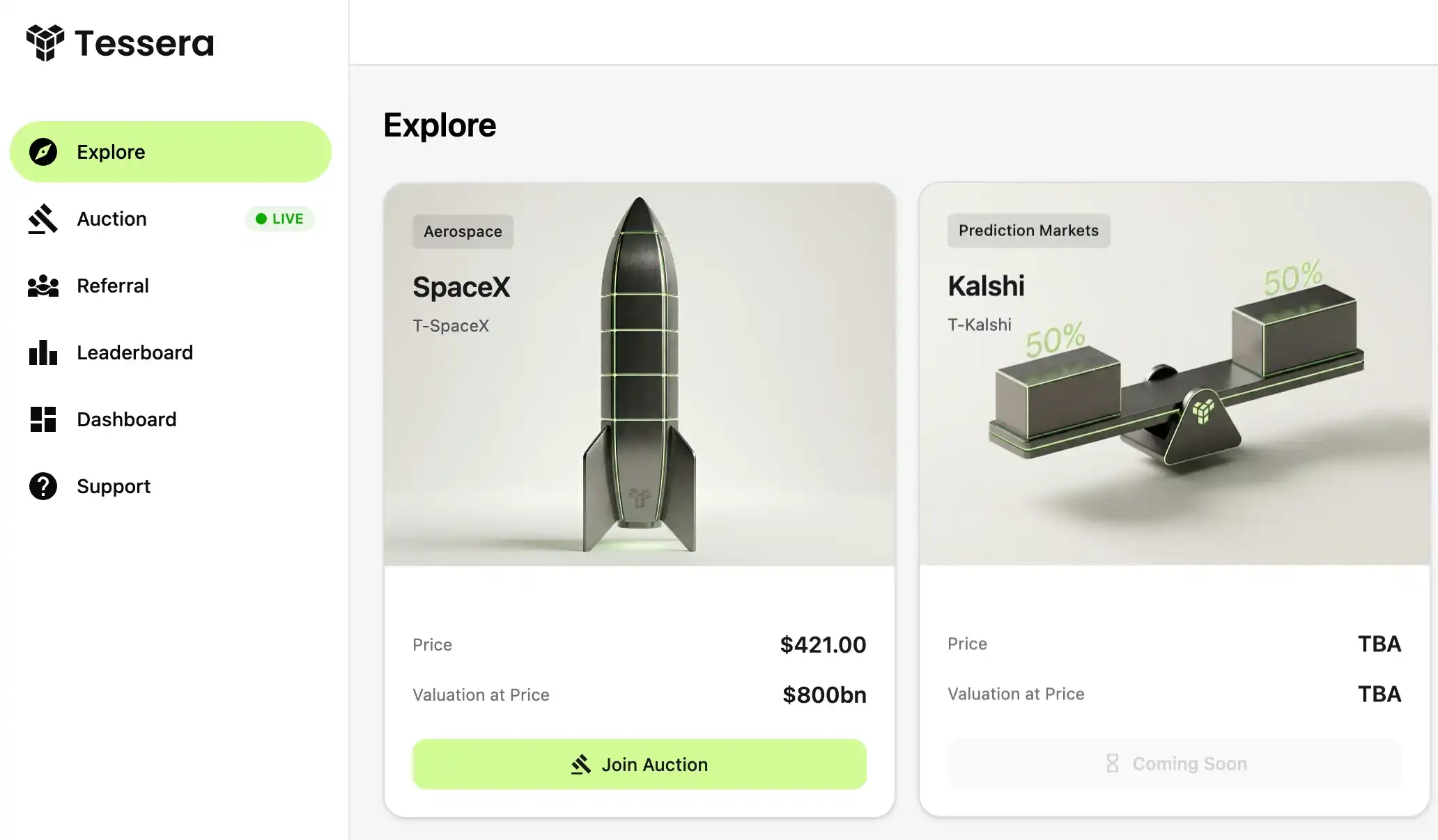
In addition, the latest tokenized stock trading platform, Tessera, plans to open equity public offerings in the future, which readers can also consider as an alternative reference (invitation code can be found here).
Combined with the relevant information mentioned in the previously published article by Odaily Planet Daily, "Data Calculation Shows Polymarket's Annual Revenue Exceeding $100 Million Is Not Difficult, Provided That...":

Based on a static calculation of the trading volume and fee ratio in the "15-minute cryptocurrency rise and fall" market on Polymarket, under the current trading volume level and structure, if Polymarket introduces a similar fee model in all markets, it is expected to generate $418 million in annual revenue for the platform.

As a prediction market platform with larger trading volume and higher fees, and taking advantage of the timing of the major sports year in 2026, Kalshi's annual revenue is expected to exceed this estimated revenue of Polymarket. From this perspective, the capital market may further raise the pre-market pricing of Kalshi stock in the future.


Пов'язані питання

QWhat is the current pre-market stock price range for Kalshi on PreStocks and Jarsy platforms?

AOn PreStocks, the pre-market stock price for Kalshi is around $369 (implied market cap) and $364 (capital market cap). On Jarsy, the pre-market price is around $504.

QWhat was the valuation of Kalshi after its Series E funding round last year?

AKalshi completed a $1 billion Series E funding round last year, valuing the company at $11 billion.

QWhat is the estimated reasonable pre-market stock price range for Kalshi based on a $11 billion valuation?

ABased on a $11 billion valuation, the estimated reasonable pre-market stock price range for Kalshi is approximately $320 to $358.

QWhat is the optimistic estimated pre-market stock price range for Kalshi if its implied market cap reaches $15 billion?

AIf Kalshi's implied market cap reaches $15 billion, the optimistic estimated pre-market stock price range is approximately $358 to $423.

QHow does the article suggest Kalshi's future annual revenue might compare to Polymarket's estimated revenue?

AThe article suggests that Kalshi's annual revenue is expected to surpass Polymarket's estimated $418 million annual revenue, especially with the advantage of the 2026 major sports year.

Пов'язані матеріали

Gensyn AI: Don't Let AI Repeat the Mistakes of the Internet

In recent months, the rapid growth of the AI industry has attracted significant talent from the crypto sector. A persistent question among researchers intersecting both fields is whether blockchain can become a foundational part of AI infrastructure. While many previous AI and Crypto projects focused on application layers (like AI Agents, on-chain reasoning, data markets, and compute rentals), few achieved viable commercial models. Gensyn differentiates itself by targeting the most critical and expensive layer of AI: model training. Gensyn aims to organize globally distributed GPU resources into an open AI training network. Developers can submit training tasks, nodes provide computational power, and the network verifies results while distributing incentives. The core issue addressed is not decentralization for its own sake, but the increasing centralization of compute power among tech giants. In the era of large models, access to GPUs (like the H100) has become a decisive bottleneck, dictating the pace of AI development. Major AI companies are heavily dependent on large cloud providers for compute resources. Gensyn's approach is significant for several reasons: 1) It operates at the core infrastructure layer (model training), the most resource-intensive and technically demanding part of the AI value chain. 2) It proposes a more open, collaborative model for compute, potentially increasing resource utilization by dynamically pooling idle GPUs, similar to early cloud computing logic. 3) Its technical moat lies in solving complex challenges like verifying training results, ensuring node honesty, and maintaining reliability in a distributed environment—making it more of a deep-tech infrastructure company. 4) It targets a validated, high-growth market with genuine demand, rather than pursuing blockchain integration without purpose. Ultimately, the boundaries between Crypto and AI are blurring. AI requires global resource coordination, incentive mechanisms, and collaborative systems—areas where crypto-native solutions excel. Gensyn represents a step toward making advanced training capabilities more accessible and collaborative, moving beyond a niche controlled by a few giants. If successful, it could evolve into a fundamental piece of AI infrastructure, where the most enduring value in the AI era is often created.

marsbit11 год тому

Gensyn AI: Don't Let AI Repeat the Mistakes of the Internet

marsbit11 год тому

Why is China's AI Developing So Fast? The Answer Lies Inside the Labs

A US researcher's visit to China's top AI labs reveals distinct cultural and organizational factors driving China's rapid AI development. While talent, data, and compute are similar to the West, Chinese labs excel through a pragmatic, execution-focused culture: less emphasis on individual stardom and conceptual debate, and more on teamwork, engineering optimization, and mastering the full tech stack. A key advantage is the integration of young students and researchers who approach model-building with fresh perspectives and low ego, prioritizing collective progress over personal credit. This contrasts with the US culture of self-promotion and "star scientist" narratives. Chinese labs also exhibit a strong "build, don't buy" mentality, preferring to develop core capabilities—like data pipelines and environments—in-house rather than relying on external services. The ecosystem feels more collaborative than tribal, with mutual respect among labs. While government support exists, its scale is unclear, and technical decisions appear driven by labs, not state mandates. Chinese companies across sectors, from platforms to consumer tech, are building their own foundational models to control their tech destiny, reflecting a broader cultural drive for technological sovereignty. Demand for AI is emerging, with spending patterns potentially mirroring cloud infrastructure more than traditional SaaS. Despite challenges like a less mature data industry and GPU shortages, Chinese labs are propelled by vast talent, rapid iteration, and deep integration with the open-source community. The competition is evolving beyond a pure model race into a contest of organizational execution, developer ecosystems, and industrial pragmatism.

marsbit13 год тому

Why is China's AI Developing So Fast? The Answer Lies Inside the Labs

marsbit13 год тому

3 Years, 5 Times: The Rebirth of a Century-Old Glass Factory

Corning, a 175-year-old glass company, is experiencing a dramatic revival as a key player in AI infrastructure, driven by surging demand for high-performance optical fiber in data centers. AI data centers require vastly more fiber than traditional ones—5 to 10 times as much per rack—to handle high-speed data transmission between GPUs. This structural demand shift, coupled with supply constraints from the lengthy expansion cycle for fiber preforms, has created a significant supply-demand gap. Nvidia has invested in Corning, along with Lumentum and Coherent, in a $4.5 billion total commitment to secure the optical supply chain for AI. Corning's competitive edge lies in its expertise in producing ultra-low-loss, high-density, and bend-resistant specialty fiber, which is critical for 800G+ and future 1.6T data rates. Its deep involvement in co-packaged optics (CPO) with partners like Nvidia further solidifies its position. While not the largest fiber manufacturer globally, Corning's revenue from enterprise/data center clients now exceeds 40% of its optical communications sales, and it has secured multi-year supply agreements with major hyperscalers including Meta and Nvidia. Financially, Corning's optical communications revenue has surged, doubling from $1.3 billion in 2023 to over $3 billion in 2025. Its stock price has risen nearly 6-fold since late 2023. Key future catalysts include the rollout of Nvidia's CPO products and the scale of undisclosed customer agreements. However, risks include high current valuations and potential disruption from next-generation technologies like hollow-core fiber. The company's long-term bet on light over electricity, maintained even through the telecom bubble crash, is now being validated by the AI boom.

marsbit13 год тому

3 Years, 5 Times: The Rebirth of a Century-Old Glass Factory

marsbit13 год тому

Торгівля

Спот
Ф'ючерси
活动图片




