Kalshi, MTS, and a16z's Ambition

链捕手Опубліковано о 2026-06-07Востаннє оновлено о 2026-06-07

Анотація

The article "Kalshi, MTS, and a16z's Ambition" explores prediction markets as a focal point of excitement in 2025 for investors, crypto enthusiasts, and media. It traces their intellectual lineage from Friedrich Hayek's ideas on dispersed knowledge and market coordination to Robin Hanson's Logarithmic Market Scoring Rule (LMSR), which incentivizes truthful information sharing. The piece argues that a16z's significant investment in prediction market platform Kalshi (valued at $220B) transcends mere financial speculation. a16z frames prediction markets as a new form of "media" that provides "presence"—a way for individuals to actively engage with and influence world events through financial stakes, countering postmodern detachment. By wagering on outcomes, users become "super observers," and the market's aggregated probabilities gain authoritative power to define event truth and importance. The article uses media company MTS ("Monitoring The Situation") as a case study of a16z's "new media" strategy: rapidly producing high-intensity, multi-format content to "take over the timeline." However, prediction markets like Kalshi are presented as the ultimate piece in this media empire. Their real-money, crowd-sourced probabilities possess a unique "reality distortion field" and perceived objectivity, potentially swaying public opinion and granting a private company unprecedented interpretive power over reality. Ultimately, Kalshi's immense valuation is attributed not just to its ex...

Author: Matou, Da Da Luosi

Prediction markets might be the only field in 2025 that can simultaneously excite distinguished dollar fund investors, crypto bros, and media professionals.

There are actually many reasons to be optimistic about it, such as the arbitrage between state and federal regulations for gambling in the US, the massive transaction fees driven by the extreme extrapolation of 0DTE, and the convergence of content industries with light betting, and so on.

But let's not talk about those today. Let's change direction and discuss the spirit behind prediction markets, and how this spirit aligns with a16z, which waves the banner of "New Media," making it one of the most crucial pieces in its new media empire.

The Chronicle of the Prediction Market Spirit

The product of a prediction market is simple (or so it seems on the surface): it turns the object of a binary option bet into any event or information. But in reality, its underlying spiritual core has gone through several periods of transformation.

The earliest discussion about prediction markets actually came from Friedrich Hayek. In his view, knowledge is unevenly distributed, and the market, as a coordinating mechanism, mobilizes information from the furthest reaches of society—from vendors to experts. Different people's judgments about the future converge into a price on the order book within the prediction market.

This discussion is the oldest, but it's also the one most frequently mentioned today. When you see terms like "probability aggregation market" or "truth machine" on marketing blogs, they all originate from Friedrich Hayek's "The Use of Knowledge in Society," written nearly a hundred years ago.

The torch was then passed to Robin Hanson after Hayek. The elder scholar is still highly active on X, battling with crypto bros. His main contribution lies in designing a system called the Logarithmic Market Scoring Rule (LMSR), which makes it more beneficial for those who know the truth to speak it. This design essentially established the paradigm for current prediction market design.

With such an incentive mechanism, information holders in various corners have the motivation to contribute their information and participate in the market. Extending this further, it seems such markets could also be used for public governance. By opening a market for every future issue and having people vote with real money, the future landscape would be constructed in the changing odds on the order book. This utopia is called "Futarchy," composed of "future" and the suffix "-archy," denoting a form of government.
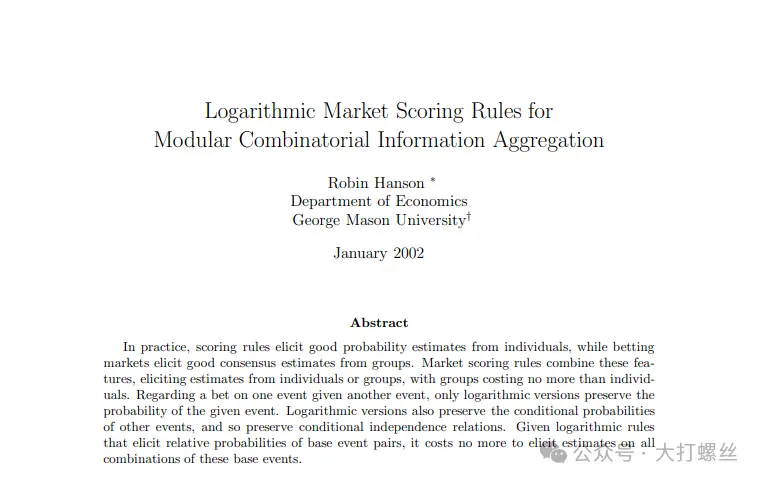
Foundational Work: "The Logarithmic Market Scoring Rule for Modular Combinatorial Information Aggregation"

The above constitutes the official, orthodox history—the kind you'd find in a university microeconomics textbook timeline. But I believe metaphysical discussions about prediction markets after this point were largely meaningless until a16z turned its gaze to this field.

Presence and New Media

a16z came into contact with the prediction market company Kalshi in 2024 and then invested in its $5 billion round in August 2025. It's currently unknown if there was a discount. Now, Kalshi's valuation has reached an astonishing $22 billion and is called one of the fastest-growing companies (in valuation) outside of AI firms.

After taking a position, a16z mobilized its media machine, writing a series of long articles explaining why Kalshi is one of the most important companies of our time. Honestly, while the exchange and casino business is attractive, due to potential regulatory pressure and moral risk, it never commands a very high PE multiple in the market. Clearly, a16z's vision extends beyond that.

So, what is truly important about Kalshi, or the entire prediction market track? The answer a16z gives is "Presence."

At the current point in time, people's contact with the world is actually separated by a layer of plastic film, somewhat like you can only browse the front end of a webpage but know nothing about its backend construction. You can consume the front-end audiovisual experiences, narratives, and even "real feelings," but you cannot change or be present.

Not to mention, obviously in the not-too-distant future, even the transformation of the real world will gradually be outsourced to agents. So, what is humanity's role in the historical process? It seems we are only left to bury our heads in light-colored sheets and cry after eating and drinking our fill.

But prediction markets offer a method of intervention called prediction. It requires you to bet with real money, then, like buying a ticket to enter a stadium, participate and observe the fluctuation of probabilities throughout the process, willingly endure theta decay, and also screenshot the prediction market probabilities, forward them in all group chats, and loudly declare your position and the views behind it.

This feeling is very anti-cynical. In an instant, the infinite distance, the endless people, the choice of the cardinal, the depth of snow in New York, the rise and fall of crude oil within five minutes, and even whether Jesus will return in 2026, all become relevant to you. All the uncertainty and powerlessness of postmodernity collapse under your powerful prediction. You are no longer a gambler; you are a distinguished super-observer, a prophet of your tribe, a calm bystander of history.

When enough people start using, discussing, and relying on this medium, the authority of the market itself begins to rise. Kalshi will grant the final interpretive power over events regarding: 1. Authenticity and 2. Importance. This is undoubtedly a key component in the new media empire envisioned by a16z.
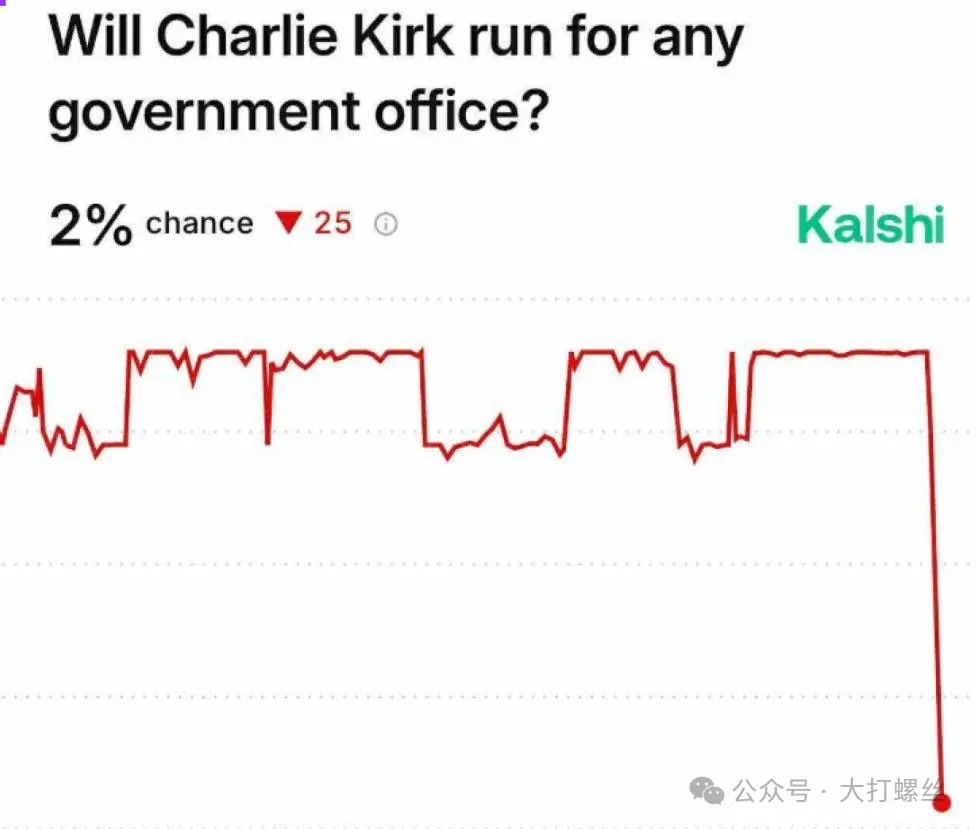
One chart explaining Charlie Kirk's assassination

Case Study: MTS

Finally, let's talk about this new media as defined by a16z. In fact, from the first-generation In-house Media advocated by a16z and YC, to the second-generation VCs that grew out of media like 20VC and Not Boring Capital, and finally to media like TBPN being acquired by companies and institutions, the power of media has been constantly shifting and decentralizing. The battlefield of public opinion has also moved from blogs and TV shows to X and podcasts.

Talking about VCs also needing to create content and build brands, helping founders with distribution, is already utterly unoriginal in 2026. The new media a16z talks about is a full-spectrum project, covering everything from upstream narrative setting, midstream product financing and promotion, to downstream customer acquisition—all within its scope, and at a speed far beyond what traditional media and agencies can comprehend.

What used to take 3-6 months to complete as a planning project, new media will accomplish in a few weeks: founder podcasts, short video clips, AI-generated launch videos, newsletters about the company's spirit and development plan, etc. They release information with extreme intensity in an extremely short time frame, calling it "taking over the timeline."

Perhaps various self-media and AI-generated information are too noisy, so we just have to be noisier. And our noise is more important than yours.

The media company MTS (full name "Monitoring The Situation") embodies this philosophy, conducting 24/7 live news broadcasts on X, bringing a series of political figures, tech company founders, and key figures from hot news topics onto the mic, then slicing and disseminating the content. They claim to only report on the most important thing happening in the world right now, until the next more important thing occurs.

MTS interviewing Robinhood

Looking back at Kalshi, everything seems to fall into place. Relying solely on clout and a16z's endorsement, media like MTS can certainly survive, but their influence outside a16z's sphere remains limited, more like a fraternity media outlet or a campus club publication. But prediction markets are different; the trading volume and positions on them are backed by real money, seemingly possessing a certain independent, third-party, cold, authoritative quality and persuasive power.

Imagine, if you were a staunch MAGA supporter, at the time of the midterm elections, you saw that the Republican victory market on Kalshi had already reached tens of billions of dollars in trading volume, but the price of the YES option for victory had dropped to $0.1. Wouldn't you waver for a moment—do the Capitol Hill elites already know the outcome? Has the fair information market already painted a picture of the future?

This is perhaps the core reason why Kalshi is worth $22 billion. This reality distortion field has not often been obtained by a private company in human history.
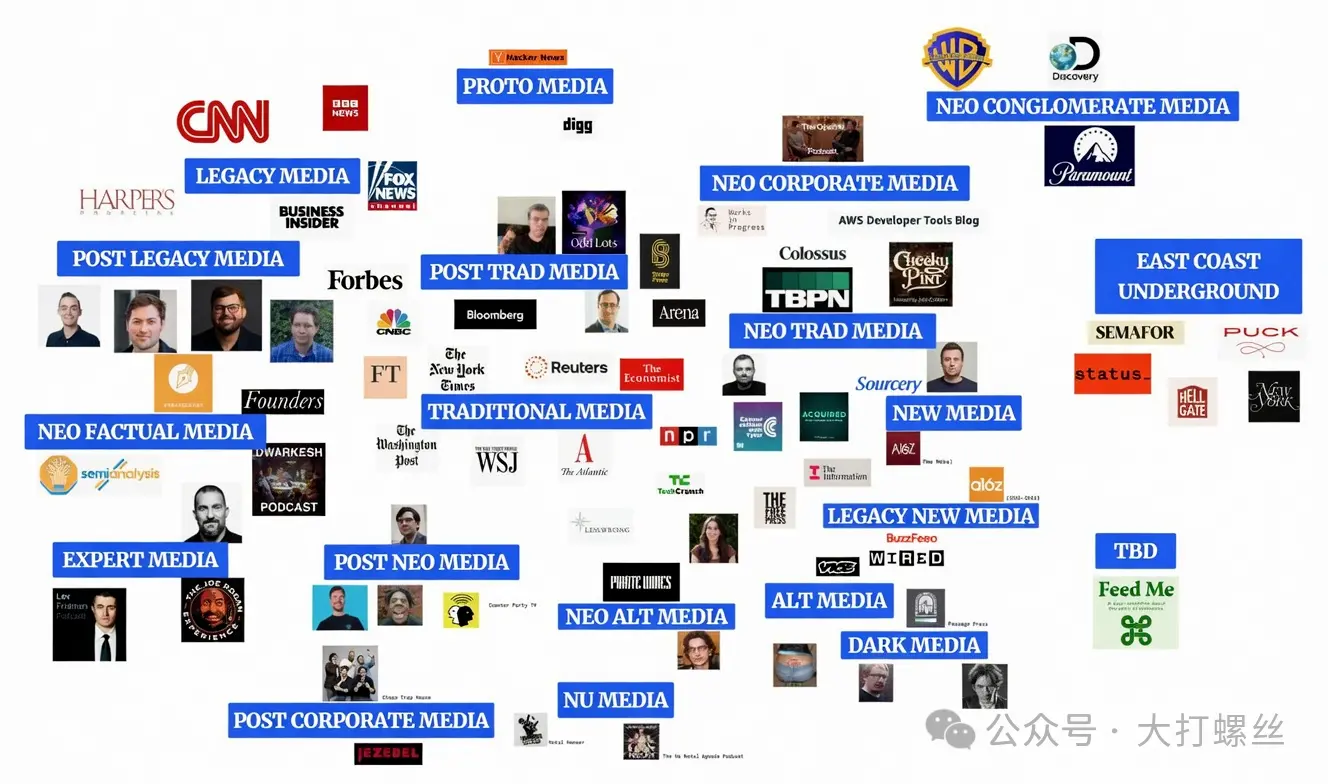
TBPN New Media Landscape

References:

[1] Alex Danco, “Prediction: the successor to postmodernism,” Andreessen Horowitz, October 10, 2025.

[2] Alex Danco, “Prediction Path Screenshots: A New Kind of Meme,” Andreessen Horowitz, October 10, 2025.

[3] F. A. Hayek, “The Use of Knowledge in Society,” The American Economic Review, Vol. 35, No. 4, pp. 519–530, 1945.

[4] Erik Torenberg, Ben Horowitz, and Marc Andreessen, “a16z’s New Media Playbook,” Andreessen Horowitz Podcast, February 27, 2026.

Пов'язані питання

QAccording to the article, what is the 'core reason' why the prediction market company Kalshi is worth $22 billion?

AThe core reason is that Kalshi has obtained a 'reality distortion field'—the authority to provide the final interpretation of an event's authenticity and importance. When a prediction market is widely used and trusted, its price signals gain a cold, third-party, and persuasive authority that can influence public perception and even sway political beliefs, a power historically rare for a private company.

QWhat key concept does a16z propose as the answer to the importance of prediction markets like Kalshi?

Aa16z proposes the concept of 'presence' or 'being there' ('在场感'). In a world where people are often passive consumers of information separated from reality, prediction markets offer a way to actively intervene and participate. By placing real-money bets, users become engaged observers, feeling connected to global events and countering postmodern feelings of uncertainty and powerlessness.

QWho are the two key historical figures mentioned in the 'intellectual history' of prediction markets, and what were their main contributions?

A1. Friedrich Hayek: He laid the early theoretical foundation, arguing in 'The Use of Knowledge in Society' that markets are coordination mechanisms that aggregate dispersed information from all corners of society, forming a collective forecast reflected in prices. 2. Robin Hanson: He designed the Logarithmic Market Scoring Rule (LMSR), an incentive mechanism that makes it more profitable for those with true information to reveal it. This established the core design paradigm for modern prediction markets.

QHow does the article describe the evolution and current strategy of a16z's 'New Media' empire?

AThe evolution moved from 1st-gen in-house VC media, to 2nd-gen media-born VCs, to 3rd-gen media acquisitions. a16z's current 'New Media' is a full-spectrum engineering project covering upstream narrative setting, midstream product promotion/funding, and downstream customer acquisition. It operates at an extreme speed, 'taking over timelines' by rapidly producing podcasts, video clips, AI-generated content, and newsletters within weeks, creating an intense, high-volume information barrage to establish its messages as 'more important' than the noise.

QWhat role does the media company MTS (Monitoring The Situation) play in illustrating a16z's New Media philosophy?

AMTS exemplifies the philosophy of speed and intensity in 'taking over the timeline.' It conducts 24/7 live news broadcasts on Twitter, featuring key figures like politicians and founders, then rapidly slices and disseminates the content. It claims to only cover the world's most important event until the next one occurs, embodying the strategy of overwhelming the information space with high-velocity, high-volume content to assert relevance and authority.

Пов'язані матеріали

New Fire Research Institute: Inflation May Become a Stubborn Problem, Can Cryptocurrencies Achieve Independent Performance in the Short Term?

New Fire Research Institute argues that despite the recent U.S. June CPI decline to 3.5% year-on-year—primarily driven by energy—core goods inflation remains persistent, with core PCE likely showing slight growth. Federal Reserve Chairman Wash has emphasized the Fed's independence and a "zero tolerance" stance on inflation, suggesting a continued hawkish posture that will pressure risk assets, especially if energy prices rise again. Concurrently, the semiconductor memory sector faces structural pressures, as seen in significant sell-offs for Micron and SK Hynix. High leverage in markets like South Korea is triggering deleveraging, amplifying volatility. Investors are also questioning the sustainability of AI-related capital expenditures. In contrast, the crypto market showed relative stability last week, with BTC and ETH gaining slightly. Positive developments include a shift to net inflows for U.S. Bitcoin spot ETFs, a narrowing Coinbase discount, and strong activity on the Robinhood Chain ecosystem. The potential advancement of the U.S. CLARITY Act provides a policy catalyst. Overall, the probability of an independent crypto bull run in the short term is low, given overarching macro pressures. However, fundamentals are improving with ETF inflows and robust on-chain activity, providing solid support. Technically, BTC and ETH show strong support at key moving averages. New Fire Research maintains that Bitcoin around $60,000 represents a high-value allocation zone, with limited downside risk near current levels. The true bull market catalyst awaits a confirmed market bottom combined with a macro policy shift and legislative progress.

marsbit20 хв тому

New Fire Research Institute: Inflation May Become a Stubborn Problem, Can Cryptocurrencies Achieve Independent Performance in the Short Term?

marsbit20 хв тому

Base Under Pressure

**Title: The Pressure Mounts for Base** Base, the Ethereum Layer 2 scaling solution backed by Coinbase, is facing significant pressure and public scrutiny from its leadership following the launch of Robinhood Chain. Base co-founder Jesse Pollak recently acknowledged strategic missteps, admitting that the chain's past focus on social and creator tokens (e.g., through Farcaster, Zora) failed to deliver sustainable adoption. He has refocused on core infrastructure, handing leadership of the Base App back to Coinbase's Cobie. While Base remains a top L2 contender alongside OP Mainnet and Arbitrum, and boasts the highest TVL (nearly $12B), its weaknesses are being highlighted by the new competitor. Key criticisms include its slow progress on decentralization. Base has faced issues with its single sequencer causing block production halts, and L2BEAT is reportedly considering downgrading its decentralization rating from Stage 1 to Stage 0. This contrasts sharply with the rapid initial success of Robinhood Chain, whose DEX quickly entered the top five by volume. The leadership styles of the parent companies are also being compared: Robinhood's CEO actively engages with new projects, while a recent incident where Coinbase's Brian Armstrong briefly changed his profile picture—sparking and then crashing a related meme token—drew community ire and mockery. Pollak stated Base is working with Coinbase on tokenized stocks backed 1:1 by real equity, differentiating it from Robinhood's derivatives model. However, the article argues that Base's most urgent task is to address its long-standing technical and trust issues. With more traditional finance players likely to emulate Robinhood's path, Base must use this competitive pressure to solidify its position as long-term financial infrastructure.

Foresight News37 хв тому

Base Under Pressure

Foresight News37 хв тому

White House Concession Removes Ethical Hurdle, Clarity Act Races Against Final Window Before Recess?

On July 21st, industry sources reported that the Trump administration has agreed to include an ethics provision in the "Clarity Act" (Digital Asset Market Clarity Act of 2025). This concession addresses the long-standing conflict-of-interest concerns regarding government officials and the crypto industry, potentially removing the final major obstacle to the bill's progress. Additionally, Patrick Witt, the executive director of the White House's Digital Asset Advisory Committee, confirmed he will remain in his role to help finalize the bill, alleviating previous concerns about his potential departure. The Clarity Act aims to establish a unified federal regulatory framework for the U.S. digital asset market. Its core objective is to resolve regulatory ambiguity by defining different types of digital assets (digital commodities, investment contract assets, and permitted payment stablecoins) and clarifying the respective oversight roles of the SEC and CFTC. This would end the long-running jurisdictional dispute between the two agencies and provide clearer compliance paths for the industry. With the ethics issue moving toward resolution, the most urgent challenge now is time. The U.S. Congress is set to begin its August recess in mid-August, leaving only a few working weeks to finalize the text and advance the bill through the Senate. Industry advocates, like the Blockchain Association's Kristin Smith, stress that this is a critical moment. If negotiations conclude successfully in the coming weeks, the Clarity Act could pass a key hurdle before the recess; otherwise, it may face significant delays. If enacted, the Clarity Act could mark a historic turning point in crypto regulation. By providing a clearer and more predictable legal framework, it aims to reduce uncertainty for businesses, developers, and traditional financial institutions looking to enter the digital asset space, potentially setting a global benchmark for market structure regulation.

Odaily星球日报43 хв тому

White House Concession Removes Ethical Hurdle, Clarity Act Races Against Final Window Before Recess?

Odaily星球日报43 хв тому

Торгівля

Спот
活动图片