Justin Sun Sues Trump Family: What $75 Million Bought Was Only a Blacklist

marsbitОпубліковано о 2026-04-23Востаннє оновлено о 2026-04-23

Анотація

Justin Sun, founder of Tron, has filed a lawsuit in federal court against World Liberty Financial (WLF), alleging he was made the "primary target of a fraudulent scheme" after investing $75 million. Sun claims the investment secured him an advisor title and WLFI tokens, which were later frozen by WLF, causing "hundreds of millions in losses." The dispute began in late 2024 when Sun's investment helped revive WLF's struggling token sale, which ultimately raised $550 million. Shortly after, the SEC dropped its lawsuit against Sun following Donald Trump's inauguration. However, relations soured when Sun refused WLF's demands for additional funding. In August 2025, WLF added a "blacklist" function to its smart contract, allowing it to unilaterally freeze tokens. Sun's holdings, worth approximately $107 million, were frozen, and he was threatened with token destruction. The lawsuit highlights WLF's structure, which directs 75% of token sale profits to the Trump family, who had earned $1 billion by December 2025. WLF's CEO is Zach Witkoff, son of U.S. Middle East envoy Steve Witkoff. The project faces scrutiny for opaque operations, including a controversial loan arrangement on the Dolomite platform, co-founded by a WLF advisor. Despite Sun's history with the SEC, the case underscores centralization risks within DeFi, as WLF controls governance and holds powers to freeze assets arbitrarily. Sun's tokens remain frozen as legal proceedings begin.

Author: Ada, Deep Tide TechFlow

Justin Sun invested $75 million and got an advisor title, a pile of frozen tokens, and a federal court lawsuit in return.

On April 22, the founder of Tron formally sued World Liberty Financial in San Francisco federal court, accusing it of making him "the primary target of its fraudulent scheme," causing him and his companies to suffer "losses amounting to hundreds of millions of dollars." He also accused WLF of being currently "on the verge of collapse" and "severely insolvent," and planning to pay 95% of the token sale proceeds to "company insiders."

The person in the crypto circle best at calculating got calculated this time.
The $75 Million "Pledge of Allegiance"

Rewind to the end of 2024.

World Liberty Financial had just launched the sale of WLFI tokens, and the scene was embarrassingly quiet, with only $22 million in sales in the first month.

Justin Sun stepped in. First, he threw in $30 million, later increased to $45 million, plus 1 billion tokens received for advisory services, totaling an investment of approximately $75 million. He became World Liberty's largest public investor.

After Sun bought, other investors followed, and the project ultimately raised about $550 million. World Liberty Financial later publicly admitted that Sun helped the project "come back to life."

At that time, the SEC was suing Sun, accusing him of market manipulation, selling unregistered securities, and paying celebrities to promote without disclosure. However, after Trump took office in January 2025, the SEC voluntarily suspended its lawsuit against Sun. In March 2026, the two sides settled for $10 million, with Sun not admitting any wrongdoing.

A $30 million investment got rid of a lawsuit that could have bankrupted him. Sun calculated this account very clearly.

Refused to Inject More Capital, Immediately Blacklisted

The honeymoon period was short.

According to the complaint, World Liberty Financial continuously asked Sun to make additional investments throughout 2025, including asking him to mint World Liberty Financial's USD1 stablecoin on the Tron network. Sun refused.

By July 2025, the relationship completely broke down.

What happened next was less a commercial dispute and more an on-chain manhunt.

In August 2025, World Liberty Financial modified the WLFI token's smart contract, inserting a "blacklist" function. The project team could unilaterally freeze any holder's tokens without notice, without reason, and without a governance vote.

A month later, Sun tried to transfer his WLFI tokens. But his wallet was blacklisted, and approximately $107 million worth of governance tokens were frozen, with voting rights revoked.

Later, World Liberty Financial threatened to "burn" (destroy) his tokens. In the blockchain world, burn means permanent eradication; the asset ceases to exist.

Sun claimed he had tried to "resolve the matter amicably," but the other party refused to unfreeze the tokens and restore his rights.

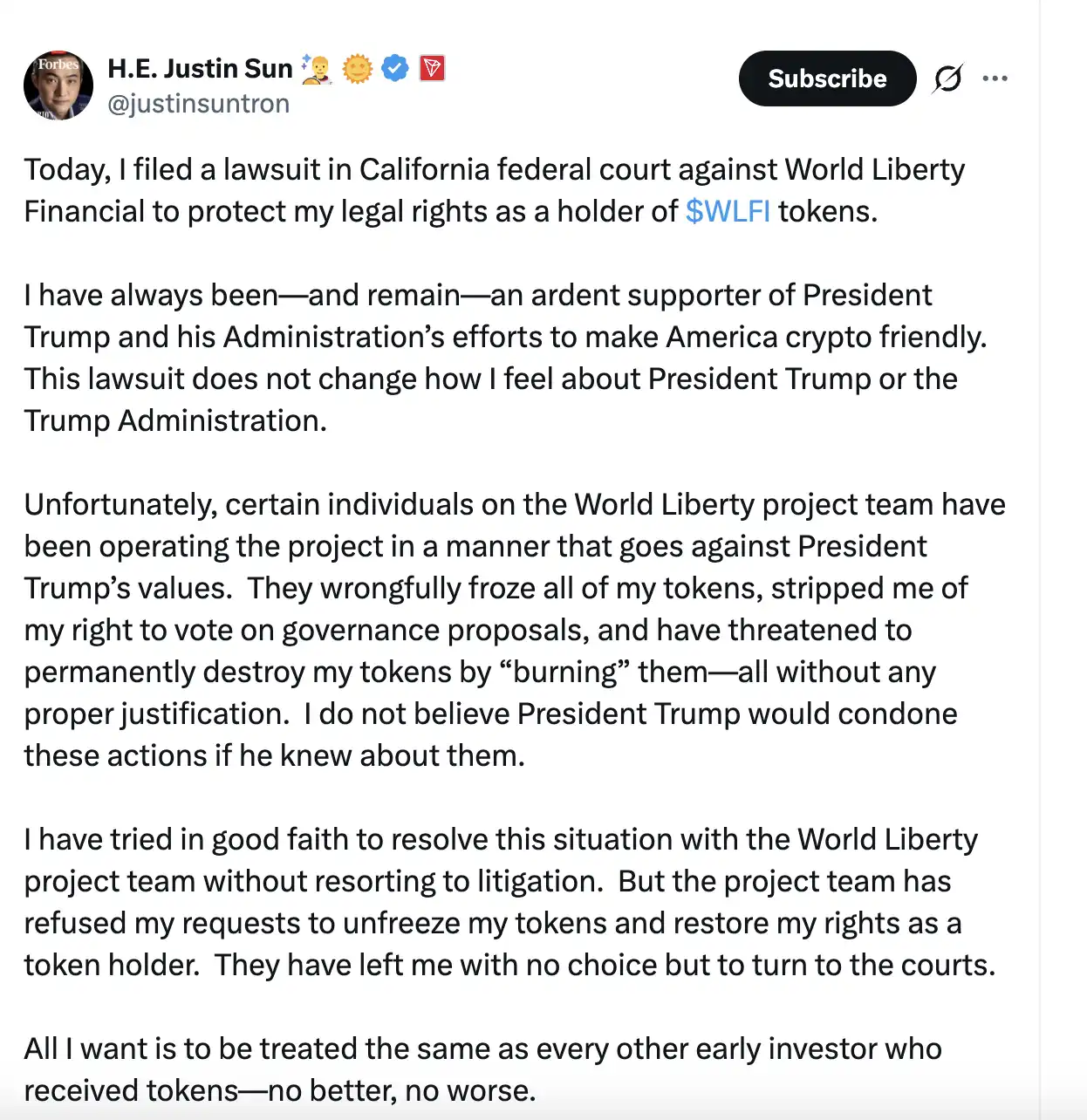
"They left me with no choice but to turn to the courts," he wrote on X.

World Liberty Financial CEO Zach Witkoff responded that Sun's allegations were "completely without merit" and said Sun had engaged in "improper conduct," forcing World Liberty Financial to take action to "protect itself and its users."

No one explained what this "improper conduct" specifically was.

The President's ATM

To understand why Sun was frozen, one must first see what World Liberty Financial really is.

On the surface, it is a "decentralized finance" project, claiming to let small investors control their own funds. It has a governance token WLFI, a stablecoin USD1, and DeFi lending products.

But peel back this layer, and the core structure is a profit pipeline.

The Trump family receives 75% of the net proceeds from WLFI token sales. By December 2025, the family had already profited $1 billion from this, while holding $3 billion worth of unsold tokens. The reserve assets for the USD1 stablecoin are invested in U.S. Treasury bonds, and the interest income generated also flows to family entities. Based on a market cap of $4.2 billion and current Treasury yields, the stablecoin alone could generate approximately $160 million in annual income.

This doesn't even include the biggest chunk.

In January 2025, just four days before Trump's inauguration, an investment entity of Abu Dhabi royal family member Sheikh Tahnoon bin Zayed acquired a 49% stake in World Liberty Financial for $500 million. The agreement was signed by Eric Trump. $187 million flowed directly into entities controlled by the Trump family, and at least $31 million went to entities linked to the Witkoff family.

Zach Witkoff, CEO and co-founder of World Liberty Financial. His father, Steve Witkoff, is the U.S. Special Envoy to the Middle East.

Senator Elizabeth Warren called it "blatant corruption." The House of Representatives subsequently launched an investigation. Trump himself said he was "unaware" of the deal.

Dolomite: Borrowing Your Own Money

In early 2026, on-chain data showed World Liberty Financial deposited 5 billion of its own WLFI tokens into the DeFi lending platform Dolomite as collateral, borrowing approximately $75 million in stablecoins. Over $40 million of this was transferred to Coinbase Prime, which usually means the tokens were converted into fiat currency.

And Dolomite's co-founder, Corey Caplan, is simultaneously an advisor to World Liberty Financial.

Your own tokens, deposited into a platform run by your own advisor, borrowing your own issued stablecoins, and then converting to cash.

This operation pushed the utilization rate of Dolomite's USD1 lending pool to 100%. Ordinary depositors were locked in, unable to withdraw their funds. And World Liberty Financial's collateral accounted for 55% of Dolomite's total value locked (TVL).

World Liberty Financial's response: "We, as an anchor borrower, created attractive yields for the platform."

In other words, they used their own issued tokens as collateral on their advisor's platform to borrow their own issued stablecoins. In traditional finance, this is called a related-party transaction, requiring separate auditing and disclosure. In DeFi, there wasn't even an announcement.

Sun publicly challenged this on April 12, saying the World Liberty Financial team treated users as a "personal ATM" and that he was the "first and biggest victim." Three days later, World Liberty Financial introduced a governance proposal.

Ultimatum

The governance proposal on April 15 was nominally about "governance restructuring." The actual content: 6.228 billion WLFI tokens (62% of the total supply) would be subject to a new unlocking schedule. The 45.2 billion tokens held by founders, team, and advisors needed to accept a 10% burn (approx. 4.52 billion tokens), then enter a 2-year lock-up period followed by 3-year linear release.

Holders who did not accept the new terms would have their tokens frozen indefinitely.

Sun called this proposal "one of the most ridiculous governance scams I have ever seen." But he couldn't vote against it because his tokens were already frozen.

Look at the distribution of voting power. In a USD1 governance proposal passed in January 2026, the top nine wallets controlled nearly 60% of the voting power.

WLFI's price action says it all. It hit an all-time high of $0.46 in September 2025 and has been falling since. On April 11, it touched an all-time low of $0.0767, down 84% from its high.

Early buyers who got in at $0.015 still have paper gains. But if you're Justin Sun, your $75 million investment bought tokens once worth over $1 billion, but now they are frozen and potentially facing permanent destruction.

The Same Mirror

Justin Sun is no innocent victim.

He has been accused by the SEC of market manipulation and fraud, and his investment timing precisely coincided with his legal troubles.

Precisely because he is not innocent, this case is interesting.

A person who made his fortune by "rug pulling" is treated with the same tactics by a larger power structure. The contrast here speaks volumes, more than any whitepaper.

World Liberty Financial promised "decentralized finance," user control over assets, no middlemen, no censorship.

But in reality, the smart contract has a backdoor, the project team can freeze your tokens at any time, governance votes are controlled by nine wallets, and the founders use your deposits to lend to themselves.

Sun's original words on X were: "Unfortunately, certain individuals within the World Liberty Financial project team are operating the project in a manner inconsistent with President Trump's values."

Even at the moment of filing the lawsuit, he was still saving face for Trump. A person who spent $75 million, after having all his assets frozen, still carefully distinguished between "President Trump" and "certain individuals within the project team" in the complaint.

The most interesting part of this case is not whether Sun can get his tokens back. It's how the court will characterize WLFI. If it is a security, then World Liberty Financial's act of modifying the contract and freezing holder assets without a vote could constitute fraud under federal securities law.

WLFI is currently quoted at $0.078, down about 84% from its high. The adequacy of the USD1 stablecoin reserve is being questioned. The risk in Dolomite's lending pool remains unresolved. The House investigation is ongoing. But the Trump family has already cashed out over $1 billion.

The earliest maturity window for Sun's convertible bonds is in 2027. Court scheduling could take over a year. During this time, WLFI tokens will continue to unlock, and more people will be forced to accept the choice of "either agree to the new terms or be frozen forever."


Пов'язані питання

QWhat is the core allegation in Justin Sun's lawsuit against World Liberty Financial?

AJustin Sun alleges that World Liberty Financial made him 'the primary target of its fraudulent scheme,' causing him and his companies to suffer 'hundreds of millions of dollars in losses.' He also claims the company is 'on the brink of collapse' and 'severely insolvent,' with plans to pay '95% of the token sale proceeds to company insiders.'

QWhat specific action did World Liberty Financial take that led to Justin Sun's assets being frozen?

AIn August 2025, World Liberty Financial modified the WLFI token's smart contract to include a 'blacklist' function. This allowed the project to unilaterally freeze any holder's tokens without notice, reason, or a governance vote. Sun's tokens, worth approximately $107 million, were frozen when he tried to transfer them a month later.

QHow is the Trump family financially connected to World Liberty Financial according to the article?

AThe Trump family receives 75% of the net proceeds from WLFI token sales, having already profited $1 billion by December 2025. They also hold $3 billion in unsold tokens. Furthermore, interest income from the USD1 stablecoin's treasury reserves flows to family entities, generating an estimated $160 million annually.

QWhat controversial transaction involving Dolomite is described in the article?

AWorld Liberty Financial deposited 5 billion of its own WLFI tokens into the DeFi lending platform Dolomite as collateral to borrow approximately $75 million in stablecoins. Over $40 million of this was transferred to Coinbase Prime, likely to be converted to cash. This is controversial because Dolomite's co-founder is also an advisor to World Liberty Financial, creating a clear conflict of interest.

QWhat was the 'ultimatum' presented to token holders in the April 15th governance proposal?

AThe proposal required that 45.2 billion tokens held by founders, team, and advisors be subject to a 10% burn (approx. 4.5 billion tokens) and then locked for 2 years with a 3-year linear release schedule. Holders who did not accept these new terms would have their tokens frozen indefinitely.

Пов'язані матеріали

The Value Distribution of Stablecoins

**Summary: The Value Distribution of Stablecoins** The article argues that stablecoins are evolving from mere trading tools into broader channels for dollar access. It divides the stablecoin ecosystem into four layers to analyze how value is distributed: 1. **Issuance Layer:** Mints stablecoins, holds reserve assets, and captures the spread between reserve yield and user costs (e.g., Tether, Circle). This layer currently earns the largest profit margin. 2. **Infrastructure Layer:** Connects stablecoins to the traditional financial system, handling fiat on/off-ramps, banking integration, compliance (KYC/AML), and asset management (e.g., Bridge, BVNK). This is the "unglamorous" but critical work, building the essential bridges between crypto and real-world finance. 3. **Acquiring/Distribution Layer:** Integrates stablecoins into merchant systems, manages payment flows, and provides enterprise financial software (e.g., Stripe, Coinbase). They act as the access point for businesses. 4. **Application Layer:** The end-users and businesses that ultimately use stablecoins for payments, settlements, or as a store of value. They benefit from convenience but have little pricing power. The core thesis is that while the issuance layer currently dominates profits, the often-overlooked **infrastructure layer holds significant long-term potential**. The real challenge and barrier to mass adoption is not the on-chain transfer of stablecoins (which is simple), but the complex "last mile" integration into existing business workflows, banking systems, and regulatory frameworks across different countries. Companies in this layer are currently in a "land grab" phase, investing heavily to build networks, secure bank partnerships, and establish compliance pathways. While their position is currently pressured by the profitable issuers above and distribution platforms below, the article suggests that if stablecoins become a default financial rail for businesses, the infrastructure providers who have done the hard work of integration will ultimately gain strong pricing power and become entrenched, essential players.

marsbit4 год тому

The Value Distribution of Stablecoins

marsbit4 год тому

The Value Distribution of Stablecoins

The Value Distribution of Stablecoins The article argues that stablecoins are evolving from a mere trading tool into a broad "dollar channel." It analyzes the industry's value chain through four layers: 1. **Issuance Layer (e.g., Tether, Circle):** The top layer that mints stablecoins, holds reserve assets, and captures the thickest interest rate spread. 2. **Infrastructure Layer (e.g., Bridge, BVNK):** Connects stablecoins to the traditional financial system, handling critical but complex "dirty work" like fiat on/off-ramps, banking integration, compliance (KYC/AML), and cross-border settlement. 3. **Acquiring/Distribution Layer (e.g., Stripe, Coinbase):** Embeds stablecoins into merchant systems, manages payment flows, and integrates with enterprise software. 4. **Application Layer:** End-users and businesses that ultimately use stablecoins for payments, settlement, or storing value. The author posits that while the issuance layer currently captures the most profit, the most overlooked and potentially critical layer is infrastructure. The core challenge for stablecoin adoption isn't the on-chain transfer (which is simple), but bridging the gap between blockchain and the real-world financial system. This involves solving practical problems for businesses: fiat conversion, reconciliation, tax handling, and user onboarding. Infrastructure companies are currently in a difficult "land-grab" phase—building networks, securing banking relationships, and achieving compliance country-by-country. They face pressure from both the profitable issuance layer above and distribution platforms below. However, the author suggests this layer is building a crucial moat. Once stablecoins become a default business rail, the infrastructure players who have done the hard work of integration may gain significant, durable value and pricing power.

链捕手4 год тому

The Value Distribution of Stablecoins

链捕手4 год тому

How to Do Research Well: Deliberately Practice the Real Skills That Matter

No one truly teaches you how to do research. You're often given a desk, a pre-selected problem, and vague instructions to "create something new." Consequently, many people reverse-engineer the job based on visible outputs—papers, posts, announcements—learning only how to *appear* like a researcher rather than how to *become* one. True research capability is built from stacking small, trainable skills, nearly all of which can be developed through deliberate practice. **Pick Your Own Problem:** Most researchers absorb problems from advisors or trends, lacking the underlying reasoning. Choosing a problem you genuinely care about, as John Schulman advises, leads to original work. Develop "taste" like a muscle: predict experiment outcomes, guess paper results from methods, and track which findings remain important over time. **Upgrade Your Inputs:** Relying on shared reading lists (arXiv hot lists, filtered group chats) leads to unoriginal conclusions. Undervalued old literature often holds crucial insights (e.g., MoE, LSTM, backpropagation). Richard Sutton's "The Bitter Lesson" or Claude Shannon's 1952 talk on creative thinking are more predictive than lengthy modern surveys. Breadth matters as much as depth: draw from neuroscience, mechanism design, hardware knowledge, and honest statistics. Read papers directly, especially appendices and limitations sections. **Write Everything Down:** As Paul Graham noted, writing exposes flaws in seemingly mature ideas. Writing is the cheapest defense against self-deception. Following Feynman's principle, Darwin programmatically wrote down facts contradicting his theory to combat memory bias. Maintain a detailed log of hypotheses, setups, predictions, results, and updated understandings. Reviewing past logs fosters essential humility.

marsbit6 год тому

How to Do Research Well: Deliberately Practice the Real Skills That Matter

marsbit6 год тому

Торгівля

Спот
Ф'ючерси

Популярні статті

Як купити SUN

Ласкаво просимо до HTX.com! Ми зробили покупку SUN (SUN) простою та зручною. Дотримуйтесь нашої покрокової інструкції, щоб розпочати свою криптовалютну подорож.Крок 1: Створіть обліковий запис на HTXВикористовуйте свою електронну пошту або номер телефону, щоб зареєструвати обліковий запис на HTX безплатно. Пройдіть безпроблемну реєстрацію й отримайте доступ до всіх функцій.ЗареєструватисьКрок 2: Перейдіть до розділу Купити крипту і виберіть спосіб оплатиКредитна/дебетова картка: використовуйте вашу картку Visa або Mastercard, щоб миттєво купити SUN (SUN).Баланс: використовуйте кошти з балансу вашого рахунку HTX для безперешкодної торгівлі.Треті особи: ми додали популярні способи оплати, такі як Google Pay та Apple Pay, щоб підвищити зручність.P2P: Торгуйте безпосередньо з іншими користувачами на HTX.Позабіржова торгівля (OTC): ми пропонуємо індивідуальні послуги та конкурентні обмінні курси для трейдерів.Крок 3: Зберігайте свої SUN (SUN)Після придбання SUN (SUN) збережіть його у своєму обліковому записі на HTX. Крім того, ви можете відправити його в інше місце за допомогою блокчейн-переказу або використовувати його для торгівлі іншими криптовалютами.Крок 4: Торгівля SUN (SUN)Легко торгуйте SUN (SUN) на спотовому ринку HTX. Просто увійдіть до свого облікового запису, виберіть торгову пару, укладайте угоди та спостерігайте за ними в режимі реального часу. Ми пропонуємо зручний досвід як для початківців, так і для досвідчених трейдерів.

547 переглядів усьогоОпубліковано 2024.12.12Оновлено 2025.03.21

Як купити SUN

Обговорення

Ласкаво просимо до спільноти HTX. Тут ви можете бути в курсі останніх подій розвитку платформи та отримати доступ до професійної ринкової інформації. Нижче представлені думки користувачів щодо ціни SUN (SUN).

活动图片












