‘Just the beginning’: Paul Atkins signals SEC’s new crypto rule changes

ambcryptoОпубліковано о 2026-03-20Востаннє оновлено о 2026-03-20

Анотація

SEC Chair Paul Atkins announced the agency will soon issue formal proposed rules to codify its recent interpretive guidance, which classifies most crypto assets as non-securities and categorizes them into five groups: digital commodities, collectibles, tools, stablecoins, and securities. The SEC also plans to create a regulatory sandbox for experimentation. Atkins noted that while this is a significant step, courts could still deviate from the SEC’s interpretation. He described the move as a "bridge" as Congress progresses on the CLARITY Act. Senator Cynthia Lummis reported that stablecoin yield issues are "99% resolved" in the bill negotiations. Market optimism for the bill has improved slightly despite earlier setbacks.

Paul Atkins, the chairman of the U.S. Securities and Exchange Commission (SEC), has said the agency will soon issue formally proposed rules for the recent crypto asset classification guidance.

In the latest interpretive guidance, the SEC designated most crypto assets as non-securities. Additionally, the framework classified digital assets into five categories, including digital commodities, collectibles, tools, stablecoins, and securities. It also explained how they fit into the current U.S. law.

To codify the framework, Atkins said the agency will formalize it alongside creating a sandbox for experimenting with different crypto products. But he warned the court could still ‘deviate’ from its interpretation.

This is just an interpretation, and the courts can deviate from that if they don’t like our rationale.

He added,

We’ll shortly follow up with a proposed rule to put much more of this framework into effect. And construct a series of exemptions, equivalent of sandbox for people to experiment and develop proof-of-concept for their products.

SEC’s plans and CLARITY Act progress

For Atkins, SEC’s interpretation of crypto laws is ‘just a beginning,’ and the move would be a ‘bridge’ as the Congress works its way through the CLARITY Act. In fact, most of the guidance issued in the past few days and months covers key topics being discussed in the CLARITY Act. For others, the SEC’s proposed rulemaking on key issues would be sufficient for the market, even if the CLARITY Act’s momentum stalls.

That said, the stablecoin yield issue has been the key deal breaker dragging the crypto bill.

Even so, after the recent Senate Republican meeting on the bill, Senator Cynthia Lummis was ‘positive,’ terming it ‘productive,’ and added,

We’re 99% of the way there on stablecoin yield, and negotiations on the digital asset portions of the bill are in a good place.
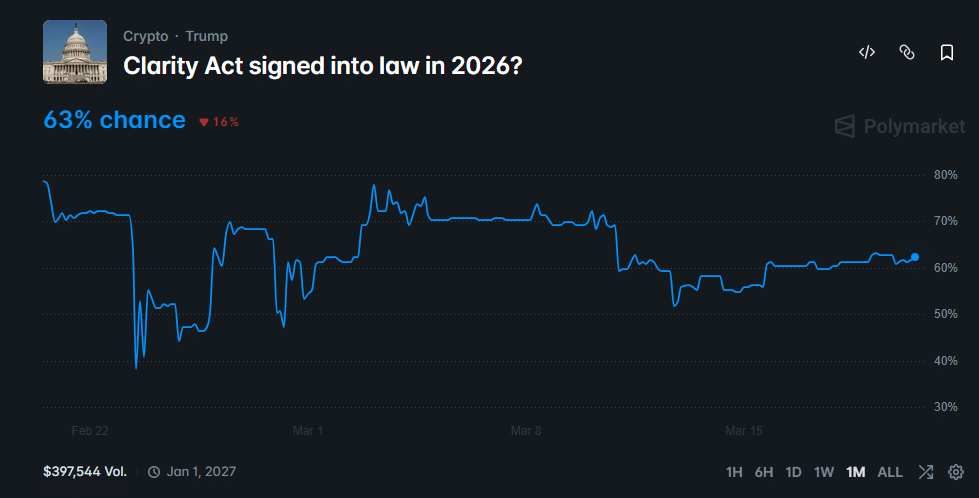
Source: Polymarket

As expected, market optimism on the bill’s passage improved slightly following the recent meetings and updates.

In early March, the chance of the CLARITY Act becoming law dropped to nearly 50% as the White House and the banking industry hit a snag over stablecoin yields.

Whatever the outcome, however, the crypto industry may still be in a better position for clear rules for the road if the SEC continues to issue and codify them.


Final Summary

  • SEC Chair reiterated plans to formalize rulemaking for its recent interpretive guidance on crypto asset classification and how current U.S. law applies to them.
  • According to Senator Lummis, the stablecoin yield issue was ‘99% resolved’ in CLARITY Act talks.

Пов'язані питання

QWhat did SEC Chairman Paul Atkins announce regarding crypto asset classification?

APaul Atkins announced that the SEC will soon issue formally proposed rules to codify its recent interpretive guidance on crypto asset classification, which designates most crypto assets as non-securities and categorizes them into five groups.

QHow did the SEC classify digital assets in its latest guidance?

AThe SEC classified digital assets into five categories: digital commodities, collectibles, tools, stablecoins, and securities, explaining how they fit under current U.S. law.

QWhat did Paul Atkins say about the role of courts in relation to the SEC's interpretation?

AAtkins warned that courts could deviate from the SEC's interpretation if they disagree with the rationale, emphasizing that the guidance is just an interpretation.

QWhat is the CLARITY Act, and how does it relate to the SEC's actions?

AThe CLARITY Act is a congressional bill addressing crypto regulation. The SEC's interpretive guidance covers key topics in the bill and is seen as a 'bridge' while Congress works on the legislation.

QAccording to Senator Cynthia Lummis, what progress has been made on the stablecoin yield issue in the CLARITY Act negotiations?

ASenator Lummis stated that the stablecoin yield issue is '99% resolved' and that negotiations on the digital asset portions of the bill are in a good place.

Пов'язані матеріали

CPU Makes a Comeback to the Table, A $170 Billion "Power Seizure" Drama Begins

A new era is dawning for the server CPU (Central Processing Unit), driven by the shift from AI model training to large-scale reasoning and the rise of Agentic AI. This article explores how the CPU is reclaiming a central role in the AI data center. For years, the focus has been on the GPU (Graphics Processing Unit) for AI training. However, as AI moves to the inference and Agent phase—where tasks involve complex, multi-step reasoning, tool calls, and data management—the workload balance is flipping. Studies show CPUs now handle over 70% of the workload in Agentic AI, up from 10-30% in training. This is because Agent tasks generate massive intermediate data (KV Cache) that exceeds GPU memory, forcing it to be offloaded to the CPU's larger, more scalable memory pools. This increased importance is translating into market changes. Major players are taking note: NVIDIA launched its first standalone CPU line, Vera, based on ARM architecture and optimized for Agent performance. AMD doubled its server CPU market forecast to over $1200 billion by 2030. Analyst reports project the total server CPU market could reach $1700 billion by 2030, with AI-driven demand being a primary driver. Furthermore, the classic ratio of CPUs to GPUs in AI servers is rapidly changing, converging from 1:8 toward 1:1 for Agent deployments. This surge in demand has led to a rare industry-wide price increase of 10-15% for server CPUs from Intel and AMD, breaking a decade-long trend of "more performance for the same price." Demand is bifurcating into high-core-count CPUs for in-rack GPU support and moderate-core CPUs for standalone Agent task orchestration. In China, this global trend presents an opportunity for domestic CPU manufacturers like Hygon (海光信息) and Huawei Kunpeng, who are bolstered by both growing AI infrastructure needs and national policies promoting technological self-reliance ("xin chuang"). The maturity of their software ecosystems is also accelerating, evidenced by faster adaptation to new AI models. In conclusion, the narrative is shifting from a GPU-centric view to one where CPU-GPU synergy is critical. The CPU is no longer a peripheral component but a performance-defining bottleneck and a key growth driver in the AI hardware stack, opening a massive new market estimated in the hundreds of billions of dollars.

marsbit1 год тому

CPU Makes a Comeback to the Table, A $170 Billion "Power Seizure" Drama Begins

marsbit1 год тому

TechFlow Intelligence: AMD AI Director Publicly Criticizes Claude Code for "Becoming Dumber and Lazier", Trump Claims Full Ceasefire in Hormuz But Strait Still Has 80 Unexploded Mines

TechFlow Intelligence Report: This daily digest covers key developments in AI, crypto, hardware, and geopolitics. In AI, SK Telecom faces US export control scrutiny over its partnership with Anthropic, while a Gemini user reports being misled in a scam scenario, sparking safety debates. China's Z.AI launches the GLM-5.2 model, rivaling Claude Opus without NVIDIA chips. In crypto, Bithumb lists ReProtocol, and Upbit delists KernelDAO. On the hardware front, MIT researchers build a custom OS to study chips, ASML denies US claims its advanced lithography machines are in China, and Amazon considers selling its in-house AI chips. Apple's future A21 Pro chip may use TSMC's latest N2P process. Major tech issues include 10,000 GitHub repositories distributing malware and Apple patching a critical eavesdropping flaw in Beats earbuds. US stocks rise, led by semiconductors, with Intel surging 10.6%, while SpaceX falls 3.5%. Geopolitically, despite a US-Iran deal, the Strait of Hormuz remains risky with ~80 uncleared mines, stalling 80M barrels of oil on standby tankers. Iran postpones Switzerland talks, and Trump calls the agreement an "unconditional surrender." The report highlights a contrast: temporary geopolitical calm versus the ongoing, fundamental restructuring of tech supply chains and chip independence.

marsbit1 год тому

TechFlow Intelligence: AMD AI Director Publicly Criticizes Claude Code for "Becoming Dumber and Lazier", Trump Claims Full Ceasefire in Hormuz But Strait Still Has 80 Unexploded Mines

marsbit1 год тому

Торгівля

Спот
Ф'ючерси
活动图片