Japan’s ‘Digital Year’: Finance Minister Eyes Crypto Integration Into Stock Exchanges

bitcoinistОпубліковано о 2026-01-06Востаннє оновлено о 2026-01-06

Анотація

Japan's Finance Minister Satsuki Katayama has declared 2026 as the nation's "Digital Year," endorsing the integration of crypto assets and blockchain technology into financial markets. She emphasized the role of stock exchanges in providing public access to digital assets and supporting the transition from savings to investment. Katayama expressed support for crypto-based investment products, similar to US ETFs, and highlighted the importance of robust governance for sector growth. Additionally, a 2026 tax reform proposal plans to reclassify crypto as financial products and introduce a separate 20% flat tax rate, replacing the current progressive tax of up to 55%.

Japan’s Finance Minister has shared her stance on crypto assets and the importance of stock exchanges in supporting the transition to a growth-oriented economy that opens up public access to digital assets.

Japan Enters Its ‘Digital Year’

On Monday, Japan’s Minister of Finance Satsuki Katayama endorsed the country’s efforts to integrate crypto assets and blockchain technology into the local financial markets, outlining her policy stance to support Japan’s development as an asset management nation, asserting that “there is still room for growth in shifting from savings to investment.”

In her New Year’s address at the Tokyo Stock Exchange’s (TSE) Grand Opening Ceremony, celebrated on January 5, Katayama declared that 2026 would be the “Digital Year” for the nation.

The Finance Minister pointed out that 2026 “is a turning point” for overcoming deflation, emphasizing the “importance of responsible, proactive fiscal policy and concentrated investment in growth sectors.”

Notably, Katayama has previously shared a positive approach to crypto and the Web3 sectors, the reports added. Last year, she declared that “with robust governance, the crypto asset and Web3 sectors can develop significantly, and the future is very bright.”

Local news media outlets reported that the Finance Minister expressed her support for integrating crypto assets into stock exchanges on Monday, highlighting the importance of existing financial infrastructure to increase exposure to crypto-related services.

“For citizens to benefit from digital assets and blockchain-based assets, the role of commodity and securities exchanges is crucial,” she stated.

During the New Year’s address, she also discussed the future of crypto-related investment products in Japan, underscoring how “In the U.S., ETFs (exchange-traded funds) are expanding as a means for citizens to hedge against inflation.”

Despite the success of US spot ETFs, Japanese regulators have been cautious about digital asset-based funds. The Financial Services Agency (FSA) has repeatedly expressed reservations about the investment products.

Nonetheless, Katayama suggested that similar initiatives to those of the US would be pursued in Japan, signaling a potential launch of crypto-based investment products this year.

She concluded her statement by declaring her support for the efforts carried out by exchanges in Japan to develop trading environments “utilizing such cutting-edge fintech and technology.”

2026 Framework To Reshape Local Crypto Landscape

Over the past few years, Japanese authorities have been working to review their regulatory system and develop policies for customer fund safety and innovation in a more reliable industry.

In December, the Liberal Democratic Party and the Japan Innovation Party published their upcoming FY2026 Tax Reform. As reported by Bitcoinist, the 2026 tax reform will introduce significant changes to the existing taxation system.

These changes, long requested by Japanese investors, are set to address the categorization and regulation of crypto assets, reclassifying them as financial products.

The proposal signals a shift from the assets’ previous treatment as speculative assets by Japanese financial authorities. Based on this, the reform is also studying the introduction of a separate taxation system for crypto income.

The current progressive tax system, where digital asset gains can be taxed at up to 55%, would be replaced with a system like the one used for stocks, with a flat 20% tax on crypto income.
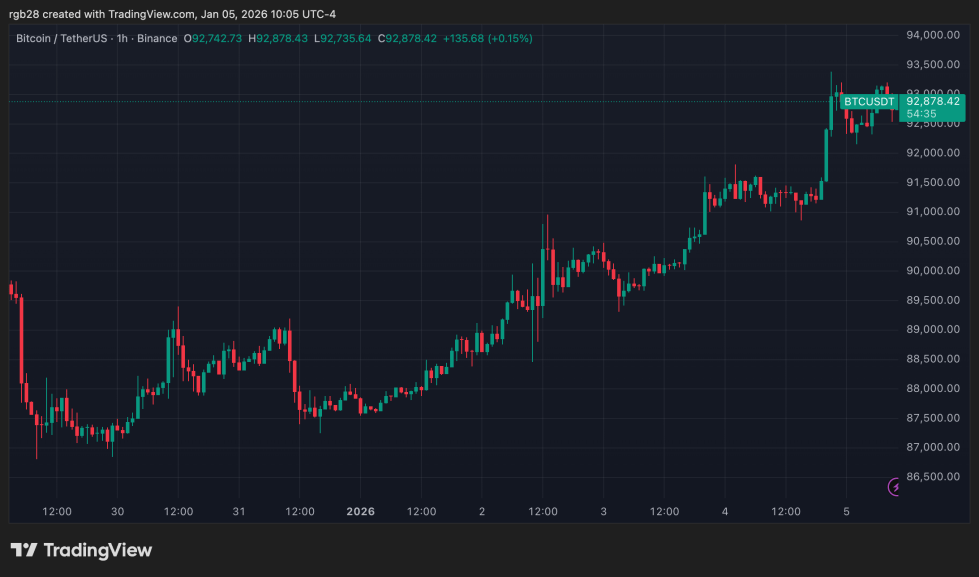
Bitcoin (BTC) trades at $92,876 in the one-week chart. Source: BTCUSDT on TradingView


Пов'язані питання

QWhat did Japan's Finance Minister declare as the country's 'Digital Year' and when was this announced?

AJapan's Finance Minister Satsuki Katayama declared 2026 as the country's 'Digital Year' during her New Year's address at the Tokyo Stock Exchange's Grand Opening Ceremony on January 5.

QAccording to the Finance Minister, what is the crucial role of commodity and securities exchanges in the context of digital assets?

AThe Finance Minister stated that the role of commodity and securities exchanges is crucial for citizens to benefit from digital assets and blockchain-based assets.

QHow does the current Japanese tax system treat crypto gains, and what change is being studied for the 2026 tax reform?

AThe current progressive tax system taxes digital asset gains at up to 55%. The 2026 tax reform is studying the introduction of a separate taxation system with a flat 20% tax on crypto income, similar to the system used for stocks.

QWhat significant change to the categorization of crypto assets is proposed in the 2026 tax reform?

AThe 2026 tax reform proposes to reclassify crypto assets from their previous treatment as speculative assets to being categorized as financial products.

QDespite the success of US spot ETFs, what has been the stance of Japanese regulators towards digital asset-based funds?

AJapanese regulators, specifically the Financial Services Agency (FSA), have been cautious and have repeatedly expressed reservations about digital asset-based investment products.

Пов'язані матеріали

Why Bitcoin Holds Above $64,000 After Fed's Hard Pause

**Bitcoin Stabilizes Near $64,000 Following Hawkish Fed Pause** The cryptocurrency market, led by Bitcoin, remained stable around $64,000 despite a volatile reaction to the latest U.S. Federal Reserve meeting. The Fed paused interest rates but signaled a hawkish stance, with three committee members voting for an increase—the highest dissent since 2016. This limits risk appetite but hasn't triggered panic selling. Key market highlights include Bitcoin ETFs seeing a net inflow of $32.1 million, breaking a streak of outflows, while Ethereum ETFs experienced outflows of $18.65 million. Liquidations affected about 90,000 traders. Technically, Bitcoin finds support around $63,000-$63,500, with major resistance near $66,000. While its price is about 49% below its all-time high, institutional demand via ETFs and the absence of mass capitulation support a potential recovery scenario in the second half of the year. Major altcoins showed mixed movements, with Solana attracting capital while Ethereum faced selling pressure despite strong on-chain metrics like a growing staking queue. Regulatory news took a pause as the U.S. Senate delayed the CLARITY Act vote until at least autumn. For the final trading day of July, U.S. inflation and consumer spending data will be crucial. Bitcoin's key levels to watch are $63,000 support and $66,000 resistance. Sustained ETF inflows and Bitcoin holding above $63,000 are seen as positive signs for a potential market recovery later in the year.

cryptonews.ru1 год тому

Why Bitcoin Holds Above $64,000 After Fed's Hard Pause

cryptonews.ru1 год тому

Participants in XRP Fraud Scheme That Stole $9 Million from 71 Investors Arrested

South Korean police have arrested three individuals accused of operating a fraudulent investment platform that stole approximately 3.4 million XRP (worth about $9 million) from 71 investors between October 16 and 23. The suspects promoted the site Fxrpntwork.com through blogs, online articles, and YouTube videos, promising guaranteed principal and monthly returns of 1.5% to 1.8%. Investors were instructed to transfer XRP from Korean exchanges to overseas platforms and then to wallets controlled by the group before the site was shut down. The scammers copied the branding of legitimate projects Flare Network and FXRP to appear credible. Authorities warn that such impersonation frauds, which use familiar branding and urgent promises of guaranteed profits, are a common red flag. Legitimate companies do not solicit cryptocurrency transfers through unsolicited promotions. Seoul police have issued an Interpol Red Notice for a fourth suspect abroad and are investigating others involved in creating and promoting the fraudulent website. While investigators froze 17.3 billion won in assets, approximately 10 billion won was moved during the probe, with wallet analysis revealing transfers totaling 27.3 billion won, suggesting there may be additional unidentified victims and accomplices. The case underscores the organized, cross-border nature of crypto investment fraud.

cryptonews.ru1 год тому

Participants in XRP Fraud Scheme That Stole $9 Million from 71 Investors Arrested

cryptonews.ru1 год тому

Торгівля

Спот
活动图片




