Japanese and Korean Stock Markets Crashed! Nikkei Plummets Over 4%, KOSPI Plunges 8%, Market Panics Ahead of AI Giants' Earnings Week

marsbitОпубліковано о 2026-07-28Востаннє оновлено о 2026-07-28

Анотація

Japanese and South Korean stock markets plunged sharply in early Tuesday trading, with the Nikkei 225 down over 4% and the KOSPI index tumbling 8%, triggering a circuit breaker. The sell-off was led by semiconductor and equipment stocks like Tokyo Electron, Kioxia, Samsung Electronics, and SK Hynix, the latter dropping as much as 30%. The primary driver is mounting investor concern over the sustainability of the AI boom. Worries intensified following news related to Nvidia's major AI supply agreements and rising debt insurance costs. Analysts point to fears over excessive capital expenditure, crowded trades in AI-related stocks, and high corporate debt levels. Market sentiment has soured ahead of key earnings reports from major tech firms, including Meta and SK Hynix. While SK Hynix is expected to post record results, its recent 38% price drop from June highs reflects deep skepticism about whether AI infrastructure spending can maintain its pace and deliver returns. The sell-off appears more driven by a sharp deterioration in sentiment than by immediate fundamental changes.

On Tuesday morning, dragged down by concerns related to Nvidia's (NVDA.O) significant AI supply agreements and intensifying market competition, investor sentiment was hit, causing Japanese and Korean stock markets to open lower and extend losses.

As of the time of writing, the Nikkei 225 Index had plunged over 4% intraday, hitting its lowest level since May 22; the TOPIX Index saw its biggest drop of 2.7%. South Korea's KOSPI Index widened its losses to 8%, triggering a trading halt for 20 minutes. The Korea Exchange had also earlier activated the KOSPI sidecar mechanism, temporarily suspending program sell orders on the KOSPI.

Semiconductor and equipment stocks like Tokyo Electron, Kioxia, Samsung Electronics, and SK Hynix led the declines, all falling more than 9%. Among them, SK Hynix's stock price plummeted as much as 30%, marking its biggest single-day drop in history; Kioxia's stock price fell up to 18%, its largest decline since last November. As the global sell-off in semiconductor stocks intensified, investor sentiment regarding the sustainability of the AI boom continued to deteriorate.

Amid a wave of AI-related deals totaling over $750 billion, the cost of debt default insurance for Nvidia surged, triggering a decline in tech stocks. Hideyuki Ishiguro, Chief Strategist at Nomura Asset Management, stated that following reports on Nvidia's significant investment deals, the rise in its credit risk is being viewed by investors as a negative signal.

Additionally, Ishiguro pointed out that China's progress in the semiconductor manufacturing equipment sector poses a threat to Japanese suppliers—who have long held a competitive advantage in this field.
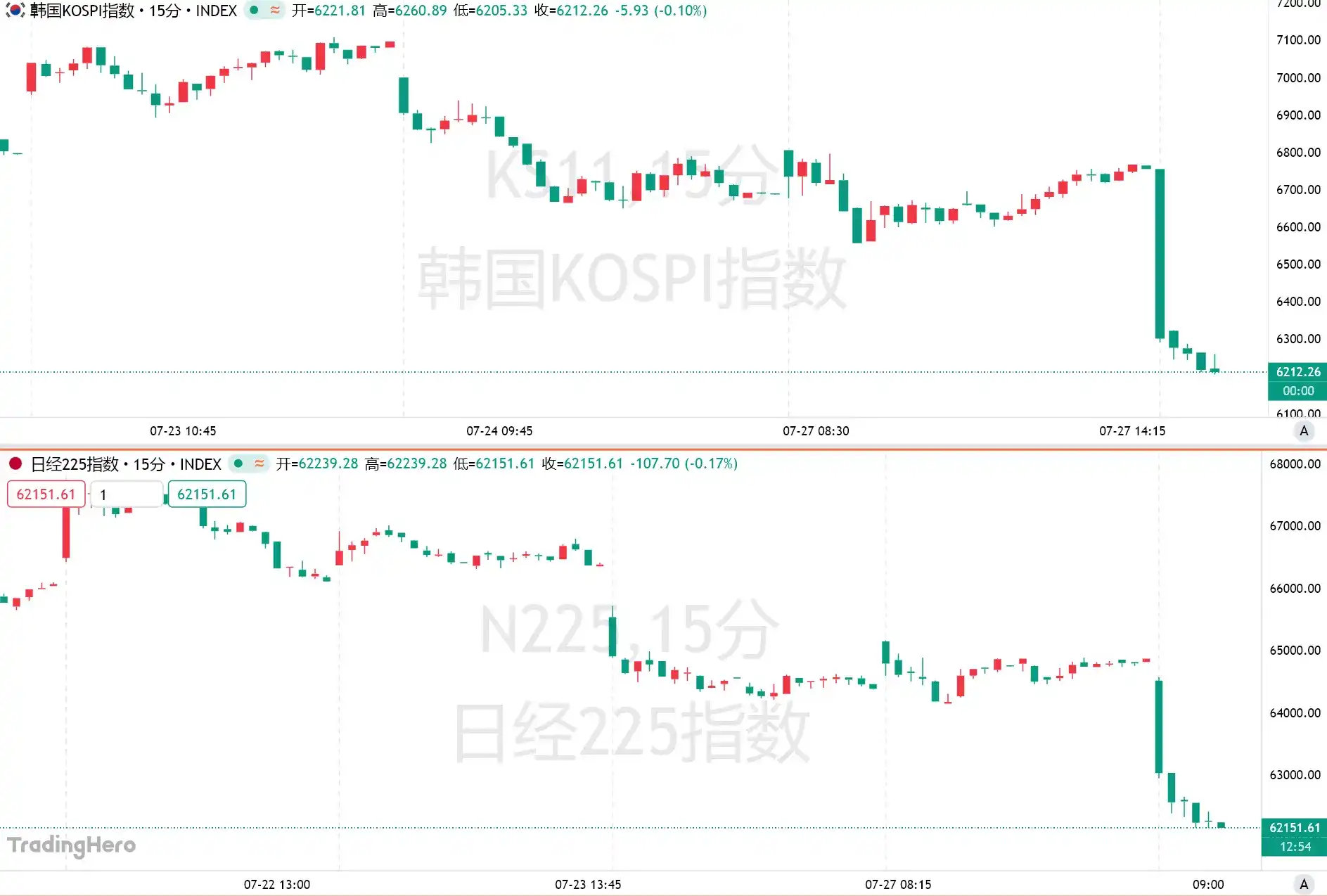
These declines point to deepening concerns in the market regarding crowded stock positioning and rising corporate debt levels as AI infrastructure development advances.

"The recent sell-off in semiconductor stocks seems to be driven more by sharply deteriorating market sentiment than by any immediate change in fundamentals," said Jung In Yun, CEO of Fibonacci Asset Management Global. "Investors are increasingly questioning whether the pace of AI infrastructure spending can be sustained."

Chris Larkin of Morgan Stanley E*Trade said: "This week is packed with potential surprises, both good and bad. Geopolitics and oil prices could be the biggest variables, but an optimistic reaction to strong earnings from the Magnificent Seven is not a given, especially if AI spending levels continue to surprise."

Kyle Rodda, Senior Analyst at Capital.com, wrote in a note to clients: "These companies embody the key themes currently affecting market sentiment—excessive capital expenditure and spending by AI companies, which investors worry will erode returns."

This week, several top tech companies, including Meta Platforms Inc. (META), are set to release key earnings. News earlier this month that Meta planned to sell excess AI computing capacity had already sparked concerns about demand. Apple Inc. (AAPL) has issued warnings about cost pressures, and reports indicate it is lobbying for approval to purchase memory components from competitors.

Investors are also awaiting the full results for Samsung Electronics' June quarter. Kim Minji, a portfolio manager at Seoul's Must Asset Management, said the world's largest traditional memory chipmaker is catching up to SK Hynix in the HBM field.

Furthermore, although SK Hynix is expected to announce another quarter of record-breaking earnings on Wednesday, investor sentiment has clearly weakened. The core market concern is that continuously rising memory prices may force customers to reduce purchases and seek lower-cost alternatives.

Since hitting a historic high in June, SK Hynix's stock price has cumulatively fallen 38%, with market worries about overcrowded trading and leverage amplifying price volatility. In this round of adjustment, the company's market capitalization shrinkage is second only to SpaceX (SPCX) globally.

In just over a month, approximately $470 billion in market value has evaporated from SK Hynix. The South Korean memory chipmaker, once seen as one of the world's hottest AI trades, is now becoming one of the most contentious holdings in investor portfolios.

Shawn Oh, Head of Korea Cash Equities Business at NH Investment & Securities, stated in a research report that, considering the current attractive valuation and the ongoing deleveraging by Korean retail investors, SK Hynix remains "an extremely attractive buying opportunity." However, he also noted that the market is reducing stock positions ahead of the U.S. tech company earnings season.

The market expects SK Hynix's June quarter sales to more than double year-on-year, reaching about $57 billion; operating profit is projected to increase sixfold year-on-year. But James Ooi, a market strategist at Tiger Brokers, said the significance of SK Hynix's earnings may transcend the company itself.

"SK Hynix's performance could also become a sentiment barometer for the global AI hardware sector," he said, adding that market expectations have largely been priced in already, so "even a slight miss could trigger a sharp reaction."

Hebe Chen, Senior Market Analyst at Vantage Global Prime, said: "The recent sell-off in chipmakers shows that doubts about spending, returns, and valuations are deepening, not subsiding. With several major catalysts approaching, the hesitation to buy the dip suggests investors are waiting for stronger evidence before rebuilding risk exposure."


Трендові криптовалюти

Пов'язані питання

QWhat were the main factors cited as causing the sharp decline in Japanese and South Korean stock markets on Tuesday morning?

AThe main factors were investor concerns about NVIDIA's major AI supply agreement and increasing market competition, which negatively impacted sentiment. Specific triggers included a surge in NVIDIA's debt default insurance costs within the large AI-related deal wave and worries about competition from China in semiconductor manufacturing equipment for Japanese firms.

QWhat specific market mechanisms were triggered in the South Korean market due to the sell-off, and for what key stock index?

AFor the South Korean KOSPI index, the decline widened to 8%, triggering a market-wide circuit breaker which halted trading for 20 minutes. The Korea Exchange also initiated a sidecar mechanism for the KOSPI, temporarily suspending program selling.

QWhich semiconductor and equipment stocks were mentioned as leading the declines, and what were some of their significant losses?

ATokyo Electron, Kioxia, Samsung Electronics, and SK Hynix were mentioned as leading the declines. Specific notable losses included SK Hynix's stock plunging as much as 30% (its biggest-ever daily drop) and Kioxia's stock falling up to 18% (its largest drop since November of the previous year).

QAccording to analysts cited in the article, what is the core investor worry regarding the current AI boom that is driving the market sell-off?

AThe core investor worry, as stated by analysts, is skepticism about the sustainability of AI infrastructure spending and capital expenditure. Investors are increasingly questioning whether the pace of AI-related spending can continue, fearing it will erode company returns. The sell-off reflects deepening concerns over crowded stock positions and rising corporate debt levels in the AI build-out.

QWhy is SK Hynix's upcoming earnings report considered significant beyond the company's own performance, and what potential market reaction is anticipated?

ASK Hynix's earnings report is seen as a potential sentiment barometer for the global AI hardware sector. The market has largely priced in high expectations, so even a slight miss in earnings could trigger a significant and volatile negative reaction across related stocks. Its performance is being watched for clues about the broader health and trajectory of AI demand.

Пов'язані матеріали

Goldman Sachs Comments on SanDisk and Western Digital Earnings: Strong Performance, But Market Expectations Too High

Highsmith commented on Sandisk and Western Digital's earnings reports, noting that while both companies delivered strong quarterly results, excessively high market expectations are likely to prevent their stock prices from benefiting. The firm anticipates downward pressure on both stocks following the earnings releases. The core issue, according to Highsmith, is not a deterioration in fundamentals but rather market expectations that have overshot reality. Despite impressive beats on revenue, gross margin, and EPS for the quarter, guidance that simply meets or falls slightly below lofty expectations is being interpreted negatively. For Western Digital, Q2 revenue was largely in line with forecasts, while gross margin and EPS beat estimates. However, its Q3 revenue guidance midpoint matched consensus, and gross margin/EPS guidance was only slightly above. Highsmith views this as "not surprising enough" given pre-earnings optimism, maintaining a Neutral rating and a $650 price target. Sandisk's Q2 results significantly exceeded consensus for revenue and EPS. However, its Q3 guidance disappointed, with revenue and gross margin midpoints below Highsmith's forecasts and consensus. Although the stock has declined ~40% from its June peak, Highsmith believes the below-consensus guidance will lead to further pressure, while maintaining a Buy rating and a $2,200 target due to longer-term potential. Highsmith also warns of a negative spillover effect on Micron Technology's stock due to its similar end-market exposure to Sandisk.

marsbit59 хв тому

Goldman Sachs Comments on SanDisk and Western Digital Earnings: Strong Performance, But Market Expectations Too High

marsbit59 хв тому

After the Lending Markets Disappear, What's Left for These Public Chains?

"The Lending Market Vanishes: What Remains for These Blockchains?" Last week, Aave announced the closure of its lending markets on six blockchains where each generated less than $5,000 in quarterly revenue. This move highlights a critical trend: while the DeFi lending sector is growing overall, it is becoming highly concentrated on a few leading chains like Ethereum, Base, and Arbitrum. The article analyzes the cascading effects when a major lending protocol like Aave exits a chain. Past examples, such as Harmony Protocol and Fantom (later rebranded as Sonic), demonstrate that losing core lending infrastructure leads to a complete collapse of the credit ecosystem. This is because a functional lending market relies on a costly, interconnected stack of services—including reliable price oracles (often maintained by the largest protocol), deep DEX liquidity for liquidations, and stablecoin issuers willing to support native minting and redemption. Once the primary lending demand disappears, maintaining this infrastructure becomes commercially unviable, triggering an exodus of other service providers. The six chains Aave is leaving (including Soneium, Aptos, zkSync, and Scroll) are in an even weaker position than Harmony or Fantom were. They never developed substantial native lending demand despite significant initial funding. Aave's departure will likely accelerate the withdrawal of oracle providers, market makers, and stablecoin issuers, as their business cases depend on a functioning credit market. This creates a self-reinforcing cycle of centralization, where resources and activity consolidate on the most viable chains. The dilemma mirrors challenges in traditional finance, such as global banks withdrawing correspondent banking services from small countries due to high fixed compliance costs. However, unlike the traditional system where institutions like the World Bank can provide subsidies, there is no such safety net in the decentralized crypto space. The key takeaway is that while launching a new blockchain is cheap, operating a full-featured, sustainable credit infrastructure on it is extremely expensive. Aave has now set a minimum annual revenue threshold of $2 million for new chain deployments, roughly covering these fixed costs. The future for many smaller chains may be a fragmented ecosystem with flawed, unofficial forks of major protocols, or they may be left with nothing at all as DeFi lending continues its aggressive consolidation.

marsbit1 год тому

After the Lending Markets Disappear, What's Left for These Public Chains?

marsbit1 год тому

Торгівля

Спот

Популярні статті

Як купити 4

Ласкаво просимо до HTX.com! Ми зробили покупку 4 (4) простою та зручною. Дотримуйтесь нашої покрокової інструкції, щоб розпочати свою криптовалютну подорож.Крок 1: Створіть обліковий запис на HTXВикористовуйте свою електронну пошту або номер телефону, щоб зареєструвати обліковий запис на HTX безплатно. Пройдіть безпроблемну реєстрацію й отримайте доступ до всіх функцій.ЗареєструватисьКрок 2: Перейдіть до розділу Купити крипту і виберіть спосіб оплатиКредитна/дебетова картка: використовуйте вашу картку Visa або Mastercard, щоб миттєво купити 4 (4).Баланс: використовуйте кошти з балансу вашого рахунку HTX для безперешкодної торгівлі.Треті особи: ми додали популярні способи оплати, такі як Google Pay та Apple Pay, щоб підвищити зручність.P2P: Торгуйте безпосередньо з іншими користувачами на HTX.Позабіржова торгівля (OTC): ми пропонуємо індивідуальні послуги та конкурентні обмінні курси для трейдерів.Крок 3: Зберігайте свої 4 (4)Після придбання 4 (4) збережіть його у своєму обліковому записі на HTX. Крім того, ви можете відправити його в інше місце за допомогою блокчейн-переказу або використовувати його для торгівлі іншими криптовалютами.Крок 4: Торгівля 4 (4)Легко торгуйте 4 (4) на спотовому ринку HTX. Просто увійдіть до свого облікового запису, виберіть торгову пару, укладайте угоди та спостерігайте за ними в режимі реального часу. Ми пропонуємо зручний досвід як для початківців, так і для досвідчених трейдерів.

546 переглядів усьогоОпубліковано 2025.10.20Оновлено 2026.06.02

Як купити 4

Обговорення

Ласкаво просимо до спільноти HTX. Тут ви можете бути в курсі останніх подій розвитку платформи та отримати доступ до професійної ринкової інформації. Нижче представлені думки користувачів щодо ціни 4 (4).

活动图片