Jackson Hole Speech Preview: Is the Fed Seeking Justification for a Rate Hike?

marsbitОпубліковано о 2026-08-26Востаннє оновлено о 2026-08-26

Анотація

"Jackson Hole Speech Preview: Is the Fed Looking for Reasons to Raise Rates?" Ahead of the key Jackson Hole symposium, Federal Reserve officials and the IMF are signaling heightened concern over persistent inflation, with some advocating for tighter policy. Boston Fed President Susan Collins, in a recent article, supported holding rates steady only if evidence of falling inflation continues. Otherwise, she argues for prompt tightening, noting inflation has been above target for over five years and warning that prolonged deviation could entrench consumer expectations. Although not a voting member this year, her stance aligns with several officials; three FOMC voters dissented in July, favoring a rate hike. Richmond Fed's Tom Barkin warned of a future "reckoning" regarding the $40 trillion public debt, while IMF Managing Director Kristalina Georgieva urged central banks to maintain a laser focus on price stability. The core dilemma lies in the sources of inflation: Trump-era tariffs, Middle East conflict-driven oil prices, and surging AI investment. Collins believes the first two factors are fading, but identifies AI infrastructure spending as exerting "upward pressure" on core goods inflation. The problem is that interest rate hikes primarily curb demand, not these supply-side shocks. Georgieva framed it as a "tug of war" between negative supply shocks from the Middle East and positive demand shocks from AI. Meanwhile, economic data shows strain. The August Consumer Confi...

On Tuesday evening, Boston Fed President Susan Collins posted an article on the Boston Fed website: If evidence of sustained disinflation does not emerge, "I believe it would be appropriate to tighten policy sooner rather than later."

Richmond Fed President Tom Barkin, asked about U.S. public debt exceeding $40 trillion at an event in Charlotte, North Carolina, said: There will be a reckoning for this, and no one can tell you when.

IMF Managing Director Kristalina Georgieva told reporters in Washington: All countries need to address their fiscal issues, and central banks must focus on price stability like a laser.

At 10 a.m. the same day, the Conference Board released the August Consumer Confidence Index: 89.4, the lowest in seven months.

What exactly did the officials say?

Let's look at Collins's original words first, because the wording contains nuance.

She supports temporarily holding rates steady, but this support is conditional: "Maintaining the current target range for the federal funds rate will require persistent evidence that inflation is indeed declining." If that evidence does not materialize, "I believe it would be appropriate to tighten policy sooner rather than later to ensure we achieve price stability within a reasonable timeframe."

She said recent inflation data was "mildly encouraging," but monthly readings are volatile, and "it remains to be seen whether recent improvements can be sustained."

A more significant statement was: Inflation has been above target for over five years; the Fed cannot wait forever. She is concerned that a persistent deviation from the target could alter consumer expectations, and once expectations change, the target itself becomes harder to achieve.

Collins is not a voting member this year. But this is not her stance alone—at the July meeting, the Fed held rates steady for the fifth consecutive time, yet three officials dissented, advocating for a 25-basis-point hike, and two non-voting members also expressed support for a hike. The policy rate now stands in the 3.5% to 3.75% range, unchanged since last December.

Barkin's "reckoning" comment is worth quoting in full: "As things progress, there will be a reckoning for this. No one can tell you when. We are the global currency, have the rule of law—all these are reasons people keep buying our debt. But, you know, at some point, people stop buying your debt, and that's the external risk."

He told reporters afterward that the July rate decision was a "tough choice." The reason for waiting is practical: two more months of data will be available before the next meeting on September 15-16. "So far, we've gotten one full set of data, we'll get another full set, and see what we learn."

What exactly is pushing up inflation?

This is the key to the whole article because it determines whether a rate hike would be effective.

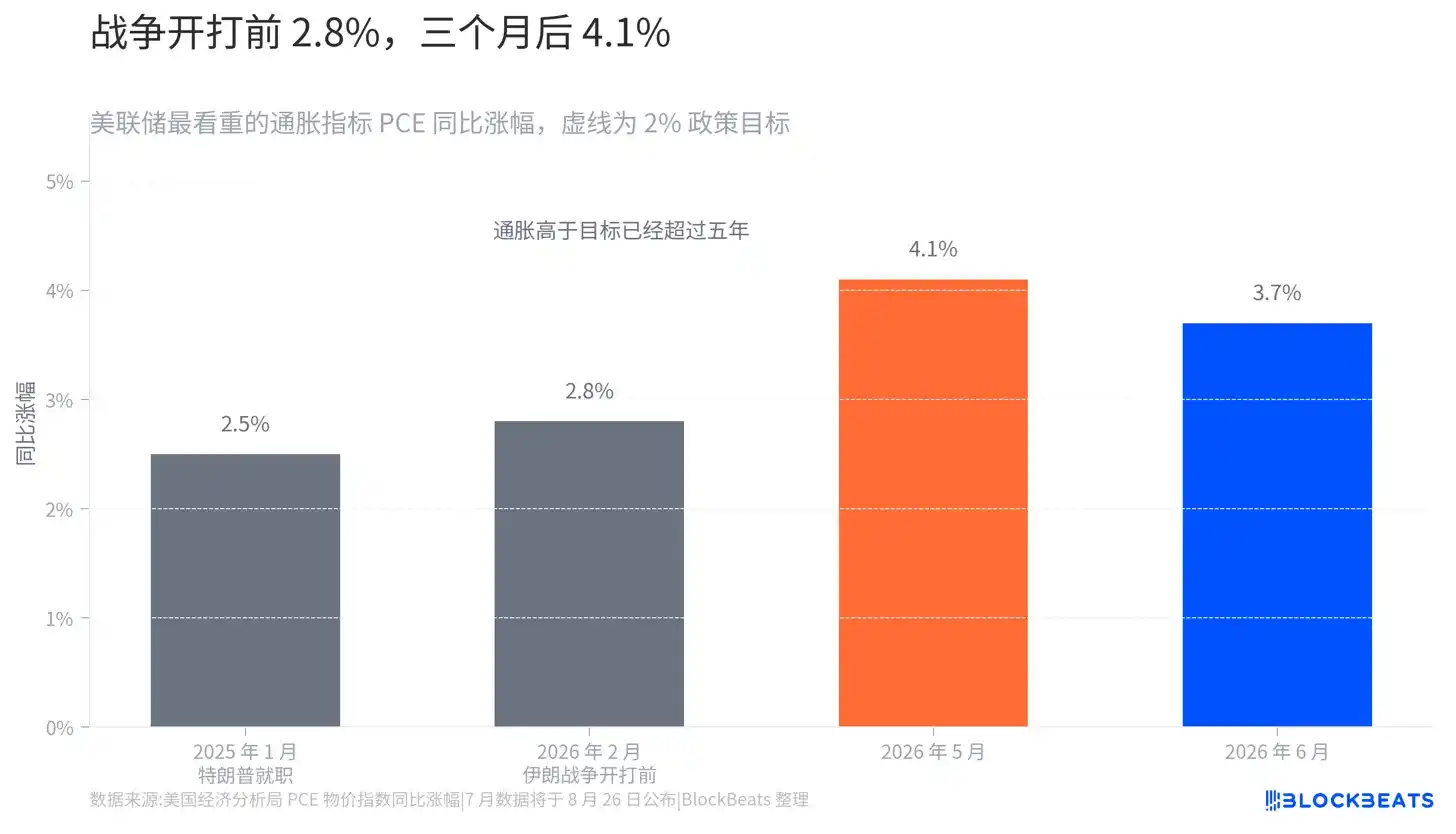
First, let's see where the line has gone. The Fed's most-watched inflation gauge is the PCE price index. When Trump took office in January 2025, it was 2.5%; before the Iran war began on February 28 this year, it was 2.8%; it surged to 4.1% in May; and fell back to 3.7% in June. The policy target is 2%.
The Fed officials themselves listed three reasons: Trump administration import tariffs, oil price increases due to the Iran war, and the current massive AI investment.

Of the three, Collins believes the first two are receding. She judges that the pass-through of earlier tariffs is largely complete, and the inflationary impact of rising oil prices should also begin to fade.

But the third one is something she named herself in the article:

"Regarding the stronger-than-expected economic activity, I would note that AI construction appears to be putting upward pressure on core goods inflation."

Laying out these three factors reveals the awkwardness of the rate hike tool.

The transmission path for rate hikes is only one: increase the cost of borrowing → suppress demand → prices fall as demand falls. It treats the "too much money" part of "too much money, too few goods."

But tariffs are set by policy; rate hikes can't change that. The transit situation in the Strait of Hormuz is determined by the Middle East situation; rate hikes can't change that either. As for AI construction, that $730 billion in data center spending, those orders scrambling for electricity, transformers, and memory, are happening in an environment where interest rates are already not low. Their sensitivity to funding costs is far lower than that of ordinary corporate investment.

IMF Managing Director Georgieva provided the clearest framework for this chaos.

She said the global economy has withstood pressure so far largely thanks to the surge in AI investment. The energy shock from the closure of the Strait of Hormuz was also less severe than initially feared, thanks to countries tapping oil and gas reserves, increased non-Gulf energy supply, falling energy demand, the rise of renewable capacity, and some regions returning to coal.

But she said uncertainty remains high, evidence lying in two places: rising bond yields and stalled disinflation. She said in a recent interview: "We are squarely in a tug-of-war. Negative supply shocks from the Middle East, positive demand shocks from AI."

This is precisely the Fed's predicament. One end of the rope is pulling up prices, the other is pulling up growth, and it only has a hammer to smash demand.

Georgieva's risk list also includes: shrinking oil and gas reserves as the Northern Hemisphere enters winter, a strong El Niño that could exacerbate food insecurity, and the impact of AI on financial stability. Her concluding remark left no room for complacency: "All of this does not allow for complacency, and that's my core message. We're not doing poorly, but that shouldn't be a reason to say, 'OK, everything is going well, easily.'"

In July, the IMF largely maintained its 2026 global growth forecast at 3% but raised its global consumer price forecast, mainly due to energy and food.

In other words, the three walls on the supply side are beyond the reach of the interest rate hammer. The only thing it can smash is demand.

And on the demand side, the strain is already showing.

Consumers are already feeling the strain

The August Consumer Confidence Index is 89.4, down 0.8 points from the revised 90.2 in July, hitting a seven-month low and below economists' expectations of 90.2.

Breaking it down, the data is split.

Assessment of the present situation is improving: the Present Situation Index rose 6.8 points to 121.2, the first improvement in four months. Employment perceptions are also improving—the proportion saying jobs are "plentiful" rose from 24.4% to 27%. The difference between those saying jobs are plentiful and those saying jobs are hard to get rose to 7.5%, the first increase in three months (the July reading was the lowest in over five years).

Assessment of the future is collapsing: the Expectations Index fell 5.8 points to 68.2, the lowest since January, a drop of 7.8%. Only 14.6% expect more jobs in the next six months, down from 16.4% last month.

The summary from Dana Peterson, Chief Economist at The Conference Board, is: "Consumers are more pessimistic about business conditions and the labor market for the next six months."

One number explains why. The survey's collection period was August 3-16, during which the U.S. average gas price stayed above $4 per gallon—due to renewed U.S.-Iran tensions pushing up oil prices. Consumers themselves expect inflation to accelerate to 5.8% over the next 12 months; in July, their expectation was 5.6%.

Other corroborating evidence points in the same direction: July U.S. retail sales posted the largest drop in over a year; the July job market unexpectedly stalled, with employers cutting a net 23,000 jobs, and the Labor Department also revised down May and June employment figures by 103,000; the unemployment rate fell to 4.1%, but for the wrong reason—several thousand people simply left the labor force, so there was less competition. The University of Michigan's Consumer Sentiment Index also fell in August for the first time in three months.

After five years of high inflation, Americans' patience is running thin. And the midterm elections are less than 70 days away.

Friday preview: Two things to watch next

First is the release of July PCE data. Economists surveyed by Reuters expect core PCE year-on-year at 3.3%, unchanged from the previous month; The Wall Street Journal survey expects headline PCE at 3.6%. Whichever measure, it remains well above the 2% target.

Then comes Jackson Hole on Friday. Kevin Warsh will deliver his first major speech as Fed Chair. He faces criticism for—not having frankly stated his views on the economy. Georgieva will also attend Jackson Hole for the first time this week.

Market pricing is currently contradictory: futures show about a 75% probability of a December hike, while IG's Chris Beauchamp says the probability of a September hold "remains firmly around 60%" and believes this speech won't change much—because Warsh prefers to be "tight-lipped."

There is one thing that has already given an answer. Gold is near $4,660, approaching a three-month high, up over 7% in a week.


Пов'язані питання

QWhat are the key reasons cited by Fed officials for persistent inflation above target, and why might raising interest rates be an inadequate tool to address them?

AFed officials, including Susan Collins, cite three main drivers of persistent inflation: 1) Trump-era import tariffs, 2) higher oil prices due to the Iran war, and 3) massive AI infrastructure investment pushing up core goods prices. Raising interest rates is a blunt tool that primarily works by increasing borrowing costs to suppress demand. However, it is largely ineffective against these specific supply-side and policy-driven factors. It cannot alter tariff policies, resolve geopolitical tensions affecting oil shipments, or easily curb capital-intensive AI investments that are less sensitive to borrowing costs.

QHow does Susan Collins frame the conditionality of her support for holding interest rates steady, and what is her primary concern about prolonged high inflation?

ASusan Collins conditionally supports holding rates steady, stating it 'will need sustained evidence that inflation is indeed coming down.' If such evidence does not appear, she believes 'prompt tightening would be appropriate.' Her primary concern is that inflation has been above target for over five years. She worries this prolonged deviation could alter consumer inflation expectations, making the 2% target itself more difficult to achieve as expectations become entrenched.

QAccording to the IMF's Kristalina Georgieva, what are the opposing forces in the 'tug of war' affecting the global economy, and what risks does she highlight?

AKristalina Georgieva describes the global economy being in a 'tug of war' between a negative supply shock from the Middle East (affecting energy) and a positive demand shock from AI investment. She highlights several risks: dwindling oil and gas reserves as winter approaches in the Northern Hemisphere, a strong El Niño potentially worsening food insecurity, and the impact of AI on financial stability. She warns against complacency, emphasizing that the situation 'does not allow for complacency.'

QWhat contradictory signals does the August Consumer Confidence Index reveal about the U.S. economy and public sentiment?

AThe August Consumer Confidence Index reveals a split in sentiment. The Present Situation Index improved to 121.2, indicating a better view of current conditions, with more people reporting jobs as 'plentiful.' However, the Expectations Index plummeted to 68.2, its lowest since January, showing deep pessimism about business conditions and the labor market over the next six months. This contradiction suggests consumers feel okay about the immediate present but are increasingly worried about the near future, partly driven by expectations of higher inflation (5.8%) due to rising gas prices.

QWhat is the market's implied probability for a Fed rate hike by December, and what asset's price action suggests rising investor concern?

AFutures markets currently imply about a 75% probability of a Fed rate hike by December. However, the price action in gold suggests rising investor concern. Gold traded near $4660, approaching a three-month high and gaining over 7% in a week. This surge is often interpreted as a hedge against economic uncertainty, stagflation risks (high inflation with weak growth), or a potential policy mistake by the Fed.

Пов'язані матеріали

Bessent's True Agenda

U.S. Treasury Secretary Besant's recent interventions in the bond market are seen by some as an attempt to artificially trigger a massive short squeeze before the midterm elections. The alleged goal is to push the 10-year yield toward 5% initially, then use covering by short sellers to drive it down to around 4.3%, providing political breathing room for the Trump administration. Analysts point to near-record short positions held by CTA trend-following funds. According to Goldman Sachs data, a price rally of two standard deviations could trigger historically large short-covering. Besant's tactics reportedly include bond buybacks, shifting issuance toward shorter-term debt, and potentially canceling ultra-long bond auctions to pressure these market positions. So far, interventions like modest buybacks have had limited effect on yields, with the Treasury later hinting at using its General Account (TGA) cash for support. Critics argue these measures cannot address structural pressures like large deficits and high inflation. Instead, the strategy appears tactical—aimed at buying time and exploiting technical market vulnerabilities rather than reversing the underlying yield trend. The political timeline is clear: achieve lower yields ahead of the midterms to help lower mortgage rates and craft a favorable narrative. However, analysts warn that once the election passes, structural upward pressure on yields and equity valuations could reassert themselves more forcefully. Market signals suggest this potential short-squeeze dynamic could intensify in the coming days.

marsbit43 хв тому

Bessent's True Agenda

marsbit43 хв тому

Today, HYPE Activates Its Second Buyback Engine

"Hyperliquid Activates Second Buyback Engine with AQAv2 Launch" On August 26th, Hyperliquid officially activated its Aligned Quote Assets v2 (AQAv2) mechanism, introducing a major new source of revenue and buyback power for its native token, HYPE. Unlike the existing revenue stream from trading fees, AQAv2 generates income by sharing approximately 90% of the adjusted reserve earnings from stablecoins (primarily USDC) circulating on the Hyperliquid chain. This income is settled every 30 days and automatically funneled into the Assistance Fund for HYPE buybacks, with the first expected distribution on October 3rd. Through a partnership with Circle (issuer of USDC) and Coinbase (treasury manager), Hyperliquid leverages its user base and financial infrastructure to share in the yield generated by stablecoin reserves. This transforms its liquidity and distribution capabilities into a scalable business model. Initial estimates project AQAv2 could generate $150-200 million in annual buyback funds, based on the current ~$6.43 billion USDC supply on Hyperliquid and an assumed reserve yield. Crucially, this revenue is weakly correlated with trading activity and grows directly with the platform's stablecoin adoption. With HYPE recently reaching an all-time high, AQAv2 provides a new fundamental support layer. It shifts Hyperliquid's value capture beyond just transaction fees, anchoring HYPE's long-term buyback potential to the expanding scale of its stablecoin ecosystem.

marsbit1 год тому

Today, HYPE Activates Its Second Buyback Engine

marsbit1 год тому

NVIDIA Earnings Preview: The Market No Longer Expects a Positive Surprise

NVIDIA's upcoming earnings report has seen market expectations shift from anticipating big positive surprises to seeking clarity on capital allocation and future growth sustainability. While analysts forecast Q2 revenue near doubling year-over-year to $92.18 billion, option markets are pricing in a relatively muted post-earnings stock move of around 5.4%—the lowest implied volatility in two years. This reflects a growing sense that the phase of massive AI-driven earnings beats and stock surges may be ending. This year, NVIDIA's stock has slightly underperformed the S&P 500 and significantly lagged the semiconductor index. Analysts now emphasize the need for more than just beating estimates. Key investor focuses include details on how NVIDIA will deploy its capital, maintain its exceptional gross margins amid rising costs, and use its substantial free cash flow for investments and share buybacks. The forward P/E ratio of about 21x suggests the market is already pricing in a growth deceleration. NVIDIA's recent strategic moves—like facilitating massive AI financing, guaranteeing loans for data center projects (including a major one for OpenAI), and investing in power infrastructure—have positioned it beyond a mere chipmaker. However, this raises questions about potential "circular financing," where revenue might be artificially supported by lending to customers. The health of its AI clients, like OpenAI which reported slowing revenue growth, is now crucial. The report arrives amid a challenging backdrop: political pushback against AI data centers, rising borrowing costs, and massive debt-funded spending by cloud giants. Investors are keenly watching for signals on the transition to the new Blackwell and upcoming Vera Rubin architectures and, ultimately, whether the explosive demand for AI is losing momentum.

marsbit1 год тому

NVIDIA Earnings Preview: The Market No Longer Expects a Positive Surprise

marsbit1 год тому

Saylor Pauses Bitcoin Purchases: The World's Largest Bitcoin Holder Is Transforming into a 'Digital Asset Bank'

Saylor's Strategy has paused its long-standing practice of buying Bitcoin, marking a significant shift for the world's largest corporate BTC holder. The company is now prioritizing capital structure management over accumulation. Strategy recently raised $2 billion by selling shares but purchased zero Bitcoin, directing funds instead to a new USD cash reserve, repaying preferred stock, and building its dollar liquidity pool. This follows a series of BTC sales in 2026, totaling around 6,916 coins, often at a loss, to meet its substantial annual dollar obligations of approximately $1.76 billion in dividends and interest payments. The core change is the adoption of a new "Digital Credit Capital Framework." Strategy is transforming from a leveraged Bitcoin proxy into a "digital asset bank." Its focus has shifted from simply increasing its BTC holdings to managing a balance sheet where Bitcoin acts as the reserve asset, common stock as equity, and preferred shares as liabilities. The goal is now to optimize the "Bitcoin per share" metric and maintain stability, even if it means selling BTC at a loss during market stress to protect its financial footing. The market appears to be re-evaluating Strategy, pricing it less as a volatile Bitcoin tracker and more as a capital management firm. Despite its recent sales, Bitcoin's price has surged, indicating Strategy's selling pressure is easily absorbed by broader market flows like ETF inflows. If successful, Strategy could emerge as a novel hybrid: a "Bitcoin bank." However, this path carries major risks, as sustained BTC prices below its average cost could steadily erode its financial safety net.

marsbit1 год тому

Saylor Pauses Bitcoin Purchases: The World's Largest Bitcoin Holder Is Transforming into a 'Digital Asset Bank'

marsbit1 год тому

Торгівля

Спот
活动图片