Israeli Military Catching Insiders on Polymarket

Odaily星球日报Опубліковано о 2026-02-13Востаннє оновлено о 2026-02-13

Анотація

Israeli military and civilian prosecutors have charged a reservist soldier and a civilian with using classified military information to profit from bets on the prediction market platform Polymarket. The suspects allegedly leveraged insider knowledge on the timing of military operations to place winning bets, netting over $150,000. One user, identified as "Rundeep," reportedly achieved a 100% success rate in six Israel-related predictions, often betting when odds were below 50%. The case highlights concerns about insider trading on prediction markets, especially regarding sensitive areas like military actions, where such activities could compromise operational security and potentially influence real-world outcomes. Regulatory scrutiny may follow as these platforms face growing scrutiny over their role in public affairs betting.

Original | Odaily Planet Daily (@OdailyChina)

Author | Azuma (@azuma_eth)

Insider information providing an unfair competitive advantage has long been a controversial focus on prediction markets like Polymarket.

Previously, during the US military's operation to capture Venezuelan President Maduro, the odds for related events on Polymarket showed abnormal movements ahead of time (see "When War is Settled Before the News: How Prediction Markets 'Priced' the Maduro Capture Operation 6 Days Early"). If that suspected insider activity could still be explained away by fluctuations in the "Pizza Index," then this time, it can be said that there is definitely an insider on Polymarket, completely confirmed.

Israeli Military Catching "Insiders" Internally

On February 12, Israel's largest English-language newspaper, The Jerusalem Post, reported that the Tel Aviv District Court indicted an Israeli civilian and an Israel Defense Forces (IDF) reservist on Monday, accusing the two of using classified military information to place bets on Polymarket for profit. The court revealed on Thursday that Israeli authorities believe this behavior poses a serious operational security risk during wartime.

According to a statement approved for release by the prosecution, the suspects were arrested in a joint operation by the Israel Security Agency (Shin Bet), the investigation unit under the Ministry of Defense's security agency, and the Israeli police. Investigators suspect that some reservists are using the classified information they access through their military duties to bet on the timing of military operations and profit from it.

Following the investigation, the prosecution stated that it has obtained evidence of misconduct by the civilian and the reservist and has therefore decided to indict the two on charges of "serious security crimes" as well as bribery and obstruction of justice. Meanwhile, the prosecution requested the court to extend the suspects' detention until the conclusion of the trial.

Apart from the information released above, more details of the case remain under a legal gag order, including the identities of the defendants, the specific betting content, and the alleged information flow situation.

Tracing the Insider's Activities

Although we cannot learn the true identity and account information of this insider, the X community had already discovered an account on Polymarket with clearly abnormal behavior. The Jerusalem Post also included a screenshot of this account's profits in its report.
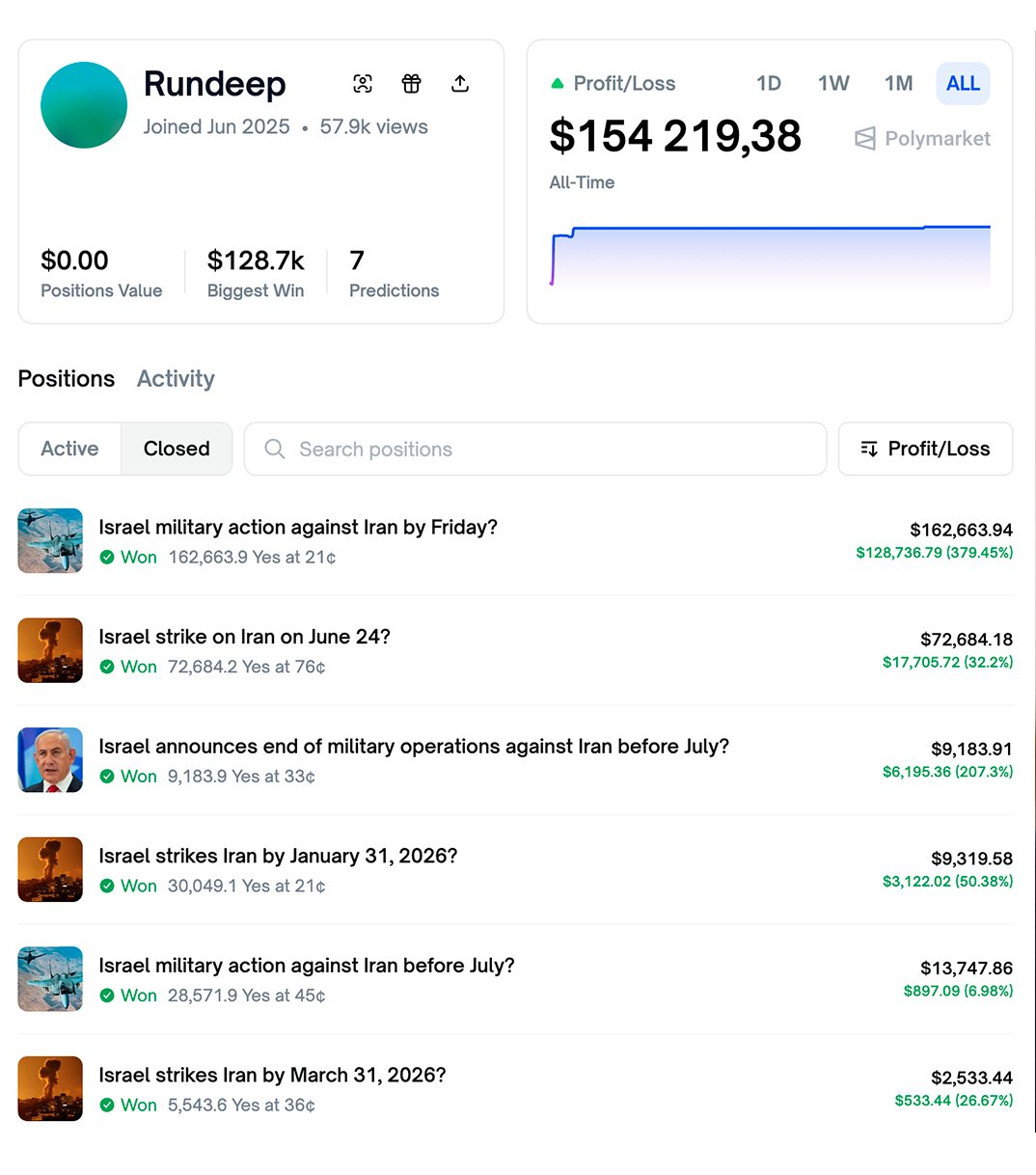
As shown in the image above, this user named Rundeep joined Polymarket in June 2025 and subsequently achieved a 100% win rate in six prediction markets related to Israeli military actions, with five of those bets placed when the probability was below 50%, ultimately profiting over $150,000.

It is worth mentioning that Odaily Planet Daily found that Rundeep had only one loss on Polymarket aside from these "six wins in six attempts." However, this failed prediction was not directly related to Israel but was about "whether the US military would take action against Iran before Saturday (June 21, 2025)"... It seems allied intelligence isn't very reliable after all.

The Real-World Repercussions of Prediction Markets, Truly Frightening to Ponder

Due to Polymarket's open, permissionless nature, anyone can freely place bets on the platform, which objectively provides a more convenient channel for "monetizing information" for those with intelligence advantages — driven by profit, those holding unequal information advantages find it hard to resist the temptation, making it inevitable that insiders will step in to make money.

If such things happened in conventional areas like sports or entertainment, the impact might still be somewhat controllable. But when similar insider betting events occur in sensitive areas like politics or even war, the potential连带 (liándài -连带 means连带, chain, related) terrifying consequences are hard to imagine.

Taking this article as an example, if opposing forces guessed the direction of an Israeli operation in advance through insider betting on Polymarket before the action took place, could it have a huge impact on the subsequent evolution of events? Most people might not easily sympathize with Israel, but in fact, such events could happen to any entity.

In traditional gambling, public affairs such as political elections, legislative outcomes, and wars are usually subject to clear restrictions. Whether prediction markets will face similar regulatory restrictions in the future may involve a long-term regulatory博弈 (bóyì -博弈 means game theory,博弈, struggle,博弈).


Пов'язані питання

QWhat is the main subject of the article regarding the Israeli military and Polymarket?

AThe article reports that the Israeli military is prosecuting a civilian and an IDF reservist for allegedly using classified military information to place bets and profit on the prediction market platform Polymarket.

QWhich user on Polymarket was identified by the X community as having suspiciously successful betting activity related to Israeli military actions?

AA user named Rundeep was identified, who achieved a 100% win rate across six prediction markets related to Israeli military actions, with five of those bets placed when the probability was below 50%, earning over $150,000.

QWhat potential risk does the article suggest that insider betting on platforms like Polymarket could pose in the context of military operations?

AThe article suggests that insider betting could pose a severe operational security risk in wartime, as opposing forces might detect upcoming military actions by observing suspicious betting patterns on the prediction market, potentially altering the course of events.

QWhat was the outcome of the single bet that the user Rundeep lost on Polymarket, and what was it about?

ARundeep's only lost bet was on the prediction 'Will the US military take action against Iran by Saturday (June 21, 2025)?', which was not directly related to Israeli operations.

QHow does the article contrast the regulation of traditional betting markets with prediction markets like Polymarket concerning public affairs?

AThe article notes that traditional betting markets often have explicit restrictions on public affairs like political elections, legislation, and war, and it suggests that prediction markets may face a long-term regulatory battle over similar restrictions in the future.

Пов'язані матеріали

Breaking: OpenAI Undergoes Major Reorganization, President Brockman Assumes Command

OpenAI has announced a major internal reorganization just months before its anticipated IPO. The company is merging its three flagship product lines—ChatGPT, Codex, and the API platform—into a single, unified product organization. The most significant leadership change involves co-founder and President Greg Brockman moving from a background technical role to take full, permanent control over all product strategy. This follows the indefinite medical leave of AGI Deployment CEO Fidji Simo. Additionally, ChatGPT's longtime lead, Nick Turley, has been reassigned to enterprise products, with former Instagram executive Ashley Alexander taking over consumer offerings. The consolidation, internally framed as a strategic move towards an "Agentic Future," aims to break down internal silos and create a cohesive "Super App." This planned desktop application would integrate ChatGPT's conversational abilities, Codex's coding power, and a rumored internal web browser named "Atlas" to autonomously perform complex user tasks. The reorganization occurs amid significant internal and external pressures. OpenAI has recently seen a wave of high-profile departures, including Sora co-lead Bill Peebles and other senior technical leaders, leading to concerns about a thinning executive bench. Externally, rival Anthropic recently secured funding at a staggering $900 billion valuation, surpassing OpenAI's own. Google's upcoming I/O developer conference also poses a competitive threat. Analysts suggest the dramatic restructure is a pre-IPO move to present a clearer, more focused narrative to Wall Street—streamlining operations and demonstrating decisive leadership under Brockman to counter internal turbulence and intense market competition.

marsbit3 год тому

Breaking: OpenAI Undergoes Major Reorganization, President Brockman Assumes Command

marsbit3 год тому

Two Survival Structures of Market Makers and Arbitrageurs

Market makers and arbitrageurs represent two distinct survival structures in high-frequency trading. Market makers primarily use limit orders (makers) to profit from the bid-ask spread, enjoying high capital efficiency (nominally 100%) but bearing inventory risk. This "inventory risk" arises from passive, fragmented, and discontinuous order fills in the limit order book (LOB). This risk, while a potential cost, can also contribute to excess profit if managed within control boundaries, allowing for mean reversion. Market makers essentially sell "time" (uncertainty over execution timing) to the market for price control and low fees. In contrast, cross-exchange arbitrageurs typically use market orders (takers) to exploit price differences or funding rates, resulting in lower nominal capital efficiency (requiring capital on both exchanges) and higher transaction costs. Their risk exposure stems from asymmetries in exchange rules (e.g., minimum order sizes), execution latency, and infrastructure risks (e.g., ADL, oracle drift). These exposures are active, exogenous gaps that primarily erode profits rather than contribute to them. Arbitrageurs essentially sell "space" (capital sunk across venues) for localized, immediate certainty. Both strategies engage in a trade-off between execution friction and residual risk. Optimal systems allow for temporary, controlled risk exposure rather than enforcing zero exposure at all costs. Their evolution converges towards hybrid models: arbitrageurs may use maker orders to reduce costs, while market makers may use taker orders or hedges for risk management. Ultimately, both use different forms of risk exposure—market makers exposing inventory, arbitrageurs immobilizing capital—to extract marginal, hard-won certainty from the market.

链捕手3 год тому

Two Survival Structures of Market Makers and Arbitrageurs

链捕手3 год тому

Who Will Define the Rules of the AI Era? Anthropic Discusses the 2028 US-China AI Landscape

This article, based on Anthropic's analysis, outlines the intensifying systemic competition between the U.S./allies and China for AI leadership by 2028. It argues that access to advanced computing power ("compute") is the critical bottleneck, where the U.S. currently holds a significant advantage through chip export controls and allied innovation. However, China's AI labs remain competitive by exploiting policy loopholes—via chip smuggling, overseas data center access, and "model distillation" attacks to copy U.S. model capabilities—keeping them close to the frontier. The piece presents two contrasting scenarios for 2028. In the first, decisive U.S. action to tighten compute controls and curb distillation locks in a 12-24 month AI capability lead, cementing democratic influence over global AI norms, security, and economic infrastructure. In the second, policy inaction allows China to achieve near-parity through continued access to U.S. technology, enabling Beijing to promote its AI stack globally and integrate advanced AI into its military and governance systems, altering the strategic balance. Anthropic contends that maintaining a decisive U.S. lead is essential for shaping safe AI development and governance. The core recommendation is for U.S. policymakers to urgently close compute and model access loopholes while promoting global adoption of the U.S. AI technology stack to secure a lasting strategic advantage.

marsbit5 год тому

Who Will Define the Rules of the AI Era? Anthropic Discusses the 2028 US-China AI Landscape

marsbit5 год тому

Торгівля

Спот
Ф'ючерси
活动图片




