Is XRP Poised To Replace SWIFT As Global Payments Infrastructure?

bitcoinistОпубліковано о 2026-02-08Востаннє оновлено о 2026-02-08

Анотація

The article examines the potential for XRP and Ripple's payment infrastructure to replace the SWIFT network as the global standard for cross-border payments. It highlights SWIFT's limitations in real-time settlement and discusses a significant shift towards faster, digital financial systems. Crypto analyst Archie suggests SWIFT is now testing integration with the XRP Ledger, mimicking Ripple's approach. Analysts speculate that if XRP captures even a small portion of SWIFT's massive annual transaction flow, its value could surge dramatically, with some predictions reaching over $3,000. The piece also draws parallels between XRP's current market cycle and its historic 2016-2018 breakout, noting similar price consolidation and indicator patterns that may signal another major bull run. The integration of Ripple's stablecoin, RLUSD, into core banking platforms is further bridging crypto and traditional finance.

For decades, SWIFT has served as the backbone of global payments, enabling banks to message one another across borders but not to settle value in real time. As global commerce becomes faster, more digital, and more interconnected, the limitations of legacy messaging-based systems are becoming increasingly visible. This has brought renewed attention to XRP and Ripple’s payment infrastructure that aims to enable near-instant, low-cost settlement of value.

From Bank Messaging To Real-Time Settlement Rails

A massive 1.5 quadrillion financial shift is quietly unfolding, and it’s already shaking the foundations of global banking. Crypto analyst Archie has mentioned on X that SWIFT, the decades-old backbone of cross-border payments, is copying Ripple’s playbook for a real-time transfer system and testing the XRP Ledger integration that could flip the script on slow, outdated cross-border payments.

Meanwhile, analysts are suggesting that if XRP captures even a fraction of SWIFT’s estimated $150 trillion annual flow by 2030, the upside could be enormous, while some stated that the altcoin might surge to $3,000+. With Ripple’s RLUSD stablecoin integrating directly into core banking and treasury platforms, the bridge between crypto rails and fiat liquidity is rapidly taking shape.

Currently, there’s a speculation that XRP is being reviewed as a full SWIFT replacement in the US document, and trillions are flowing into the XRP Ledger. Meanwhile, banks like Citi are tokenizing, and Ripple technology is capable of leading the charge. Archie believes that Citi is already somewhere running on Ripple technology.

How The Last Major XRP Breakout Took Shape

A side-by-side comparison chart of XRP’s historical and current market cycles suggests that history may be rhyming once again. Analyst Archie has also pointed out that in the 2016 to 2018 cycle, the price started trading at a low level around $0.003, gradually building along a rising trendline, then dipping in the orange box, before the price exploded to highs near $3.50.

During that period, the Relative Strength Index (RSI) formed a clear low around the 50 level, signaling a momentum reset rather than a breakdown. The current 2025 to 2027 cycle is showing a structurally similar pattern. XRP is consolidating around the dollar mark, following a similar trend line, with a dip marked in an orange box to $0.70, and the formed bottom closer to the 40 mark.
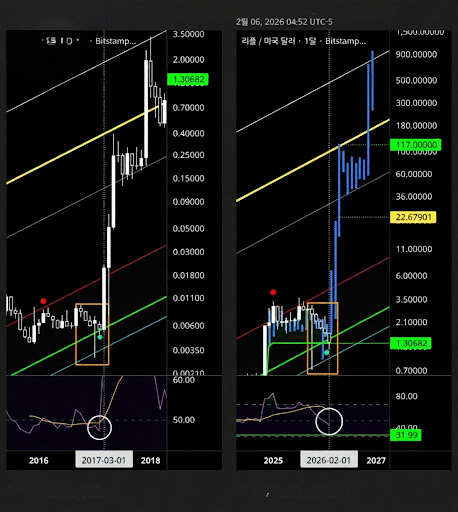
Source: Chart from Archie on X

Archie noted that the patterns in price action, the dips, and the indicator signals across cycles are repeating almost identically. While history never repeats perfectly, these recurring fractal patterns suggest that XRP may be priming for an epic bull run phase, from fractions to dollars, now potentially from dollars to triple digits, like the projected $117 range. Archie is bullish because the riddlers were right all along, and believes Phoenix will rise.

XRP trading at $1.40 on the 1D chart | Source: XRPUSDT on Tradingview.com

Пов'язані питання

QWhat is the main limitation of the current SWIFT system that XRP and Ripple aim to address?

ASWIFT enables banks to message one another across borders but does not settle value in real time, whereas XRP and Ripple's payment infrastructure aims to enable near-instant, low-cost settlement of value.

QAccording to the analyst Archie, what significant development is SWIFT undertaking regarding the XRP Ledger?

ASWIFT is copying Ripple's playbook for a real-time transfer system and testing the XRP Ledger integration to improve slow, outdated cross-border payments.

QWhat potential price target for XRP is mentioned if it captures a fraction of SWIFT's annual flow by 2030?

ASome analysts suggest that if XRP captures a fraction of SWIFT's estimated $150 trillion annual flow by 2030, the altcoin might surge to $3,000 or more.

QHow does the current market cycle for XRP (2025-2027) compare to its 2016-2018 cycle, according to the analysis?

AThe current cycle is showing a structurally similar pattern: XRP is consolidating around the dollar mark, following a similar trend line, with a dip to $0.70, mirroring the previous cycle where the price built along a trendline before exploding to highs near $3.50.

QWhat role does Ripple's RLUSD stablecoin play in the broader financial ecosystem, as mentioned in the article?

ARipple's RLUSD stablecoin is integrating directly into core banking and treasury platforms, which is rapidly building a bridge between crypto rails and fiat liquidity.

Пов'язані матеріали

Google and Amazon Simultaneously Invest Heavily in a Competitor: The Most Absurd Business Logic of the AI Era Is Becoming Reality

In a span of four days, Amazon announced an additional $25 billion investment, and Google pledged up to $40 billion—both direct competitors pouring over $65 billion into the same AI startup, Anthropic. Rather than a typical venture capital move, this signals the latest escalation in the cloud wars. The core of the deal is not equity but compute pre-orders: Anthropic must spend the majority of these funds on AWS and Google Cloud services and chips, effectively locking in massive future compute consumption. This reflects a shift in cloud market dynamics—enterprises now choose cloud providers based on which hosts the best AI models, not just price or stability. With OpenAI deeply tied to Microsoft, Anthropic’s Claude has become the only viable strategic asset for Google and Amazon to remain competitive. Anthropic’s annualized revenue has surged to $30 billion, and it is expanding into verticals like biotech, positioning itself as a cross-industry AI infrastructure layer. However, this funding comes with constraints: Anthropic’s independence is challenged as it balances two rival investors, its safety-first narrative faces pressure from regulatory scrutiny, and its path to IPO introduces new financial pressures. Globally, this accelerates a "tri-polar" closed-loop structure in AI infrastructure, with Microsoft-OpenAI, Google-Anthropic, and Amazon-Anthropic forming exclusive model-cloud alliances. In contrast, China’s landscape differs—investments like Alibaba and Tencent backing open-source model firm DeepSeek reflect a more decoupled approach, though closed-source models from major cloud providers still dominate. The $65 billion bet is ultimately about securing a seat at the table in an AI-defined future—where missing the model layer means losing the cloud war.

marsbit3 год тому

Google and Amazon Simultaneously Invest Heavily in a Competitor: The Most Absurd Business Logic of the AI Era Is Becoming Reality

marsbit3 год тому

Computing Power Constrained, Why Did DeepSeek-V4 Open Source?

DeepSeek-V4 has been released as a preview open-source model, featuring 1 million tokens of context length as a baseline capability—previously a premium feature locked behind enterprise paywalls by major overseas AI firms. The official announcement, however, openly acknowledges computational constraints, particularly limited service throughput for the high-end DeepSeek-V4-Pro version due to restricted high-end computing power. Rather than competing on pure scale, DeepSeek adopts a pragmatic approach that balances algorithmic innovation with hardware realities in China’s AI ecosystem. The V4-Pro model uses a highly sparse architecture with 1.6T total parameters but only activates 49B during inference. It performs strongly in agentic coding, knowledge-intensive tasks, and STEM reasoning, competing closely with top-tier closed models like Gemini Pro 3.1 and Claude Opus 4.6 in certain scenarios. A key strategic product is the Flash edition, with 284B total parameters but only 13B activated—making it cost-effective and accessible for mid- and low-tier hardware, including domestic AI chips from Huawei (Ascend), Cambricon, and Hygon. This design supports broader adoption across developers and SMEs while stimulating China's domestic semiconductor ecosystem. Despite facing talent outflow and intense competition in user traffic—with rivals like Doubao and Qianwen leading in monthly active users—DeepSeek has maintained technical momentum. The release also comes amid reports of a new funding round targeting a valuation exceeding $10 billion, potentially setting a new record in China’s LLM sector. Ultimately, DeepSeek-V4 represents a shift toward open yet realistic infrastructure development in the constrained compute landscape of Chinese AI, emphasizing engineering efficiency and domestic hardware compatibility over pure model scale.

marsbit4 год тому

Computing Power Constrained, Why Did DeepSeek-V4 Open Source?

marsbit4 год тому

Торгівля

Спот
Ф'ючерси
活动图片





