Is the Crypto Market Doomed to Face Pressure in Q1? Progress of the CLARITY Act Becomes a Key Factor

marsbitОпубліковано о 2026-01-13Востаннє оновлено о 2026-01-13

Анотація

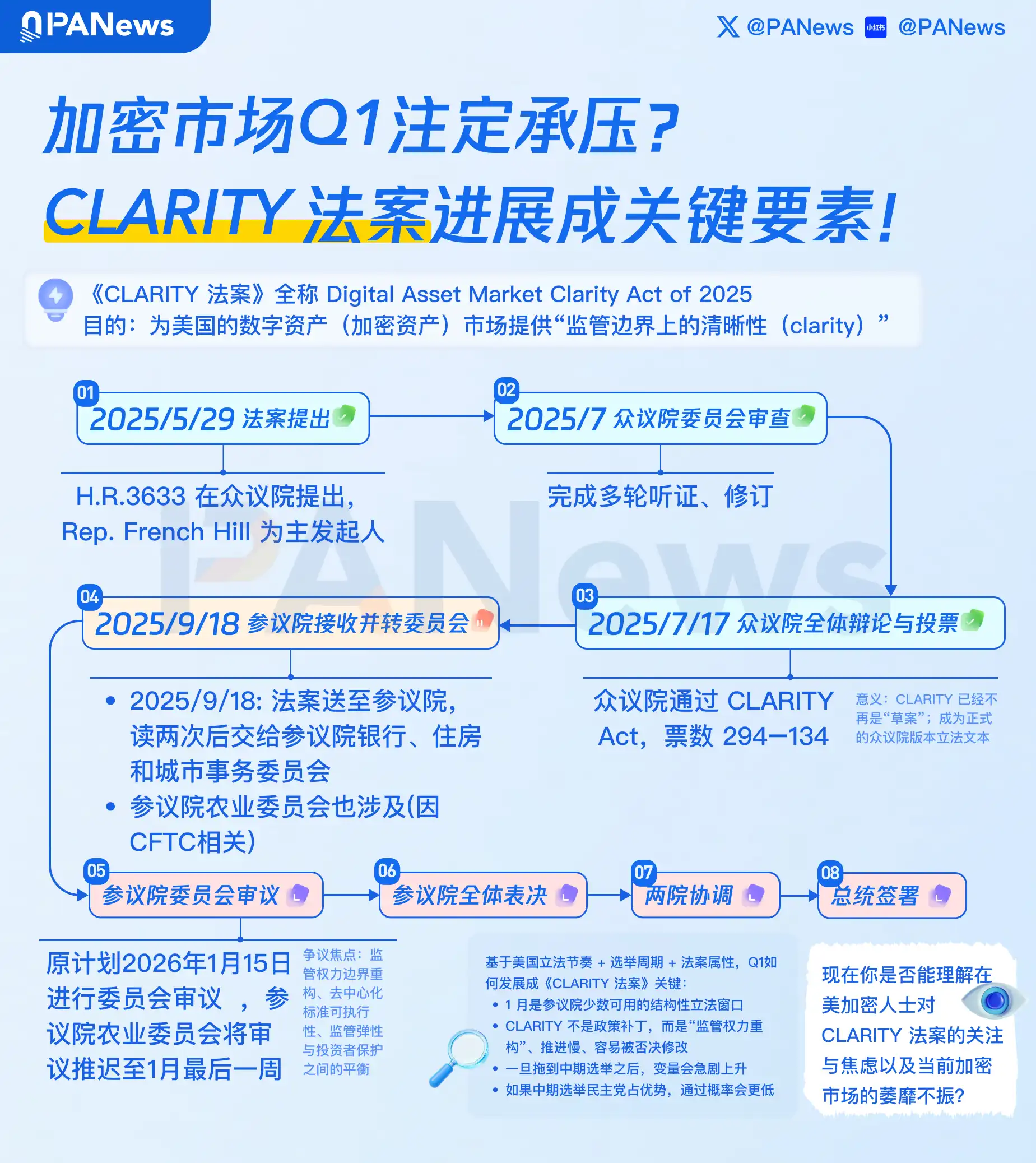
The CLARITY Act, introduced in the U.S. House of Representatives on May 29, 2025, aims to provide regulatory clarity for the digital asset market. It is currently stalled in the Senate after being received and referred to committee. Market participants are concerned that without significant progress in Q1, the bill faces increasing obstacles. Key reasons include the limited legislative window in the Senate from January to March, which is typically reserved for complex, non-urgent bills like CLARITY. If no substantive committee action occurs in January, the bill risks being sidelined by the legislative schedule. The Act is not a minor policy adjustment but a restructuring of regulatory authority, making it slow-moving, highly amendable, and prone to delays rather than outright rejection. If delayed until after the midterm elections, its prospects become even more uncertain due to potential shifts in Congressional power. Should Democrats gain influence post-election, the bill’s chances would likely decrease. Democratic leadership generally favors broader SEC authority, regulatory flexibility, and is hesitant to limit enforcement discretion—contrary to CLARITY’s goal of defining regulatory boundaries and reducing regulation by enforcement. In a Democrat-led Senate, the bill could be substantially rewritten, broken into smaller pieces, or indefinitely postponed. These factors explain the anxiety among U.S. crypto stakeholders and contribute to current market pessimism.

The purpose of the "CLARITY Act" is to provide "clarity at the regulatory boundaries" for the digital asset (crypto asset) market in the United States. It was introduced in the House of Representatives on May 29, 2025, primarily sponsored by Rep. French Hill, and is currently stuck at "received in the Senate and referred to committee." The market is widely concerned that if the CLARITY Act does not make significant progress in Q1, delays will make the situation increasingly unfavorable!

The reasons are multiple:

January is one of the few structural legislative windows for the Senate


Every year from January to March is the main period for the Senate to handle highly complex, non-urgent bills. The CLARITY Act falls into the category of a "highly complex + highly controversial + non-urgent" market structure bill, naturally ranking lower in priority. If it fails to enter substantive advancement (such as clear action at the committee level) in January, it is very likely to be "naturally squeezed out" by the overall legislative schedule.

CLARITY is not a policy patch, but a "regulatory power restructuring"
The characteristics of such bills are: slow progress, repeated demands for amendments, and a high tendency to be postponed rather than rejected.

Once delayed until after the midterm elections, variables will increase sharply


Midterm elections = a reset of the congressional power structure. Bills that have been advanced but not completed will have their priorities reshuffled. The CLARITY Act, which has not yet taken effect, has not formed strong bipartisan consensus, and highly relies on the support of the current committee, is very likely to be "re-evaluated" or even redrafted after a change in the power structure.

If the Democratic Party gains an advantage in the midterm elections, the probability of passage will be even lower The mainstream stance of the Democratic Party tends to: strengthen the coverage of securities laws, retain regulatory agency interpretation flexibility, and be highly cautious about "limiting the space for law enforcement agencies through legislation."
The core effect of the CLARITY Act, however, is to: predefine some regulatory boundaries, limit "regulation by enforcement," and reduce the SEC's discretionary power in gray areas. Therefore, in a Senate environment dominated by Democrats, the CLARITY Act is more likely to: be required to undergo substantial revisions (effectively a rewrite), be broken down into multiple sub-bills, or be shelved for a long time.

Can you now understand the attention and anxiety of crypto professionals in the U.S. regarding the CLARITY Act and the current sluggishness of the crypto market?
Пов'язані питання

QWhat is the main purpose of the CLARITY Act mentioned in the article?

AThe CLARITY Act aims to provide regulatory clarity and establish clear boundaries for the digital asset (crypto asset) market in the United States.

QWhy is January considered a critical legislative window for the CLARITY Act in the Senate?

AJanuary is one of the few structural legislative windows in the Senate, as the period from January to March is typically used to handle highly complex, non-urgent bills. If the CLARITY Act does not see substantial progress (such as committee-level action) by January, it risks being pushed out of the legislative schedule.

QHow might the midterm elections impact the progression of the CLARITY Act?

AThe midterm elections could lead to a reset of congressional power structures, causing bills that are in progress but not yet passed to have their priorities reshuffled. The CLARITY Act, which lacks strong bipartisan consensus and relies heavily on current committee support, is particularly vulnerable to being re-evaluated or even redrafted after the elections.

QWhy would the CLARITY Act face lower chances of passing if Democrats gain an advantage in the midterm elections?

ADemocrats generally favor strengthening securities law coverage, preserving regulatory agency flexibility, and are cautious about limiting enforcement agency discretion through legislation. The CLARITY Act, which aims to predefine regulatory boundaries and restrict 'regulation by enforcement,' would likely face significant amendments, be broken into sub-bills, or be shelved indefinitely in a Democrat-dominated Senate.

QWhat are the key characteristics of the CLARITY Act that make its legislative process challenging?

AThe CLARITY Act is a highly complex and controversial market structure bill that is non-urgent, making it low priority. It involves a 'regulatory power restructuring,' which leads to slow progress, frequent demands for revisions, and a high likelihood of delays rather than outright rejection.

Пов'язані матеріали

OpenAI Post-Training Engineer Weng Jiayi Proposes a New Paradigm Hypothesis for Agentic AI

OpenAI engineer Weng Jiayi's "Heuristic Learning" experiments propose a new paradigm for Agentic AI, suggesting that intelligent agents can improve not just by training neural networks, but also by autonomously writing and refining code based on environmental feedback. In the experiment, a coding agent (powered by Codex) was tasked with developing and maintaining a programmatic strategy for the Atari game Breakout. Starting from a basic prompt, the agent iteratively wrote code, ran the game, analyzed logs and video replays to identify failures, and then modified the code. Through this engineering loop of "code-run-debug-update," it evolved a pure Python heuristic strategy that achieved a perfect score of 864 in Breakout and performed competitively with deep reinforcement learning (RL) algorithms in MuJoCo control tasks like Ant and HalfCheetah. This approach, termed Heuristic Learning (HL), contrasts with Deep RL. In HL, experience is captured in readable, modifiable code, tests, logs, and configurations—a software system—rather than being encoded solely into opaque neural network weights. This offers potential advantages in explainability, auditability for safety-critical applications, easier integration of regression tests to combat catastrophic forgetting, and more efficient sample use in early learning stages, as demonstrated in broader tests on 57 Atari games. However, the blog acknowledges clear limitations. Programmatic strategies struggle with tasks requiring long-horizon planning or complex perception (e.g., Montezuma's Revenge), areas where neural networks excel. The future vision is a hybrid architecture: specialized neural networks for fast perception (System 1), HL systems for rules, safety, and local recovery (also System 1), and LLM agents providing high-level feedback and learning from the HL system's data (System 2). The core proposition is that in the era of capable coding agents, a significant portion of an AI's learned experience could be maintained as an auditable, evolving software system.

marsbit20 хв тому

OpenAI Post-Training Engineer Weng Jiayi Proposes a New Paradigm Hypothesis for Agentic AI

marsbit20 хв тому

Your Claude Will Dream Tonight, Don't Disturb It

This article explores the recent phenomenon of AI companies increasingly using anthropomorphic language—like "thinking," "memory," "hallucination," and now "dreaming"—to describe machine learning processes. Focusing on Anthropic's newly announced "Dreaming" feature for its Claude Agent platform, the piece explains that this function is essentially an automated, offline batch processing of an agent's operational logs. It analyzes past task sessions to identify patterns, optimize future actions, and consolidate learnings into a persistent memory system, akin to a form of reinforcement learning and self-correction. The article draws parallels to similar features in other AI agent systems like Hermes Agent and OpenClaw, which also implement mechanisms for reviewing historical data, extracting reusable "skills," and strengthening long-term memory. It notes a key difference from human dreaming: these AI "dreams" still consume computational resources and user tokens. Further context is provided by discussing the technical challenges of managing AI "memory" or context, highlighting the computational expense of large context windows and innovations like Subquadratic's new model claiming drastically longer contexts. The core critique argues that this strategic use of human-centric vocabulary does more than market products; it subtly reshapes user perception. By framing algorithms with terms associated with consciousness, companies blur the line between tool and autonomous entity. This linguistic shift can influence user expectations, tolerance for errors, and even perceptions of responsibility when systems fail, potentially diverting scrutiny from the companies and engineers behind the technology. The article concludes by speculating that terms like "daydreaming" for predictive task simulation might be next, continuing this trend of embedding the idea of an "inner life" into computational processes.

marsbit22 хв тому

Your Claude Will Dream Tonight, Don't Disturb It

marsbit22 хв тому

Торгівля

Спот
Ф'ючерси
活动图片





