Is the Crypto Market Doomed to Face Pressure in Q1? Progress of the CLARITY Act Becomes a Key Factor

marsbitОпубліковано о 2026-01-13Востаннє оновлено о 2026-01-13

Анотація

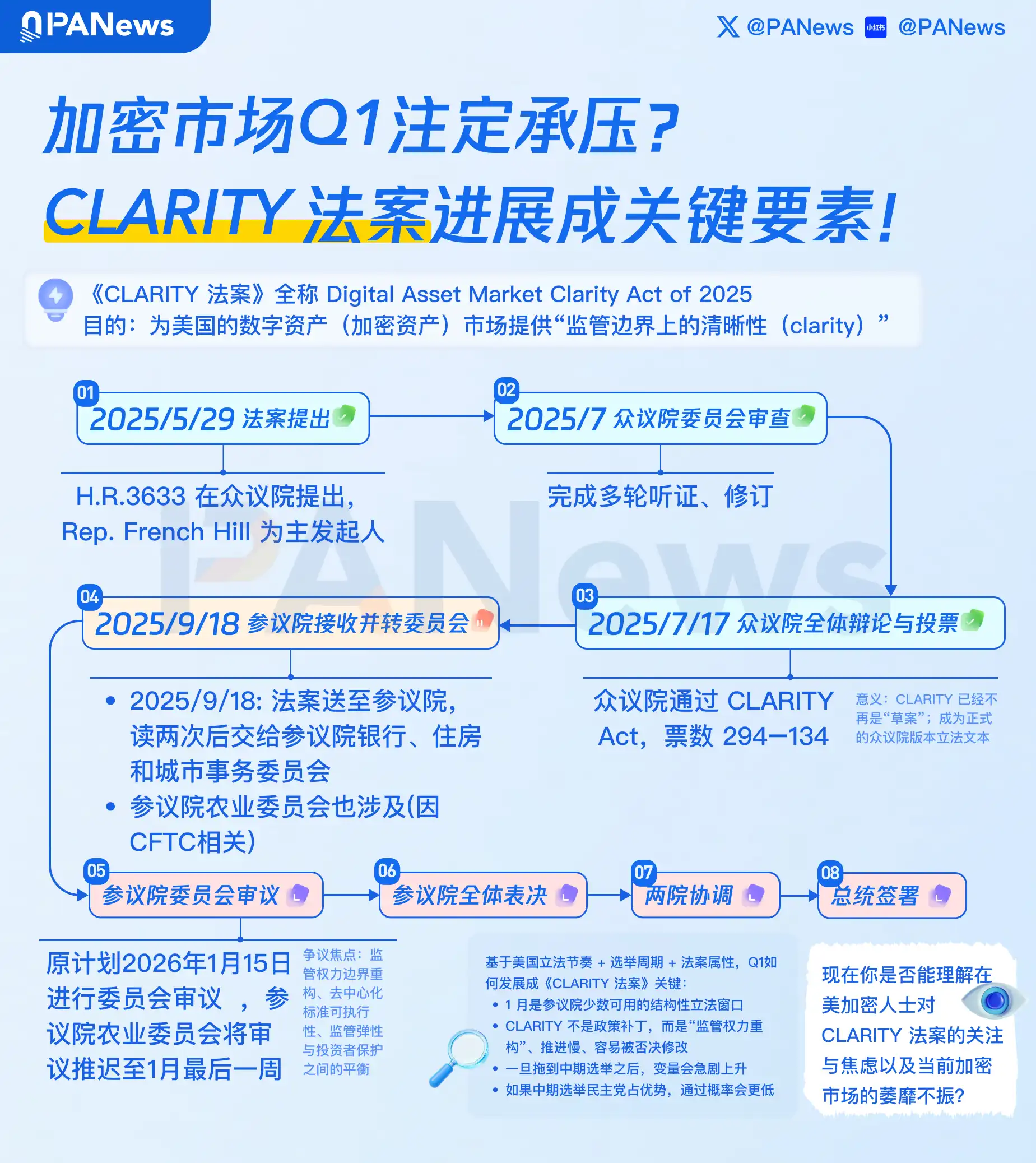
The CLARITY Act, introduced in the U.S. House of Representatives on May 29, 2025, aims to provide regulatory clarity for the digital asset market. It is currently stalled in the Senate after being received and referred to committee. Market participants are concerned that without significant progress in Q1, the bill faces increasing obstacles. Key reasons include the limited legislative window in the Senate from January to March, which is typically reserved for complex, non-urgent bills like CLARITY. If no substantive committee action occurs in January, the bill risks being sidelined by the legislative schedule. The Act is not a minor policy adjustment but a restructuring of regulatory authority, making it slow-moving, highly amendable, and prone to delays rather than outright rejection. If delayed until after the midterm elections, its prospects become even more uncertain due to potential shifts in Congressional power. Should Democrats gain influence post-election, the bill’s chances would likely decrease. Democratic leadership generally favors broader SEC authority, regulatory flexibility, and is hesitant to limit enforcement discretion—contrary to CLARITY’s goal of defining regulatory boundaries and reducing regulation by enforcement. In a Democrat-led Senate, the bill could be substantially rewritten, broken into smaller pieces, or indefinitely postponed. These factors explain the anxiety among U.S. crypto stakeholders and contribute to current market pessimism.

The purpose of the "CLARITY Act" is to provide "clarity at the regulatory boundaries" for the digital asset (crypto asset) market in the United States. It was introduced in the House of Representatives on May 29, 2025, primarily sponsored by Rep. French Hill, and is currently stuck at "received in the Senate and referred to committee." The market is widely concerned that if the CLARITY Act does not make significant progress in Q1, delays will make the situation increasingly unfavorable!

The reasons are multiple:

January is one of the few structural legislative windows for the Senate


Every year from January to March is the main period for the Senate to handle highly complex, non-urgent bills. The CLARITY Act falls into the category of a "highly complex + highly controversial + non-urgent" market structure bill, naturally ranking lower in priority. If it fails to enter substantive advancement (such as clear action at the committee level) in January, it is very likely to be "naturally squeezed out" by the overall legislative schedule.

CLARITY is not a policy patch, but a "regulatory power restructuring"
The characteristics of such bills are: slow progress, repeated demands for amendments, and a high tendency to be postponed rather than rejected.

Once delayed until after the midterm elections, variables will increase sharply


Midterm elections = a reset of the congressional power structure. Bills that have been advanced but not completed will have their priorities reshuffled. The CLARITY Act, which has not yet taken effect, has not formed strong bipartisan consensus, and highly relies on the support of the current committee, is very likely to be "re-evaluated" or even redrafted after a change in the power structure.

If the Democratic Party gains an advantage in the midterm elections, the probability of passage will be even lower The mainstream stance of the Democratic Party tends to: strengthen the coverage of securities laws, retain regulatory agency interpretation flexibility, and be highly cautious about "limiting the space for law enforcement agencies through legislation."
The core effect of the CLARITY Act, however, is to: predefine some regulatory boundaries, limit "regulation by enforcement," and reduce the SEC's discretionary power in gray areas. Therefore, in a Senate environment dominated by Democrats, the CLARITY Act is more likely to: be required to undergo substantial revisions (effectively a rewrite), be broken down into multiple sub-bills, or be shelved for a long time.

Can you now understand the attention and anxiety of crypto professionals in the U.S. regarding the CLARITY Act and the current sluggishness of the crypto market?
Пов'язані питання

QWhat is the main purpose of the CLARITY Act mentioned in the article?

AThe CLARITY Act aims to provide regulatory clarity and establish clear boundaries for the digital asset (crypto asset) market in the United States.

QWhy is January considered a critical legislative window for the CLARITY Act in the Senate?

AJanuary is one of the few structural legislative windows in the Senate, as the period from January to March is typically used to handle highly complex, non-urgent bills. If the CLARITY Act does not see substantial progress (such as committee-level action) by January, it risks being pushed out of the legislative schedule.

QHow might the midterm elections impact the progression of the CLARITY Act?

AThe midterm elections could lead to a reset of congressional power structures, causing bills that are in progress but not yet passed to have their priorities reshuffled. The CLARITY Act, which lacks strong bipartisan consensus and relies heavily on current committee support, is particularly vulnerable to being re-evaluated or even redrafted after the elections.

QWhy would the CLARITY Act face lower chances of passing if Democrats gain an advantage in the midterm elections?

ADemocrats generally favor strengthening securities law coverage, preserving regulatory agency flexibility, and are cautious about limiting enforcement agency discretion through legislation. The CLARITY Act, which aims to predefine regulatory boundaries and restrict 'regulation by enforcement,' would likely face significant amendments, be broken into sub-bills, or be shelved indefinitely in a Democrat-dominated Senate.

QWhat are the key characteristics of the CLARITY Act that make its legislative process challenging?

AThe CLARITY Act is a highly complex and controversial market structure bill that is non-urgent, making it low priority. It involves a 'regulatory power restructuring,' which leads to slow progress, frequent demands for revisions, and a high likelihood of delays rather than outright rejection.

Пов'язані матеріали

The Verdict in Choi Tae-won's Divorce Case: Revealing the Inheritance Undercurrent Behind SK Hynix's Trillion-Won Empire

SK Group Chairman Chey Tae-won's high-profile divorce case, involving a record 1.38 trillion won settlement, has drawn attention to the succession plans for Korea's second-largest conglomerate, especially its crown jewel, SK hynix. Unlike traditional chaebol scripts centered on the eldest son, Chey's three children from his marriage to former President Roh Tae-woo's daughter, Roh Soh-yeong, are carving distinct, non-traditional paths. Eldest daughter Chey Yun-jung (b. 1989) is seen as the most evident successor. With a scientific and consulting background, she holds executive roles at SK bioscience and SK Inc.'s growth support department, focusing on future strategy and biopharma. Her marriage is to an AI infrastructure entrepreneur, not a traditional business alliance. Second daughter Chey Min-jung (b. 1991) took a unique route, voluntarily serving as a South Korean naval officer, including an anti-piracy deployment. She later worked on policy and strategy for SK hynix in Washington D.C. before co-founding an AI-driven healthcare startup. She married a former U.S. Marine Corps officer, connecting her to U.S. defense and policy circles—networks crucial for a global semiconductor giant. The only son, Chey In-geun (b. 1995), who studied physics like his father, worked briefly at SK E&S before joining McKinsey. Despite fitting the traditional "heir" profile as the eldest son, he remains silent and holds no public position or shares in SK, suggesting the old succession playbook is obsolete. As SK hynix's valuation soars, becoming a geopolitical asset in the AI era, the heirs' legitimacy is no longer automatic. They must prove themselves in fields like AI biotech, global policy, and strategic consulting. Their marriages also reflect new elite networks in tech and defense, not old political alliances. Their inheritance is the complex challenge of navigating a globalized, tech-driven world, not just a corporate throne.

marsbit12 год тому

The Verdict in Choi Tae-won's Divorce Case: Revealing the Inheritance Undercurrent Behind SK Hynix's Trillion-Won Empire

marsbit12 год тому

From OpenSea to OpenRouter: Is Alex Atallah Repeating His 'Exit at the Peak' Playbook?

From OpenSea to OpenRouter: Is Alex Atallah Repeating His "Exit at the Peak" Playbook? According to the Wall Street Journal, payments giant Stripe is in talks to acquire the AI model aggregation platform OpenRouter in a potential deal valuing the company near $100 billion. This would mark founder Alex Atallah's second creation of a company reaching a $100 billion valuation, following his co-founding of NFT marketplace OpenSea. OpenRouter, founded just over three years ago, has grown rapidly by acting as a unified gateway for developers to access over 400 AI models. It currently has about 10 million users and processes over 200 trillion tokens monthly. While the platform's annualized revenue is around $50 million, its valuation has skyrocketed from $1.3 billion in March 2026. The potential acquisition by Stripe, a company OpenRouter's founder once likened it to, represents a major expansion into AI infrastructure for the payments leader. This move echoes Atallah's previous timing with OpenSea, where he departed before the NFT market's significant downturn. For OpenRouter, selling now may be strategic. Despite its scale, its business model—charging a 5-5.5% fee on AI inference calls—faces pressure from competition, open-source models, and potential price wars among model providers, limiting its profitability narrative for an IPO. A key asset for potential acquirers like Stripe is OpenRouter's vast repository of real-world AI usage data, which offers unique insights into model performance and developer preferences that are difficult to replicate. Whether this potential deal signifies a new valuation benchmark for AI infrastructure or another market peak signal remains to be seen.

链捕手12 год тому

From OpenSea to OpenRouter: Is Alex Atallah Repeating His 'Exit at the Peak' Playbook?

链捕手12 год тому

Торгівля

Спот
活动图片





