There has been little dispute regarding the leading token on the Robinhood chain, which is undoubtedly $CASHCAT. However, when it comes to the token with the most dramatic price movements, the title is still up for contention.
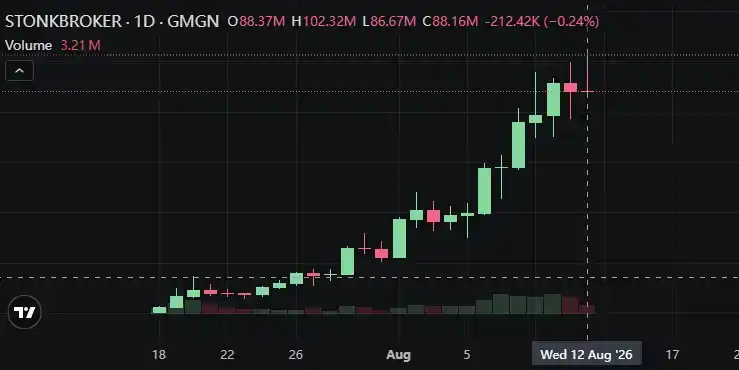
$STONKBROKER has charted a course resembling a "pixiu" (a mythical creature) in just 14 days. Yesterday, its market capitalization once exceeded $100 million, reaching an all-time high. Since BlockBeats first mentioned this project in an article, it has risen 9-fold.
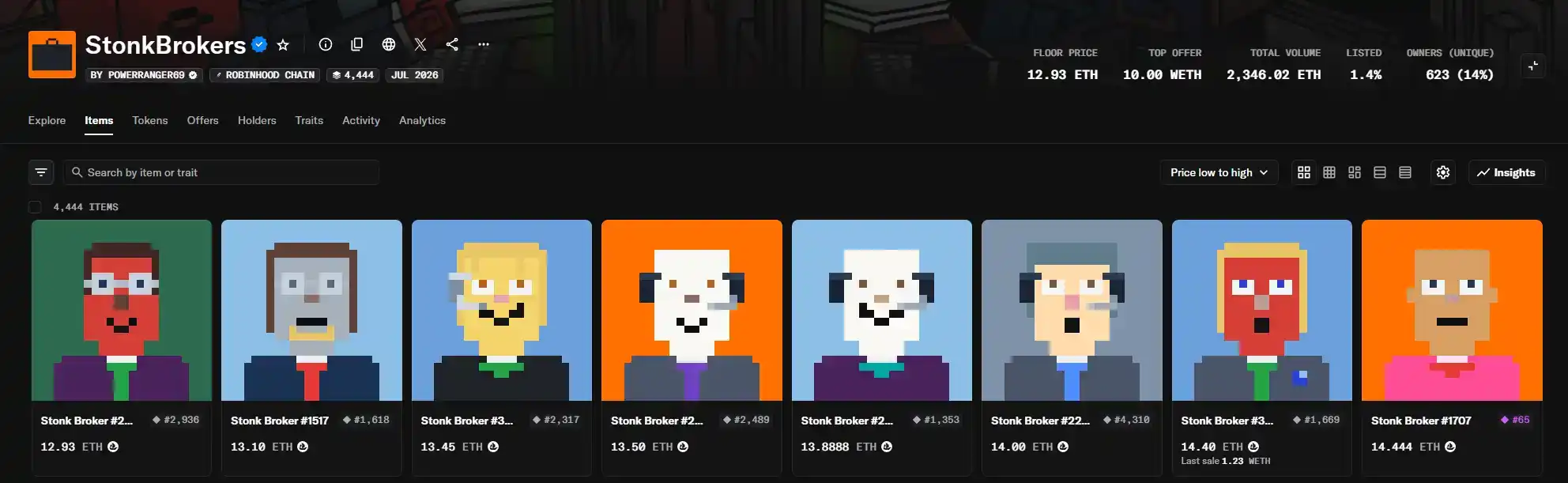
The floor price of its NFT series once exceeded 13 ETH (approximately $25,000) and currently remains at 12.93 ETH. In terms of individual NFT prices, this series has surpassed BAYC, and its total market capitalization has also exceeded $100 million, outpacing established blue-chip NFTs like Pudgy Penguins and Milady.
Due to its strong market capitalization and price performance, many players already consider StonkBroker the second-largest token on the Robinhood chain. However, I believe its underlying logic may not be as solid as it appears.
The NFT-Token Flywheel Is Successful, But Can It Be Considered Genuine Business Revenue?
According to data from defillima, over the past 7 days, StonkBroker's revenue ranked third, trailing only Uniswap and Pons, and on some single days, it even surpassed Pons.

However, if we examine the composition of StonkBroker's revenue, we find that it is entirely concentrated in "NFT AMM Transaction Fees" and "Broker Activation Fees."
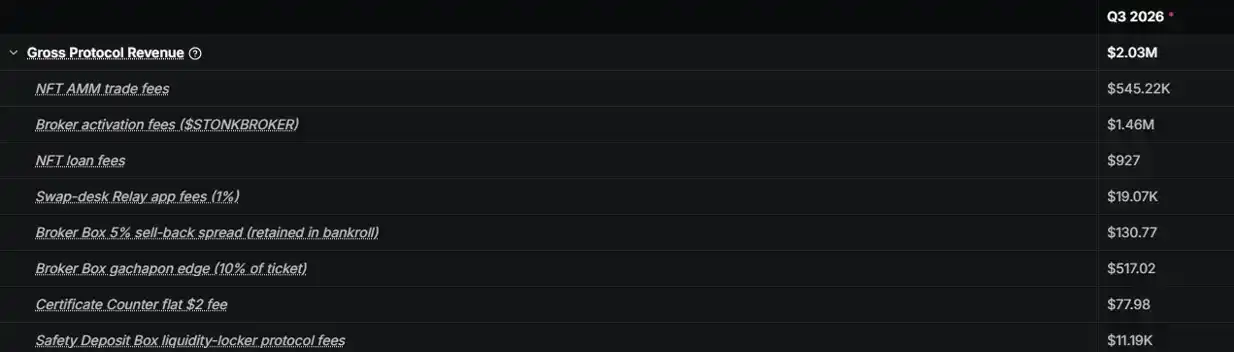
"NFT AMM Transaction Fees"—this portion of revenue corresponds to 666,666 $STONKBROKER tokens for each NFT. StonkBroker provides an NFT AMM for this NFT-to-token conversion. Each conversion incurs a 10% ETH transaction fee, with 7% used to purchase tokenized U.S. stocks on the Robinhood chain and airdrop them to activated StonkBroker NFT holders, 2.5% allocated to the protocol treasury, and 0.5% used for buyback and burn.
This revenue largely stems from arbitrage opportunities between NFTs and tokens, where arbitrageurs generate income for NFT holders and the project. Especially since the project's inception, both the NFT and token have experienced a one-sided upward trend, attracting significant attention. The better the performance, the higher the attention, and the more arbitrage opportunities arise—this is the logic driving this revenue flywheel.
"Broker Activation Fees"—this revenue comes from new NFT buyers. To qualify for the aforementioned tokenized stock airdrops, you need to "activate" the NFT by spending STONKBROKER tokens to obtain dividend eligibility. The minimum spend is 66,666 tokens, while the maximum is 1,666,666 tokens. The more you spend, the higher the dividend coefficient. Fifty percent of the "activation fee" is burned, while the remaining 50% goes to the protocol.

After activation, holders can select up to three types of tokenized U.S. stocks as corresponding airdrop rewards, with the option to choose the proportion of each asset or simply opt for ETH and $STONKBROKER as rewards. However, if the NFT is transferred on the secondary market, the new holder must reactivate the NFT.
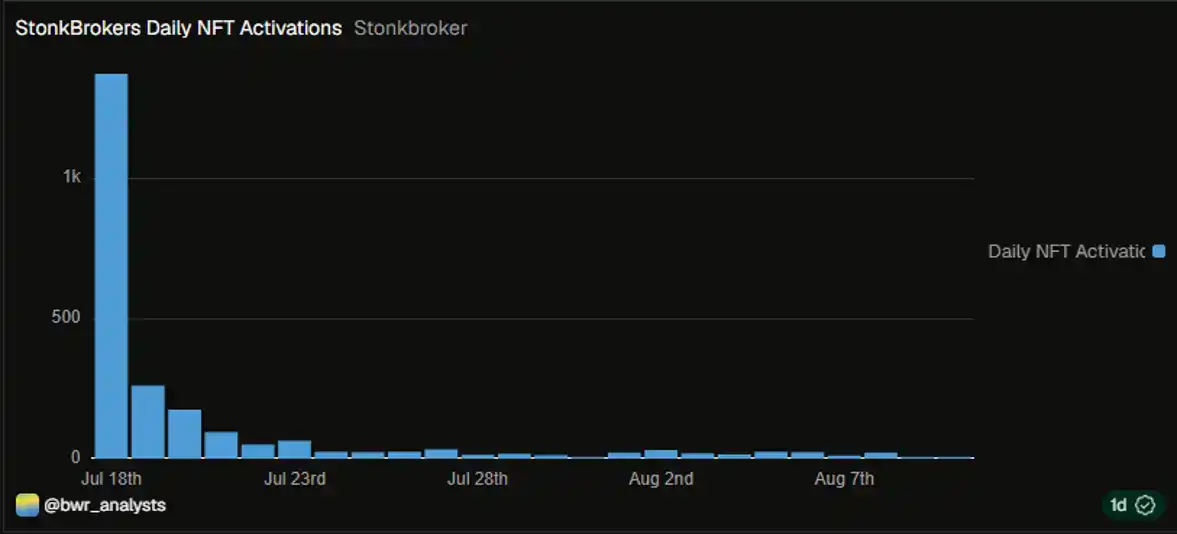
According to data from the official website, StonkBroker NFT holders have received over $620,000 in airdrop distributions so far. However, as both NFT and token prices have reached high levels, the daily number of newly activated NFTs has significantly decreased:
It cannot be said that this gameplay lacks technical innovation—for example, the NFTs utilize ERC-6551, with each NFT linked to a wallet where airdrops are directly deposited. However, in practice, it is evident that while the StonkBroker project has many planned features, such as NFT lending, Launchpad, stock lottery blind boxes, etc., its revenue so far has almost entirely come from this NFT-token flywheel.
The essence of this gameplay is familiar to NFT players: it is essentially a form of staking, where both NFTs and tokens rise, creating a jaw-dropping spectacle. Compared to other Launchpads or projects on the Robinhood chain—especially given that Pons' token rose due to its winning share of the Robinhood chain's Launchpad, with speculation based on market share and revenue—this project can be said to have achieved nothing substantial so far, as its Launchpad has yet to officially launch and generate revenue.
However, its price has surged, which in turn has drawn attention to the new projects it will host. If these new projects perform well, they could further drive the value of its primary asset. Coupled with the NFT layer, memories of the "golden shovel" gameplay—where various sub-projects airdrop significant profits to the main asset—are easily rekindled.
It May Be Premature to Declare It the Second-Largest Token
After carefully analyzing StonkBroker's revenue composition, I am not suggesting it is purely a hollow NFT-token Ponzi scheme. On the contrary, if the project has risen this much solely based on the NFT-token layer and its yet-to-be-realized narratives have gained credibility, it at least indicates two things:
- The team behind it is quite capable.
- Regardless of future developments, the community's cohesion is relatively strong at the moment.
However, declaring it the second-largest token may still be premature. Their Launchpad is soon to host a meme coin, $CLOCKIN, organized by community members. Since "Clock in" is the official term for NFT holders to claim airdrop rewards, this token has garnered significant attention. On X, scammers are already promoting paid insider Telegram groups promising early access to contract addresses.
It is important to emphasize that while projects like Mancer and Yard are already listed in the "Special Project" section of the Launchpad, this cannot be considered as the Launchpad being officially operational. These projects were actually launched through the NFT AMM that the project had already been operating, which can be understood as a multi-chain NFT-to-token launchpad. A common practice is to conduct initial NFT sales by allowing users to buy tokens and exchange them for NFTs.
For example, Yard placed all NFTs directly into the liquidity pool, with no whitelist—those wanting NFTs had to buy tokens on the market and exchange them. However, the description of the Launchpad on StonkBroker's official website still refers to the familiar token launchpad with a bonding curve, which has not yet been opened.
Nevertheless, we have already seen projects like Mancer and Yard benefit from the strong performance of StonkBroker's primary asset, enjoying increased attention and market enthusiasm. However, the success of $CLOCKIN will have a more significant impact on the future performance of the primary asset, and whether it will be positive or negative remains uncertain.
As the project's planned features gradually roll out, it will ultimately be judged by its ability to generate wealth for market participants or its competitiveness in market share. If expectations fall short, asset performance will likely suffer as well.
Of course, the most critical factor is the intentions of the capital behind it, which remain unknown.
Finally, regarding the search for the second-largest token on the Robinhood chain, here are two perspectives:
- The potential ceiling for $CASHCAT, as the first native ecosystem asset listed on Robinhood. If $CASHCAT cannot even reach the heights of $WIF on Solana, then searching for a second-largest token might be more about betting on speculation than genuine analysis.
- If you remain optimistic about StonkBroker, it might be wise to wait and observe after its derivative assets are launched. All "golden shovels," no matter how good, eventually decline as they are continuously diluted through further subdivisions. When it becomes clear that the primary asset relies on new, smaller wealth-generating tokens for momentum, it is essential to carefully consider the risks and reward ratios.