Is Crypto Over? Don't Give Up, Liquidity Relief Is Coming

marsbitОпубліковано о 2026-02-02Востаннє оновлено о 2026-02-02

Анотація

The article "Is Crypto Over? Don't Give Up, Liquidity is Coming" by Raoul Pal addresses the current downturn in the crypto market, arguing it is not a sign of the industry's demise but a temporary liquidity crisis. Pal refutes the narrative that crypto has permanently decoupled from other assets by showing that Bitcoin's price chart is nearly identical to that of the SaaS index, indicating a shared, external factor: a shortage of U.S. dollar liquidity. He explains this was caused by a combination of events, including the draining of the Reverse Repo facility, the rebuilding of the Treasury General Account (TGA) without monetary offset, and government shutdowns. This liquidity drain negatively impacted risk assets like crypto and tech stocks, while gold absorbed the marginal liquidity. The key takeaway is that this period of illiquidity is ending. The impending resolution of the U.S. government shutdown is seen as the final obstacle. Once cleared, a significant injection of liquidity is expected from sources like the easing of the SLR rule, TGA drawdowns, fiscal stimulus, and eventual rate cuts. Pal, alongside analysis from Stanley Druckenmiller, suggests the new Fed leadership under a potential Warsh chairmanship would be focused on cutting rates to keep the economy hot, aligning with a pro-growth strategy from the administration. The author admits a mistake in not prioritizing U.S. liquidity as the dominant short-term driver over global liquidity but remains highly bulli...

Original Author:Raoul Pal, CEO of Real Vision and GMI

Compiled by: CryptoLeo(@LeoAndCrypto)

This morning, Raoul Pal, CEO of Real Vision and GMI (Raoul Pal's investment bible), published an article titled "False Narratives....and Other Thoughts". Through data comparison and macro analysis, he explained the recent downturn and crisis in the crypto industry, indicating that the industry winter will soon pass, and everyone needs to be patient and not lose confidence in the industry. Odaily Planet Daily translates it as follows:

These were the insights I wrote for GMI over the weekend, hoping to give you some confidence. I would usually keep this content for GMI and Pro Macro discussions, but I know you all need this to ease your tense nerves.

Mainstream Narrative: Is Crypto Over?

The mainstream view is that Bitcoin and cryptocurrencies have crashed, this cycle is over, everything is finished, and it can't be like before. Cryptocurrencies have decoupled from other assets, this is CZ's fault, it's BlackRock's fault, etc. This is undoubtedly an attractive narrative trap, especially when mainstream coin prices are plummeting daily.

But yesterday, a GMI hedge fund client sent me a message asking if they should buy the dip in SaaS stocks, or, as everyone is saying now, if Claude Code has already killed the SaaS industry.

So I started researching SaaS, and in the process, I found conclusions that debunked both the mainstream narrative about Bitcoin and the narrative about the SaaS industry. The charts for SaaS and BTC look exactly the same?
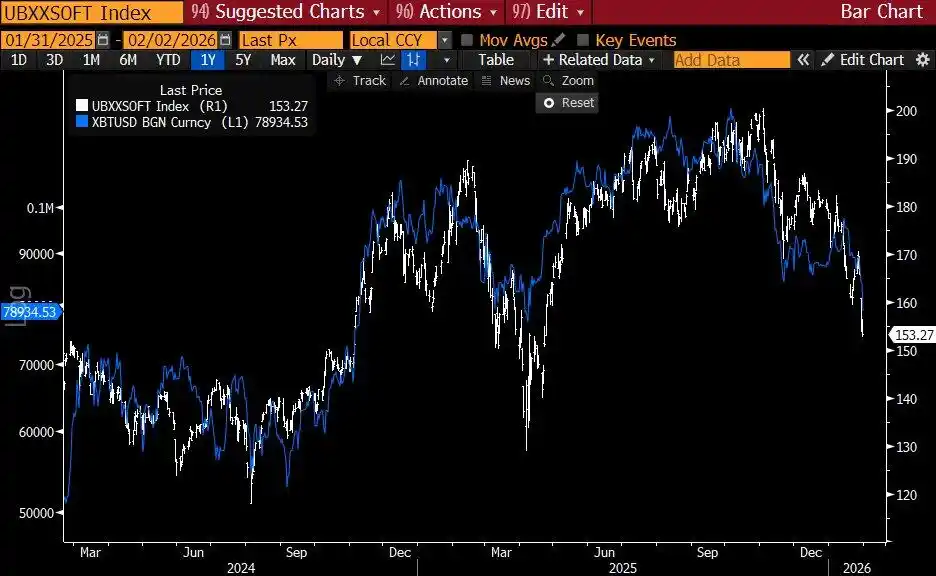
UBS SaaS Index vs. Bitcoin Trend

This indicates there is another factor that everyone is ignoring affecting this trend.

This factor is: Due to two shutdowns and issues with the US financial system's underlying mechanisms (the reverse repo mechanism's liquidity was only fully replenished in 2024), US liquidity has been constrained. Therefore, the TGA (Treasury General Account) rebuilding in July and August had no corresponding monetary offset measures, leading to a reduction in liquidity.
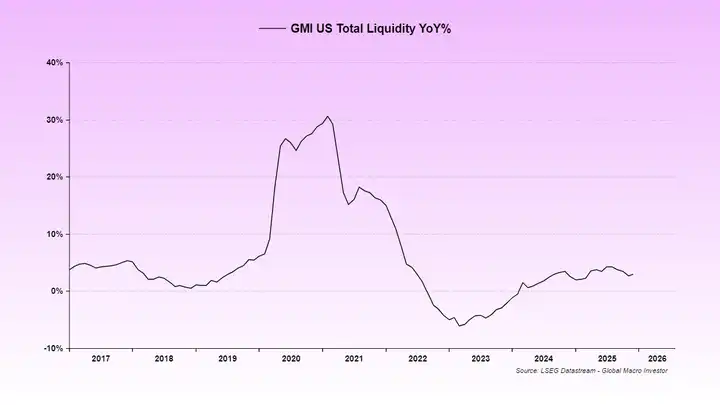
So far, the low liquidity is the reason the ISM Manufacturing Index has remained low.
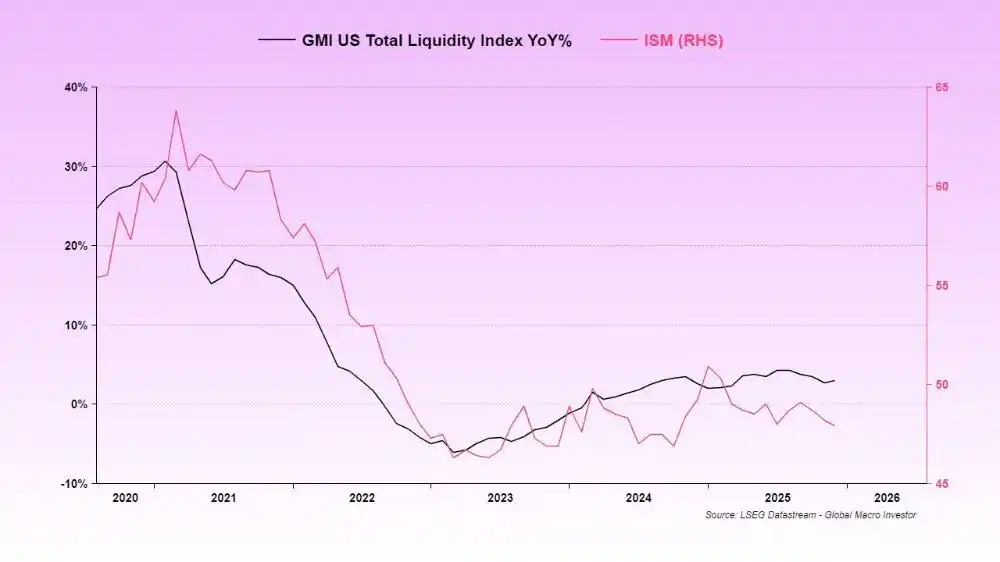
We usually use the Global Total Liquidity indicator because it has the highest long-term correlation with BTC and the Nasdaq, but at this stage, US Total Liquidity seems more important because the US is the primary provider of global liquidity.

In this cycle, the GMI Global Total Liquidity index is leading the US Total Liquidity index and is about to rebound (and thus will also drive the ISM index).
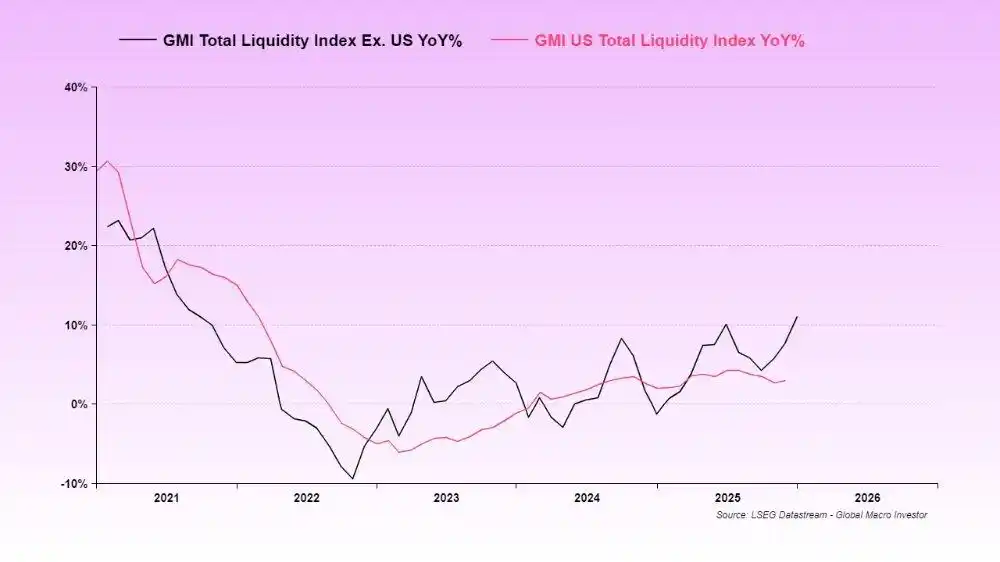
This is precisely what is impacting SaaS and BTC. Both assets are among the longest-duration assets in existence and have fallen due to the temporary withdrawal of liquidity.

The rise in gold has essentially sucked out the marginal liquidity from the system that might have flowed into the Bitcoin and SaaS markets. There isn't enough liquidity to support these assets, so high-risk assets are getting hit and falling. There's really no way around it.
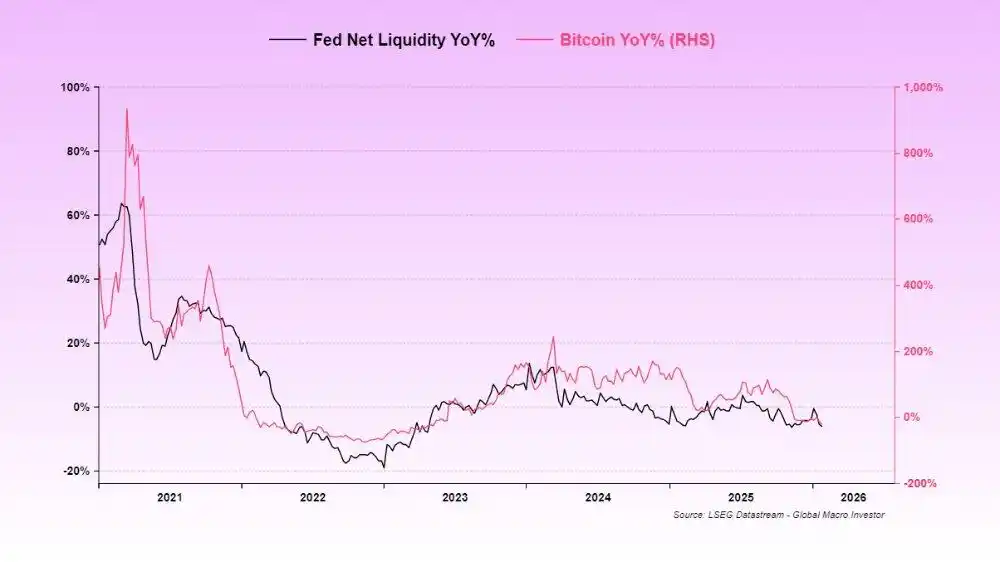
Now, the US government is facing another shutdown. The Treasury Department has taken preventive measures: after the last government shutdown, no TGA funds were used; instead, the balance was increased (i.e., further liquidity drain). This is the crisis we are facing now. It has caused violent price swings, and our beloved crypto is still lacking liquidity.

However, all signs indicate that this government shutdown will be resolved this week, which will clear the last liquidity obstacle.

Odaily Note: US House Speaker Johnson said in an interview on NBC News' "Meet the Press" on Sunday that he believes he has secured Republican support votes to ensure the shutdown of some government agencies ends by Tuesday.

I have mentioned the risk of this government shutdown many times before, but it will be over soon, and then we can continue to deal with the upcoming liquidity injection, which includes measures from eSLR, some TGA回流 (TGA回流: TGA runoff/return of funds?), fiscal stimulus, rate cuts, all related to the mid-term elections.

Odaily Note: US regulators are easing leverage ratio requirements through legislation to alleviate capital pressure on several major banks like Bank of America (BAC.US).

In a full trading cycle, time is often more important than price. Price can be hit hard, but as time passes and the cycle evolves, everything gets resolved and eventually settles.

This is why I have always emphasized "patience". Events need to unfold. Focusing solely on profit and loss ratios will only affect your mental health, not your investment portfolio.

The Fed's False Narrative

Regarding the issue of rate cuts, there is also a false narrative that Kevin Warsh is a hawk. This is complete nonsense; these statements are mainly from over 18 years ago.

Warsh's job and mission were to execute the strategies of the Greenspan era. Both Trump and Besant have said (not detailed here, but the main direction is rate cuts) to keep the economy hot, assuming that the productivity gains from AI will suppress core CPI rises (just like the 1995-2000 era).

Odaily Note: Greenspan is one of the longest-serving Chairs in Fed history. His advocated monetary policy (controlling inflation + promoting maximum employment) was highly flexible but practically prioritized fighting inflation, while also actively injecting liquidity during crises.

He doesn't like the balance sheet, but the system is reserve-constrained, so he is unlikely to change its current practices, otherwise it would destroy the credit market.

Warsh will cut rates and do nothing else. He will not interfere with Trump and Besant's actions to manage liquidity through banks. Fed Governor Milan will likely forcefully push for a full eSLR cut to accelerate this process.

If you don't believe me, believe Druck ↓
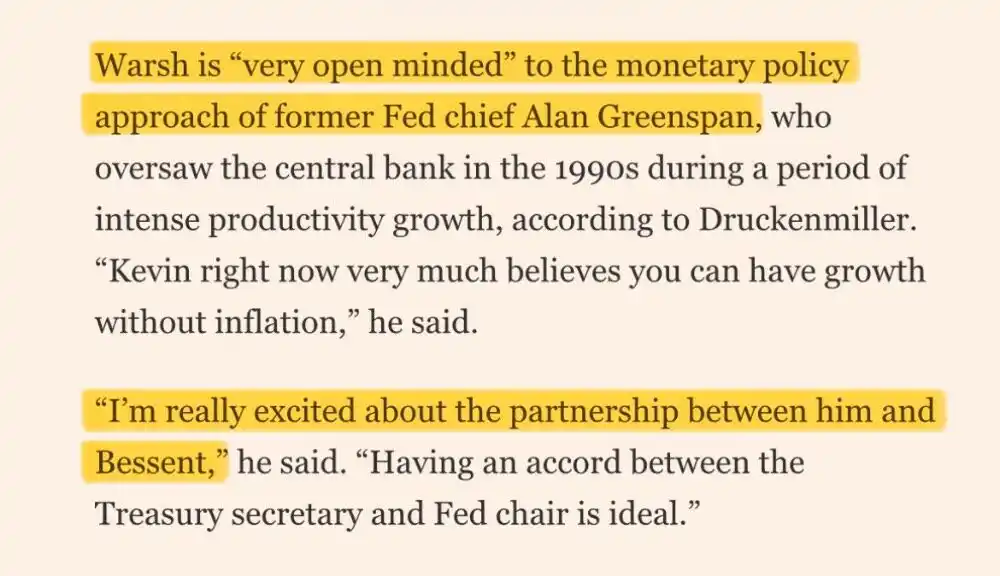
The above shows "investment guru" Stanley Druckenmiller's content on Warsh's monetary policy philosophy and his agreement with Besant upon becoming Fed Chair.

I know how difficult it is to hear optimistic narratives when the crypto market looks so dark. My SUI holdings are terrible, we don't know what or who to believe anymore. First, we have been through this many times before. When BTC falls 30%, altcoins can fall even 70%. But if they are high-quality alts, they bounce back faster too.

Mea Culpa (My Mistake)

GMI's mistake was not considering US liquidity as the current driving factor; usually, Global Total Liquidity dominates the entire cycle. But now the situation is clear, anything is possible.

The two are not unrelated. We just couldn't predict the combination of events (reverse repo draining liquidity > TGA rebuilding > government shutdown > gold rising > another shutdown), or we failed to anticipate their impact.

It's almost over, soon we can get back to normal work.

We cannot guarantee that every single link is error-free (now we have a deeper understanding), and we are still very bullish on the 2026 outlook because we understand the strategy of Trump/Besant/Warsh. These three have repeatedly told us: we just need to listen and be patient. In full-cycle investing, time is more important than price.

If you are not a cycle investor and don't have such strong risk tolerance, that's completely fine. Everyone has their own style, but Julien (GMI Head of Macro Research) and I are not good at swing trading (we don't care about intra-cycle fluctuations), but we are proven and have a track record in full-cycle investing, leading the industry for the past 21 years. (Warning: We also make mistakes, like in 2009). Now is not the time to give up. Good luck, and let's achieve greater results in 2026.

Liquidity relief is on the way!

Пов'язані питання

QAccording to Raoul Pal, what is the main factor causing the recent downturn in both the crypto and SaaS markets?

AThe main factor is the suppression of US liquidity due to two government shutdowns and issues with the US financial system's plumbing (the reverse repo mechanism), combined with TGA (Treasury General Account) rebuilding in July and August without monetary offset measures, which drained liquidity.

QWhat does Raoul Pal predict will happen once the current US government shutdown is resolved?

AHe predicts that resolving the shutdown will clear the final liquidity hurdle, allowing for a return to normalcy and the arrival of incoming liquidity injections from measures like eSLR, TGA drawdowns, fiscal stimulus, and rate cuts.

QHow does the article describe the relationship between the performance of Bitcoin and the UBS SaaS Index?

AThe article shows that the performance of Bitcoin and the UBS SaaS Index charts are identical, indicating they are both being affected by the same factor: the withdrawal of US liquidity.

QWhat is the 'false narrative' that Raoul Pal identifies regarding the potential new Fed Chair, Kevin Warsh?

AThe false narrative is that Kevin Warsh is a hawk. Pal argues this is nonsense and that Warsh's role would be to execute a Greenspan-era strategy of keeping the economy hot, cutting rates, and not interfering with liquidity management by the administration and banks.

QWhat key investment principle does Raoul Pal emphasize for navigating the current market cycle?

AHe emphasizes that 'time is more important than price' in a full cycle investment. He advises patience, stating that events need to play out and that focusing solely on profit and loss ratios affects mental health, not the investment portfolio.

Пов'язані матеріали

7 Months After the Collapse of Huiwang, Southeast Asia's Escrow Platforms Undergo a Major Reshuffle

Following the collapse of Huione Pay—dubbed the "Alipay of Southeast Asia"—seven months ago, the region's underground financial guarantee platform sector is undergoing a significant reshuffle. This power vacuum has been swiftly filled by emerging platforms such as XinBi, Tiger/Navigator, JinBei (renamed JinBo), Dali/Tiancheng, and FullyLight. These platforms, operating largely via Telegram and offering services like escrow for illicit transactions, have absorbed the vast user base and markets left behind by Huione. While positioning themselves as "trust intermediaries," their primary clientele consists of networks involved in online scams, money laundering, illegal gambling, and even human trafficking. For instance, the Tiger/Navigator platform explicitly provides "escrow" services for kidnapping-for-ransom operations ("强押车交易"). Data underscores the immense scale: Huione alone processed over $103 billion in cryptocurrency payments and facilitated over $31 billion through its escrow market before its downfall, linking it to Cambodia's notorious Prince Group. Since its collapse, competitors have seen explosive growth. For example, the XinBi platform has accumulated over $1.6 billion in total USDT revenue, while platforms like NewPay, OkPay (under Dali), and FullyLight Wallet collectively processed over $4.8 billion in USDT in a single year. This ecosystem thrives in regions like Cambodia and Myanmar, where regulatory gaps allow these platforms to act as critical financial infrastructure for sprawling cybercrime industries, from scam compounds to online casinos. The article concludes that the moniker "Southeast Asian Alipay" is a misnomer, obscuring the platforms' fundamental role in enabling serious criminal enterprises rather than representing legitimate financial innovation.

Odaily星球日报35 хв тому

7 Months After the Collapse of Huiwang, Southeast Asia's Escrow Platforms Undergo a Major Reshuffle

Odaily星球日报35 хв тому

The Changing Landscape: What Are Crypto VCs Experiencing?

Title: The Shifting Landscape of Crypto Venture Capital The era of dedicated crypto venture capital funds is undergoing a significant transformation. Once essential for navigating the sector's complexity and high risk, these specialized funds are now facing an identity crisis as the market matures. This shift mirrors historical patterns in other specialized investment classes like cleantech and SPACs, where initial information advantages dissipate as technologies become mainstream and integrated into existing industry frameworks. The article argues that crypto is reaching a critical inflection point, transitioning from a "building phase" to an "integration phase." Major players like Stripe, BlackRock, and Visa now engage with crypto not for its novel mechanics but as a foundational financial infrastructure. Their needs—regulatory compliance, banking partnerships, distribution channels—align with traditional fintech, a domain easily understood by large, generalist funds like Sequoia and Founders Fund. This evolution creates a "barbell effect" within the VC landscape. On one end are massive, diversified platforms that can incorporate crypto as one vertical among many. On the other are small, nimble funds focused on niche, experimental projects. The middle ground—medium-sized dedicated crypto funds—is being squeezed out. Their typical fund size makes it impossible to generate sufficient returns solely from early-stage crypto bets, yet they cannot compete with giants for later-stage deals. Consequently, leading crypto-native firms like Paradigm and Framework Ventures are expanding into AI, robotics, and other sectors, driven partly by LP pressure for better returns amid a broader VC DPI crisis. Others, like Dragonfly and a16z, have narrowed their crypto focus predominantly to financial infrastructure like stablecoins, reframing the sector's core narrative. For crypto entrepreneurs, this consolidation presents challenges. While generalist funds offer larger checks and broader resources, crypto projects now compete fiercely with AI for attention and capital within these firms. Furthermore, the long-term, non-commercial foundational work that built the ecosystem—funded by dedicated crypto VCs—is less likely to attract generalist capital focused on direct returns. The conclusion is that "crypto investor" as a standalone category is becoming obsolete, akin to "internet investor." Crypto is becoming a baseline infrastructure layer. The future will see a barbell structure: large-scale growth financing handled by generalist funds, while pioneering, speculative projects are funded by small, specialized vehicles. The dedicated crypto funds of the 2017-2021 boom, which incubated core infrastructure, are giving way to this new, bifurcated reality.

Foresight News53 хв тому

The Changing Landscape: What Are Crypto VCs Experiencing?

Foresight News53 хв тому

As Consensus Accelerates, What Are Young Investors Betting On?

Title: As Consensus Forms Faster, What Are Young Investors Betting On? In the rapid evolution of tech investment, a new generation of young investors is navigating a landscape where AI, robotics, commercial aerospace, and quantum computing are advancing simultaneously. Traditional investment logic based on financial models is giving way to a need for deep technical understanding and the ability to act before industry consensus forms. An analysis of trends from the "WAIC FUTURE TECH" list of young investment leaders reveals key shifts in focus. The first major trend is the movement of AI from the digital screen into the physical world. Investment is shifting from large language models and chatbots towards embodied AI, robotics, AI hardware, and edge computing. While demonstrations generate excitement, the real challenge lies in achieving scalable, reliable, and cost-effective delivery in complex real-world environments like factories and logistics. Success depends not just on algorithms but on the integration of sensors, actuators, and control systems. Second, the competitive focus for large models is moving beyond raw capability toward building an "intelligence flywheel." The goal is to create self-reinforcing systems where user interaction generates data, improving the model, which in turn enhances the user experience and attracts more engagement. Companies that successfully embed AI into workflows to create these closed-loop systems can build lasting value that isn't easily erased by the next model upgrade. Third, facing a potential bottleneck in high-quality human-generated data, investors are looking at new underlying technologies. Reinforcement learning and self-play, as demonstrated by AlphaGo Zero, offer paths for AI to generate its own experience. Scientific foundation models, which aim to build general AI capabilities for fields like life sciences and materials discovery, represent a non-consensus direction that could unlock new frontiers of knowledge and data. Finally, in deep-tech areas like quantum computing, commercial aerospace, and space-based infrastructure, patient capital is essential. These fields have long, uncertain development and validation cycles involving complex engineering, supply chains, and regulations. Investment here requires a long-term view, focusing on foundational team capabilities and the eventual emergence of market demand, even if commercial returns are distant. Collectively, these trends illustrate how young investors are adapting to a new era. They are learning to make earlier, technically-informed judgments, balance hype with real-world viability, and provide the patient capital needed to build the deep-tech foundations of the future.

marsbit1 год тому

As Consensus Accelerates, What Are Young Investors Betting On?

marsbit1 год тому

Торгівля

Спот
活动图片





