Is AAOI's P/S Ratio of 18.5 Expensive? Model Says 'Undervalued by 13%', Short Sellers Say '67% Bubble' — Who's Lying?

Опубліковано о 2026-08-17Востаннє оновлено о 2026-08-17

Анотація

The crucial question facing investors is whether the demand for its high-speed optical products and its planned capacity expansion can support the current revenue expectations. If this assumption proves untenable, the current valuation might resemble a value trap rather than a sound investment opportunity.

Applied Optoelectronics' stock has delivered many years of very strong upward momentum, but its low overall Value Score suggests the current share price may already reflect much of the market's optimism.

Over the past 5 years, Applied Optoelectronics' returns have been approximately 19 times the initial investment, which further focuses attention on how much upside the company may have left.

Recently, surging demand for the company's high-speed optical products (used to support AI and cloud data centers) may have raised investor expectations. However, any slowdown in demand or hiccups in planned capacity expansion could quickly affect what investors are willing to pay.

Applied Optoelectronics passes only 1 out of 6 valuation checks, so even considering its growth prospects, the company appears overvalued rather than undervalued on the whole.

The question now is whether Applied Optoelectronics' current valuation offers enough runway for reasonable returns after such a strong run-up.

Applied Optoelectronics returned 519.1% last year. Here's a look at how it stacks up across the Communications industry.

Is Applied Optoelectronics a Bargain Now?

For Applied Optoelectronics, the Price-to-Sales (P/S) ratio is a useful metric because the company is focused on revenue growth rather than established profitability.

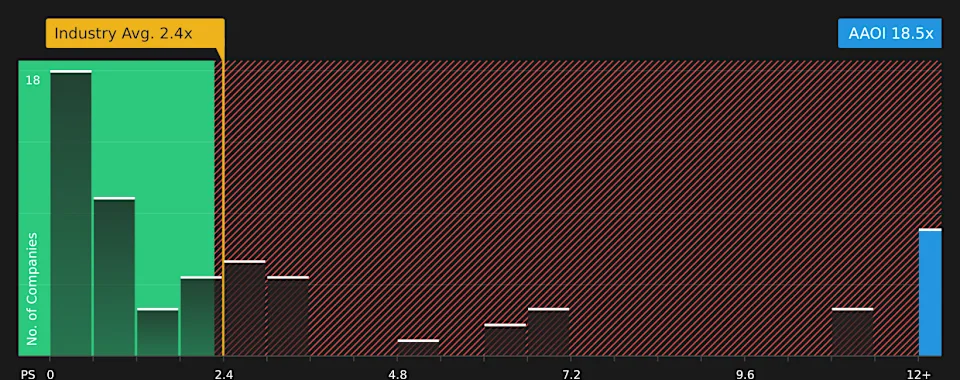
Applied Optoelectronics' P/S ratio is around 18.5x, significantly higher than the Communications industry average (~2.4x) and higher than the peer average (~7.0x). On a simple comparison, investors are paying much more per $1 of sales for this company than for many other communications stocks.

However, a more justified P/S ratio, considering the company's growth prospects, margins, size, and risk, is around 29.3x, which is still far above the current P/S. Despite the strong recent rally driven by AI-related policy news and revenue updates, the model indicates the current price does not fully reflect market expectations for Applied Optoelectronics based on revenue.

On a P/S basis, Applied Optoelectronics stock appears undervalued relative to where it should typically trade given its growth and risk profile.
The Applied Optoelectronics Narrative: What Must Hold True to Justify Today's Price?

The Simply Wall St Narratives series picks up Applied Optoelectronics' valuation puzzle, outlining what assumptions in growth, margins, and earnings must hold for the stock to be worth significantly more or less than its current price. Each article treats Applied Optoelectronics' implied fair value as a theory about the company's business that can be reassessed over time, not a one-time snapshot.

Currently, there is a stark divergence in views on Applied Optoelectronics, with a vast chasm between bullish and bearish theses on the stock.

Bull Thesis: Undervalued by 13%

"Growing demand from AI/machine learning workloads, video streaming, the Internet of Things, and the ongoing transition from copper to fiber in network infrastructure creates persistent tailwinds for the industry..."

Bear Thesis: Overvalued by 67%

"The case for going short is equally clear: the stock already reflects most of its upside potential..."

Summary

Applied Optoelectronics appears undervalued based on a customized Price-to-Sales (P/S) metric, but its low overall Value Score suggests most other metrics are not giving a clear endorsement. Recent high volatility in the share price implies market expectations are already elevated, warranting extra caution on relying on the P/S metric alone. The key question for investors is whether demand for its high-speed optical products and planned capacity expansion can support the current revenue expectations. If this assumption fails to hold, the current valuation might look more like a value trap than an investment opportunity.

Пов'язані матеріали

U.S. 'Operation Economic Outcast' Targets Iran's Crypto Sector, Over $100 Million in Oil-Related Payments Allegedly Facilitated via Cryptocurrency

U.S. Treasury Launches "Operation Economic Outcast," Sanctions Iran's Crypto Sector On August 24, the U.S. Treasury Department initiated "Operation Economic Outcast," a government-wide economic campaign against Iran. As part of this, the Office of Foreign Assets Control (OFAC) issued a sectoral sanctions determination targeting digital assets under Executive Order 13902, significantly expanding its authority. The Treasury stated that Iran is increasingly using cryptocurrency as a "tool of choice" to evade sanctions and support transactions linked to the Islamic Revolutionary Guard Corps (IRGC). Concurrently, OFAC sanctioned Ukrainian-Emirati broker Ivan Obukhov and his company, Foscom FZE. The Treasury alleges that since 2023, Obukhov has processed over $100 million in cryptocurrency payments to facilitate oil sales on behalf of the IRGC-Quds Force. Nearly 60 other entities, individuals, and vessels involved in nuclear procurement, cyber operations, and oil revenue networks were also sanctioned. This move marks an escalation from prior actions against specific exchanges, now establishing a broad basis to sanction any foreign entity deemed to operate in or support Iran's digital asset sector. Treasury Secretary Scott Bessent warned that any entity engaging economically with the Iranian regime will face the full reach of U.S. power, calling the operation an "economic D-Day" aimed at isolating Tehran.

marsbit9 хв тому

U.S. 'Operation Economic Outcast' Targets Iran's Crypto Sector, Over $100 Million in Oil-Related Payments Allegedly Facilitated via Cryptocurrency

marsbit9 хв тому

Is Your Account Still Blocked? Rosfinmonitoring Gets Direct Access to SBP and 'Mir'

Starting September 1, 2026, Russia's Federal Law No. 461-FZ grants Rosfinmonitoring (the Federal Financial Monitoring Service) direct access to transaction data from the National Payment Card System (NSPK), the operator of the Mir payment card system and the Faster Payments System (SBP). This allows the agency to bypass individual banks when reconstructing transaction trails for anti-money laundering (AML) purposes. The data, provided free of charge and without requiring customer consent or court orders, includes information on operations via SBP, the unified QR-code, and Mir cards, with no minimum transaction threshold. Customers will not be notified when their data is shared. The law does not introduce new taxes, automatic account freezes, or new enforcement powers. If suspicious activity is identified under existing AML laws, existing procedures with banks and law enforcement will apply. The agreement's specific terms between Rosfinmonitoring and NSPK, including the scope and historical depth of accessible data, are not public. The change centralizes access to a vast volume of domestic payments, potentially speeding up financial investigations. However, it also creates a single point of concentration for sensitive data and reduces transparency for cardholders, as customers are not informed about data requests. Observers note a global trend of expanding supervisory powers, with differences in the Russian model being the non-public agreement and the lack of customer notification.

cryptonews.ru12 хв тому

Is Your Account Still Blocked? Rosfinmonitoring Gets Direct Access to SBP and 'Mir'

cryptonews.ru12 хв тому

Solana Price Forecast Hits $110 as Bitwise's BSOL Posts Record Trading Volume

Solana (SOL) price is testing a critical resistance zone between $102-$103, having recently risen above $100 and now trading at $101.36. Technical analysis indicates a bullish but cautious trend, with the Parabolic SAR signaling a bullish short-term trend and the MACD gaining momentum. The price is within a rising wedge pattern, suggesting a potential breakout or sharper pullback. Key bullish factors include sustained, record-high network activity, with Solana processing over 1 billion transactions for the fourth consecutive week. Strong institutional demand is also evident, as Bitwise's Solana ETF (BSOL) recorded its highest-ever daily trading volume of over $108 million, contributing to significant daily inflows into SOL ETFs. However, caution is warranted. A major whale unstaked and transferred over 45,000 SOL, realizing a $3.3 million loss. Additionally, long-dated futures are trading at a discount to spot prices, indicating some long-term trader skepticism. **Price Forecast:** * **Bullish Case (Target: $110):** A confirmed daily close above the $102-$103 wedge resistance, supported by strong network usage and ETF inflows, could propel SOL towards $110. * **Bearish Risk (Support: $93-$95):** A rejection at resistance and a breakdown from the rising wedge's support could see the price retreat to the $93-$95 zone, especially if the whale's exit signals broader caution. In conclusion, the outlook is balanced between strong fundamental demand and emerging caution from large holders. The price action around the $102-$103 resistance will be decisive in determining the next significant move.

cryptonews.ru12 хв тому

Solana Price Forecast Hits $110 as Bitwise's BSOL Posts Record Trading Volume

cryptonews.ru12 хв тому

Торгівля

Спот
活动图片