Iran’s Hidden Crypto Trails Exposed As Arkham Publishes Public Wallet Map

bitcoinistОпубліковано о 2026-05-14Востаннє оновлено о 2026-05-14

Анотація

Blockchain intelligence firm Arkham has published a public, searchable map of cryptocurrency wallets linked to Iran's central bank, Bank Markazi. The core of the map is two Tron-based wallets that were sanctioned by the U.S. Treasury on April 24, identified as property of the bank and tied to the IRGC-Qods Force and Hezbollah. Approximately $344 million in crypto was frozen in the action, with Tether complying to freeze the funds. Arkham's research aims to serve as a starting point for tracing transaction flows. Analysis reveals a complex, layered system where Iranian oil revenues move through brokers, intermediary wallets, and DeFi protocols to obscure their origin before reaching central bank-linked accounts. While the Tron network itself cannot monitor transactions, it points to a joint financial crime unit with Tether and TRM Labs to flag illicit activity. The exposed wallets are part of a larger trend. Estimates indicate Iran's total crypto transaction volume reached roughly $11.4 billion in 2024 and $10 billion in 2025. Furthermore, Iran is reportedly considering charging crypto tolls for ships in the Strait of Hormuz, signaling digital assets' expanding role beyond sanctions evasion.

Blockchain analytics firm Arkham has built a public, searchable map of crypto wallets it links to Iran’s central bank — a move that puts Tehran’s alleged digital holdings in plain sight of investigators and anyone else curious enough to look.

How Iran Moves Money Through Crypto

The map centers on two Tron-based wallets that were added to the US Treasury’s Specially Designated Nationals list on April 24. Treasury identified both addresses as property of Bank Markazi Jomhouri Islami Iran — the country’s central bank — citing ties to the Islamic Revolutionary Guard Corps-Qods Force and Hezbollah.

Around $344 million in crypto was frozen as part of the action, Treasury Secretary Scott Bessent said, describing the goal as cutting off Tehran’s ability to generate, move, and bring home funds.

Stablecoin issuer Tether confirmed it had frozen the funds at the request of US authorities, citing activity tied to unlawful conduct, without naming Iran directly in its public statement.
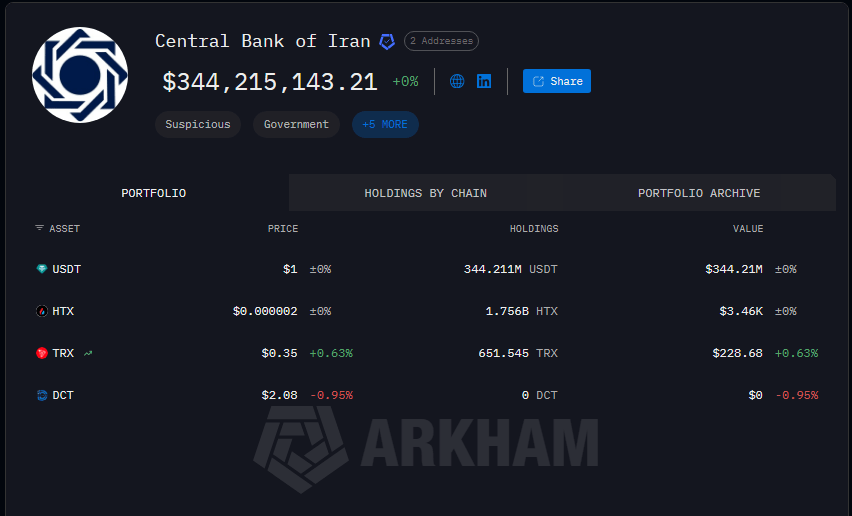
Arkham published its research on May 11, grouping the sanctioned addresses under a Central Bank of Iran entity page that it says can be used as a starting point to trace connected wallets and transaction flows.

The firm said the wallets hold TRC-20 tokens — a token standard that runs on the Tron network and includes USDT, the world’s largest stablecoin.

A Layered System Built To Hide

The money trail is not simple. According to Chainalysis, Iranian oil revenues passed through brokers, intermediary wallets, cross-chain bridges, and decentralized finance protocols before ending up in accounts linked to Iran’s central bank and IRGC-connected entities. The pipeline was built for concealment, layered step by step to obscure its origins.

A TRON spokesperson said the network itself cannot monitor or block individual transactions, but pointed to the T3 Financial Crime Unit — a joint effort between TRON, Tether, and TRM Labs launched in 2024 — as its main tool for flagging abuse.

BTCUSD trading at $80,564 on the 24-hour chart: TradingView

The unit works with law enforcement to freeze hundreds of millions in funds tied to sanctioned groups and terrorism financing, the spokesperson said. Tether declined to comment separately.

Iran’s Crypto Activity Runs Deep

The exposed wallets are just one piece of a much larger picture. Based on estimates from TRM Labs and Chainalysis, Iran’s total crypto transaction volume reached roughly $11.4 billion in 2024 and $10 billion in 2025.

Meanwhile, Iran is said to be looking into charging crypto-denominated tolls to ships passing through the Strait of Hormuz — a sign that digital assets are being considered as a revenue channel well beyond sanctions evasion.

Featured image from Bitcoin Policy Institute, chart from TradingView

Пов'язані питання

QWhat did the blockchain analytics firm Arkham do regarding Iran's crypto activity?

AArkham built a public, searchable map of crypto wallets it links to Iran's central bank, exposing Tehran's alleged digital holdings.

QWhat was the amount of crypto frozen by the US Treasury action related to Iran, and what were the cited reasons?

AAround $344 million in crypto was frozen. The US Treasury identified the wallets as property of Iran's central bank, citing ties to the Islamic Revolutionary Guard Corps-Qods Force and Hezbollah.

QHow does the article describe the complexity of Iran's money trail involving crypto?

AThe money trail is described as not simple; it involved a layered system built for concealment, passing through brokers, intermediary wallets, cross-chain bridges, and DeFi protocols to obscure origins before reaching accounts linked to Iran's central bank.

QAccording to estimates mentioned, what was Iran's estimated total crypto transaction volume in 2024 and 2025?

ABased on estimates from TRM Labs and Chainalysis, Iran's total crypto transaction volume reached roughly $11.4 billion in 2024 and $10 billion in 2025.

QWhat is one potential future use of digital assets by Iran mentioned in the article, beyond sanctions evasion?

AIran is said to be looking into charging crypto-denominated tolls to ships passing through the Strait of Hormuz, indicating digital assets are being considered as a broader revenue channel.

Пов'язані матеріали

Fei-Fei Li's Team Clarifies the Concept of 'World Models', Sora Merely a Renderer

"World Models" has become a widely used yet confusing term in AI. To address this, a team led by Fei-Fei Li and World Labs proposed a functional taxonomy based on the Partially Observable Markov Decision Process framework. This taxonomy categorizes systems called "world models" into three distinct projections: Renderers, Simulators, and Planners. Renderers, like OpenAI's Sora and other video generation models, focus on producing photorealistic visual outputs for human perception. They prioritize visual fidelity over physical accuracy. Simulators, such as NVIDIA Omniverse, aim to compute precise future environmental states for computational tasks like engineering analysis or digital twins. Planners, like Vision-Language-Action models, take in observations and goals to output executable actions for robots or agents. The article clarifies that most current "world models," including Sora, are primarily Renderers. They generate convincing visuals but lack the core ability to simulate state transitions based on actions, a key requirement for a true world model in classic reinforcement learning definitions. This conceptual confusion has practical implications, leading to potential misalignment in technology selection, investment, and public understanding of AI capabilities. Clear categorization is crucial. It helps enterprises avoid costly mistakes (e.g., using a renderer for robot training), allows investors to accurately assess markets, and enables researchers to build comparable benchmarks. While future systems may integrate these functions, recognizing current boundaries is essential for honest assessment and progress.

marsbit38 хв тому

Fei-Fei Li's Team Clarifies the Concept of 'World Models', Sora Merely a Renderer

marsbit38 хв тому

Bloomberg Uncovered: How Do China's Wealthy Circumvent the Annual $50,000 Limit to Transfer Assets?

**Summary: How Wealthy Chinese Circumvent $50,000 Annual Foreign Exchange Limits** Despite China's strict capital controls, including an annual $50,000 per person foreign exchange quota, an estimated $150 billion in funds still leaves the country annually via various gray and underground channels. This report outlines the evolution of China's "capital wall" and the methods used to bypass it. **The Evolving Capital Controls:** * **Foundation (1994):** The system of "current account convertibility with strict capital account controls" was established. * **Quota Set (2007):** The $50,000 individual annual forex purchase limit was formalized. * **Crackdown Begins (2015-2017):** Following market volatility, enforcement tightened. Banks were required to scrutinize transactions, and channels like using UnionPay cards for Hong Kong insurance premiums or buying overseas property were blocked. * **Digital & Legal Upgrades (2024-2026):** Enhanced algorithms now flag suspicious patterns (e.g., "smurfing"). The Common Reporting Standard (CRS) provides Chinese tax authorities with data on citizens' offshore accounts. Unlicensed cross-border brokers have been targeted. **Five Primary Methods for Moving Capital:** 1. **Underground Banking / "Hawala" (Duiqiao):** The largest-scale method. No money crosses borders. Clients pay RMB to a domestic account; an overseas associate deposits equivalent foreign currency into the client's offshore account. Risks include high fees, account freezes, and legal penalties. 2. **"Smurfing" or "Ant Moving":** Using multiple individuals' $50,000 quotas to pool funds for one offshore recipient. Increasingly detected by anti-money laundering algorithms. 3. **Trade Invoice Manipulation:** Businesses over-invoice imports or under-invoice exports via offshore shell companies, creating a pretext to transfer excess funds abroad under the guise of trade. 4. **Channel Migration:** After a crackdown on internet brokers, funds flow toward more compliant but costly channels like major banks' cross-border wealth management services or Qualified Domestic Institutional Investor (QDII) quotas. 5. **Structural Arrangements:** High-net-worth individuals use complex, high-cost legal structures involving offshore trusts, insurance, and investment migration programs to transfer asset ownership. **Regulatory Response: Focusing on People, Not Just Money** The current strategy extends oversight from enterprises to **individual residents**. Tools like CRS allow retroactive visibility into offshore assets. Cryptocurrencies, once seen as a potential loophole, are now actively monitored and prosecuted as an illegal channel. The underlying driver remains: with significant wealth concentrated among millions of affluent households seeking diversification amid domestic economic shifts, the incentive to move assets offshore persists despite regulatory barriers.

marsbit58 хв тому

Bloomberg Uncovered: How Do China's Wealthy Circumvent the Annual $50,000 Limit to Transfer Assets?

marsbit58 хв тому

Торгівля

Спот
Ф'ючерси
活动图片





