Iran’s Hidden Crypto Trails Exposed As Arkham Publishes Public Wallet Map

bitcoinistОпубліковано о 2026-05-14Востаннє оновлено о 2026-05-14

Анотація

Blockchain intelligence firm Arkham has published a public, searchable map of cryptocurrency wallets linked to Iran's central bank, Bank Markazi. The core of the map is two Tron-based wallets that were sanctioned by the U.S. Treasury on April 24, identified as property of the bank and tied to the IRGC-Qods Force and Hezbollah. Approximately $344 million in crypto was frozen in the action, with Tether complying to freeze the funds. Arkham's research aims to serve as a starting point for tracing transaction flows. Analysis reveals a complex, layered system where Iranian oil revenues move through brokers, intermediary wallets, and DeFi protocols to obscure their origin before reaching central bank-linked accounts. While the Tron network itself cannot monitor transactions, it points to a joint financial crime unit with Tether and TRM Labs to flag illicit activity. The exposed wallets are part of a larger trend. Estimates indicate Iran's total crypto transaction volume reached roughly $11.4 billion in 2024 and $10 billion in 2025. Furthermore, Iran is reportedly considering charging crypto tolls for ships in the Strait of Hormuz, signaling digital assets' expanding role beyond sanctions evasion.

Blockchain analytics firm Arkham has built a public, searchable map of crypto wallets it links to Iran’s central bank — a move that puts Tehran’s alleged digital holdings in plain sight of investigators and anyone else curious enough to look.

How Iran Moves Money Through Crypto

The map centers on two Tron-based wallets that were added to the US Treasury’s Specially Designated Nationals list on April 24. Treasury identified both addresses as property of Bank Markazi Jomhouri Islami Iran — the country’s central bank — citing ties to the Islamic Revolutionary Guard Corps-Qods Force and Hezbollah.

Around $344 million in crypto was frozen as part of the action, Treasury Secretary Scott Bessent said, describing the goal as cutting off Tehran’s ability to generate, move, and bring home funds.

Stablecoin issuer Tether confirmed it had frozen the funds at the request of US authorities, citing activity tied to unlawful conduct, without naming Iran directly in its public statement.
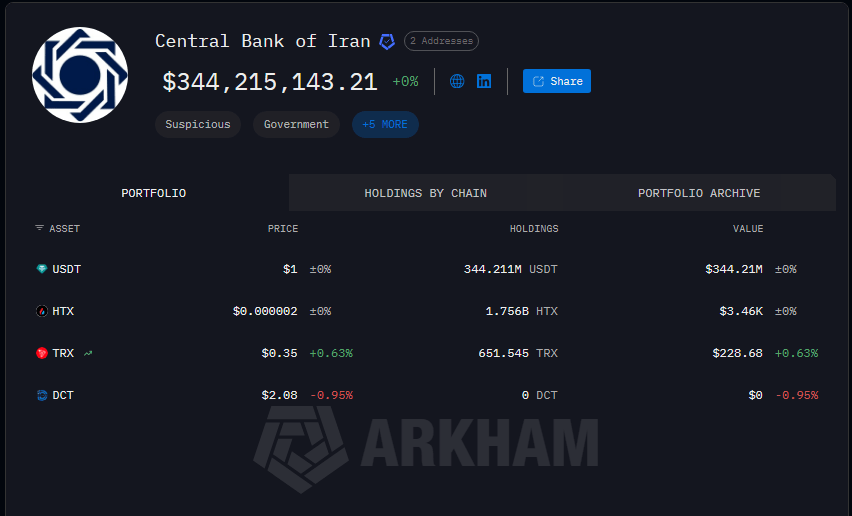
Arkham published its research on May 11, grouping the sanctioned addresses under a Central Bank of Iran entity page that it says can be used as a starting point to trace connected wallets and transaction flows.

The firm said the wallets hold TRC-20 tokens — a token standard that runs on the Tron network and includes USDT, the world’s largest stablecoin.

A Layered System Built To Hide

The money trail is not simple. According to Chainalysis, Iranian oil revenues passed through brokers, intermediary wallets, cross-chain bridges, and decentralized finance protocols before ending up in accounts linked to Iran’s central bank and IRGC-connected entities. The pipeline was built for concealment, layered step by step to obscure its origins.

A TRON spokesperson said the network itself cannot monitor or block individual transactions, but pointed to the T3 Financial Crime Unit — a joint effort between TRON, Tether, and TRM Labs launched in 2024 — as its main tool for flagging abuse.

BTCUSD trading at $80,564 on the 24-hour chart: TradingView

The unit works with law enforcement to freeze hundreds of millions in funds tied to sanctioned groups and terrorism financing, the spokesperson said. Tether declined to comment separately.

Iran’s Crypto Activity Runs Deep

The exposed wallets are just one piece of a much larger picture. Based on estimates from TRM Labs and Chainalysis, Iran’s total crypto transaction volume reached roughly $11.4 billion in 2024 and $10 billion in 2025.

Meanwhile, Iran is said to be looking into charging crypto-denominated tolls to ships passing through the Strait of Hormuz — a sign that digital assets are being considered as a revenue channel well beyond sanctions evasion.

Featured image from Bitcoin Policy Institute, chart from TradingView

Пов'язані питання

QWhat did the blockchain analytics firm Arkham do regarding Iran's crypto activity?

AArkham built a public, searchable map of crypto wallets it links to Iran's central bank, exposing Tehran's alleged digital holdings.

QWhat was the amount of crypto frozen by the US Treasury action related to Iran, and what were the cited reasons?

AAround $344 million in crypto was frozen. The US Treasury identified the wallets as property of Iran's central bank, citing ties to the Islamic Revolutionary Guard Corps-Qods Force and Hezbollah.

QHow does the article describe the complexity of Iran's money trail involving crypto?

AThe money trail is described as not simple; it involved a layered system built for concealment, passing through brokers, intermediary wallets, cross-chain bridges, and DeFi protocols to obscure origins before reaching accounts linked to Iran's central bank.

QAccording to estimates mentioned, what was Iran's estimated total crypto transaction volume in 2024 and 2025?

ABased on estimates from TRM Labs and Chainalysis, Iran's total crypto transaction volume reached roughly $11.4 billion in 2024 and $10 billion in 2025.

QWhat is one potential future use of digital assets by Iran mentioned in the article, beyond sanctions evasion?

AIran is said to be looking into charging crypto-denominated tolls to ships passing through the Strait of Hormuz, indicating digital assets are being considered as a broader revenue channel.

Пов'язані матеріали

Bitcoin Withdrawals Continue: 8 Years of Storage in a Coldcard Cold Wallet Ended in Zero

Coldcard Hardware Wallet Hacked: Losses Mount Due to Vulnerable Seed Generation A critical vulnerability in Coldcard hardware wallets has led to a continued wave of fund thefts. According to Galaxy Research, the total stolen has reached 1,367.05 BTC (approx. $88.6 million) from 4,585 addresses, a significant increase from the initial 594.5 BTC reported on July 30, 2026. Most of the stolen funds remain on the attackers' addresses. The issue is not with the current firmware, which Coinkite has updated, but with seed phrases generated on vulnerable devices between March 2021 and the release of fixed firmware versions. Due to a programmer error, devices switched from using a hardware random number generator to the software-based Yasmarang generator, which was initialized with publicly accessible data like the chip's serial number. This made the seed phrases predictable through offline brute-force attacks, meaning wallets remain at risk until funds are moved to a new wallet generated with the patched firmware. Affected devices include Mk2/Mk3 with firmware 4.0.1–4.1.9 (and up to 5.0.3), Mk4/Mk5 up to version 5.6.0, and Q models up to 1.5.0Q. The only exceptions are seeds created with a high-entropy method like at least 50 independent dice rolls or a strong unique BIP-39 passphrase. All other owners must generate a new seed on the fixed firmware and transfer their assets. A case highlighting the human impact involves a 39-year-old long-term investor who lost 2 BTC (approx. $130,000) in minutes. He had accumulated the Bitcoin over eight years through physical labor, viewing it as a financial lifeline and a retirement plan in a country suffering from hyperinflation. His story underscores that even conservative "buy and hold in cold storage" strategies can be compromised by such underlying technical flaws. From a technical perspective, this incident echoes historical failures where weak random number generators undermined cryptographic security, challenging the assumption that offline storage is automatically foolproof.

cryptonews.ru3 год тому

Bitcoin Withdrawals Continue: 8 Years of Storage in a Coldcard Cold Wallet Ended in Zero

cryptonews.ru3 год тому

Торгівля

Спот
活动图片





