Iran Opens Fire on an Oil Tanker That Paid Bitcoin Transit Fees to Scammers

marsbitОпубліковано о 2026-04-22Востаннє оновлено о 2026-04-22

Анотація

Iran announced plans to charge Bitcoin and USDT transit fees for oil tankers passing through the Strait of Hormuz. Within two weeks, scammers impersonated Iranian officials and sent fraudulent messages to stranded vessels, demanding cryptocurrency payments in exchange for safe passage. At least one tanker that paid the fake fee was fired upon by Iranian Revolutionary Guard boats when attempting to cross. Maritime risk firm MARISKS confirmed the scam exploited shipowners’ anxiety amid heightened regional tensions. Chain analysis firms TRM Labs and Chainalysis found no evidence of large-scale crypto payments actually being made to Iranian entities. Legal experts warned that even payments made to scammers—if intended for Iran—could violate international sanctions. The incident highlights how cryptocurrency’s irreversibility, often touted as a strength, becomes a critical risk in conflict-driven fraud. While Iran’s proposal initially sparked excitement in crypto circles, it ultimately created a new attack vector for deception, leaving ships trapped, fined, or even under fire.

Author: Deep Tide TechFlow

Deep Tide Introduction: Less than two weeks after Iran announced it would collect Bitcoin transit fees in the Strait of Hormuz, scammers impersonated Iranian officials and sent fake messages to stranded oil tankers demanding BTC and USDT.

At least one tanker that paid the fake transit fee was fired upon by the Iranian Revolutionary Guard Corps when attempting to pass. Chain analysis firms TRM Labs and Chainalysis both stated that no large-scale on-chain evidence of cryptocurrency payments has been found so far.
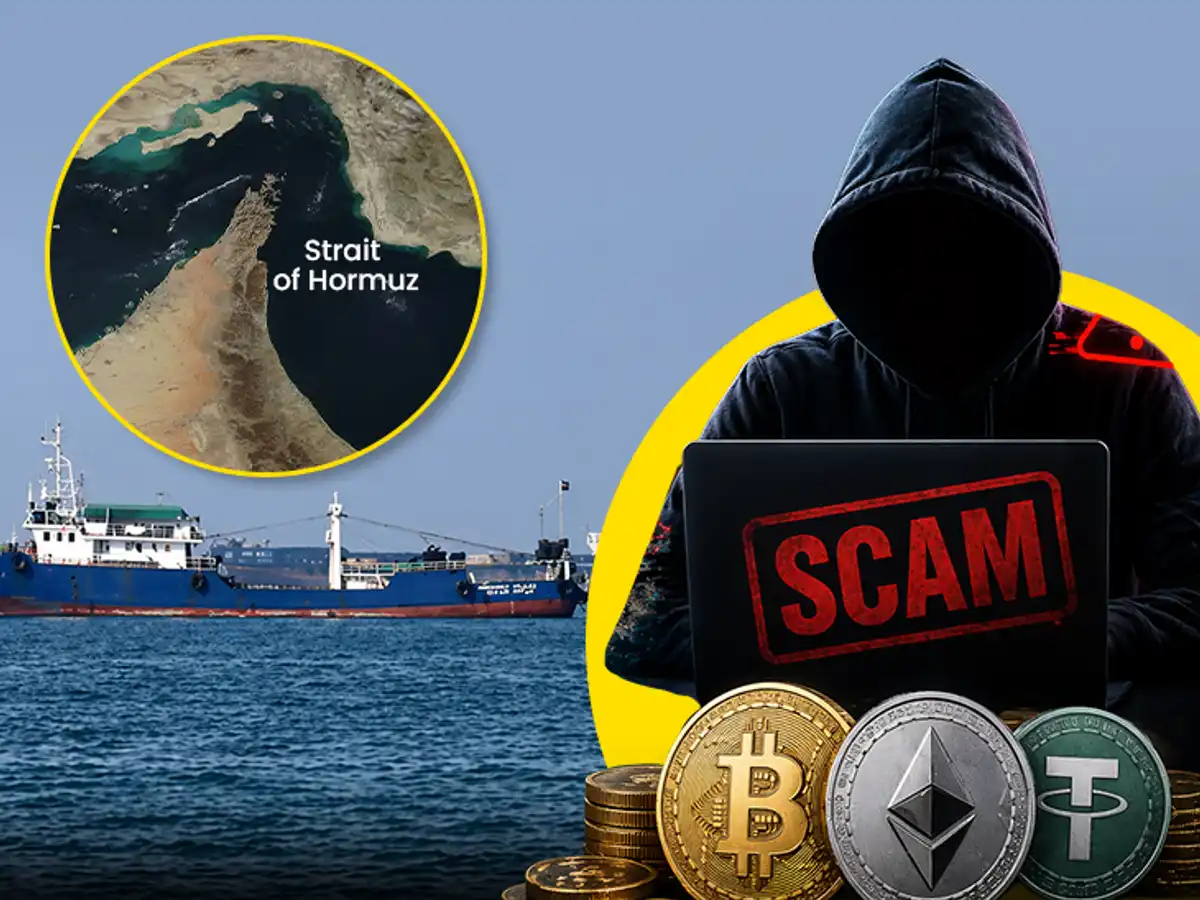
Iran announced it would collect transit fees in Bitcoin, and within two weeks, scammers turned this narrative into a weapon.

According to a Reuters report on April 21, the maritime risk management company MARISKS issued a warning: unidentified individuals are posing as Iranian authorities and sending false messages to ships stranded on the western side of the Strait of Hormuz, demanding payment of "transit fees" in BTC or USDT in exchange for safe passage. MARISKS believes that at least one of the vessels fired upon by Iranian Revolutionary Guard Corps speedboats on April 18, when Iran briefly opened the strait, was a victim of this scam.

The absurdity of the incident lies in the entire chain of causality: a sovereign state announces it will collect Bitcoin transit fees, scammers copy this rhetoric to commit fraud, shipowners believe it and pay, and then get shot at by the real Iranian military.

From "National-Level Settlement Tool" to Attack Surface for Scammers

The story begins in early April.

From March 30 to 31, the Iranian parliament passed the "Hormuz Strait Management Plan," formally writing into law the transit fee system that the Islamic Revolutionary Guard Corps had already been implementing since mid-March. According to the Financial Times, Hamid Hosseini, spokesperson for the Iran Oil, Gas, and Petrochemical Products Exporters Union, confirmed that fully loaded tankers are required to pay a fee of $1 per barrel, with payment methods including Bitcoin, USDT, or Chinese yuan. A supertanker carrying 2 million barrels of crude oil could face a single transit fee of up to $2 million.

Upon the news, Bitcoin's price jumped 5%, briefly breaking through $72,700. The crypto community quickly interpreted this as a milestone validation of Bitcoin as a "neutral settlement layer for international trade." Institutions like Bitwise even linked it to predictions of Bitcoin reaching $1 million.

But there were also many skeptics.

Sam Lyman of the Bitcoin Policy Institute pointed out in a report on April 15 that large-scale collection of Bitcoin transit fees with existing technology is "almost impossible." Ari Redbord, global policy head at TRM Labs, told Fortune magazine that on-chain data does not show transit fee payments occurring on a large scale. Chainalysis, in its analysis report, noted that on-chain activities of entities linked to Iran primarily rely on USDT on the Tron network, not Bitcoin.

Scammers don't care about these technical debates. They only need a credible narrative, and the Iranian government has already written the script for them.

Ships That Paid the Fake Fee Got Shot at for Real

According to Reuters and DL News, the wording of the scam messages highly imitates official language. The scammers required shipowners to submit ship documents, claiming they would be assessed by the "Iranian security department." After passing the assessment, payment in BTC or USDT would be required, after which the ship could "safely pass through the strait at the scheduled time."

Approximately 400 ships and about 20,000 crew members are currently stranded in the Persian Gulf. With the U.S. blockading Iranian ports and Iran repeatedly opening and closing the strait for passage, the anxiety of shipowners is understandable. The scammers precisely exploited this anxiety.

On April 18, Iran briefly opened the strait, and some ships attempted to pass. According to the UK Maritime Trade Operations (UKMTO), two Iranian Revolutionary Guard Corps speedboats opened fire on an oil tanker trying to exit the strait, forcing it to turn back. MARISKS believes this tanker had previously paid the cryptocurrency "transit fee" to scammers, thinking it had obtained passage permission.

They paid, but the money didn't go to Iran. The ship was still shot at.

Paying Scammers Could Also Violate Sanctions Laws

Even more ironically, even if shipowners realize they have been scammed, the legal risks won't disappear.

Xue Yin Peh, investigation strategy head at Chainalysis, told Decrypt that regardless of whether the recipient is actually the Iranian authorities, as long as the payer intended to pay a sanctioned regime, it could constitute a violation of OFAC, EU, and UK sanctions regulations. In other words, even if you thought you were paying Iran and the money ended up in a scammer's pocket, regulators could still pursue your "subjective intent."

Isabella Chase, head of policy for Europe, the Middle East, and Africa at TRM Labs, also warned that any wallet addresses associated with such demands should be considered "high-risk," and cryptocurrency payments do not provide any "safe harbor" in terms of sanctions compliance.

This creates a nearly unsolvable dilemma for shipowners: paying Iran violates sanctions, paying scammers might also violate sanctions, and not paying means continuing to drift in the Persian Gulf.

"Bitcoin's Irreversibility" Turns from Advantage to Flaw

The most noteworthy aspect for the crypto industry to reflect on is how Bitcoin's core characteristics performed in this scenario.

Benzinga's report highlighted the key issue: cryptocurrency payments cannot be reversed once sent. Traditional bank transfers at least offer the possibility of freezing and recovery, but once Bitcoin or USDT is transferred, the funds are lost. This feature is called "trustless settlement" in normal commercial contexts but becomes "irrecoverable loss" in the combined scenario of war and fraud.

This might be the most absurd crypto story of 2026... Iran's plan to collect transit fees in Bitcoin may never have been truly implemented, but scammers have already made money from this story, and an oil tanker got shot because of it.


Пов'язані питання

QWhat did Iran announce regarding the Strait of Hormuz in early April, and what was the proposed payment method?

AIran announced a toll system for oil tankers passing through the Strait of Hormuz, requiring a fee of $1 per barrel of oil. The payment methods included Bitcoin, USDT, or Chinese Yuan.

QHow did scammers exploit Iran's announcement about cryptocurrency toll payments?

AScammers impersonated Iranian authorities and sent fake messages to ships stranded in the Strait of Hormuz, demanding payments in BTC or USDT as 'tolls' for safe passage, capitalizing on the anxiety of shipowners.

QWhat happened to at least one ship that paid the fake toll to scammers?

AAt least one ship that paid the fake toll was fired upon by Iranian Revolutionary Guard Corps boats when it attempted to pass through the strait during a brief opening, forcing it to turn back.

QAccording to chain analysis firms TRM Labs and Chainalysis, was there evidence of large-scale cryptocurrency toll payments to Iran?

ANo, both TRM Labs and Chainalysis stated that there was no on-chain evidence of large-scale cryptocurrency toll payments being made to Iran.

QWhat legal risk do shipowners face even if they pay scammers instead of the actual Iranian authorities?

AShipowners could still be deemed in violation of OFAC, EU, and UK sanctions laws because the intent to pay a sanctioned regime (Iran) is what matters, regardless of whether the funds actually reached Iranian authorities or scammers.

Пов'язані матеріали

If the AI Bubble Is Already Bursting, Who Will Truly Survive?

If the AI Bubble is Bursting, Who Will Remain? The debate over an AI bubble is intensifying, with figures like Ray Dalio warning of high levels and Jensen Huang seeing immense, early-stage opportunity. Both views hold truth: a speculative bubble in capital markets likely exists, mirroring the dot-com era, but the underlying technological shift is real and transformative. History shows that while bubbles burst—wiping out overvalued companies and speculative capital—they often leave behind critical physical and digital infrastructure. The dot-com bust, for instance, eliminated many firms but left the global fiber optic networks and data centers that enabled the rise of Amazon, Netflix, and cloud computing. Today's massive AI infrastructure investments (projected at trillions by 2030) in data centers, power, cooling, and GPUs may follow a similar path, creating the foundation for future applications. A key divergence from past bubbles is the "Jevons Paradox" effect in AI. As the cost of AI inference has plummeted by over 99.7% since 2023, enterprise spending on AI has skyrocketed. Cheap "tokens" have unlocked vast, previously uneconomical use cases, moving AI from simple chatbots into core business workflows—code generation, legal document review, scientific simulation, and financial analysis. The market is now in a phase of self-correction, weeding out superficial "API-wrapper" startups, but this cleansing process strengthens the ecosystem. The long-term trajectory is clear. The value is gradually shifting from capital expenditure (CapEx) on hardware to operational expenditure (OpEx) on transformative applications. As AI becomes a utility, the winners will be firms that deeply integrate it to solve vertical industry problems in law, healthcare, finance, and manufacturing. The泡沫 will recede, but the foundational shift towards an AI-powered era across all sectors is irreversible. The underlying productive force of AI contains no bubble.

marsbit27 хв тому

If the AI Bubble Is Already Bursting, Who Will Truly Survive?

marsbit27 хв тому

If the AI Bubble Is Already Bursting, Who Will Truly Remain?

**Summary: If the AI Bubble is Bursting, What Will Remain?** The debate around an AI bubble is intensifying, with figures like Ray Dalio warning of high valuations while Jensen Huang sees immense opportunity. This echoes the dot-com bubble, which saw massive wealth destruction but ultimately left behind critical infrastructure like undersea cables and broadband, enabling future giants like Amazon and Netflix. Similarly, today's AI boom involves trillions invested in data centers, power, cooling, and GPUs, while application-layer revenue remains comparatively modest. This investment-disparity signals a bubble. However, the core technological progress is real and accelerating. AI inference costs have plummeted by over 99.7% since 2023, making intelligence increasingly cheap and accessible. This cost collapse is unlocking vast new demand. Instead of reducing spending, enterprises are tripling their AI cloud expenditure. Cheap "tokens" enable AI to move beyond simple chatbots into complex workflows—automating code writing, legal document review, financial analysis, and scientific research. This follows "Jevons's paradox": improved efficiency leads to greater total consumption. The market is now undergoing a necessary purification, weeding out "API-wrapper" startups with no real moat. The deeper evolution involves a shift from capital expenditure (CapEx) on infrastructure to operational expenditure (OpEx) on value-creation in applications. While hardware vendors currently profit most, long-term value will migrate to AI-native firms solving vertical industry problems. Ultimately, a market correction will cleanse speculative excess but will not reverse the AI+ trend. The massive physical and algorithmic infrastructure being built will endure, becoming a cheap, utility-like foundation. Just as the internet became indispensable to all industries post-2000, AI is poised to empower and redefine every sector, moving society irreversibly toward an intelligence-augmented era. The bubble may burst, but the underlying productive momentum is solid.

链捕手33 хв тому

If the AI Bubble Is Already Bursting, Who Will Truly Remain?

链捕手33 хв тому

Microsoft CEO: In the AI Era, How Do You Define a Company's Moat?

Microsoft CEO Satya Nadella argues that in the AI era, a company's true competitive edge, or "moat," is not determined by choosing the single most powerful model, but by its ability to build a continuous "learning loop." This system integrates and evolves by connecting human workflows, domain expertise, organizational judgment, and employee experience. He posits that future companies will accumulate two types of capital: Human Capital (employee knowledge, judgment, creativity) and "Token Capital" (a firm's own built and owned AI capabilities). Importantly, AI amplifies rather than devalues human capital. Human direction is essential to guide progress, as computational power alone is aimless. The core opportunity lies in creating a closed-loop system where human and token capital reinforce each other in a compound, self-improving cycle. A company must be able to preserve its unique institutional knowledge—its "company veteran" expertise—even if it switches underlying general-purpose AI models. This requires private evaluation benchmarks, reinforcement learning environments based on internal data, and queryable knowledge bases. Nadella warns against a future where economic value is concentrated by a few dominant models that commoditize entire industries' knowledge. Instead, the priority should be building a broad "frontier ecosystem" where every company, industry, and nation can own its learning loop. This allows organizations to retain control of their intellectual property, amplify employee capabilities, and ensure the economic value created by AI is captured within their own businesses and communities. True corporate sovereignty in the AI age comes from turning organizational knowledge into a compounding system that creates enduring, defensible value.

marsbit1 год тому

Microsoft CEO: In the AI Era, How Do You Define a Company's Moat?

marsbit1 год тому

ETFs Are Just the Ticket: The True Institutionalization of Bitcoin Is Happening Where You Can't See It

Beyond the Bitcoin ETF spotlight, a deeper institutionalization is underway, leveraging Bitcoin as a foundational financial primitive. Institutions are using Bitcoin for purposes long reserved for assets like U.S. Treasuries and gold: as collateral for loans, insurance reserves, and the backbone of rated bonds. Examples include a Barbados-based insurer capitalizing with $40M in Bitcoin reserves and Ledn's $188M securitization of Bitcoin-backed loans, which received the first-ever investment-grade rating (BBB-) from S&P for a digital asset-backed security. This structure was stress-tested during a 27% price drop in early 2026, triggering automatic liquidations that functioned as designed but revealed the systemic risk of synchronized selling across leveraged positions. Infrastructure is evolving to support this, with platforms like Anchorage Digital's Atlas network enabling secure, institutional-grade settlement and collateral management. Strategies like basis trades and corporate treasuries (exemplified by companies like MicroStrategy issuing billions in equity and debt to fund Bitcoin acquisitions) further integrate Bitcoin into financial mechanics. While ETFs solved "how to own" Bitcoin, these developments answer "what to do with it," embedding the asset into the working machinery of finance—as collateral upon which loans, derivatives, and structured products are built. The real, enduring institutional shift is happening in these largely invisible plumbing and financing systems.

marsbit1 год тому

ETFs Are Just the Ticket: The True Institutionalization of Bitcoin Is Happening Where You Can't See It

marsbit1 год тому

ZEC Co-Founder Responds to Orchard Vulnerability: No Signs of Theft, Orchard Pool to Be Sealed

ZEC Co-Founder Addresses Orchard Vulnerability: No Signs of Theft, Plans to Sunset Orchard Pool A security vulnerability was recently discovered in Zcash's Orchard shielded pool, raising key concerns. The primary questions are whether the flaw was exploited, if user funds are safe, whether users can verify the total ZEC supply, and if other similar vulnerabilities exist. Analysis suggests the vulnerability was likely not exploited prior to its discovery. It was found proactively by a researcher using specialized tools, not due to an active breach. The development team and mining pools acted quickly to contain the issue. Typical financially-motivated attacks would likely have left visible on-chain evidence, which has not been observed. User funds in Orchard are considered safe and should be recoverable, assuming no prior exploitation. If the flaw was never used, all legitimate funds can be withdrawn. The article outlines risks associated with moving funds to transparent addresses or other pools, but concludes that leaving assets in place is a reasonable option. Currently, users cannot independently verify that the total ZEC supply hasn't been inflated due to this bug. However, the planned Ironwood network upgrade is designed to resolve this. It will permanently close the Orchard pool to new deposits and internal transfers, allowing only withdrawals. This mechanism will cap total withdrawals at the amount of legitimately deposited funds, enabling anyone to cryptographically verify the supply post-upgrade. Multiple teams, including Shielded Labs, have conducted extensive audits focused on counterfeiting vulnerabilities, assisted by advanced AI tools. No additional flaws of this type have been found so far, increasing confidence that no other similar undisclosed vulnerabilities exist. In summary, evidence indicates the Orchard bug was probably not used, user funds are secure, and no other counterfeiting flaws are currently known. The upcoming Ironwood upgrade will restore users' ability to independently verify the total ZEC supply, closing this chapter.

Foresight News1 год тому

ZEC Co-Founder Responds to Orchard Vulnerability: No Signs of Theft, Orchard Pool to Be Sealed

Foresight News1 год тому

Торгівля

Спот
Ф'ючерси

Популярні статті

Як купити IR

Ласкаво просимо до HTX.com! Ми зробили покупку Infrared Finance (IR) простою та зручною. Дотримуйтесь нашої покрокової інструкції, щоб розпочати свою криптовалютну подорож.Крок 1: Створіть обліковий запис на HTXВикористовуйте свою електронну пошту або номер телефону, щоб зареєструвати обліковий запис на HTX безплатно. Пройдіть безпроблемну реєстрацію й отримайте доступ до всіх функцій.ЗареєструватисьКрок 2: Перейдіть до розділу Купити крипту і виберіть спосіб оплатиКредитна/дебетова картка: використовуйте вашу картку Visa або Mastercard, щоб миттєво купити Infrared Finance (IR).Баланс: використовуйте кошти з балансу вашого рахунку HTX для безперешкодної торгівлі.Треті особи: ми додали популярні способи оплати, такі як Google Pay та Apple Pay, щоб підвищити зручність.P2P: Торгуйте безпосередньо з іншими користувачами на HTX.Позабіржова торгівля (OTC): ми пропонуємо індивідуальні послуги та конкурентні обмінні курси для трейдерів.Крок 3: Зберігайте свої Infrared Finance (IR)Після придбання Infrared Finance (IR) збережіть його у своєму обліковому записі на HTX. Крім того, ви можете відправити його в інше місце за допомогою блокчейн-переказу або використовувати його для торгівлі іншими криптовалютами.Крок 4: Торгівля Infrared Finance (IR)Легко торгуйте Infrared Finance (IR) на спотовому ринку HTX. Просто увійдіть до свого облікового запису, виберіть торгову пару, укладайте угоди та спостерігайте за ними в режимі реального часу. Ми пропонуємо зручний досвід як для початківців, так і для досвідчених трейдерів.

484 переглядів усьогоОпубліковано 2025.12.17Оновлено 2026.06.02

Як купити IR

Обговорення

Ласкаво просимо до спільноти HTX. Тут ви можете бути в курсі останніх подій розвитку платформи та отримати доступ до професійної ринкової інформації. Нижче представлені думки користувачів щодо ціни IR (IR).

活动图片












