Iran Launches Bitcoin Payment Platform For Strait Of Hormuz Insurance

bitcoinistОпубліковано о 2026-05-18Востаннє оновлено о 2026-05-18

Анотація

Iran has launched a maritime insurance platform named "Hormuz Safe" for cargo transiting the Strait of Hormuz, with insurance payments settled in Bitcoin. According to a report from Iran's Fars News Agency, the state-backed initiative could generate significant revenue and embeds Bitcoin into a critical global shipping corridor. The platform offers cryptographically verifiable policies for cargo moving through the Persian Gulf and surrounding waterways, with coverage beginning upon payment confirmation. This move occurs amid heightened geopolitical tensions in the strait, a vital chokepoint for global oil shipments. The report did not specify technical details on Bitcoin payment processing or identify external partners.

Iran has launched a new maritime insurance platform for cargo moving through the Strait of Hormuz, with payments settled in Bitcoin, according to a report from Iran’s semi-official Fars News Agency. The project places Bitcoin inside one of the world’s most politically sensitive shipping corridors, where energy flows, sanctions pressure and maritime risk have become increasingly intertwined.

Iran Officially Turns To Bitcoin

Fars reported that the platform, called “Hormuz Safe,” has begun offering insurance for maritime cargo passing through the Strait of Hormuz. The outlet said a document obtained by its reporter showed Iran’s Ministry of Economic Affairs and Finance had been working since early Ordibehesht, the second month of the Iranian calendar, on a plan to make management of the strait possible through insurance. The same report said the scheme could issue maritime insurance policies and financial responsibility certificates, potentially generating more than $10 billion in revenue for Iran.

The most crypto-relevant element is the settlement layer. Fars said the platform’s rules provide “fast, cryptographically verifiable” insurance policies for cargo moving through the Persian Gulf, the Strait of Hormuz and surrounding waterways. “Payments are settled with Bitcoin,” the report said, adding that cargo is covered “from the moment of confirmation” and that owners receive a signed receipt.

That wording makes the story more specific than a generic Bitcoin-payment initiative. The Fars report names Bitcoin directly, rather than referring only to crypto assets, stablecoins or blockchain-based payment rails. It also frames the product not as a consumer-facing wallet or exchange service, but as infrastructure for a maritime insurance and compliance process around ships and cargo.

Related Reading: Bitcoin Social Euphoria Hits Yearly High Amid CLARITY Act Buzz

The launch comes amid heightened scrutiny of the Strait of Hormuz, the narrow waterway between Iran and Oman that connects the Persian Gulf with the Gulf of Oman and Arabian Sea. The US Energy Information Administration has called Hormuz the world’s most important oil chokepoint, noting that oil flows through the strait averaged 21 million barrels per day in 2022, equal to about 21% of global petroleum liquids consumption.

The geopolitical context has become even more acute in recent months. Iran had begun allowing some Chinese vessels to transit the Strait of Hormuz after an understanding over Iranian management protocols for the waterway. Iran had severely restricted transit following the start of US and Israeli strikes on February 28, while a US blockade on Iranian ports after an early-April ceasefire had prolonged the crisis in a corridor through which one-fifth of global oil and natural gas transit.

Fars did not provide technical details on how Bitcoin payments are received, whether the platform uses on-chain settlement directly, third-party custody, internal accounting, or conversion into local or foreign currency. It also did not identify counterparties, underwriters, wallet infrastructure, or any external insurers connected to the platform.

At press time, BTC traded at $76,685.
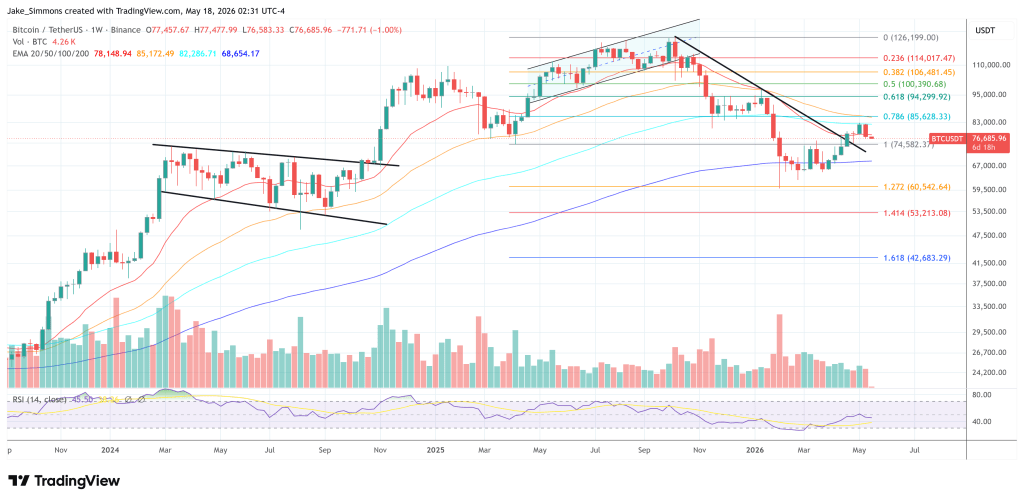
Bitcoin bulls rejected at the 100-week EMA, 1-week chart | Source: BTCUSDT on TradingView.com

Пов'язані питання

QWhat is the name of the new Bitcoin-based maritime insurance platform launched by Iran, and which waterway does it specifically cover?

AThe platform is called 'Hormuz Safe,' and it offers insurance for maritime cargo passing through the Strait of Hormuz and surrounding waterways like the Persian Gulf.

QAccording to the Fars News Agency report, what specific cryptocurrency is used for payment settlement on the 'Hormuz Safe' platform?

APayments on the 'Hormuz Safe' platform are settled with Bitcoin.

QWhat major geopolitical and economic significance does the Strait of Hormuz hold, as mentioned in the article?

AThe Strait of Hormuz is described as the world's most important oil chokepoint, with oil flows averaging 21 million barrels per day in 2022, equal to about 21% of global petroleum liquids consumption.

QWhat details about the Bitcoin payment process did the Fars report notably NOT provide, according to the article?

AThe report did not provide technical details on how Bitcoin payments are received, whether the platform uses on-chain settlement directly, third-party custody, internal accounting, or currency conversion. It also did not identify counterparties, underwriters, wallet infrastructure, or any external insurers.

QWhat was the approximate price of Bitcoin (BTC) at the time the article was published?

AAt press time, BTC traded at $76,685.

Пов'язані матеріали

In-Depth Research Report on U.S. Crypto Equity Market in 2026 — Opportunities, Risks, and Portfolio Allocation Framework

Since the U.S. Securities and Exchange Commission (SEC) historically approved spot Bitcoin ETFs in January 2024, the U.S. crypto investment landscape has undergone a profound maturation process. In 2026, investors can participate in the crypto market through four primary channels: spot ETFs, crypto-related public equities (including miners and treasury companies), leveraged and inverse ETFs, and blockchain-themed funds. As of March 30, 2026, U.S. spot Bitcoin ETFs collectively held approximately 1.29 million BTC, representing roughly $86.9 billion in assets under management (AUM), while spot Ethereum ETFs reached approximately $18 billion in AUM. Notably, the rise of the Ethereum treasury company model is reshaping the logic of institutional participation. Exemplified by Bitmine Immersion Technologies (BMNR), these firms generate native on-chain yield annually through ETH staking, creating a fundamentally different business resilience model compared with traditional Bitcoin treasury companies. On the regulatory front, the 2025 GENIUS Act established the first federal stablecoin framework in the United States. The U.S. Strategic Bitcoin Reserve has been officially established, banks have been authorized to provide crypto custody services, and major compliance bottlenecks have been definitively removed. Nevertheless, the high volatility of leveraged ETFs, the balance-sheet risks embedded in treasury-company financing structures, and the slashing risk of staked assets continue to pose investment obstacles that cannot be overlooked. For investors seeking exposure to this sector, building a tiered portfolio comprising core holdings, sector beta exposure, and high-risk tactical position may be the most viable path of participation.

HTX Learn10 хв тому

In-Depth Research Report on U.S. Crypto Equity Market in 2026  — Opportunities, Risks, and Portfolio Allocation Framework

HTX Learn10 хв тому

Viewpoint: After Surviving the Death Cycle, Why Has Privacy Pioneer Zcash Returned to the Mainstream Spotlight?

Zcash, the pioneering privacy-focused cryptocurrency built with zero-knowledge proof (ZK) technology, is re-emerging as a major narrative. Having survived a "death cycle" and proven its resilient community, Zcash is now positioned at a unique convergence of factors driving renewed institutional and retail interest. Key catalysts include the increasing institutionalization of crypto (e.g., BlackRock's ETF), which creates a "Trojan horse" for privacy adoption through Zcash's transparent mode. The rise of AI-powered on-chain surveillance makes financial privacy a critical necessity, not just for niche users but for mainstream wealth preservation against overreach. ZK technology has finally matured to enable practical, user-friendly private transactions, a core advantage over older "obfuscation" methods like Monero's ring signatures. Zcash’s narrative as "private Bitcoin"—a fork with the same 2100M cap and PoW—is simple and powerful. It competes in the store-of-value arena, offering cryptographic privacy as a fundamental human right. Its development roadmap is robust, featuring a soon-to-be-complete quantum resistance upgrade for its shielded pool, faster block times, and improved wallet support (e.g., from Ledger). With backing from major funds and a growing developer ecosystem, Zcash is seen as leading the crucial reintegration of privacy into the crypto landscape, fulfilling the original cypherpunk vision.

marsbit18 хв тому

Viewpoint: After Surviving the Death Cycle, Why Has Privacy Pioneer Zcash Returned to the Mainstream Spotlight?

marsbit18 хв тому

Google's AI Chief is Actually the Secret Backer of Anthropic, Hassabis Quietly Controls the Global AI Ecosystem

A bombshell report reveals that Demis Hassabis, the head of Google AI and DeepMind founder, was an early, secret investor in Anthropic, Google's arch-rival in the AI race. This discovery unveils a vast, interconnected empire—dubbed the "DeepMind Mafia"—where Hassabis's capital and influence extend through numerous top AI startups like Inflection AI and Ineffable Intelligence, which have collectively raised over $14 billion. Despite the public rivalry between Google's Gemini and Anthropic's Claude, Hassabis personally funded Anthropic at its inception, a stake now astronomically valuable given the company's reported $900 billion valuation. Furthermore, a close, mentor-like relationship exists between Hassabis and Anthropic CEO Dario Amodei. Concurrently, Hassabis has consolidated power within Google. Following the 2023 merger of Google Brain and DeepMind into Google DeepMind, his loyalists have assumed key leadership roles across Google's AI and cloud divisions. However, Hassabis continues to operate his power base from London, not Silicon Valley. The report paints a picture of Hassabis as a master strategist, quietly orchestrating the global AI ecosystem through a web of personal investments, former protégés, and internal corporate control, ensuring his influence prevails regardless of which public-facing company wins in the market.

marsbit1 год тому

Google's AI Chief is Actually the Secret Backer of Anthropic, Hassabis Quietly Controls the Global AI Ecosystem

marsbit1 год тому

Conversation with Glassnode Analyst: Bitcoin Bull Market Has Restarted, Current Market Still in 'Sell on Rally' Phase

Bitcoin analyst Checkmate believes the cryptocurrency market is now in a bull phase following a likely capitulation event in June, with an 80% probability the $60,000 low marked the bottom. However, he expects a prolonged consolidation period, similar to past cycles. Key resistance levels are identified at $78,000 (short-term cost basis), $85,000 (a critical supply zone and 200-day moving average), and $95,000. Sustained price appreciation requires consistent capital inflows, with institutions expected to enter more aggressively if Bitcoin surpasses $100,000. The discussion extends to macroeconomics, where rising global bond yields signal a loss of trust in government fiscal management. Checkmate argues this reflects a broader monetary regime change, where Bitcoin and gold will serve as primary stores of value outside the traditional system, while fiat currencies like the USD act as mediums of exchange. Finally, Checkmate criticizes proposed Australian capital gains tax reforms, calling them a "wealth grab." The plan to replace a 50% discount for assets held over a year with inflation indexing based on low CPI rates would drastically increase effective tax rates, punishing savers and investors trying to overcome the country's severe housing affordability crisis. He urges public opposition to prevent such policies from spreading globally.

marsbit1 год тому

Conversation with Glassnode Analyst: Bitcoin Bull Market Has Restarted, Current Market Still in 'Sell on Rally' Phase

marsbit1 год тому

Торгівля

Спот
Ф'ючерси
活动图片




