Iran and the Fed -- Three Scenarios That Will Impact Global Markets Next

marsbitОпубліковано о 2026-05-28Востаннє оновлено о 2026-05-28

Анотація

"Three Scenarios for Iran and the Fed Shaping Global Markets" Iranian geopolitics and the Fed's monetary policy path are two dominant themes for markets. Deutsche Bank Research outlines three scenarios linking Iran ceasefire outcomes to Fed policy, with oil prices as the key transmission channel. **Scenario 1: Peace Deal.** A breakthrough leading to the Strait of Hormuz reopening would ease near-term Fed tightening pressure. Recent inflation would be viewed as a temporary energy shock. However, medium-term risks remain; rate hikes could resurface in 2027 if inflation persists. **Scenario 2: Stalemate.** A breakdown in talks and a prolonged Strait closure, but no major escalation, is deemed the scenario with the *highest* Fed hike risk. Sustained high oil prices would feed into core inflation and threaten inflation expectations, while not severely damaging demand enough to give the Fed a reason to pause. This environment could necessitate multiple Fed rate hikes in 2026. **Scenario 3: Conflict Escalation.** Renewed conflict and sharply higher oil prices create a two-way risk for Fed policy. On one hand, it would risk severe inflation expectations de-anchoring, forcing a hawkish response. On the other, extreme oil prices could severely damage demand and the labor market, potentially shifting the Fed's focus toward easing. The ultimate policy decision would depend on which risk materializes first. Overall, Deutsche Bank's framework emphasizes that the path for oil prices, d...

Author: Dong Jing

Source: Wall Street News

The direction of the Iran situation and the outlook for the Federal Reserve's monetary policy are becoming the two most critical factors influencing global markets.

Deutsche Bank's economic research team, in its latest report, systematically outlined the potential impact on the Fed's policy path based on three possible outcomes of the Iran ceasefire negotiations—ranging from the fading of near-term interest rate hike risks to multiple hikes in 2026, and to two-way policy uncertainty. Each scenario corresponds to a distinct market logic.

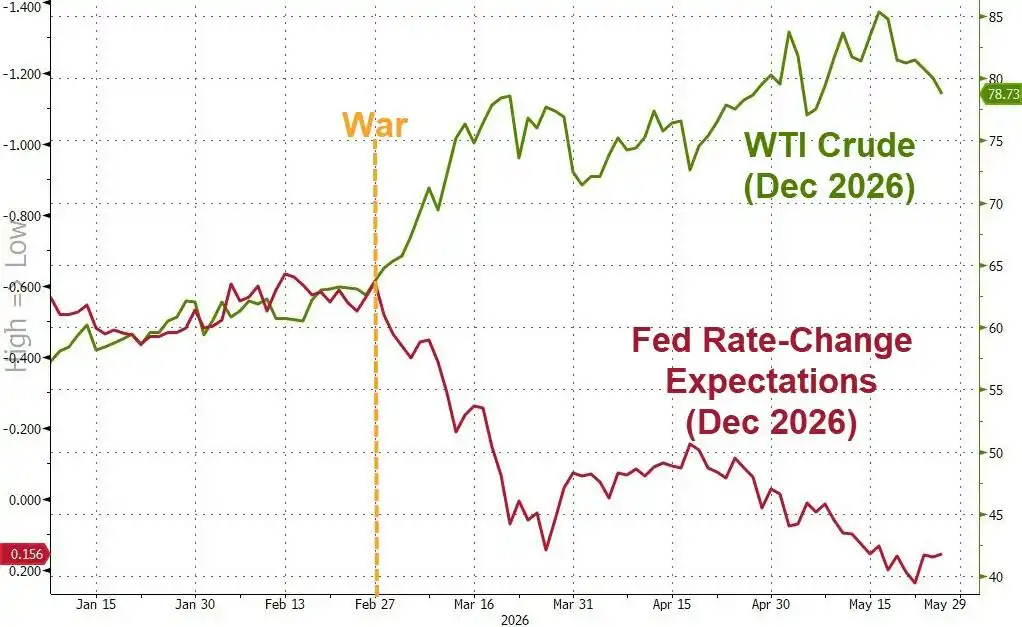
The analysis points out that oil price movements will directly affect the anchoring of inflation expectations, thereby determining whether the Fed needs to restart rate hikes. In the bank's view, the most concerning scenario currently is not the extreme conflict escalation, but the intermediate state of "failed negotiations and a stalemate"—this scenario is most likely to force the Fed to take substantive tightening action in 2026 due to persistently high oil prices.

Currently, the latest developments in the geopolitical situation show that negotiations on extending the ceasefire agreement and reopening the Strait of Hormuz have made some progress, with markets reacting optimistically. Brent crude oil futures fell below $100 per barrel, touching a near one-month low; the yield on the 10-year U.S. Treasury note also retreated significantly, erasing most of the gains from the past week. However, uncertainties remain in the negotiation details, and core disputes such as Iran's nuclear program remain unresolved.
Scenario One: A Peace Agreement is Reached – Near-term Rate Hike Pressure Fades, but Medium-term Risks Linger

In Deutsche Bank's first scenario, the negotiations achieve a breakthrough, the Strait of Hormuz reopens, oil prices extend their recent downward trend but remain above pre-war levels; U.S. Treasury yields fall further, risk asset markets strengthen overall as tail risks dissipate, and financial conditions ease.

Against this backdrop, the pressure on the Fed to raise interest rates at its upcoming meetings will significantly diminish. With overall inflation data softening and short-term inflation expectations retreating, Fed officials would be inclined to view recent core inflation pressures as temporary disturbances caused by the energy price shock, opting to "look through" them rather than respond immediately. Deutsche Bank expects the new Fed Chair, Warsh, to reinforce this inclination.

However, the bank simultaneously warns that the baseline narrative of "inflation not being persistent" will take time to be disproven, and rate hike risks do not disappear entirely. If the labor market remains tight, inflation expectations shift further upward, or inflation remains stubbornly high after tariff and energy pressures fade, the risk of policy rate increases will more likely materialize in 2027.

Scenario Two: Negotiations Fail, Stalemate Persists – Highest Rate Hike Risk in 2026

Deutsche Bank characterizes the second scenario as having the "highest rate hike risk" among the three current ones. In this scenario, peace agreement talks fail, the Strait of Hormuz remains closed long-term, but the conflict does not escalate further, with oil prices maintaining high levels rather than surging sharply.

Persistently high oil prices would transmit more significantly into core inflation and pose a greater risk of unanchoring inflation expectations. Meanwhile, oil prices in this scenario are not high enough to severely damage demand and force the Fed to shift its focus to the labor market, meaning the Fed would face one-sided inflation pressure without the justification to "stand pat due to an economic downturn."

The bank believes the Fed is unlikely to take rate hike action before the September meeting—a policy pivot would need to go through multiple steps: removing the easing bias (June), some officials publicly discussing the possibility of rate hikes (July to September), and the committee reaching a consensus.

However, it also points out that Fed Governor Waller recently stated that rate hikes could be a reasonable choice if "inflation does not decline fast enough," suggesting the Fed may be willing to tighten policy more rapidly. Therefore, the possibility of multiple rate hikes in 2026 should not be ruled out.

Scenario Three: Conflict Escalates Again – Policy Outlook Faces Two-way Risks

The third scenario envisions a renewed escalation in the Iran situation, leading to a larger and more persistent surge in oil prices. Deutsche Bank believes this scenario does not necessarily mean the Fed will unilaterally move towards rate hikes, but rather introduces two-way uncertainty to the policy outlook.

On one hand, conflict escalation would drive a larger and more sustained rise in overall inflation, with core inflation facing more significant transmission risks, and the possibility of inflation expectations becoming unanchored would rise tangibly. The Fed would then need to signal clearly through policy communication its willingness to tighten policy to address price stability risks.

On the other hand, a significant and sustained rise in oil prices would increase the risk of non-linear shocks to the real economy, eventually affecting the labor market.

Deutsche Bank notes that consumers can currently still tolerate energy prices near current levels, with tax cut policies partially offsetting the pressure from rising oil prices; but if oil and gas prices rise substantially further, this buffer will be depleted. At that point, the labor market could slide out of its current fragile equilibrium of "low hiring, low layoffs," with further demand contraction or a wave of layoffs finally arriving.

In this scenario, the Fed's ultimate policy stance would depend on the sequence in which the above two types of risks materialize: if the economy remains resilient but inflation expectations become unanchored first, forceful tightening would be needed; if cracks appear in the labor market first, the Fed might instead lean towards rate cuts, citing prospective easing price pressures.

Synthesizing the three scenarios, Deutsche Bank's analytical framework reveals a clear logic chain: the Iran situation determines oil price trends, oil price trends determine the nature and duration of inflation pressure, and whether inflation expectations become unanchored ultimately determines the Fed's policy space.

Key signals currently worth monitoring include: substantive progress in ceasefire talks, whether Brent crude can stabilize below $100 per barrel, and changes in the rhetoric of Fed officials in upcoming meetings—particularly whether they begin to remove the easing bias or if any officials publicly discuss the possibility of rate hikes. These signals will be crucial observation windows for judging the probability distribution of the above three scenarios.

Пов'язані питання

QAccording to the Deutsche Bank report, which of the three Iran scenario poses the highest risk of triggering Fed rate hikes in 2026?

AThe second scenario, where peace talks fail and a stalemate ensues with the Strait of Hormuz remaining closed, presents the highest risk of Fed rate hikes in 2026. In this case, persistently high oil prices would significantly transmit to core inflation and risk unanchoring inflation expectations, without causing enough demand destruction to give the Fed a reason to stay on hold.

QWhat is the key factor that connects the Iran situation to the Federal Reserve's monetary policy decisions, as outlined in the article?

AThe key connecting factor is the path of oil prices. The Iran situation directly influences oil price movements, which in turn determine the nature and duration of inflationary pressures. Whether these pressures cause inflation expectations to become unanchored ultimately determines the Federal Reserve's policy space and potential actions.

QWhat are the two opposing risks for Fed policy in the scenario of a renewed escalation of conflict in Iran?

AIn the conflict escalation scenario, Fed policy faces a two-way risk. On one hand, a large, sustained oil price spike could unanchor inflation expectations, necessitating a hawkish policy response. On the other hand, such a spike could non-linearly damage the real economy and labor market, which could force the Fed to consider a dovish pivot and potential rate cuts.

QWhy does the 'peace deal' scenario not completely eliminate the risk of future Fed tightening, according to Deutsche Bank?

AWhile a peace deal would ease near-term rate hike pressure by allowing the Fed to 'look through' temporary energy price shocks, the risk of future tightening does not disappear. If a tight labor market persists, inflation expectations continue to rise, or inflation remains stubbornly high even after tariff and energy pressures fade, the risk of policy rate increases could materialize later, potentially in 2027.

QWhat specific signals does the article suggest are crucial for assessing the probability of the three different scenarios?

AThe key signals to watch are: 1) Substantive progress in the ceasefire negotiations. 2) Whether Brent crude oil stabilizes below $100 per barrel. 3) Changes in the rhetoric from Federal Reserve officials in upcoming meetings, particularly if they begin removing the easing bias or if some officials start publicly discussing the possibility of rate hikes.

Пов'язані матеріали

ETH Bull and Bear Views Compilation: Can Ethereum's Value Flow Back to ETH?

Titled "ETH Bull and Bear Views: Can Ethereum's Value Flow Back to ETH?", this article synthesizes the current heated debate around Ethereum's native token, ETH, following Bankless co-founder David Hoffman's decision to sell his entire ETH holdings. The **bullish case**, represented by figures like Tom Lee (BitMine CEO) and Raoul Pal, argues that ETH's core thesis remains intact. They contend Ethereum is the essential, secure, and neutral foundational layer for future finance—encompassing stablecoins, RWA, DeFi, L2s, and Agentic AI. Bulls bet on ETH's long-term revaluation as institutional adoption of on-chain finance grows, with significant buying activity from entities like BitMine and Consensys cited as evidence. Conversely, the **bearish perspective**, led by Hoffman and analysts like Markus Thielen, questions ETH's value capture mechanism. They acknowledge Ethereum's network success but argue that the value created by L2s, DeFi, and applications does not sufficiently accrue to the ETH token itself. Bears point to ETH's prolonged underperformance versus the broader crypto market, lack of traditional cash flows, weakening "ultrasound money" narrative, and apparent institutional retreat (e.g., Harvard Management Company exiting its ETH ETF position) as key concerns. The debate highlights a pivotal shift: ETH is no longer just a community belief asset. The central question is whether ETH can transition from being a "**used infrastructure**" to a "**continuously bought and held core asset**" as more value enters the Ethereum ecosystem. The market is now critically examining the direct link between network growth and ETH's value.

marsbit38 хв тому

ETH Bull and Bear Views Compilation: Can Ethereum's Value Flow Back to ETH?

marsbit38 хв тому

Crypto is dead, Perps are forever

The crypto industry is shifting from a focus on creating native assets (like altcoins and protocol tokens) to becoming a "global asset pipeline." Native cryptocurrencies, except for Bitcoin, are seen as failing in their value storage and utility promises, with demand driven largely by speculation. Attention and liquidity are now moving toward real-world assets (RWAs) like U.S. stocks, bonds, gold, and oil traded on-chain via perpetual contracts (Perps). Stablecoins like USDT and USDC set the precedent, proving blockchain's core strength is efficient global settlement and transfer, not inventing new monetary systems. Meanwhile, assets like Ethereum and many DeFi tokens struggle as their narratives weaken against tangible traditional assets and the rapid real-world progress of AI. Perpetual contracts have emerged as a pivotal innovation. They simplify trading by offering pure price exposure to any asset, bypassing complexities of ownership, custody, and traditional market hours. Projects like Hyperliquid gained traction by combining CEX-like efficiency with on-chain transparency, capitalizing on post-FTX distrust, macroeconomic volatility, and the surge in demand for 24/7 stock trading. In conclusion, while the era of speculative native "crypto assets" may be over, perpetual contracts persist as the industry's most potent financial instrument—transforming all assets into globally accessible, constantly tradable instruments centered on price speculation.

marsbit44 хв тому

Crypto is dead, Perps are forever

marsbit44 хв тому

Tencent, Alibaba, ByteDance in a Battle for the Skill Store

Skill is becoming a key concept in the AI field, essentially serving as a structured "instruction manual" for AI Agents that specifies tool calls, decision logic, and output standards. This allows Agents to execute predefined tasks. As the number of Skills grows, distribution platforms have emerged. Major tech companies are swiftly entering this space. In March, Tencent, Alibaba, and ByteDance launched Skill stores within their respective Agent platforms. Subsequently, players like Zhipu AI, Meituan, and Xiaohongshu joined the fray. This competition for the "Skill store" is fundamentally a battle for the AI-era user entry point; whoever controls distribution controls the users. While ByteDance's Coze has experimented with paid Skills, most platforms offer them for free. The real value lies not in the stores themselves but in using them to attract and retain users within an ecosystem, driving revenue from services like cloud computing, model calls, or advertising. The landscape features three main player types: 1) **Internet giants** (e.g., Alibaba, ByteDance, Tencent, Meituan), leveraging Skills to drive traffic and monetize through their broader ecosystems (cloud services, transactions, ads). 2) **Large model companies** (e.g., Zhipu AI, Moonshot AI), using Skill stores to increase user engagement and monetize model API calls. 3) **Content platforms** (e.g., Xiaohongshu), treating Skills as a new content format to generate traffic and ad revenue. However, transforming Skill stores into a sustainable business faces significant hurdles. Key challenges include: the **difficulty in pricing Skills** due to inconsistent outputs across different models and contexts; **lack of cost transparency** (varying token consumption); **security risks** like Skill poisoning; and the **absence of standardized protocols** for development and evaluation. Unlike standardized mobile apps, Skills are often personalized workflows resistant to uniformity, which hinders the establishment of a reliable review and monetization system akin to the App Store. While there is genuine user demand for paid Skills—particularly in enterprise (e.g., contract review) and certain personal productivity scenarios—current platforms offer developers limited and unpredictable distribution. The future of Skill stores depends on overcoming these standardization, evaluation, and safety challenges to make acquiring a Skill as straightforward as downloading an app. For now, the stores function more as display shelves than robust marketplaces.

marsbit44 хв тому

Tencent, Alibaba, ByteDance in a Battle for the Skill Store

marsbit44 хв тому

The Crypto Scene Is Dead, Perpetual Swaps Are Eternal

The crypto industry is undergoing a fundamental shift. The era defined by minting novel, native digital assets (altcoins) is fading. These assets, lacking real-world cash flows or clear value, are losing relevance as attention and capital flow elsewhere. Two powerful external forces are reshaping the space. First, traditional assets like U.S. stocks, bonds, gold, and oil are being tokenized and traded on-chain. Second, the explosive growth of AI, with its tangible products, has overshadowed crypto's once-dominant "future narrative." This marks a critical pivot: crypto is transitioning from being a "factory for new assets" to becoming a "global conduit for existing assets." Its validated utility is not complex financial reinvention but efficient global settlement, transfer, and trading—the original promise of blockchain. Stablecoins like USDT and USDC exemplify this, offering faster dollar movement rather than replacing it. Consequently, native ecosystems like Ethereum face profound challenges. While still crucial infrastructure, ETH struggles to capture value as users interact with Layer 2s or trade traditional assets without needing to hold it. DeFi's grand narrative of rebuilding finance has narrowed to core needs like cheap transfers and deep liquidity. The true breakout innovation is the perpetual contract (Perp). It brilliantly bypasses the complexities of direct asset ownership (custody, compliance, dividends) by creating pure price exposure. Users can speculate on the price movement of *any* asset—NVIDIA, gold, oil—24/7, globally, and with leverage. This "price casino" model, while risky and ethically fraught, delivers unmatched liquidity and accessibility. Projects like Hyperliquid succeeded not by inventing new mechanics but by perfecting the timing and execution of this model. Key drivers included making on-chain Perps feel like centralized exchanges, post-FTX trust migration towards transparency, and rising demand to trade macro assets and equities round-the-clock. In conclusion, the crypto world's most enduring successes are the dollar (via stablecoins), Bitcoin, and trading. Its new frontier is not creating alternative assets but providing a seamless, perpetual trading layer—a new API—for the world's existing financial system. The age of native altcoins is over; the age of perpetual synthetic exposure has begun.

Odaily星球日报53 хв тому

The Crypto Scene Is Dead, Perpetual Swaps Are Eternal

Odaily星球日报53 хв тому

Торгівля

Спот
Ф'ючерси
活动图片