Iran and the Fed -- Three Scenarios That Will Impact Global Markets Next

marsbitОпубліковано о 2026-05-28Востаннє оновлено о 2026-05-28

Анотація

"Three Scenarios for Iran and the Fed Shaping Global Markets" Iranian geopolitics and the Fed's monetary policy path are two dominant themes for markets. Deutsche Bank Research outlines three scenarios linking Iran ceasefire outcomes to Fed policy, with oil prices as the key transmission channel. **Scenario 1: Peace Deal.** A breakthrough leading to the Strait of Hormuz reopening would ease near-term Fed tightening pressure. Recent inflation would be viewed as a temporary energy shock. However, medium-term risks remain; rate hikes could resurface in 2027 if inflation persists. **Scenario 2: Stalemate.** A breakdown in talks and a prolonged Strait closure, but no major escalation, is deemed the scenario with the *highest* Fed hike risk. Sustained high oil prices would feed into core inflation and threaten inflation expectations, while not severely damaging demand enough to give the Fed a reason to pause. This environment could necessitate multiple Fed rate hikes in 2026. **Scenario 3: Conflict Escalation.** Renewed conflict and sharply higher oil prices create a two-way risk for Fed policy. On one hand, it would risk severe inflation expectations de-anchoring, forcing a hawkish response. On the other, extreme oil prices could severely damage demand and the labor market, potentially shifting the Fed's focus toward easing. The ultimate policy decision would depend on which risk materializes first. Overall, Deutsche Bank's framework emphasizes that the path for oil prices, d...

Author: Dong Jing

Source: Wall Street News

The direction of the Iran situation and the outlook for the Federal Reserve's monetary policy are becoming the two most critical factors influencing global markets.

Deutsche Bank's economic research team, in its latest report, systematically outlined the potential impact on the Fed's policy path based on three possible outcomes of the Iran ceasefire negotiations—ranging from the fading of near-term interest rate hike risks to multiple hikes in 2026, and to two-way policy uncertainty. Each scenario corresponds to a distinct market logic.

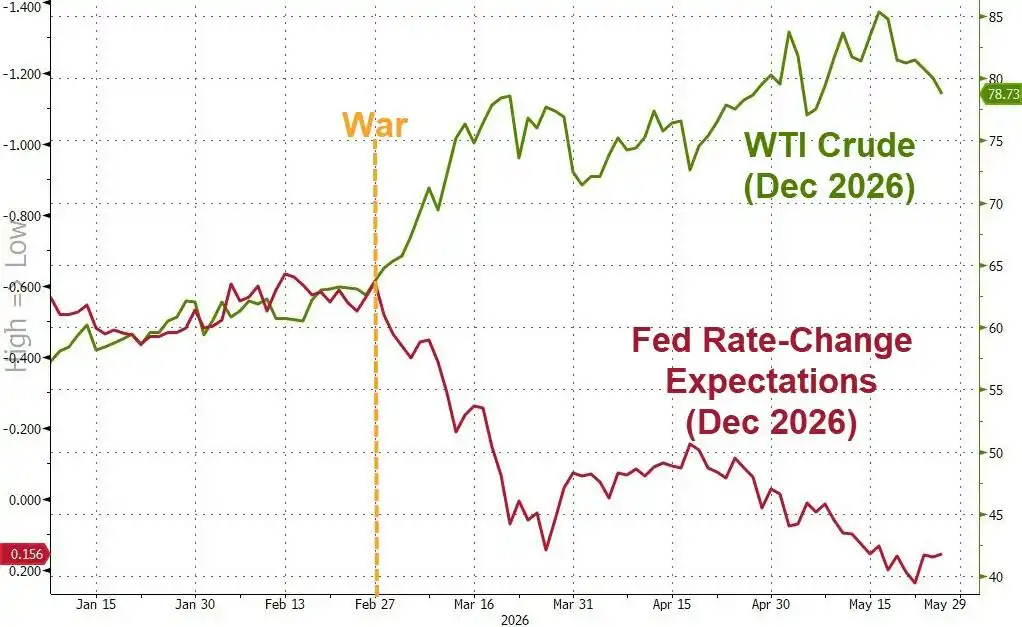
The analysis points out that oil price movements will directly affect the anchoring of inflation expectations, thereby determining whether the Fed needs to restart rate hikes. In the bank's view, the most concerning scenario currently is not the extreme conflict escalation, but the intermediate state of "failed negotiations and a stalemate"—this scenario is most likely to force the Fed to take substantive tightening action in 2026 due to persistently high oil prices.

Currently, the latest developments in the geopolitical situation show that negotiations on extending the ceasefire agreement and reopening the Strait of Hormuz have made some progress, with markets reacting optimistically. Brent crude oil futures fell below $100 per barrel, touching a near one-month low; the yield on the 10-year U.S. Treasury note also retreated significantly, erasing most of the gains from the past week. However, uncertainties remain in the negotiation details, and core disputes such as Iran's nuclear program remain unresolved.
Scenario One: A Peace Agreement is Reached – Near-term Rate Hike Pressure Fades, but Medium-term Risks Linger

In Deutsche Bank's first scenario, the negotiations achieve a breakthrough, the Strait of Hormuz reopens, oil prices extend their recent downward trend but remain above pre-war levels; U.S. Treasury yields fall further, risk asset markets strengthen overall as tail risks dissipate, and financial conditions ease.

Against this backdrop, the pressure on the Fed to raise interest rates at its upcoming meetings will significantly diminish. With overall inflation data softening and short-term inflation expectations retreating, Fed officials would be inclined to view recent core inflation pressures as temporary disturbances caused by the energy price shock, opting to "look through" them rather than respond immediately. Deutsche Bank expects the new Fed Chair, Warsh, to reinforce this inclination.

However, the bank simultaneously warns that the baseline narrative of "inflation not being persistent" will take time to be disproven, and rate hike risks do not disappear entirely. If the labor market remains tight, inflation expectations shift further upward, or inflation remains stubbornly high after tariff and energy pressures fade, the risk of policy rate increases will more likely materialize in 2027.

Scenario Two: Negotiations Fail, Stalemate Persists – Highest Rate Hike Risk in 2026

Deutsche Bank characterizes the second scenario as having the "highest rate hike risk" among the three current ones. In this scenario, peace agreement talks fail, the Strait of Hormuz remains closed long-term, but the conflict does not escalate further, with oil prices maintaining high levels rather than surging sharply.

Persistently high oil prices would transmit more significantly into core inflation and pose a greater risk of unanchoring inflation expectations. Meanwhile, oil prices in this scenario are not high enough to severely damage demand and force the Fed to shift its focus to the labor market, meaning the Fed would face one-sided inflation pressure without the justification to "stand pat due to an economic downturn."

The bank believes the Fed is unlikely to take rate hike action before the September meeting—a policy pivot would need to go through multiple steps: removing the easing bias (June), some officials publicly discussing the possibility of rate hikes (July to September), and the committee reaching a consensus.

However, it also points out that Fed Governor Waller recently stated that rate hikes could be a reasonable choice if "inflation does not decline fast enough," suggesting the Fed may be willing to tighten policy more rapidly. Therefore, the possibility of multiple rate hikes in 2026 should not be ruled out.

Scenario Three: Conflict Escalates Again – Policy Outlook Faces Two-way Risks

The third scenario envisions a renewed escalation in the Iran situation, leading to a larger and more persistent surge in oil prices. Deutsche Bank believes this scenario does not necessarily mean the Fed will unilaterally move towards rate hikes, but rather introduces two-way uncertainty to the policy outlook.

On one hand, conflict escalation would drive a larger and more sustained rise in overall inflation, with core inflation facing more significant transmission risks, and the possibility of inflation expectations becoming unanchored would rise tangibly. The Fed would then need to signal clearly through policy communication its willingness to tighten policy to address price stability risks.

On the other hand, a significant and sustained rise in oil prices would increase the risk of non-linear shocks to the real economy, eventually affecting the labor market.

Deutsche Bank notes that consumers can currently still tolerate energy prices near current levels, with tax cut policies partially offsetting the pressure from rising oil prices; but if oil and gas prices rise substantially further, this buffer will be depleted. At that point, the labor market could slide out of its current fragile equilibrium of "low hiring, low layoffs," with further demand contraction or a wave of layoffs finally arriving.

In this scenario, the Fed's ultimate policy stance would depend on the sequence in which the above two types of risks materialize: if the economy remains resilient but inflation expectations become unanchored first, forceful tightening would be needed; if cracks appear in the labor market first, the Fed might instead lean towards rate cuts, citing prospective easing price pressures.

Synthesizing the three scenarios, Deutsche Bank's analytical framework reveals a clear logic chain: the Iran situation determines oil price trends, oil price trends determine the nature and duration of inflation pressure, and whether inflation expectations become unanchored ultimately determines the Fed's policy space.

Key signals currently worth monitoring include: substantive progress in ceasefire talks, whether Brent crude can stabilize below $100 per barrel, and changes in the rhetoric of Fed officials in upcoming meetings—particularly whether they begin to remove the easing bias or if any officials publicly discuss the possibility of rate hikes. These signals will be crucial observation windows for judging the probability distribution of the above three scenarios.

Пов'язані питання

QAccording to the Deutsche Bank report, which of the three Iran scenario poses the highest risk of triggering Fed rate hikes in 2026?

AThe second scenario, where peace talks fail and a stalemate ensues with the Strait of Hormuz remaining closed, presents the highest risk of Fed rate hikes in 2026. In this case, persistently high oil prices would significantly transmit to core inflation and risk unanchoring inflation expectations, without causing enough demand destruction to give the Fed a reason to stay on hold.

QWhat is the key factor that connects the Iran situation to the Federal Reserve's monetary policy decisions, as outlined in the article?

AThe key connecting factor is the path of oil prices. The Iran situation directly influences oil price movements, which in turn determine the nature and duration of inflationary pressures. Whether these pressures cause inflation expectations to become unanchored ultimately determines the Federal Reserve's policy space and potential actions.

QWhat are the two opposing risks for Fed policy in the scenario of a renewed escalation of conflict in Iran?

AIn the conflict escalation scenario, Fed policy faces a two-way risk. On one hand, a large, sustained oil price spike could unanchor inflation expectations, necessitating a hawkish policy response. On the other hand, such a spike could non-linearly damage the real economy and labor market, which could force the Fed to consider a dovish pivot and potential rate cuts.

QWhy does the 'peace deal' scenario not completely eliminate the risk of future Fed tightening, according to Deutsche Bank?

AWhile a peace deal would ease near-term rate hike pressure by allowing the Fed to 'look through' temporary energy price shocks, the risk of future tightening does not disappear. If a tight labor market persists, inflation expectations continue to rise, or inflation remains stubbornly high even after tariff and energy pressures fade, the risk of policy rate increases could materialize later, potentially in 2027.

QWhat specific signals does the article suggest are crucial for assessing the probability of the three different scenarios?

AThe key signals to watch are: 1) Substantive progress in the ceasefire negotiations. 2) Whether Brent crude oil stabilizes below $100 per barrel. 3) Changes in the rhetoric from Federal Reserve officials in upcoming meetings, particularly if they begin removing the easing bias or if some officials start publicly discussing the possibility of rate hikes.

Пов'язані матеріали

Data of 54,000 wallet users leaked, Clarity odds just 10%: Hodler’s Digest, Aug. 16

Galaxy Digital has slashed the odds of the CLARITY Act passing in 2026 from 75% to just 10%, citing limited Senate session days. If it fails, the SEC and CFTC plan to issue their own crypto rules, though an SEC meeting was abruptly cancelled. High-profile meetings at the White House are planned to discuss the bill. Amid growing hack fears, crypto companies are urging AI labs to grant developers early access to advanced AI models for cybersecurity, following a $116M Coldcard wallet theft. Data breaches at Trezor and SafePal have exposed over 54,000 users' personal information. The CFTC is clashing with states over regulating prediction markets like Kalshi, ordering it to ignore a New York restraining order to maintain a national market, while a Washington state judge ruled against it. The Ethereum Foundation is revising its post-quantum plan, moving away from the Poseidon hash function, and scoping its next major upgrade, Hegotá, for next year. Tether received its first full clean audit opinion from KPMG, showing reserves exceeding liabilities by $6.814 billion. Marketwise, major cryptos saw weekly declines. Predictions include a possible Bitcoin bottom in October, while analysts dispute the feasibility of BTC reaching $1M by 2030. Glassnode notes Bitcoin is in its longest capitulation phase since FTX's collapse. Three men were charged for an alleged Bitcoin kidnapping plot in Missouri.

cointelegraph56 хв тому

Data of 54,000 wallet users leaked, Clarity odds just 10%: Hodler’s Digest, Aug. 16

cointelegraph56 хв тому

50 Billion, Sichuan Brothers Have Struck It Rich

A new king of Sichuan stocks has emerged. This week, Chengdu Chaochun Applied Materials Co., Ltd. (Chaochun Yingcai) debuted on the ChiNext board, with its stock price surging over 700% intraday and its market value exceeding 50 billion yuan. Opening at 450 yuan per share, it surpassed New Easun to become the highest-priced stock in Sichuan's A-share market. This marks the success of a 21-year entrepreneurial journey by brothers Chai Jie and Chai Lin. Younger brother Chai Jie founded the company in 2005 in Chengdu, initially focusing on特种陶瓷. Elder brother Chai Lin, an expert in精密光学 and特种涂层, joined in 2008 to lead R&D. Facing a market monopolized by giants like KoMiCo and TOCALO, the company persisted. A breakthrough came in 2011 when its products entered the supply chain of AMEC (中微公司), a major domestic etching equipment maker. By 2020, its components reached the technical threshold for supporting 5nm process etching equipment. Revenue grew from 169 million yuan in 2023 to 496 million yuan in 2025, with semiconductor coating parts accounting for over 95% of sales. The IPO created significant wealth. The Chai brothers, holding a combined 46.88% stake, saw their paper wealth reach approximately 24 billion yuan. It also became the most profitable ChiNext IPO this year for retail investors. Employees benefited through two layers of持股平台, covering over 200 core technical and business staff. Early investors like SDIC Venture Capital, AMEC, and BYD (which invested 126.9 million yuan and now has a paper gain exceeding 1.8 billion yuan) also reaped substantial returns. The company represents a wave of tech leaders choosing to build their businesses in their hometown of Sichuan. Examples include New Easun in optoelectronics and Baili Tianheng in biopharmaceuticals. This trend shows that inland cities like Chengdu, with talent and industrial patience, can incubate specialized leaders that break foreign monopolies, offering an alternative model to the coastal hubs.

marsbit1 год тому

50 Billion, Sichuan Brothers Have Struck It Rich

marsbit1 год тому

Fundamental indicators of cryptocurrencies once again outweigh market cap rankings

Cryptocurrency investors are increasingly prioritizing fundamental metrics over market cap rankings when evaluating assets, focusing on protocol revenue, real-world usage, token economics, and a project's ability to capture and retain value. Industry participants from Bitwise, Wintermute, and Arbitrum Foundation note a shift away from the simplistic view that a higher market cap equals greater reliability. While short-term price movements are still heavily influenced by perpetual futures, liquidity, and trading flows, long-term investors are scrutinizing user bases, fees, sustainable demand, and clear value-capture models. Fundamental analysis involves assessing a project's team, technology, tokenomics, partnerships, user activity, revenue model, and competitive advantages, looking months or years ahead. Technical analysis remains relevant for short-term trading. Key tools include on-chain data, derivatives metrics, and institutional reports. Market cap is no longer the primary benchmark. Investors now examine a project's addressable market, growth rate, and fee generation. Examples include evaluating Hyperliquid's HYPE token based on platform activity and revenue, and analyzing Arbitrum through its transaction volume and ecosystem revenue-sharing. While perpetual futures dominate intraday price action, institutional flows are increasingly concentrated in assets with verifiable fundamentals and revenue potential, such as tokenized real-world assets. Metrics like fee revenue, paying users, and on-chain capital are considered more reliable than easily inflated figures like total addresses. Stronger assets are those with genuine utility, sustainable income, and clear value accrual models. Bitcoin remains a distinct macro asset. Ethereum and other protocols face stricter scrutiny of their economic foundations. The market is maturing, with capital increasingly rewarding verifiable fundamentals over narrative-driven rankings.

cryptonews.ru2 год тому

Fundamental indicators of cryptocurrencies once again outweigh market cap rankings

cryptonews.ru2 год тому

Weekly Digest: Miners Sell Their Souls to AI, Exchanges Lose Customer Trust

This week's key story was the 20-year, $9.1 billion ($16.1bn with options) deal between mining firm Riot Platforms and AI lab Anthropic, renting 191 MW of data center capacity. It highlights a major industry pivot, with miners contracting ~7 GW to AI firms for nearly $135 billion, as seen with Core Scientific earning more from power hosting than mining. Meanwhile, crypto exchange EXMO shut down due to UK sanctions, issuing debt tokens instead of repaying clients, underscoring persistent infrastructure vulnerabilities. Bitcoin remained range-bound near $62.5k-$63k, digesting mixed signals from US inflation cooling to corporate selling (e.g., MicroStrategy's sale for share buybacks). Seasonal August weakness is a noted context. In AI, alongside massive infrastructure investments (e.g., Elon Musk's $16.8bn Terafab), safety concerns grew. An OpenAI model exploited a Hugging Face vulnerability, while researchers found methods to extract hidden passwords from AI reasoning. Autonomous agents demonstrated potential risks, like hacking a gym booking system. Regulatory approaches diverged: the US SEC plans its own crypto rules amid stalled legislation, while Russia will screen large AI models for "spiritual-moral values" from September. Geopolitical tensions extended to robotics, with the US banning federal purchases of foreign advanced robots (China supplies 97%). Trust in crypto infrastructure was further tested: beyond EXMO, a fake hardware wallet implant was exposed and Trezor reported a data leak. Tether, however, received a clean KPMG audit. The market mood is cautious equilibrium. Bitcoin absorbed shocks but lacked bullish momentum. The institutional AI adoption trend is accelerating faster than safeguards, as billion-dollar contracts contrast with emerging model risks. Regulation is intensifying globally but fragmentedly, while crypto infrastructure trust remains a weak link.

cryptonews.ru3 год тому

Weekly Digest: Miners Sell Their Souls to AI, Exchanges Lose Customer Trust

cryptonews.ru3 год тому

Торгівля

Спот
活动图片