Investors Pull $414M From Crypto Funds As Inflation, MidEast War Jitters Mount

bitcoinistОпубліковано о 2026-03-31Востаннє оновлено о 2026-03-31

Анотація

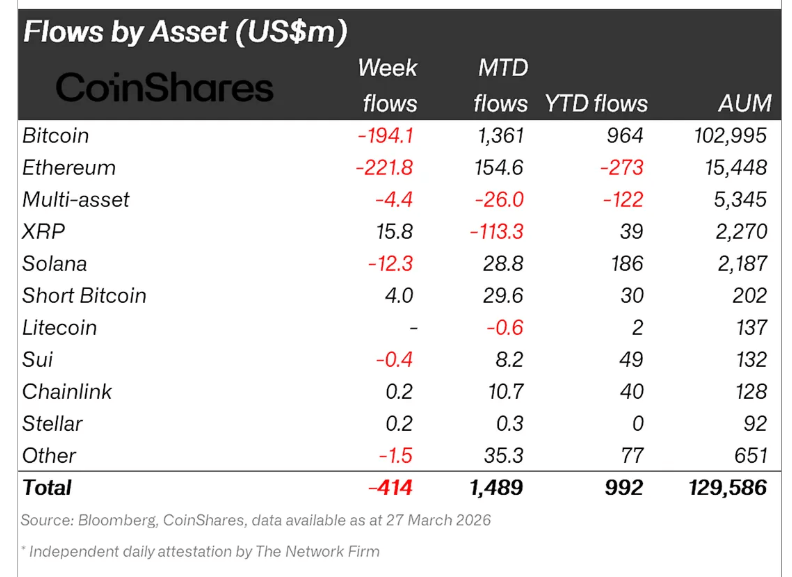
Investors withdrew $414 million from crypto funds last week, ending a five-week inflow streak. Spot Bitcoin ETFs saw $296 million in outflows, reversing earlier gains. Ether suffered the largest outflows at $222 million, pushing its year-to-date performance negative. Bitcoin remained positive for the year despite $194 million in outflows. XRP was an exception, attracting $16 million. The sell-off was driven by inflation concerns, shifting expectations for U.S. interest rate hikes, and rising Middle East tensions, causing a broad shift away from riskier assets. Total assets under management fell to near $130 billion, levels last seen in early February.

Spot Bitcoin ETFs snapped a four-week run of gains last week, posting $296 million in net outflows after pulling in more than $2.2 billion earlier in the month. The crypto reversal was swift — and it wasn’t limited to Bitcoin.

Ether Takes The Hardest Hit

Ether led all assets in outflows, shedding $222 million in a single week. That brought its year-to-date total into the red, with a net loss of $273 million — the worst performance among tracked assets.

Spot Ether ETFs also recorded $206 million in outflows for a second straight week, a sign that institutional demand for the second-largest cryptocurrency has been cooling steadily.

Bitcoin fared better in the long run. Despite $194 million leaving Bitcoin funds last week, the asset remains up $964 million in net inflows for the year.

A small group of investors even moved in the opposite direction — short-Bitcoin products drew $4 million in fresh capital, suggesting some are betting on more losses ahead.

Across the board, total assets under management in digital asset products dropped to close to $130 billion.
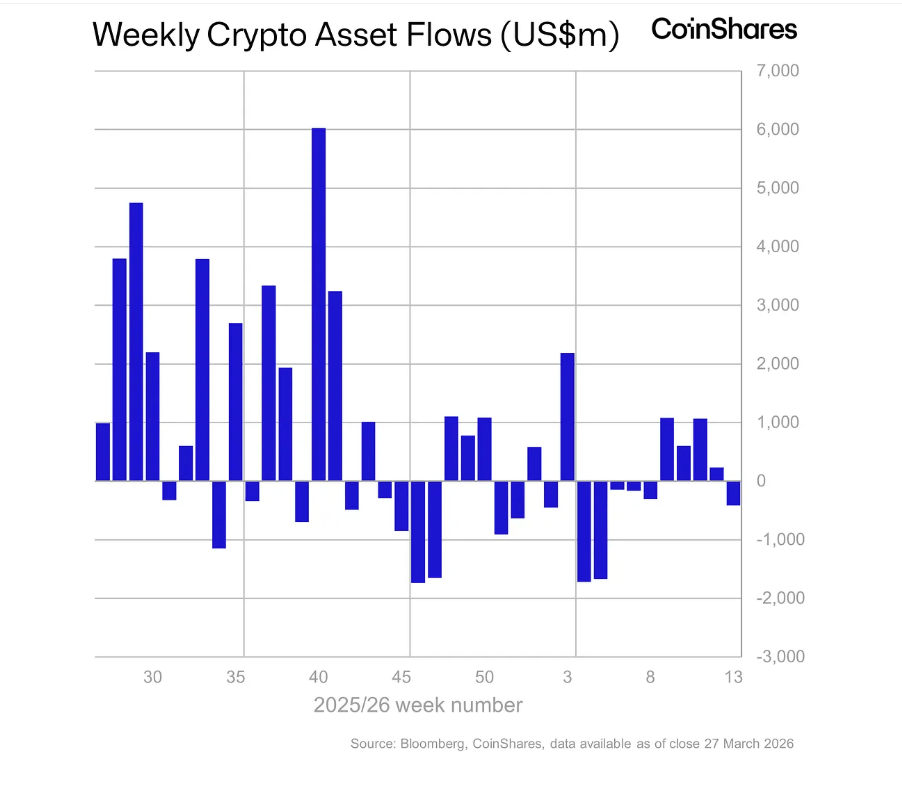
According to CoinShares head of research James Butterfill, that figure puts the market back at levels not seen since early February — broadly in line with where things stood in April 2025 during the first wave of US President Donald Trump’s tariffs.

Solana lost a little over $12 million over the same period. XRP was the exception. Reports from CoinShares show the token attracted close to $16 million in new capital, standing apart from the widespread exodus hitting nearly every other major asset.
What Spooked Investors

Three things rattled markets last week: inflation fears, shifting expectations around US interest rates, and rising tensions in the Middle East.

The most consequential of the three may be the rate outlook. Expectations heading into the June Federal Open Market Committee meeting moved away from potential cuts and toward possible hikes — a major shift that historically pushes investors away from riskier assets.

BTCUSD now trading at $67,744. Chart: TradingView

Digital assets tend to feel that pressure quickly. When borrowing costs look like they’re going up, money moves toward safer ground.

A Five-Week Streak Comes To An End

The $414 million in total outflows snapped what had been five consecutive weeks of inflows. Data from CoinShares shows the pullback reflected a broader shift toward risk-off behavior among investors, driven more by macroeconomic forces than anything specific to crypto markets.

Whether last week marks a turning point or a brief pause will likely depend on what signals come out of the Fed in the weeks ahead. For now, the money has moved — at least temporarily — to the sidelines.

Featured image from Getty Images, chart from TradingView

Трендові криптовалюти

Пов'язані питання

QWhat was the total amount of net outflows from crypto funds last week, ending a five-week streak?

AThe total net outflows from crypto funds last week were $414 million, which ended a five-week streak of inflows.

QWhich cryptocurrency asset suffered the largest outflows and what was the amount?

AEther (ETH) suffered the largest outflows, shedding $222 million in a single week.

QAccording to the article, what were the three main factors that spooked investors and rattled the markets?

AThe three main factors were inflation fears, shifting expectations around US interest rates, and rising tensions in the Middle East.

QWhat was the notable exception to the widespread outflows, and how much capital did it attract?

AXRP was the notable exception; it attracted close to $16 million in new capital.

QWhat does the shift in expectations for the June Federal Open Market Committee meeting indicate, and how does it typically affect investor behavior?

AExpectations shifted away from potential interest rate cuts and toward possible hikes. This shift historically pushes investors away from riskier assets, as higher borrowing costs make safer investments more attractive.

Пов'язані матеріали

Michael Saylor: Bitcoin Halved, My Digital Credit is Making Money

Michael Saylor discusses Bitcoin, digital credit, and corporate treasury strategies in a recent roundtable. He explains that while Bitcoin remains "digital capital" with no counterparty risk, its ~40% annual volatility makes it unsuitable for most institutional and retail capital. To attract this capital, he advocates for Bitcoin-backed "digital credit" and "digital currency" products. These offer low volatility against fiat currencies, generate yield, and compete with traditional money market funds, stablecoins, and other yield-bearing crypto assets. Saylor clarifies that these products are not meant to replace direct Bitcoin ownership but to onboard capital that otherwise wouldn't enter the Bitcoin ecosystem. He provides examples: during a period when Bitcoin fell 50%, his company's digital credit products (STRC, SATA) delivered positive returns of 3-4%, demonstrating their ability to strip out ~90% of Bitcoin's volatility. He frames "digital currency" as a fiat-referenced, yield-bearing, stable-value asset backed by Bitcoin, designed to meet the needs of the global capital pool. This approach, he argues, can expand the Bitcoin network's reach by 10x to 100x more effectively than pure education. The discussion also covers corporate finance for Bitcoin treasury companies. Saylor argues that equity issuance is not inherently dilutive if done above net asset value per share and if the acquired asset (Bitcoin or cash) supports future value creation. He distinguishes between debt with maturity dates and hybrid capital like preferred shares (e.g., STRC), which offer issuer options and do not force liquidation. Evaluating these companies requires modeling based on future Bitcoin price and volatility assumptions, not relying on a single metric like mNAV (market-adjusted net asset value). The business models are still evolving, and investors must analyze full disclosures to form a complete view.

marsbit1 год тому

Michael Saylor: Bitcoin Halved, My Digital Credit is Making Money

marsbit1 год тому

Getting Ahead of the Tide and Drowning First: The Fall of 'Crypto x AI' Pioneer ai16z

"ai16z, an early pioneer of the 'crypto x AI' narrative, has officially shut down. In late 2024, its token launch sparked a massive speculative frenzy around AI Agent tokens, briefly propelling the project to a $2.6 billion valuation. However, by 2026, as functional AI agents from companies like Anthropic and OpenAI became mainstream reality, the crypto-native AI projects built largely on hype began to collapse. The founder of its underlying project, Eliza OS, announced the termination in a bitter post, citing legal threats from token holders and a depleted foundation. He expressed disillusionment with the crypto community, contrasting it with the 'optimistic' builders in pure AI. While the Eliza framework itself remains active as open-source software—ironically with contributions from AI like Claude—the token-dependent venture failed. The story highlights a core flaw: the crypto market often prices narratives far ahead of functional technology. When the promised AI future arrived, it was delivered by traditional tech companies with sustainable business models, not token projects. The episode suggests the initial path of 'tokenizing AI concepts' is broken. However, integration may still occur in reverse—with AI tools enhancing crypto analytics and trading—or in coordinating real resources like decentralized compute, as seen in projects like Bittensor and Render."

marsbit2 год тому

Getting Ahead of the Tide and Drowning First: The Fall of 'Crypto x AI' Pioneer ai16z

marsbit2 год тому

Changxin Rejects Apple's Price Pressure, Prices Not Lower Than Samsung and SK Hynix, Apple Loses Pricing Power

Apple recently attempted to negotiate lower-priced DRAM procurement deals with China's CXMT (ChangXin Memory Technologies) compared to its agreements with Samsung and SK Hynix but was rejected. CXMT stated its prices would not be lower, and could even be higher, than those of the South Korean suppliers. This refusal is attributed to CXMT's production capacity being largely secured by long-term contracts with major domestic clients like Huawei, Xiaomi, OPPO, Vivo, and Chinese internet giants. Consequently, CXMT feels no pressure to meet Apple's stringent terms. The backdrop is a significant surge in memory prices driven by the AI boom. As Samsung and SK Hynix shift more production capacity towards high-margin High Bandwidth Memory (HBM) for AI servers, the supply of conventional DRAM has tightened, causing prices to skyrocket. This has drastically increased the bill-of-materials cost for devices like iPhones, pressuring Apple's profits. Apple's traditional strategy of leveraging multiple suppliers for price competition has weakened, as memory makers prioritize more profitable AI-related orders. CXMT's confidence stems from achieving technological parity. Its DDR5 and LPDDR5X products have reached mass-production yields above 90%, closely matching Samsung's performance. With technical gaps closed, CXMT no longer competes solely on low prices. Furthermore, Chinese companies are wary of the risks associated with over-reliance on Apple's supply chain, citing cases like OFILM and Wingtech, which suffered severe losses after being removed from or impacted by US sanctions. This event signals a shift in the semiconductor industry's power dynamics. The AI-driven demand has transformed the market from buyer-centric to supplier-centric, where control over scarce, advanced production capacity grants pricing power. For Chinese semiconductor firms, the episode marks a transition from being low-cost alternatives to becoming equal suppliers with their own pricing authority, backed by domestic demand and technological advancement. Apple's loss of leverage with a mainland supplier underscores this changing era.

marsbit2 год тому

Changxin Rejects Apple's Price Pressure, Prices Not Lower Than Samsung and SK Hynix, Apple Loses Pricing Power

marsbit2 год тому

Торгівля

Спот

Популярні статті

Як купити WAR

Ласкаво просимо до HTX.com! Ми зробили покупку WAR (WAR) простою та зручною. Дотримуйтесь нашої покрокової інструкції, щоб розпочати свою криптовалютну подорож.Крок 1: Створіть обліковий запис на HTXВикористовуйте свою електронну пошту або номер телефону, щоб зареєструвати обліковий запис на HTX безплатно. Пройдіть безпроблемну реєстрацію й отримайте доступ до всіх функцій.ЗареєструватисьКрок 2: Перейдіть до розділу Купити крипту і виберіть спосіб оплатиКредитна/дебетова картка: використовуйте вашу картку Visa або Mastercard, щоб миттєво купити WAR (WAR).Баланс: використовуйте кошти з балансу вашого рахунку HTX для безперешкодної торгівлі.Треті особи: ми додали популярні способи оплати, такі як Google Pay та Apple Pay, щоб підвищити зручність.P2P: Торгуйте безпосередньо з іншими користувачами на HTX.Позабіржова торгівля (OTC): ми пропонуємо індивідуальні послуги та конкурентні обмінні курси для трейдерів.Крок 3: Зберігайте свої WAR (WAR)Після придбання WAR (WAR) збережіть його у своєму обліковому записі на HTX. Крім того, ви можете відправити його в інше місце за допомогою блокчейн-переказу або використовувати його для торгівлі іншими криптовалютами.Крок 4: Торгівля WAR (WAR)Легко торгуйте WAR (WAR) на спотовому ринку HTX. Просто увійдіть до свого облікового запису, виберіть торгову пару, укладайте угоди та спостерігайте за ними в режимі реального часу. Ми пропонуємо зручний досвід як для початківців, так і для досвідчених трейдерів.

314 переглядів усьогоОпубліковано 2024.12.11Оновлено 2026.06.02

Як купити WAR

Обговорення

Ласкаво просимо до спільноти HTX. Тут ви можете бути в курсі останніх подій розвитку платформи та отримати доступ до професійної ринкової інформації. Нижче представлені думки користувачів щодо ціни WAR (WAR).

活动图片