
Investors Are Now Hunting for AI Projects on Bilibili and Xiaohongshu

marsbitОпубліковано о 2026-06-12Востаннє оновлено о 2026-06-12

Анотація

Investors Turn to Bilibili and Xiaohongshu to Source AI Projects The AI hardware boom is in full swing in 2025, with a surge in smart wearables like AI glasses, rings, toys, and companion robots. This frenzy has investors scrambling, not just sifting through business plans, but actively hunting for promising "under-the-radar" projects on youth and tech-enthusiast content platforms like Bilibili and Xiaohongshu. The logic is straightforward: for consumer-facing AI hardware, genuine user demand and potential pitfalls are often revealed earlier in public discussions, comments, and critiques on these communities than in formal pitches. As one industry insider notes, these products must ultimately be tested and understood by real people. This shift highlights a crucial challenge in the sector: user education. The success of AI hardware depends on moving beyond mere efficiency gains to fulfilling higher-order needs like "unleashing personal creativity." Products must convince users they are natural, unobtrusive additions to daily life. Early hype, as seen with devices like the Rabbit R1, often fades if the product fails to clearly solve real-world problems, leading to high return rates and market rejection. The market is now entering a shakeout phase. 2026 is seen as a year of commercial validation. Some projects have already stalled or been canceled due to market resistance, lack of differentiation, or financial woes. However, the long-term opportunity remains vast, with forec...

Author: Investment Community

"In the AI era, all hardware is worth remaking from scratch."

This statement might have sounded somewhat radical in 2024, but in 2025, its credibility has surged significantly—as we are witnessing, the wave of AI hardware entrepreneurship is rising, with financings following one after another. Across the ocean, the smart ring Oura Health has seen its latest valuation soar to a staggering 70 billion yuan.

This frenzy is sweeping up FOMO-stricken investors. This time, aside from sifting through thousands of pitch deck emails, they have strikingly turned their deal-sourcing gaze towards content communities densely populated by tech geeks and young people.

The underlying logic is rather simple: compared to spec sheets and roadshows, the real demand for a consumer-grade AI smart hardware product is often first exposed by whether it can be understood, discussed, and questioned in the public sphere.

Ultimately, all tech products aimed at the masses must go through the test of the crowd.

AI Hardware Explosion, Investors Scramble for Under-the-Radar Projects

We are experiencing a banner year for AI hardware.

Since 2025, extending from the wearable device track, more segmented smart hardware products such as AI glasses, AI toys, AI recording cards, AI rings, AI earphones, companion robots, and Agent Boxes have collectively seen an explosion.

Amid the fervor, certain details reveal the excitement in the investment circle: in the latter half of 2025, we frequently saw several top-tier institutions posting job openings to recruit AI/smart hardware investors, with the job descriptions almost invariably requiring the candidates to be based in Shenzhen, the hardware capital.

Good projects almost require 'repeated visits' and intense competition, especially those still under the radar with valuations not yet sky-high. Investors have even started approaching potential founders who haven't yet left their jobs. For instance, cafes near DJI are packed with VCs and FAs trying to 'persuade people to start a business.'
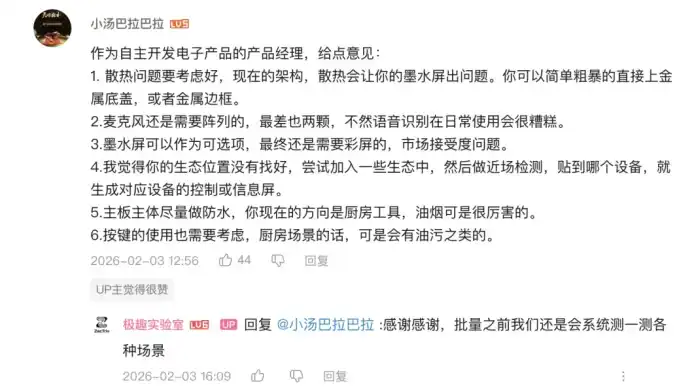
(Comment section of an AI sticky note product pre-sale video)

"After this content was posted, many technical discussion threads appeared in the bullet comments and comment section, and more users began sharing their similar needs: some mentioned frequently attending cross-border exhibitions, others talked about communication barriers when collaborating remotely with overseas teams, and some shared experiences where translation tools were inconvenient when accompanying foreign relatives for medical treatment or handling foreign affairs."

"These feedbacks not only helped us expand the direction for creator content but also directly influenced our thinking about the product line," Wu Zhen said.
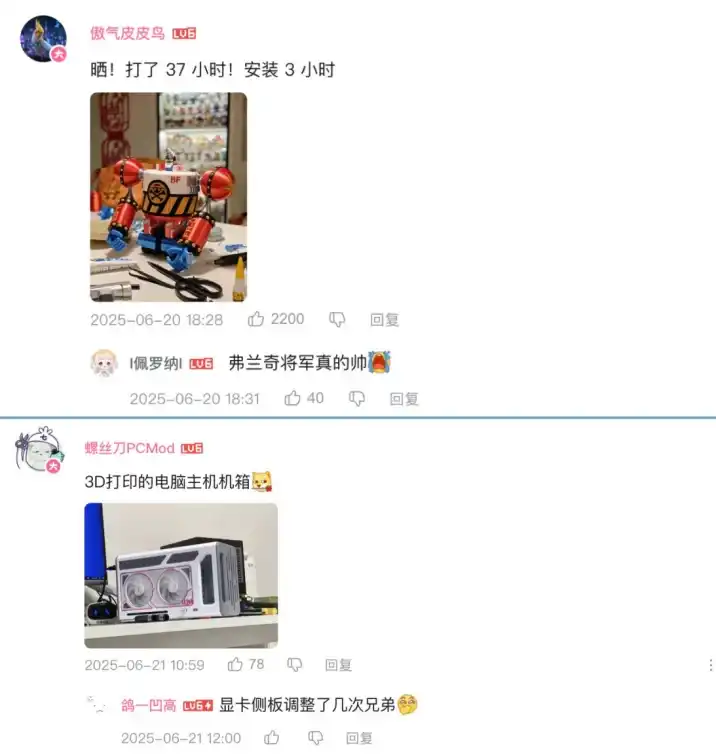
(Comment section of UP主影视飓风's video)

Enthusiasts Gather

Remember January 2024, at CES.

A little orange square box called Rabbit R1, touted as 'the world's first AI hardware device,' stirred a frenzy in the tech world. The market hailed it as the iPhone of the AI era, selling 100,000 units upon launch.

But what followed was not success. On the contrary, skepticism soon arose with comments like 'actually using it is not as good as a phone.' At the time, the high-flying Rabbit R1 failed to adequately explain to users: what exactly can Rabbit R1 do now and in the future? What real user problems does this innovation actually solve?

Even today, user education remains the most critical challenge for AI smart hardware—when AI enters consumer electronics, the product consumption logic is no longer limited to 'improving life efficiency' but also includes higher-dimensional needs like 'unleashing personal creativity' and 'liberating the mind.' In this context, whoever can make users understand, discuss, and pay in real-life scenarios truly crosses the threshold from a tech product to a consumer good.

But this is not easy. Regarding user education for AI glasses, INMO's CMO Wu Zhen told us frankly: This is not simply about conveying product information; it also requires overcoming a psychological barrier. Users must first complete a 'virtual try-on' in their minds, confirming that integrating this device into daily life feels natural and not awkward, before they can proceed to the next step.

In Wu Zhen's view, the process of psychologically preparing users for AI smart hardware might be longer than for most consumer electronics categories. "The day users naturally put on AI glasses to go out without reminding themselves 'I need to use AI glasses today,' this behavioral change might be more convincing than many data points."

Shakeout Begins, Battle for Attention Heats Up

While the frenzy peaks, a shakeout is underway.

There is now market consensus that 2026 will be the year of commercial validation for AI hardware. This also means that trend-chasers and狂热资本 will face rationality and冷静.

A winnowing process is unfolding: At the end of 2025, the AI wearable device Friend AI Necklace stalled after encountering severe market resistance; after its peak appearance in 2024, Rabbit R1, unable to keep up with product expectations amid negative feedback, saw abnormally high return rates, severely damaging its reputation, and ultimately陷入欠薪与现金流枯竭的困境 (fell into困境 of salary arrears and cash flow depletion).

Meanwhile, savvy players are also开始审慎调整和优化决策 (beginning to prudently adjust and optimize decisions). In February 2026, market rumors emerged that the Doubao AI glasses project was suspended; at least within the visible cycle, this product line is no longer considered a direction to pursue. Earlier, in January, smartphone manufacturer vivo halted its AI glasses project, citing the difficulty of achieving differentiation at present.

Such developments are a reflection of industry differentiation.

Nevertheless, it is undeniable that in this trillion-dollar-value赛道 (track), entrepreneurs still possess enormous确定性机会 (deterministic opportunities). According to AICC predictions, by 2030, the global AI-related hardware market will easily surpass several trillion dollars. In China, the industry expects the market size for consumer-grade AI hardware (excluding phones and cars) to突破 (break through) 1.27 trillion yuan in 2026 and reach 2.56 trillion yuan by 2030.

Currently, opportunities for exit and entry coexist. OpenAI just announced it will launch its first AI hardware device in the second half of the year, and Meta plans to double the annual production capacity of its AI smart glasses to 20 million units by the end of 2026. The latest scene domestically: a batch of AI smart terminals from京东 (JD.com), including AI desk lamps, AI cooking machines, AI mattresses, and AI wheelchairs, are酝酿上新售卖 (being酝酿 for launch and sale).

People remain convinced that the battle for入口之争 (portals) behind AI smart hardware will not stop. The AI era is still an era of用户主权 (user sovereignty).

The热浪 (heat wave) will push everyone forward. But when attention, product power, and user perception begin to compete on the same table, the final battle is just beginning.


Трендові криптовалюти

Пов'язані питання

QWhat new strategy are venture capitalists adopting to find promising AI hardware projects?

AVenture capitalists are increasingly looking for promising AI hardware projects on youth-focused content communities like Bilibili and Xiaohongshu. They analyze user discussions, comments, and product reviews to gauge genuine market demand and real-world product understanding before these ventures become widely known or receive high valuations.

QWhy is user education considered crucial for AI consumer hardware adoption?

AUser education is crucial because the value proposition of AI hardware often involves higher-level needs like 'unleashing personal creativity' or 'liberating the brain,' not just efficiency. Consumers need to understand and visualize how these devices fit into their daily lives without being intrusive. This mental acceptance and natural integration into routines are considered more important than just product specifications for driving adoption.

QWhat are some examples of AI consumer hardware that faced significant market challenges?

AExamples of AI consumer hardware that faced significant market challenges include the Rabbit R1, which suffered from high return rates and negative feedback regarding its practical utility, leading to cash flow problems. The Friend AI Necklace also encountered severe market resistance and stalled development.

QWhat is the predicted market size for consumer AI hardware in China by 2030?

AIndustry predictions estimate that the market size for consumer AI hardware (excluding smartphones and cars) in China will reach 2.56 trillion yuan by 2030. It is projected to first exceed 1.27 trillion yuan by 2026.

QWhy are some companies adjusting their strategies in the AI hardware market in 2026?

ACompanies are adjusting their strategies because 2026 is widely seen as the 'commercial validation year' for AI hardware. The market is entering a phase of rationalization and consolidation. Projects that fail to demonstrate clear product differentiation, genuine user value, or sustainable business models are being paused or canceled, as seen with Doubao's AI glasses and vivo's AI glasses project, indicating an industry-wide shakeout.

Пов'язані матеріали

STAR 50 Soars 10.73%, Why Did A-Shares Stage a "V-Shaped Reversal"?

After a prolonged decline, the Chinese A-share market staged a strong rally on July 21. The STAR 50 index surged 10.73%, its largest single-day gain in nearly a year, leading a broad-based "V-shaped" reversal. The Shanghai Composite Index rose 1.79%, the Shenzhen Component Index gained 4.81%, and the ChiNext Index jumped 7.05%. Total market turnover reached 2.97 trillion yuan, an increase of 256.1 billion yuan from the previous session, with over 3,100 stocks advancing. The semiconductor sector spearheaded the rebound, with related ETFs posting significant gains. Analysts attribute the surge to three converging factors. First, coordinated capital inflows from "national team" institutions, insurance funds, listed company buybacks, and fund house self-purchases have bolstered market liquidity and confidence. Second, supportive policy signals, including commitments from regulators to ensure stable market operations, provided a favorable backdrop. Third, a stabilization and recovery in overseas markets, notably South Korea, created a positive external environment. Institutions suggest the most severe panic selling phase for the tech sector has likely passed, following a significant digestion of crowded positions and leveraged funds. While short-term volatility may persist, the medium to long-term outlook remains underpinned by enduring trends like AI computing demand expansion and semiconductor localization. The market's focus now shifts to the sustainability of supportive fund flows, earnings reports, and upcoming catalysts from the global AI industry chain.

marsbit18 хв тому

STAR 50 Soars 10.73%, Why Did A-Shares Stage a "V-Shaped Reversal"?

marsbit18 хв тому

U.S. Tech Momentum Stocks Post Largest Single-Day Gain Ever, But Is the Plunge Over?

US tech momentum stocks staged a sharp rebound on Tuesday (July 21st). Morgan Stanley's TMT Momentum Factor surged over 12%, marking its largest single-day gain on record, exceeding even peaks from the 2000 dot-com bubble. Key momentum indices from Goldman Sachs also posted their strongest daily performances in years. The rally was led by semiconductors, with the Philadelphia Semiconductor Index jumping 4.6%. This rebound followed three consecutive down days and a cumulative 33% plunge in momentum stocks, one of the steepest drawdowns since the dot-com era. Analysts attribute the surge largely to a short squeeze. Heavy selling had pushed high-beta momentum stocks into deeply oversold territory, forcing many short sellers, particularly in Asia, to cover their positions, creating a self-reinforcing buying spiral. However, the rebound's internals appear weak. Trading volume was notably low, and advancing stocks still lagged decliners on the S&P 500, indicating a narrow, concentrated rally rather than broad market participation. Diverging views emerge on the outlook. BTIG warns the bounce has hit key resistance and recommends selling into strength, citing extreme volatility and historical parallels to past market tops. Conversely, Goldman Sachs and UBS believe the momentum unwind is nearing its end, suggesting it may be time to gradually add exposure, as positioning has been significantly reduced. They caution, however, that high volatility warrants a measured approach, potentially using defined-risk strategies. The upcoming earnings season, particularly reports from major tech firms like Alphabet, is seen as a critical test for the rally's sustainability. Simultaneously, bond markets flashed a warning, with yields rising partly due to spiking oil prices. Analysts note that if long-term Treasury yields break decisively higher, it could pose a significant headwind for equities, especially growth stocks.

marsbit26 хв тому

U.S. Tech Momentum Stocks Post Largest Single-Day Gain Ever, But Is the Plunge Over?

marsbit26 хв тому

U.S. Tech Momentum Stocks Record Largest Single-Day Gain Ever, but Has the Rout Ended?

U.S. tech momentum stocks staged a dramatic rebound on Tuesday, July 21st. Key momentum indices like the Morgan Stanley TMT Momentum Factor and Goldman Sachs' High Beta Momentum Long Index posted historic or near-historic single-day gains, fueled largely by semiconductor stocks. This sharp rally followed a severe three-day sell-off that saw momentum stocks plunge 33%, marking one of the steepest pullbacks since the dot-com bubble. Analysts attribute the bounce primarily to a short squeeze, as forced covering from over-leveraged traders, particularly in Asia, created a buying spiral. However, the rally's health is questioned due to weak market breadth—overall trading volume was low, and decliners outnumbered advancers in the S&P 500 despite the index's gain—suggesting a narrow, concentrated surge rather than broad recovery. Opinions on the sustainability diverge. BTIG strategists warn the rebound has hit key resistance levels, citing extreme volatility and historic stock dispersion as signs of an ongoing broader correction, and recommend selling into strength. Conversely, Goldman Sachs and UBS view the aggressive momentum unwinding as nearing its end, noting reduced positioning and a lack of new fundamental catalysts. They suggest the sell-off presents a selective opportunity to add exposure, albeit cautiously and gradually using defined-risk strategies. The immediate trajectory hinges on the ongoing earnings season, with market focus on Alphabet's capital expenditure guidance for AI investment clarity. Meanwhile, bond markets present a risk, with rising Treasury yields—potentially heading toward 5.5%—and widening credit spreads for mega-cap tech companies posing a threat to equity valuations. The combination of technical factors, earnings results, and macro conditions leaves the durability of the rebound in doubt.

链捕手28 хв тому

U.S. Tech Momentum Stocks Record Largest Single-Day Gain Ever, but Has the Rout Ended?

链捕手28 хв тому

Long-Divided Must Unite, Long-United Must Divide: When L1 Becomes Its Own Rollup, What Is Ethereum's Endgame?

"The Inevitable Cycle: When L1 Becomes Its Own Rollup – What is Ethereum's Endgame?" For years, the Ethereum community grappled with concerns that L2s were fragmenting the ecosystem and eroding L1's value. While L2s provided cheaper execution, they also splintered liquidity and the unified user experience of a single chain. This has prompted a fundamental reassessment of the relationship between L1 and L2. Ethereum's roadmap is evolving. The "Scale" initiative merges L1 and L2 expansion into a holistic framework. L1 itself is advancing with higher gas limits, statelessness, and zkEVM verification, no longer content to be just a low-throughput settlement layer. Consequently, the primary value proposition of L2s is shifting from merely providing cheap blockspace to offering L1 cannot easily provide: application-specific optimizations, privacy features, and flexible governance models. L2s are becoming a spectrum of execution environments with varying degrees of security inheritance from Ethereum. A critical challenge in this multi-chain future is interoperability. The vision is to make Ethereum "feel like one chain again." This relies on advancements in native account abstraction (like EIP-7702) and intent-based architectures (Open Intents Framework), where users declare desired outcomes, and solvers handle the complex cross-chain execution. Furthermore, shortening Ethereum's finality time from minutes to seconds is crucial, as it underpins trust between chains for bridges, stablecoins, and cross-chain applications. Perhaps the most provocative idea is that Ethereum L1 itself could become a form of "its own Rollup." As zkEVM and proof systems mature, high-performance nodes could execute transactions and generate validity proofs. Regular validators would then verify these proofs instead of re-executing all transactions. This blurs the traditional L1/L2 hierarchy, making "Rollup" more of a general execution-verification architecture. Native Rollup aims to integrate L2 validation more directly into the Ethereum protocol, allowing L2s to inherit L1's security more fully and move away from reliance on security councils. In the end, L2s are not destined to replace L1 or be made obsolete by it. The likely future is a unified system where diverse execution environments—each optimized for specific use cases like DeFi, gaming, or privacy—coexist. They will share a common foundation of security, liquidity, and verifiable state, seamlessly connected to restore a cohesive user experience. The next phase for Ethereum is not just about scaling through separation, but about intelligently reintegrating what was separated back into a coherent whole.

链捕手44 хв тому

Long-Divided Must Unite, Long-United Must Divide: When L1 Becomes Its Own Rollup, What Is Ethereum's Endgame?

链捕手44 хв тому

Торгівля

Спот

Популярні статті

Як купити ERA

Ласкаво просимо до HTX.com! Ми зробили покупку Caldera (ERA) простою та зручною. Дотримуйтесь нашої покрокової інструкції, щоб розпочати свою криптовалютну подорож.Крок 1: Створіть обліковий запис на HTXВикористовуйте свою електронну пошту або номер телефону, щоб зареєструвати обліковий запис на HTX безплатно. Пройдіть безпроблемну реєстрацію й отримайте доступ до всіх функцій.ЗареєструватисьКрок 2: Перейдіть до розділу Купити крипту і виберіть спосіб оплатиКредитна/дебетова картка: використовуйте вашу картку Visa або Mastercard, щоб миттєво купити Caldera (ERA).Баланс: використовуйте кошти з балансу вашого рахунку HTX для безперешкодної торгівлі.Треті особи: ми додали популярні способи оплати, такі як Google Pay та Apple Pay, щоб підвищити зручність.P2P: Торгуйте безпосередньо з іншими користувачами на HTX.Позабіржова торгівля (OTC): ми пропонуємо індивідуальні послуги та конкурентні обмінні курси для трейдерів.Крок 3: Зберігайте свої Caldera (ERA)Після придбання Caldera (ERA) збережіть його у своєму обліковому записі на HTX. Крім того, ви можете відправити його в інше місце за допомогою блокчейн-переказу або використовувати його для торгівлі іншими криптовалютами.Крок 4: Торгівля Caldera (ERA)Легко торгуйте Caldera (ERA) на спотовому ринку HTX. Просто увійдіть до свого облікового запису, виберіть торгову пару, укладайте угоди та спостерігайте за ними в режимі реального часу. Ми пропонуємо зручний досвід як для початківців, так і для досвідчених трейдерів.

501 переглядів усьогоОпубліковано 2025.07.17Оновлено 2026.06.02

Як купити ERA

Обговорення

Ласкаво просимо до спільноти HTX. Тут ви можете бути в курсі останніх подій розвитку платформи та отримати доступ до професійної ринкової інформації. Нижче представлені думки користувачів щодо ціни ERA (ERA).

活动图片












