Author: FinTax
1 Introduction
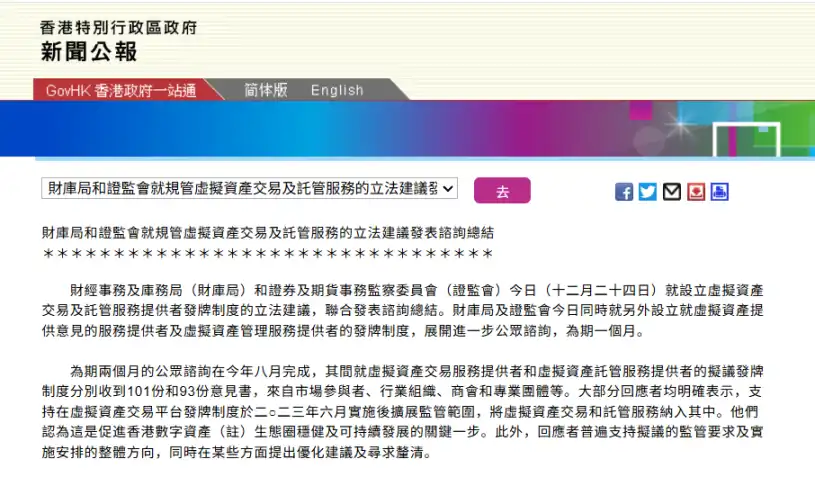
On December 24, 2025, the Hong Kong Financial Services and the Treasury Bureau (FSTB) and the Securities and Futures Commission (SFC) jointly issued a consultation conclusion on legislative proposals for regulating virtual asset trading and custody services. Simultaneously, they launched a further one-month public consultation on establishing a separate licensing regime for providers of virtual asset advisory services and virtual asset management services.
In 2023, Hong Kong amended the Anti-Money Laundering and Counter-Terrorist Financing Ordinance (AMLO), establishing a statutory licensing regime for virtual asset trading platforms. To address regulatory gaps, under the AMLO framework, the FSTB, in conjunction with the SFC, initiated a consultation on legislative proposals for regulating virtual asset trading and custody services in June 2025. The two policy documents released this time serve as a summary and response to the legislative consultation from June of last year. They clearly bring virtual asset trading and custody services under the scope of the licensing regime, propose preliminary regulatory approaches, and innovatively extend the new licensing regime to include 'services providing advice on virtual assets' and 'virtual asset management services'. This signifies that Hong Kong's virtual asset market will achieve a complete regulatory closed loop covering trading, custody, advisory, and asset management.
This article will interpret the new regulatory requirements and analyze their core impact on the market based on the two documents: the 'Consultation Conclusion on Legislative Proposals for Regulating Virtual Asset Trading and Further Public Consultation' and the 'Consultation Conclusion on Legislative Proposals for Regulating Virtual Asset Custody Services', and provide corresponding recommendations.
2 Interpretation of Policy Content
The two policy documents not only systematically summarize the feedback from the June consultation last year on the regulation of virtual asset trading and custody services but also propose to expand the scope of licensing regulation to include investment advisory and asset management activities. The involved regulatory regime is still in the legislative process and will only take effect formally after the passage of the legal amendments.
2.1 Consultation Conclusion on Legislative Proposals for Regulating Virtual Asset Trading and Further Public Consultation
This document summarizes the consultation on virtual asset trading services and simultaneously puts forward two new regulatory proposals. Firstly, it finalizes the details of regulating virtual asset trading services, clarifying the scope, financial requirements, transitional arrangements, etc., for virtual asset trading services in the document.
- Definition Scope: Clarifies that the definition of virtual asset trading services aligns with the scope of 'Type 1 regulated activity (dealing in securities)' under the Securities and Futures Ordinance. Any business conducting buying and selling of virtual assets for clients, or inducing such activities, requires a license. This includes operating virtual asset trading matching platforms, providing over-the-counter (OTC) intermediary services, acting as a virtual asset broker to execute client trades, and providing virtual asset market-making services.
- Capital Requirements: Specifies that the financial resource requirements for licensed virtual asset dealers are consistent with those for Type 1 licensed corporations, with a minimum paid-up share capital of HKD 5 million and minimum liquid capital of HKD 3 million. This, to some extent, filters out small service platforms with insufficient strength, enhancing the overall safety and soundness of the industry.
- Mandatory Custody: Licensed traders must appoint an SFC-regulated virtual asset custodian to safeguard client virtual assets, ensuring the separation of trading and custody, and are prohibited from self-custody of client assets. This initially excludes the option of using overseas custodians, aiming to establish a closed-loop, controllable local custody ecosystem.
Secondly, it proposes to further expand the scope of regulation under the AMLO framework by adding licensing requirements for 'providing advice on virtual assets' and 'virtual asset management services'.
Providing advice on virtual assets refers to offering investment advice on whether to acquire or dispose of virtual assets, which virtual assets to acquire or dispose of, or how to acquire or dispose of virtual assets, or publishing decisive analysis reports, similar to investment advisors. Specific scenarios include recommending specific timing for virtual asset trades or providing virtual asset portfolio allocation plans. For such entities, the regulatory authorities intend to formulate specific regulatory requirements from dimensions such as financial resources, professional personnel, compliance obligations, and business restrictions. Exemptions will be set up for activities like in-house services, incidental acts of trading or professional services, referencing the traditional finance model.
Virtual asset management refers to providing services for managing investment portfolios of virtual assets, requiring core characteristics such as having client-authorized investment decision-making power and providing portfolio management services in a professional capacity. The regulators indicated that no minimum investment proportion exemption will be set for asset management services. Any entity providing asset management services for investment portfolios investing in virtual assets, regardless of the amount of virtual assets, must apply for a license or register. This regulation aims to prevent related risks from being transmitted to the market through unregulated advisory or asset management channels and to reduce arbitrage opportunities that use traditional financial product forms to evade specialized virtual asset regulation.
2.2 Consultation Conclusion on Legislative Proposals for Regulating Virtual Asset Custody Services
The 'Consultation Conclusion on Legislative Proposals for Regulating Virtual Asset Custody Services' constructs a regulatory system specifically for virtual asset custody, treating custody as the last line of defense for client asset safety and setting higher capital requirements.
- Coverage Scope: The regulatory targets are business entities that custody private keys or similar tools capable of transferring client virtual assets. Among them, independent third-party custodians must apply for a specific license, while custody businesses affiliated with trading platforms may receive exemption arrangements to avoid duplicate licensing. Furthermore, responsibilities across the custody chain are clarified. For example, if an associated entity of a licensed trading platform engages in custody, it needs to separately apply for a custody license; existing financial institutions like banks providing virtual asset custody services also need to be included in this framework.
- Capital Requirements: Sets higher capital requirements for licensed custodians than for traders. The minimum paid-up share capital is HKD 10 million, and the minimum liquid capital is HKD 3 million. This requirement aims to ensure licensed custodians have operational sustainability and risk response capabilities matching their business, reflecting the special nature of the custody business.
- Other Stipulations: The operational standards for licensed custodians will be formulated with reference to traditional financial regulatory rules or existing custody guidelines for licensed trading platforms, covering aspects such as online/offline asset storage ratios, private key management, insurance coverage, and independent audits. For instance, requiring a high proportion of cold wallet storage while allowing flexible adjustment based on business needs to balance quick withdrawal demands and security; requiring strict multi-signature and hierarchical permission controls, regular penetration tests, and stress tests, etc.
3 Impact on Hong Kong's Crypto Industry
3.1 Comprehensive Upgrade of the Licensing System
Hong Kong's virtual asset licensing regime has undergone a fundamental transformation. It has upgraded from issuing a single license solely for centralized trading platforms (VATPs) to a comprehensive, full-industry-chain licensing system covering four core businesses: trading, custody, advisory, and asset management. The VATP licensing system targeted the specific institutional form of 'centralized exchanges', imposing comprehensive requirements including capital, custody, and anti-money laundering measures. However, the regulatory focus was primarily on the 'trading venue' itself. Business activities widely existing outside trading venues, such as over-the-counter (OTC) trading, independent asset custody, investment advisory, and specialized asset management, were either ambiguously regulated or in an unlicensed regulatory vacuum, creating potential risks and regulatory arbitrage opportunities. The independent trading license, custody license, and the proposed new advisory and asset management license systems are a systematic response to these limitations, conducive to fostering a professional and stable virtual asset service market ecosystem.
3.2 Building Institutional Trust in the Crypto Market
The new regulations build institutional trust in the crypto market through a series of quantifiable, auditable hard constraints. Firstly, establishing capital and operational thresholds benchmarked against traditional financial institutions (e.g., HKD 5 million for dealers, HKD 10 million for custodians) filters out institutions with weak risk resistance to some extent, constructing institutional credit based on capital. Secondly, forming a complete regulatory closed loop for virtual asset trading, custody, advisory, and asset management shifts asset safety from single-license, self-regulation to comprehensive regulation. For individual and institutional investors, this framework provides them with legal and regulatory safeguards similar to traditional financial services, which are easy to understand and trustworthy.
3.3 Challenges and Uncertainties After Regulatory Implementation
The update of the regulatory system inevitably comes with challenges. At the market level, some small and medium-sized service providers may face relatively severe compliance transformation challenges. Meanwhile, global crypto hot money with higher risk appetite might flow to regions with more flexible regulations due to the strict regulatory framework. At the regulatory level, this regulatory model places high demands on its professionalism. Regulatory authorities need to process a massive volume of license applications in the short term. If the approval speed lags, it could lead to a compliance vacuum in market services, inhibiting the development of legitimate businesses. Simultaneously, regulatory agencies also need sufficient technical capabilities to identify and assess risks in custody solutions, blockchain analysis tools, and new trading models.
4. Responses for Crypto Market Practitioners
In the short term, 'active compliance for survival, strategic repositioning for development' is the primary strategy for practitioners in Hong Kong's crypto market. As Hong Kong's virtual asset regulation is about to enter an era of fully licensed operation, market participants need to immediately legally categorize their businesses as trading, custody, advisory, or asset management and initiate preparations for the corresponding license application procedures. Notably, some licenses do not have a transition period; any delay may result in the risk of illegal operation after the regulations take effect.
In the medium to long term, market practitioners can gradually shift from responding to regulatory upgrades to building their core competitiveness based on compliance advantages. This requires internalizing requirements such as anti-money laundering monitoring, asset custody security, and transparent financial auditing into operational norms that exceed regulatory thresholds, providing credible, robust, and auditable financial-grade services.
The institutionalization driven by the new regulations may bring accompanying tax implications, requiring market practitioners to make forward-looking plans for potential tax burden changes. For example, it is necessary to clarify the characterization of business income based on the regulatory framework to determine the type of taxable income. Newly added compliance operating costs (such as license fees, audit fees) may also bring tax deduction opportunities, necessitating policy tracking and accounting voucher management. More importantly, as institutional clients enter the market, providing transaction records and tax reports that meet audit requirements will become a basic service capability. Market practitioners can improve their financial and tax systems in advance to meet growing business demands.
Against the backdrop of the licensing system upgrade, the market may form a competitive landscape coexisting with a few full-license comprehensive service groups and numerous specialized service providers in niche areas. Beyond obtaining licenses, practitioners who提前布局 (layout in advance) compliance technology capabilities or seek specific ecological niches for deep cooperation may find good opportunities to establish their advantages in the next phase.


















