Interactive Tutorial | Perle Labs, Which Raised $17.5 Million, Launches Season 1 Points Campaign

Odaily星球日报Опубліковано о 2026-01-22Востаннє оновлено о 2026-01-22

Анотація

Perle Labs, an AI training data platform backed by $17.5 million in funding, has launched its Season 1 points campaign. The platform, which uses human experts to perform verifiable, on-chain data labeling on Solana, allows users to earn points by completing tasks. The interactive tasks, available on their app, include: a legal contract classification quest (1,000 points), social media account bindings (500 points), a product tagging quest from complaint emails (1,000 points), a meeting caption quest requiring audio recordings (1,000 points, pending manual review), and a medical specialty classification quest (1,000 points). Each task requires connecting a Solana wallet with some SOL for transaction fees. Users can also earn a 10% referral bonus from invited friends. Points and badges can be tracked in the "Earnings" section.

Original | Odaily Planet Daily (@OdailyChina)

Author | Asher (@Asher_ 0210)
On January 19, Perle Labs, an AI training data platform driven by human experts, announced on platform X that the beta version ended on January 6. The Season 1 campaign is now officially launched. Users can earn points by completing various tasks.

Below, Odaily Planet Daily will give you a quick overview of Perle Labs and a step-by-step guide to participating in the Season 1 campaign to earn points and potentially qualify for a future token airdrop.

Perle Labs: An AI Training Data Platform Driven by Human Experts

Project Introduction

Perle Labs is an AI training data platform driven by human experts, focused on providing high-quality datasets to support decentralized AI development. According to ROOTDATA, Perle Labs has raised a total of $17.5 million in funding to date.

On the Perle Labs platform, experts (such as doctors, financial analysts) perform data annotation. Each step is recorded on the Solana blockchain, making it tamper-proof and fully traceable. Clients (such as pharmaceutical companies, banks) can directly access this "certified" data via API.

Step-by-Step Interaction Tutorial

Interaction Link: https://app.perle.xyz/

STEP 1. Click "Connect Wallet" to connect a wallet supporting the Solana network (you will get a personal referral link; inviting friends earns you 10% of the points they earn). Ensure the connected wallet has a small amount of SOL, as each task requires on-chain confirmation.
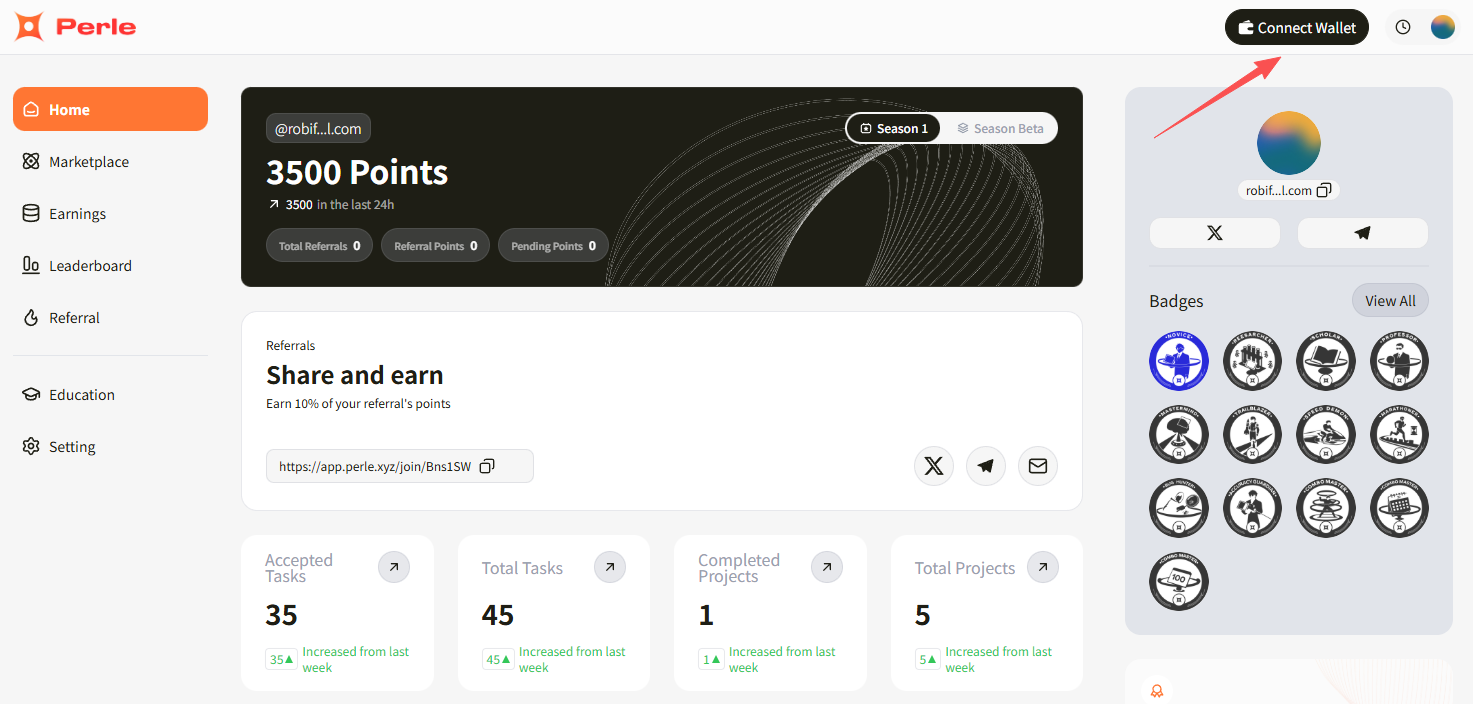
STEP 2. Click "Marketplace". There will be 5 tasks available to participate in.
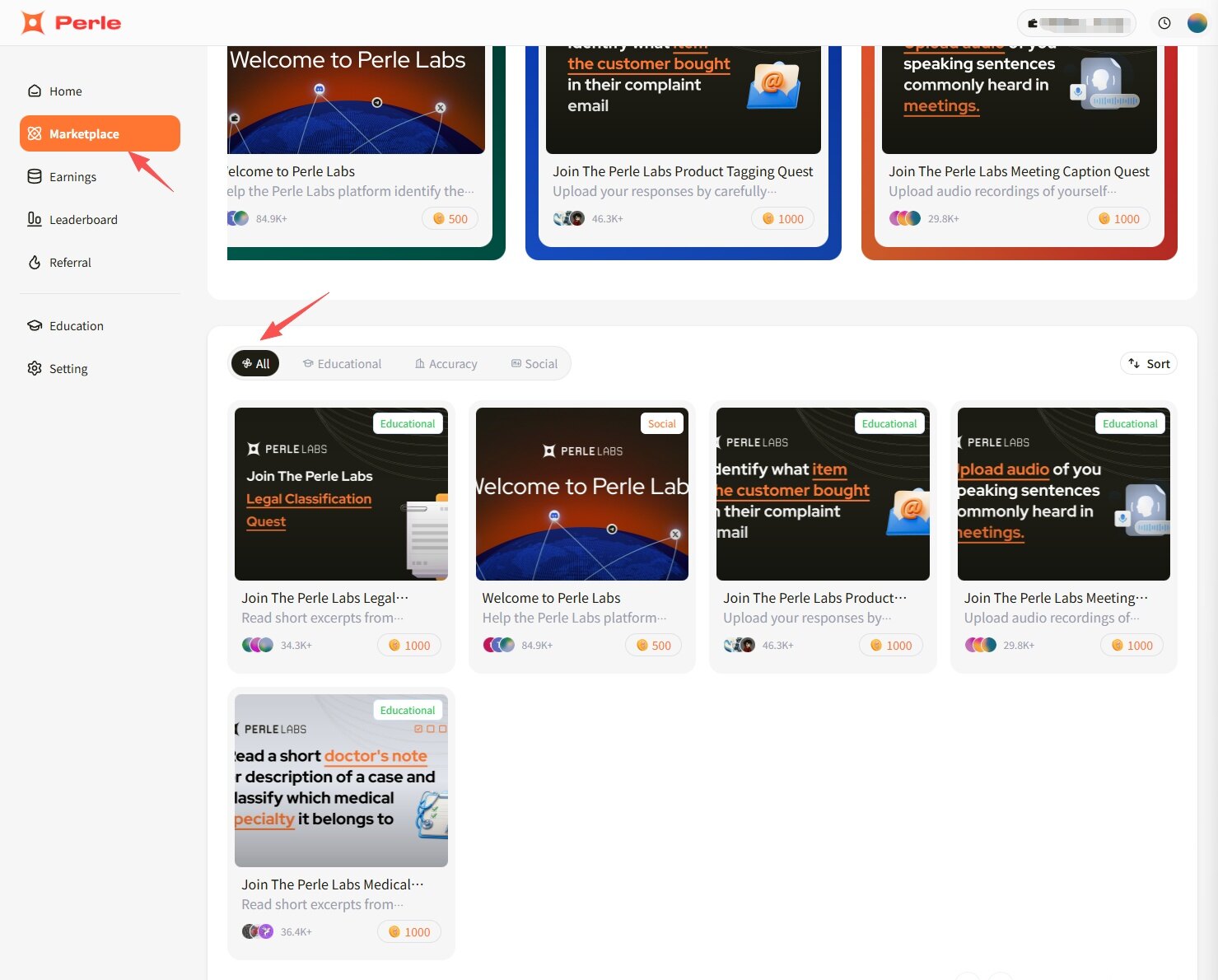
Except for the social binding task, for each other task, you need to fully watch the instructions to unlock it.

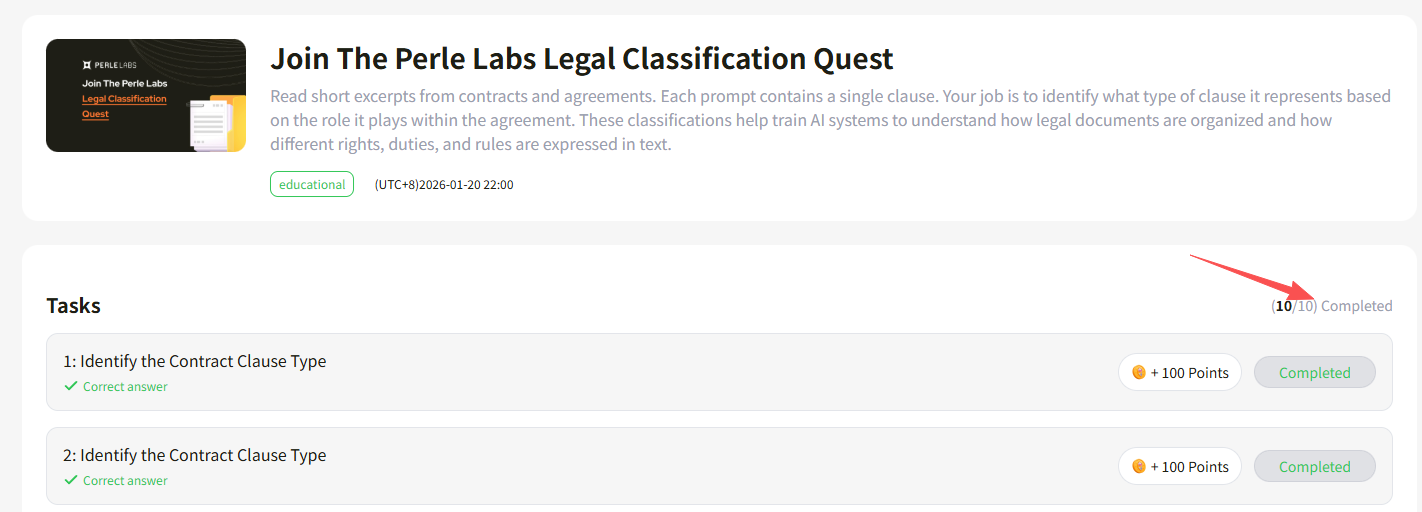
Task 1. Join The Perle Labs Legal Classification Quest: Read excerpts from legal contracts and select the corresponding clause (the questions are highly specialized; using AI tools for assistance is recommended). 10 questions, 100 points each, 1000 points total.
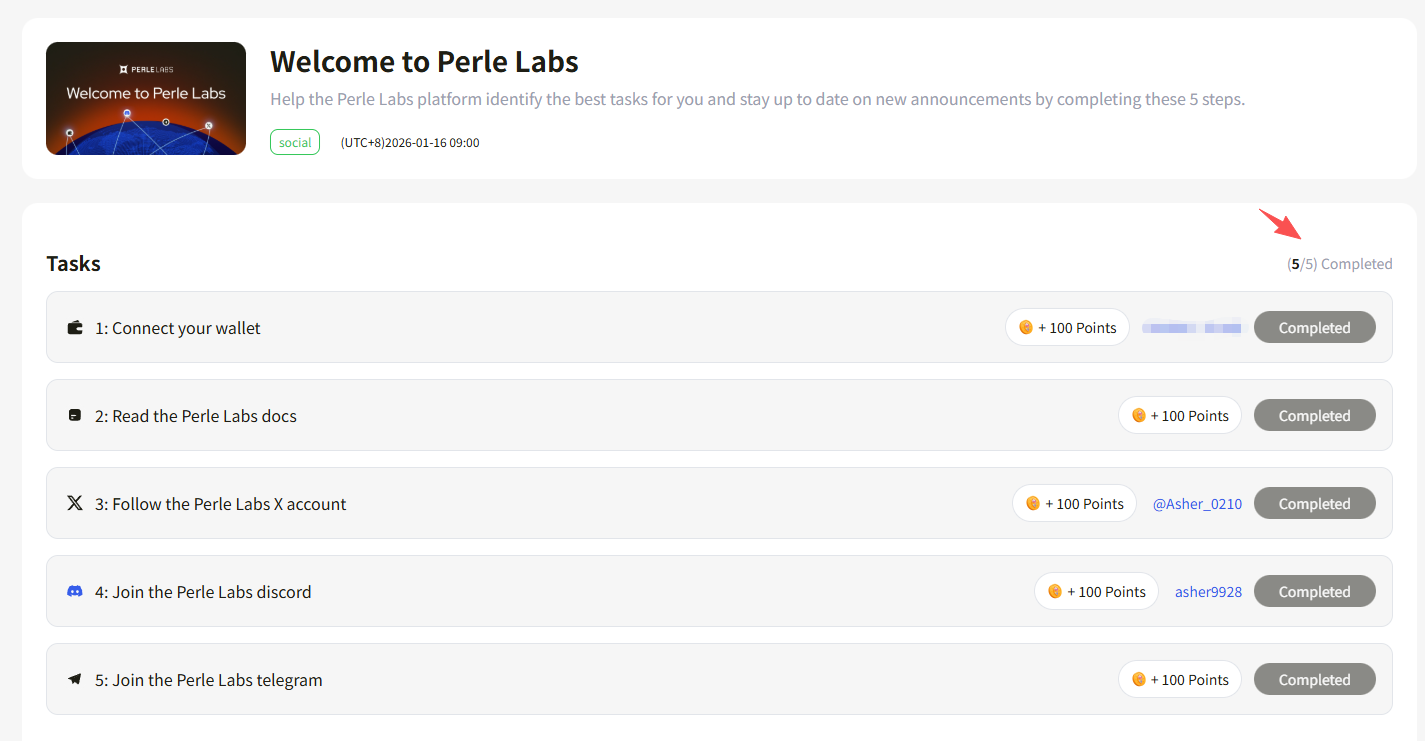
Task 2. Welcome to Perle Labs: Bind your personal X, Discord, Telegram, etc. 5 tasks total, 100 points each, 500 points total.
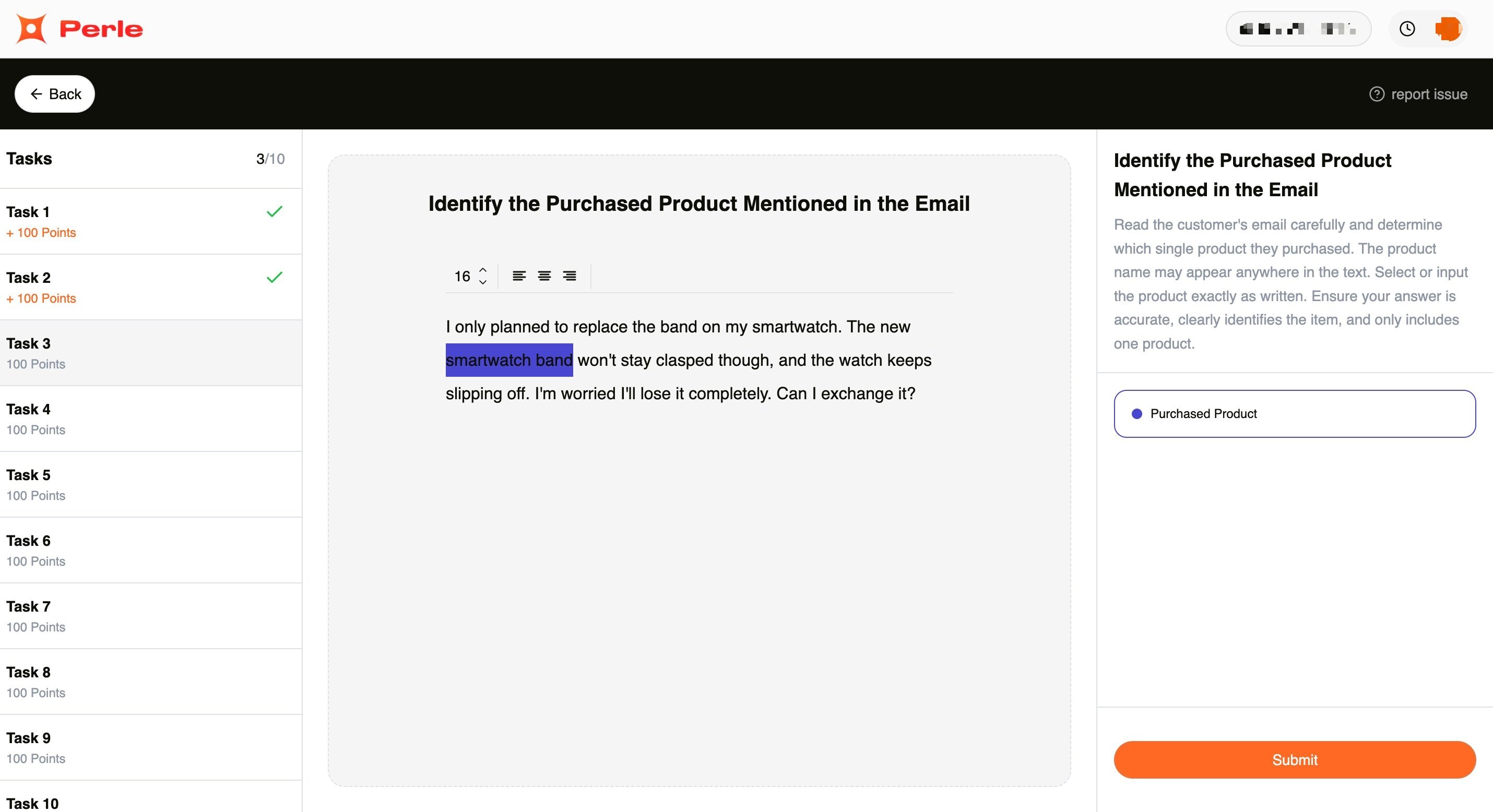
Task 3. Join The Perle Labs Product Tagging Quest: Find the mentioned product in complaint email messages. 10 questions, 100 points each, 1000 points total.
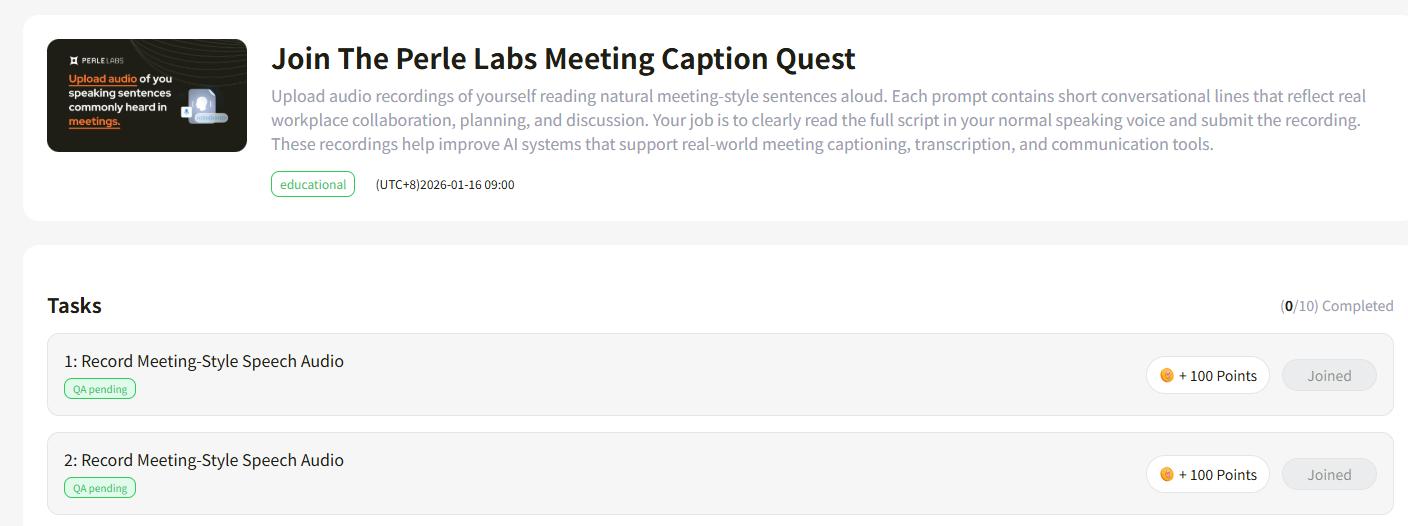
Task 4. Join The Perle Labs Meeting Caption Quest: Read sentences aloud (in English). 10 questions, 100 points each, 1000 points total. The audio part requires manual review and won't show as completed immediately; just submit the voice content on-chain.
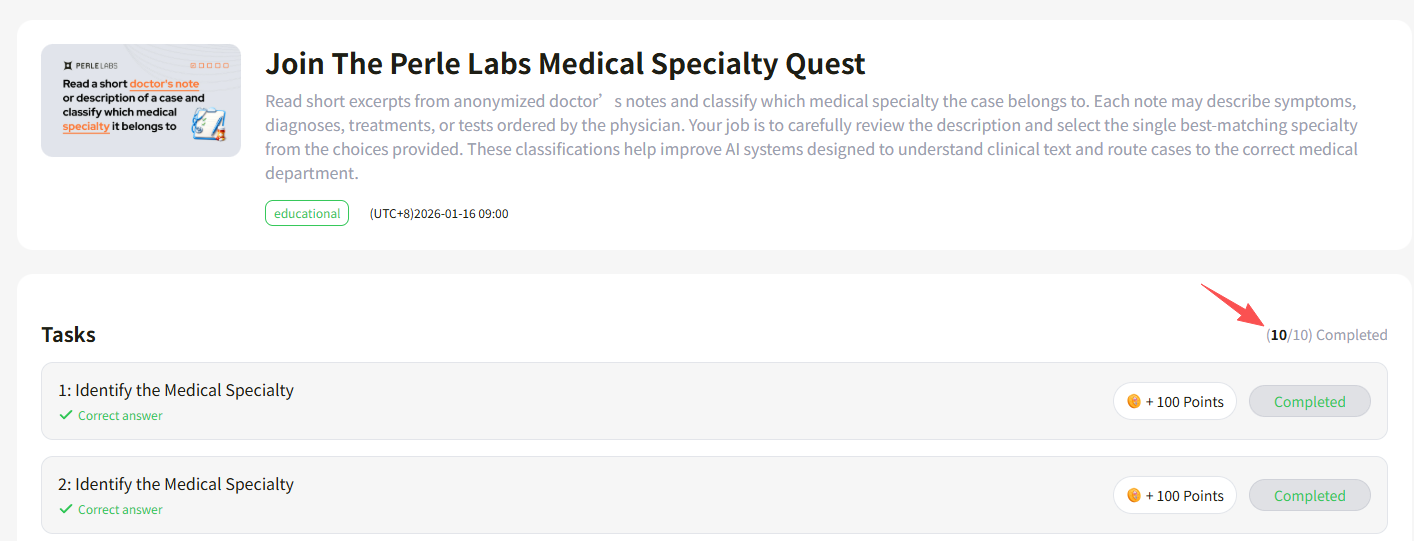
Task 5. Join The Perle Labs Medical Specialty Quest: Read the content of doctor's notes to determine the medical specialty of the case (the questions are highly specialized; using AI tools for assistance is recommended). 10 questions, 100 points each, 1000 points total.
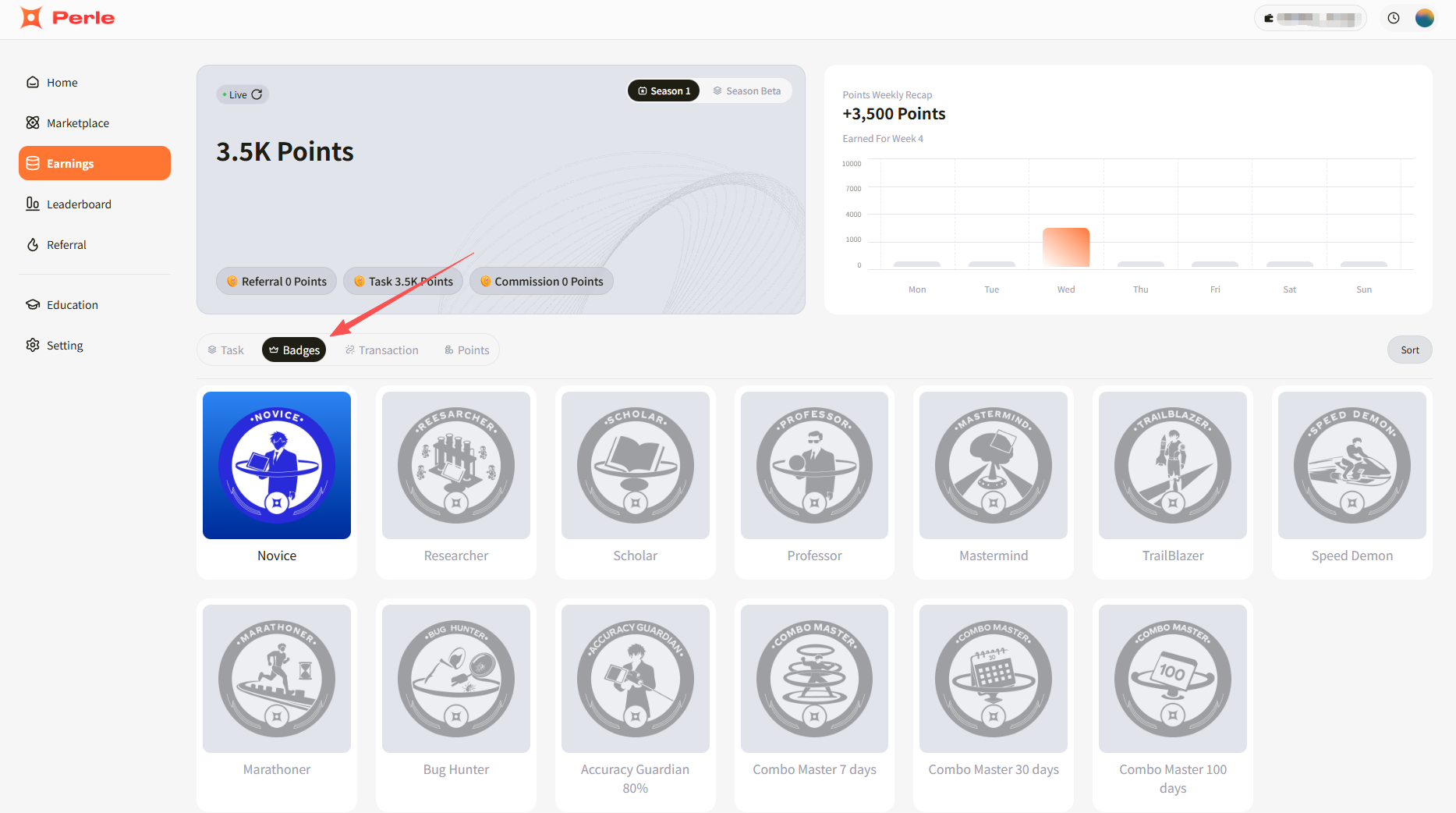
STEP 3. Click "Earnings" to view your points and badge acquisition status.
Пов'язані питання

QWhat is Perle Labs and what is its primary focus?

APerle Labs is a human expert-driven AI training data platform that focuses on providing high-quality datasets to support decentralized AI development.

QHow much total funding has Perle Labs raised according to the article?

APerle Labs has raised a total of $17.5 million in funding.

QWhat is the purpose of the Season 1 campaign launched by Perle Labs?

AThe purpose of the Season 1 campaign is for users to complete various tasks to earn points, potentially for future token airdrops.

QWhich blockchain does Perle Labs use to record data annotation steps?

APerle Labs records every step of expert data annotation on the Solana blockchain.

QWhat are the five main quests available in the Marketplace for users to earn points?

AThe five main quests are: 1. Legal Classification Quest, 2. Social Account Binding, 3. Product Tagging Quest, 4. Meeting Caption Quest, and 5. Medical Specialty Quest.

Пов'язані матеріали

Who Funds the Agents?

**Summary: Who Funds AI Agents?** OpenAI recently shut down a feature allowing AI agents to shop for users, highlighting the challenge of creating a secure and regulated environment for agent-driven transactions. While payment infrastructure exists, a crucial governance layer—defining spending limits, fraud detection, tax handling, and return policies—is largely missing. The potential is enormous: AI agents already processed $73M across 176M transactions last year, with McKinsey forecasting this could grow to $3-5T in global consumer commerce by 2030. The core competition isn't just about processing payments, which can be very cheap (especially with crypto-based settlement), but about controlling the rules that govern agent spending. Key players like Stripe and Coinbase are racing to dominate this governance layer. Stripe's acquisition of wallet provider Privy allows it to set spending policies, identity checks, and human-in-the-loop approvals directly at the wallet level. Similarly, Coinbase's stack, including its x402 protocol and AgentKit, embeds governance rules. This vertical integration across settlement, wallet, and governance layers is becoming the dominant strategy. Control over the governance layer is where significant future value lies. If agents handle trillions in transactions, even a small fee for managing compliance, fraud prevention, and policy enforcement could generate billions in annual revenue. The companies that successfully integrate across the payment stack will capture value from idle agent balances, transaction fees, and governance services, positioning themselves as the foundational banks of the AI agent economy.

marsbit13 хв тому

Who Funds the Agents?

marsbit13 хв тому

A Nation Blocks Chips, a Giant Buys a Nuclear Power Plant: Why It's Time to Seriously Consider DeAI

**Title: Great Powers Blockade Chips, Giants Buy Nuclear Plants: Why It's Time to Seriously Consider DeAI** In May 2026, the US closed loopholes for Chinese firms to acquire advanced NVIDIA chips via overseas subsidiaries. That same month, Kenya halted a $1B geothermal data center project involving Microsoft, fearing its immense energy consumption. Meanwhile, Huawei announced mass production of its Ascend AI chip. These disparate events underscore a new reality: the competition for computing power ("compute") has escalated beyond the tech industry, becoming a geopolitical and infrastructural battleground. A new era of oligopoly is forming, with control over the AI stack—from GPU chips (NVIDIA) and cloud platforms (AWS, Azure, Google Cloud) to foundational models (OpenAI, Anthropic)—concentrating in a few Western "AI Octopus" corporations. This centralization creates systemic risks: pricing power and platform lock-in for users, infrastructure fragility, and a widening "compute divide" that threatens to marginalize nations without independent AI capacity. An "AI Iron Curtain" is deepening through export controls. In response, some nations like Saudi Arabia and the UAE are investing heavily to buy compute power, aiming to transition from oil to AI economies. The EU seeks to triple its compute capacity by 2030 to reduce dependency. However, the spending gap is vast, with four US tech giants alone planning ~$750B in AI capex for 2026. The race is increasingly constrained by energy, with AI tasks consuming up to 1000x more power than web searches, pushing firms to even acquire nuclear plants. This landscape is fueling interest in Decentralized AI (DeAI). It proposes a third way: using open protocols to coordinate a global network of idle GPUs, independent developers, and data centers, creating an AI infrastructure without a single controlling entity. Leveraging blockchain and cryptographic verification, DeAI aims to break market concentration, disperse energy demands, reduce geopolitical dependencies, and enhance transparency. While still nascent in performance and stability, DeAI's core promise is not immediate superiority but providing a crucial alternative architecture to resist monopoly, censorship, and centralized power. As specialized AI hardware costs fall and open-source models flourish, the window to build this foundation is open. The very existence of such competition serves as a vital check against the inevitable abuse of concentrated power.

marsbit1 год тому

A Nation Blocks Chips, a Giant Buys a Nuclear Power Plant: Why It's Time to Seriously Consider DeAI

marsbit1 год тому

Торгівля

Спот
Ф'ючерси
活动图片