ING Now Allows Crypto Investments as SUBBD Token Soars

bitcoinistОпубліковано о 2026-02-03Востаннє оновлено о 2026-02-03

Анотація

The cryptocurrency market is experiencing a divergence, with institutional players like ING adopting crypto services—adding legitimacy—while retail traders pursue high-risk assets. Tokens like SUBBD are surging, reflecting a strong risk-on appetite. SUBBD Token targets the $85 billion creator economy by offering a decentralized platform with AI tools, aiming to solve Web2 issues like high fees and limited control. It has raised $1.4M and offers a 20% APY staking reward to incentivize holding. This represents a shift toward utility-driven crypto projects.

The cryptocurrency market is showing a fascinating divergence: institutional giants are building the floor while retail traders are aggressively testing the ceiling.

Reports that major banking institutions like ING are warming up to direct crypto services signal a critical shift in market structure.

That’s not just about accessibility, it’s about the legitimization of digital assets as a standard portfolio component for conservative European wealth. (Frankly, when a legacy bank moves, it validates the asset class for risk-averse capital that has remained on the sidelines for a decade).

Meanwhile, the retail sector is operating with a totally different risk profile. Just look at the parabolic moves in assets like $SUBBD. The surge in these niche, community-driven tokens suggests that despite macroeconomic headwinds, risk-on appetite remains voracious.

The dichotomy is stark: while bankers analyze Bitcoin ETFs, the ‘degen’ economy is hunting for 100x multipliers in the AI infrastructure sector. This barbell structure, stability on one end, high volatility on the other, implies liquidity is returning to the system, but it’s bifurcated.

But the most astute capital is looking beyond the safety of banks or the casino-like nature of memes. Smart money is positioning itself in the middle ground: utility-driven protocols that solve tangible Web2 problems using Web3 infrastructure.

Specifically, the intersection of Artificial Intelligence and the creator economy is emerging as the next major growth narrative. Investors are increasingly rotating profits from high-volatility plays into infrastructure projects like SUBBD Token that offer sustainable revenue models.

Visit SUBBD Token’s official page.

SUBBD Token Targets the $85 Billion Creator Economy

While the broader market debates regulatory frameworks, SUBBD Token is executing a targeted strike on the $85 billion content creation industry. The current Web2 model? It’s fundamentally broken for creators. Platforms often extract up to 70% of earnings in fees, impose arbitrary bans, and enforce strict geographical payment restrictions.

SUBBD uses Ethereum-based EVM-compatible smart contracts to dismantle these barriers, offering a decentralized alternative where creators actually retain control over their content and revenue.

The project differentiates itself by integrating proprietary AI models directly into its ecosystem. This isn’t merely about payment processing, it’s about workflow automation. The platform features an AI Personal Assistant for automated interactions and advanced AI Voice Cloning technology, allowing influencers to scale their presence without scaling their workload.
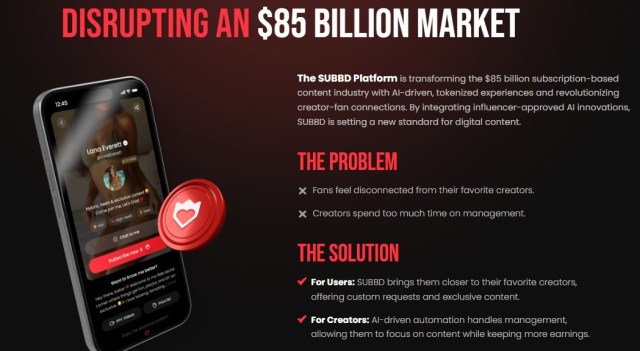
For fans, the utility is equally tangible: token-gated access creates an exclusive layer of interaction that fiat subscriptions can’t replicate.

From a portfolio standpoint, this represents a shift from speculative assets to productive ones. By merging Web3 transparency with AI-driven influencer tools, the project addresses the fragmentation of current software. Instead of subscribing to five different services for chatbots, voice generation, and payments, creators access a unified ecosystem. That consolidation of utility is precisely what transforms a token from a trading vehicle into a fundamental infrastructure play.

Explore the SUBBD ecosystem.

Early Capital Flows and Staking Metrics

The market’s appetite for this AI-Web3 hybrid model is reflected in the early capital inflows. According to official data, the project has already raised $1.4M, a figure that suggests significant conviction from early entrants despite the broader market’s volatility.
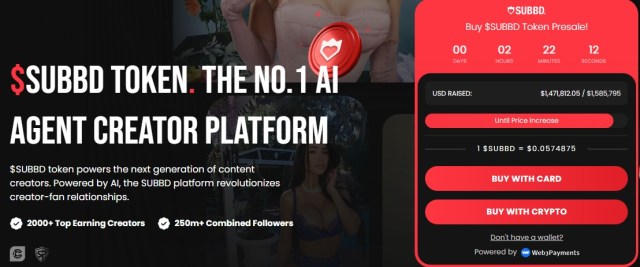
With tokens currently priced at $0.0574875, the entry point allows for position sizing that’s difficult to achieve in established large-cap assets.

Beyond the capital raise, the protocol’s retention mechanics are designed to mitigate the sell pressure often seen in new launches. The staking structure offers a fixed 20% APY for the first year, creating a compelling incentive for holders to lock supply. This isn’t just an inflationary reward; it’s a mechanism to align user behavior with long-term platform growth.

Stakers also gain access to XP multipliers and exclusive ‘behind the scenes’ content drops, gamifying the holding process.
This approach, combining high-yield staking with functional platform benefits, creates a liquidity sink that stabilizes the token economy.

While ING clients are limited to market-beta returns, SUBBD offers a third path: early-stage exposure to a utility protocol with built-in yield generation.

As the presale advances, the window to acquire tokens at the $0.0002802 valuation tightens, placing a premium on early decision-making.

View the official SUBBD presale site.

The information provided in this article does not constitute investment advice, financial advice, trading advice, or any other sort of advice and you should not treat any of the article’s content as such. Cryptocurrency markets are highly volatile and carry significant risk. Always conduct your own due diligence before making any investment decisions.


Пов'язані питання

QWhat major shift in the cryptocurrency market does the article highlight regarding traditional banking institutions like ING?

AThe article highlights that major banking institutions like ING are warming up to direct crypto services, signaling a critical shift in market structure. This move legitimizes digital assets as a standard portfolio component for conservative European wealth and validates the asset class for risk-averse capital.

QHow does SUBBD Token differentiate itself in the cryptocurrency market according to the article?

ASUBBD Token differentiates itself by targeting the $85 billion creator economy with a decentralized alternative that allows creators to retain control over their content and revenue. It integrates proprietary AI models for workflow automation, including an AI Personal Assistant and AI Voice Cloning technology, and provides token-gated access for fans.

QWhat is the current price of SUBBD Token and what incentive does the staking structure offer?

AThe current price of SUBBD Token is $0.0574875. The staking structure offers a fixed 20% APY for the first year, which incentivizes holders to lock supply and aligns user behavior with long-term platform growth. Stakers also gain access to XP multipliers and exclusive content.

QWhat problem in the current Web2 model for creators does SUBBD Token aim to solve?

ASUBBD Token aims to solve the problems in the current Web2 model where platforms often extract up to 70% of earnings in fees, impose arbitrary bans, and enforce strict geographical payment restrictions. It offers a decentralized alternative that allows creators to retain control and revenue.

QHow much capital has SUBBD Token raised according to the official data mentioned in the article?

AAccording to official data, SUBBD Token has raised $1.4M, indicating significant conviction from early entrants despite the broader market's volatility.

Пов'язані матеріали

From South Korea to the United States: Blue-Collar Jobs Are Becoming Increasingly Popular, Thanks to AI

AI is reshaping the labor market's value proposition. The traditional four-year college degree is losing its appeal as a guaranteed career path, while skilled blue-collar trades like electricians, welders, and plumbers are experiencing historic demand and wage premiums. This shift is driven by dual pressures: AI's displacement of certain white-collar roles and a booming need for physical infrastructure and data center construction. Data confirms the trend. In the U.S., vocational school revenue surged, and a significant portion of recent layoffs are AI-related. Surveys show a majority of Gen Z adults plan to pursue blue-collar work, citing better job security against AI automation. Vocational education interest has exploded recently. Experts cite a psychological shift as younger generations seek tangible, AI-resistant careers and avoid high student debt. In many cases, salaries for skilled trades now match or exceed those requiring a bachelor's degree. In South Korea, semiconductor vocational high schools boast near-total employment, with graduates securing high-paying roles at companies like Samsung. The shortage is structural, exacerbated by a retiring baby boomer workforce and massive infrastructure projects. Companies like JPMorgan Chase, Meta, and Lowe's are investing heavily in training programs. However, overcoming historical stigma and a "perception gap" around trade careers remains a key challenge to closing the talent gap.

marsbit21 хв тому

From South Korea to the United States: Blue-Collar Jobs Are Becoming Increasingly Popular, Thanks to AI

marsbit21 хв тому

Qualcomm: AI Hype Subsides, When Will Smartphones Emerge from the Gloom?

Qualcomm reported its Q3 FY2026 results (ending June 2026), with revenue of $9.95B, down 4% YoY but above expectations. Gross margin declined to 53.1%, pressured by rising costs across manufacturing and memory. Key business segments showed mixed performance: Handset revenue fell 19.6% YoY to $5.09B, dragged by an 11% decline in non-Apple Android shipments and weaker high-end mix. Conversely, Automotive revenue surged 61% to $1.59B, and IoT grew 9% to $1.83B. Core operating profit dropped 41% YoY due to margin compression and higher expenses. Management's Q4 FY2026 guidance projects revenue of $9.7B-$10.5B, in line with consensus, but Non-GAAP EPS guidance of $2.05-$2.25 fell short of expectations. Amidst persistent weakness in its core handset market, Qualcomm is pursuing growth in AI, focusing on Edge AI (smartphones, PCs, automotive) and Data Center AI. Its data center strategy includes four pillars: AI accelerators (e.g., AI200), commercial CPUs (Dragonfly C1000), custom silicon, and connectivity solutions. While these initiatives initially boosted its stock, concerns over AI capital expenditure sustainability have since erased those gains. The company targets $5B in data center revenue for FY2027 and $15B for FY2029. The report concludes that with the traditional handset business still under pressure, the data center opportunity is currently viewed as a longer-term option, and a more conservative valuation based on core operations may be warranted until AI contributions materialize.

marsbit25 хв тому

Qualcomm: AI Hype Subsides, When Will Smartphones Emerge from the Gloom?

marsbit25 хв тому

From TPU to Self-Evolving Agents: How Jeff Dean Predicts the Next Step in AI

At the 2026 YC Startup School, Jeff Dean outlined his vision for AI's next phase, shifting focus from simply scaling models to building intelligent, autonomous systems. He believes AI's progress is no longer just about creating smarter models, but about integrating them into systems capable of long-term, iterative work, automated experimentation, and continuous learning. This evolution moves the competition from "who has the bigger model" to "who can best organize intelligence." Dean suggests AI capabilities are now comparable to a junior engineer, enabling the automation of complex workflows. However, the true challenge and opportunity lie in managing these AI "workers" at scale. He emphasizes the importance of **context engineering**—structuring tools, memory, and feedback loops—over raw model power. For startups, this means building deep expertise in niche domains where general models currently fail (near 0-1% success rates), leveraging proprietary data, specialized tools, and domain-specific evaluators. A recurring theme is re-examining fundamental constraints. Dean's past work, like moving Google's search index to memory or creating the TPU, stemmed from questioning outdated assumptions about hardware and cost. He sees similar inflection points today, particularly in **specialized inference hardware** to drastically reduce latency and energy consumption for real-time Agent operation. Notably, he points out that in modern AI systems, the dominant cost is often not computation but **data movement**. Reliable, long-running Agents require robust system design, borrowing concepts from distributed computing like checkpointing, state management, and parallel exploration to handle failures and maintain progress over days or weeks. As AI automates execution, the scarcest human skills will shift to **defining clear specifications**, **judging what problems are worth solving** (taste), and designing effective feedback loops. Ultimately, Dean's framework prioritizes understanding the problem deeply, identifying the true bottlenecks, and systematically building closed-loop systems where AI can not only perform tasks but also improve AI itself.

marsbit25 хв тому

From TPU to Self-Evolving Agents: How Jeff Dean Predicts the Next Step in AI

marsbit25 хв тому

Торгівля

Спот
活动图片




