InfoFi Narrative Collapses, Kaito, Cookie, and Others Shut Down Related Products

marsbitОпубліковано о 2026-01-15Востаннє оновлено о 2026-01-15

Анотація

The InfoFi narrative, which gained significant traction in the crypto industry, experienced a sudden collapse following an announcement by X's product lead, Nikita Bier, regarding changes to the platform’s API policy. The new policy prohibits applications that reward users for posting on X, citing concerns over AI-generated spam and low-quality replies. This decision effectively undermines the core functionality of many InfoFi projects that rely on X’s API to access user data and distribute tokenized rewards. Key projects, Kaito and Cookie, quickly responded to the policy shift. Kaito announced it would pivot toward Kaito Studio, a more selective, brand-driven platform that moves beyond the crypto space. Its founder, Yu Hu, emphasized a broader focus beyond cryptocurrency. Similarly, Cookie decided to shut down its Snaps platform but is developing Cookie Pro, a real-time crypto market intelligence tool, while exploring potential future adaptations in line with X’s guidelines. The abrupt policy change highlights the vulnerability of InfoFi models that depend heavily on-platform engagement metrics. While some projects, such as those focused on monetizing narratives rather than direct posting rewards, may remain unaffected, the incident marks a significant shift for the attention economy within crypto. The evolution of InfoFi may continue in new forms, but its current iteration has been severely disrupted.

Author: Gu Yu, ChainCatcher

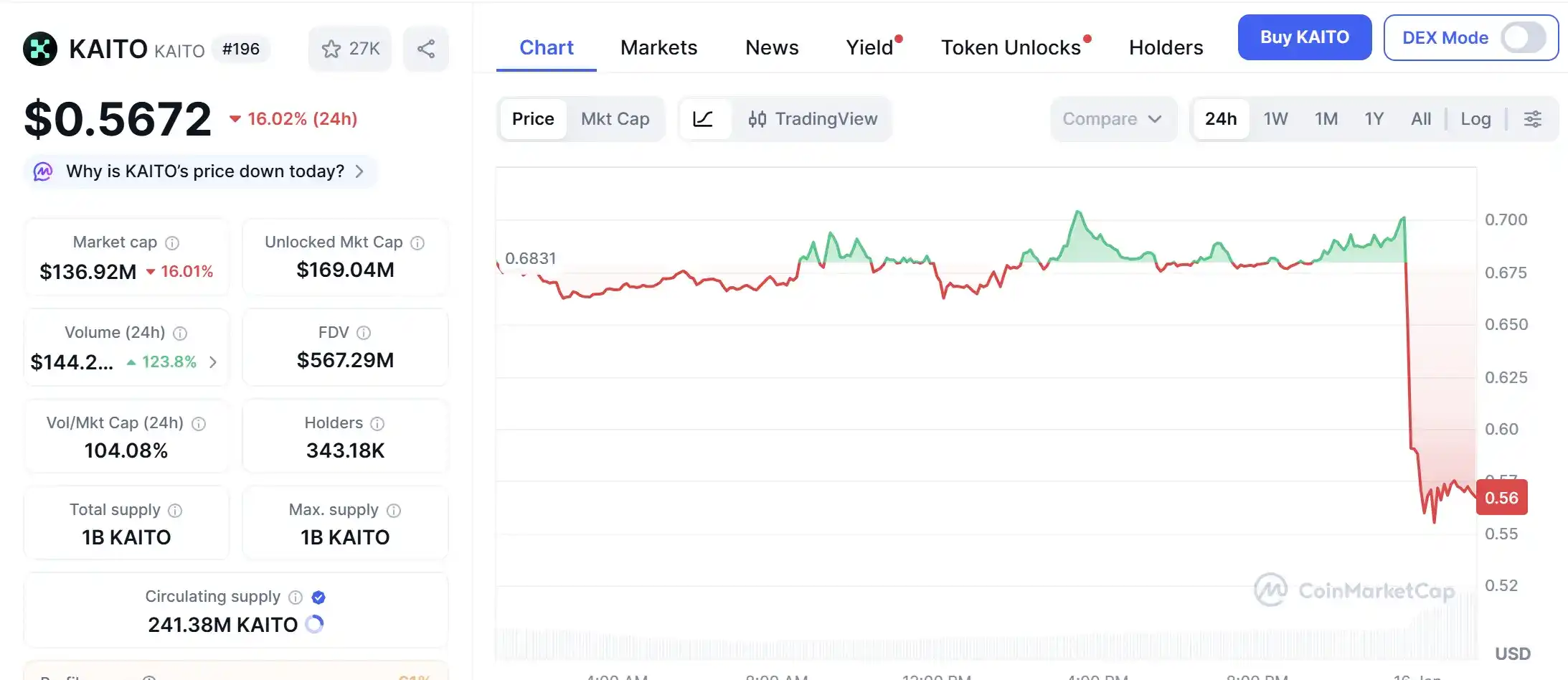
At 1:16 AM Beijing time on January 16, the crypto industry was once again as the highly popular InfoFi narrative suddenly collapsed. Kaito, Cookie, and others successively announced the shutdown of InfoFi-related products and attempted to pivot, with their token prices plummeting by nearly 20% at one point.
And this was all triggered by a tweet from X Product Lead Nikita Bier. Nikita Bier stated that the team is revising its developer API policy and will no longer allow any applications that reward users for posting on the X platform (e.g., "infofi"). This has led to the platform being flooded with a large amount of AI spam and reply spam.

"We have revoked the API access for these applications, so your X experience should start to improve soon (once the bots realize they are no longer being paid)." Nikita Bier said.

Since most InfoFi projects rely on the X product API to obtain user tweet data and determine reward schemes, once the API is disabled, the vast majority of content for such products will stop updating, losing their foundation.

An hour after the news was released, projects like Kaito and Cookie quickly issued response statements on their official Twitter accounts, showing that they had anticipated and prepared for this situation. Let's first see how they specifically responded.

Kaito: To Focus More on Areas Beyond Crypto

Kaito stated that in response to the large number of spam tweets, the project tried stricter eligibility reviews, higher leaderboard thresholds, social + on-chain screening mechanisms, and different incentive mechanisms. However, due to platform-wide X algorithm changes and the launch of other InfoFi projects with varying thresholds, the problem of low-quality and spam information remains widespread across the cryptocurrency field.

After discussions with the X team, both parties agreed that a completely permissionless distribution system is no longer feasible and does not meet the needs of high-quality brands, serious content creators, or X as a platform.

Next, Kaito will focus on launching Kaito Studio, which will be closer to a traditional tiered marketing platform where brands can selectively collaborate with creators based on established criteria and clear project scopes.

Kaito founder Yu Hu said that the past few months have been busy with the development of Kaito Studio, hence the low profile on social media and announcements, with little mention of project construction and strategic adjustments. Additionally, he personally met with some large brands outside the cryptocurrency field to learn from the successful experiences of traditional industry.

"We should no longer build and create for cryptocurrency, but for the broader world." Yu Hu believes that 2026 will be the year Kaito transcends CT as its main platform and cryptocurrency as its primary vertical.

Cookie: To Launch Real-Time Crypto Market Wallet Tool

Cookie posted that deciding to shut down the Snaps platform and all active creator campaigns was a difficult and sudden decision, but it was necessary to maintain the integrity of the Cookie data layer and products.

After discussions with the X team regarding its API and X usage policies, Cookie decided to immediately shut down Snaps and all ongoing activities.

However, the project still holds hope for the future of the Snaps product. "Currently, we are actively negotiating with X to determine if Snaps can continue to operate in a new form." Cookie believes, "We have always firmly believed that we fully comply with all of X's rules and policies. We will await confirmation and guidance from X on whether creator activities (such as Snaps) can operate in any form in the future."

At the same time, Cookie also proposed future product iteration plans, "For the past six months, we have been developing Cookie Pro—a real-time market intelligence tool for the cryptocurrency field, planned for official launch in the first quarter."

Has InfoFi Fallen?

It is undeniable that InfoFi has brought much vitality and change to the industry in recent years. It combines information and finance, creating a mechanism that evaluates user contributions based on the attention generated by their content (e.g., views, comments, and shares) and links it to token rewards.

In essence, InfoFi transforms attention from an abstract concept into quantifiable and tradable data. User participation shifts from simple content consumption to productive activity, and projects can more targetedly provide rewards to their content contributors.

However, when attention becomes the standard for rewards, the purpose of creating content now shifts from providing information or encouraging meaningful engagement to merely seeking rewards. And generative AI makes content creation easier, leading to the rapid spread of bulk content lacking real information or insight.

Several key members of the X team have mentioned the decline in Twitter content quality brought by InfoFi, so projects like Kaito have tried to optimize their algorithmic solutions, but never expected X to directly block this path from its foundation.

It is worth noting, however, that not all InfoFi projects incentivize users to post for rewards. For example, projects like xHunt and Ethos that rely on the X API primarily use the API to obtain tweet data for scoring and other operations. The impact of this X API policy adjustment on these projects is not yet known and requires further observation.

Additionally, some types of InfoFi projects mainly focus on the monetization of industry hotspot narratives, such as Noise and Narrative, and are expected to be largely unaffected.

Now that the InfoFi narrative has quickly collapsed, the attention economy and creator economy remain key focuses of the entire internet industry. In the future, InfoFi may reappear in front of the public in new forms and concepts.


Трендові криптовалюти

Пов'язані питання

QWhat major event led to the collapse of the InfoFi narrative and the shutdown of products like Kaito and Cookie?

AThe collapse was triggered by X's product lead Nikita Bier announcing a revision to the developer API policy, which no longer allows applications that reward users for posting on X (such as 'infofi') due to the proliferation of AI-generated spam and low-quality replies.

QHow did Kaito respond to X's API policy change, and what is their new strategic direction?

AKaito responded by shifting focus to Kaito Studio, a more traditional graded marketing platform where brands can selectively collaborate with creators based on set criteria. They aim to expand beyond the cryptocurrency领域 and target broader industries.

QWhat product did Cookie announce it was developing after shutting down its Snaps platform?

ACookie announced it is developing 'Cookie Pro,' a real-time market intelligence tool for the cryptocurrency space, planned for launch in the first quarter.

QWhy did X decide to restrict API access for InfoFi applications according to the article?

AX restricted API access because InfoFi applications incentivized users to post content primarily for rewards, leading to an influx of low-quality, AI-generated spam that degraded the overall user experience on the platform.

QAre all types of InfoFi projects affected equally by X's API policy change, as per the article?

ANo, not all InfoFi projects are equally affected. Projects like xHunt and Ethos that use X API for data scoring may be impacted, while others like Noise and Narrative, which focus on monetizing industry narratives, are expected to remain largely unaffected.

Пов'язані матеріали

How Does Codex Use a Computer? Three Entry Points and Permission Boundaries

This article explains the three primary methods for Codex to interact with a computer, each with distinct use cases, permission boundaries, and trust levels. **1. Computer Use:** This offers the broadest access, allowing Codex to visually control and interact with the graphical user interface of authorized macOS/Windows apps, system settings, and even iOS simulators. It's ideal for tasks lacking APIs or structured tools, such as operating legacy software or multi-app workflows. However, it's the slowest method and has the widest permission scope, requiring careful supervision for sensitive actions. **2. Chrome Extension:** This grants Codex access to the user's logged-in Chrome browser state, including cookies, profiles, and open tabs. It's best for tasks requiring user identity across websites like Gmail, LinkedIn, Salesforce, or internal dashboards. Its key advantage is multi-tab control for complex workflows. While more powerful for browser-based tasks than Computer Use, it carries higher sensitivity as actions are performed under the user's identity. **3. In-App Browser:** This is a browser isolated within the Codex thread, separate from the user's personal browsing data. It excels in web development and debugging scenarios—previewing local servers, testing responsive layouts, or annotating designs directly on the page. Its isolation is a strength for development but a limitation for tasks requiring login sessions. The core principle is to choose the narrowest, safest, and most structured interface for the task. Use plugins or MCPs first, resort to visual control (Computer Use) only for GUI-dependent tasks, employ the Chrome extension for identity-reliant browser work, and prefer the In-App Browser for isolated development. **Appshots** are clarified as a fourth, complementary tool for *inputting* context—capturing a screenshot of a window to point Codex to something—rather than a method for Codex to *act*. Together, this layered approach highlights a key to AI agent productization: not granting unlimited permissions, but constraining them within clear boundaries for specific tasks while preserving user oversight.

marsbit38 хв тому

How Does Codex Use a Computer? Three Entry Points and Permission Boundaries

marsbit38 хв тому

The "Iron Rule" of Chip Equipment Is Being Broken

For years, the semiconductor equipment industry followed an unwritten "iron rule": suppliers offered steep discounts for new tool introductions (Design-in) and faced consistent price pressure during repeat orders, especially during market downturns. This long-standing buyer's market dynamic is now being upended. Recently, SK Hynix's primary equipment suppliers have reportedly requested a 3-4% price *increase*, a nearly unprecedented move. This shift is driven by a severe supply-demand imbalance fueled by the AI compute boom. Securing equipment has become an urgent arms race as chipmakers' expansion speed dictates their ability to fulfill massive AI chip orders. Key areas feeling the strain include: **TCB (Thermal Compression Bonding) Equipment:** Demand is exploding, driven by the simultaneous needs of HBM4 memory stacking, AI chip Chip-on-Substrate (C2S), and logic Chiplet Chip-on-Wafer (C2W) packaging. Players like Hanmi Semiconductor, Hanwha Semitech, and ASMPT are receiving major orders. While hybrid bonding is seen as the future, TCB remains the pragmatic choice for HBM4 mass production, with its lifecycle extended by relaxed specifications and ongoing technological upgrades. **Test Equipment Bottlenecks:** Ironically, AI-driven shortages are now crippling test equipment manufacturing. Critical components like FPGAs, Driver ICs, and CPUs face severe shortages and extended lead times (up to 52 weeks for FPGAs), as AI data center and server vendors prioritize supply. This creates a paradoxical cycle: AI chip shortages drive fab expansion, which requires more test equipment, whose production is delayed because its key parts are diverted to make AI chips. The industry is entering a broad, AI-powered upcycle. SEMI forecasts global semiconductor equipment sales to hit a record $156 billion by 2027, fueled by investment in advanced logic/foundry, HBM-driven DRAM, and advanced packaging (like CoWoS). Major players like TSMC, SK Hynix, and Micron are aggressively ramping capital expenditure. In conclusion, leading equipment vendors are no longer just selling tools; they are selling the critical capability to deliver AI-era capacity. Pricing power is shifting decisively to those with indispensable technology in key process nodes like advanced logic, HBM, and advanced packaging, rewriting the industry's traditional power structure.

marsbit51 хв тому

The "Iron Rule" of Chip Equipment Is Being Broken

marsbit51 хв тому

Торгівля

Спот
Ф'ючерси

Популярні статті

Як купити COOKIE

Ласкаво просимо до HTX.com! Ми зробили покупку Cookie DAO (COOKIE) простою та зручною. Дотримуйтесь нашої покрокової інструкції, щоб розпочати свою криптовалютну подорож.Крок 1: Створіть обліковий запис на HTXВикористовуйте свою електронну пошту або номер телефону, щоб зареєструвати обліковий запис на HTX безплатно. Пройдіть безпроблемну реєстрацію й отримайте доступ до всіх функцій.ЗареєструватисьКрок 2: Перейдіть до розділу Купити крипту і виберіть спосіб оплатиКредитна/дебетова картка: використовуйте вашу картку Visa або Mastercard, щоб миттєво купити Cookie DAO (COOKIE).Баланс: використовуйте кошти з балансу вашого рахунку HTX для безперешкодної торгівлі.Треті особи: ми додали популярні способи оплати, такі як Google Pay та Apple Pay, щоб підвищити зручність.P2P: Торгуйте безпосередньо з іншими користувачами на HTX.Позабіржова торгівля (OTC): ми пропонуємо індивідуальні послуги та конкурентні обмінні курси для трейдерів.Крок 3: Зберігайте свої Cookie DAO (COOKIE)Після придбання Cookie DAO (COOKIE) збережіть його у своєму обліковому записі на HTX. Крім того, ви можете відправити його в інше місце за допомогою блокчейн-переказу або використовувати його для торгівлі іншими криптовалютами.Крок 4: Торгівля Cookie DAO (COOKIE)Легко торгуйте Cookie DAO (COOKIE) на спотовому ринку HTX. Просто увійдіть до свого облікового запису, виберіть торгову пару, укладайте угоди та спостерігайте за ними в режимі реального часу. Ми пропонуємо зручний досвід як для початківців, так і для досвідчених трейдерів.

225 переглядів усьогоОпубліковано 2025.07.23Оновлено 2026.06.02

Як купити COOKIE

Обговорення

Ласкаво просимо до спільноти HTX. Тут ви можете бути в курсі останніх подій розвитку платформи та отримати доступ до професійної ринкової інформації. Нижче представлені думки користувачів щодо ціни COOKIE (COOKIE).

活动图片