Infinex Token Sale New Rules: Two Options - $0.0099 Locked for One Year or $0.03 Unlocked Immediately

Odaily星球日报Опубліковано о 2025-12-26Востаннє оновлено о 2025-12-26

Анотація

Infinex, a DeFi platform founded by Synthetix's Kain Warwick, has revised its token sale terms for its INX token. The fully diluted valuation (FDV) has been reduced from $300 million to $99.99 million following community feedback, though the one-year lockup period remains unchanged. The sale, scheduled for January 3-6, 2026, will offer 5% of the total token supply. Participants are given two pricing options: purchase tokens at $0.0099 each with a mandatory one-year lock, or opt for immediate unlocking at TGE (end of January 2026) at a higher valuation of $300 million FDV, equating to $0.03 per token. The latter option features a linear valuation decrease over the year, settling at the $99.99 million FDV. The changes have sparked significant community backlash, particularly from Patron NFT holders. They argue the new immediate unlock option at a lower FDV devalues their earlier investments, which were made under the expectation that early liquidity required a much higher valuation threshold. The Patron NFT floor price fell nearly 10% following the announcement. Despite the FDV reduction, the core complaint about the lengthy one-year lockup persists, with many in the community viewing it as a major disadvantage in the current market.

Original | Odaily Planet Daily (@OdailyChina)

Author | Asher (@Asher_ 0210)
Yesterday, Infinex founder Kain Warwick posted on X platform that due to feedback indicating the pricing was too high, the valuation of the Sonar token sale conducted by Infinex on Echo has been reduced from the initial $300 million to $99.99 million, while the lock-up period remains unchanged at one year, to better adapt to the current market environment.

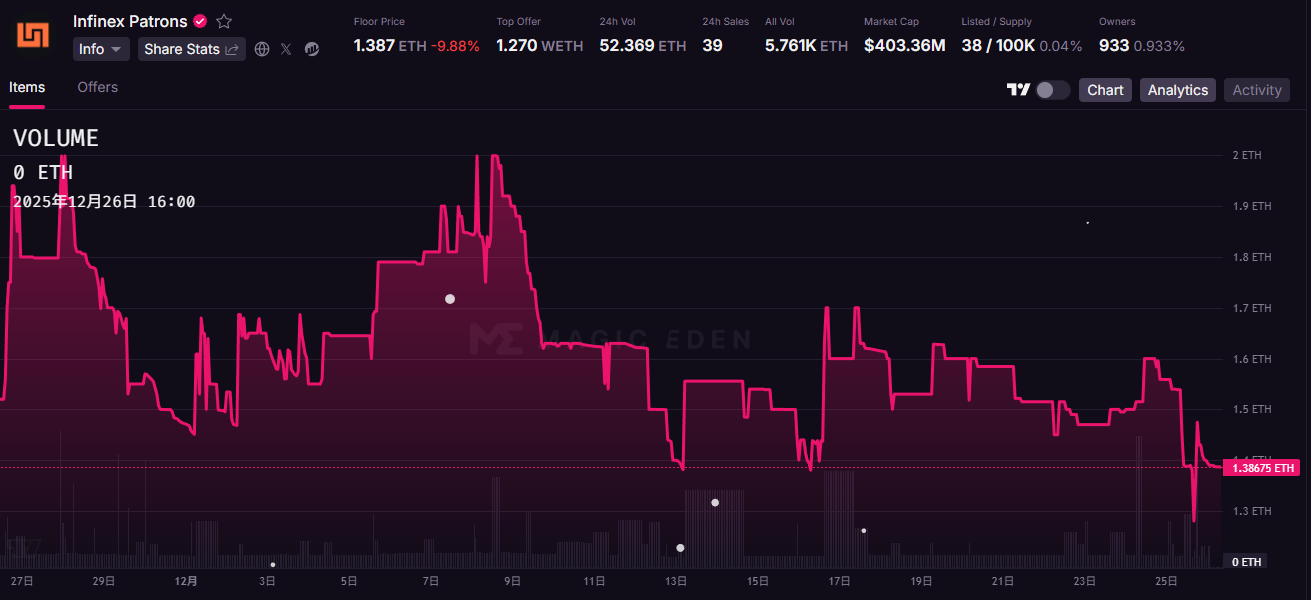
Affected by the FDV reduction, the overall allocation quota for the Sonar sale has decreased, making it impossible to guarantee the priority allocation arrangement for the original Patron NFT holders. The floor price of Infinex Patrons NFT has dropped nearly 10% in 24 hours, temporarily at 1.387 ETH.
Below, Odaily Planet Daily takes you through the Infinex project, the new token sale rules, and community sentiment.

Infinex: Full-Stack DeFi Services

Infinex is a decentralized finance platform launched by Synthetix founder Kain Warwick in April 2024. Its goal is to provide a product form close to the experience of a centralized exchange under a decentralized premise, thereby narrowing the usability gap between CeFi and DeFi. While maintaining non-custodial assets and on-chain security, the platform focuses on optimizing the interaction process and user experience.
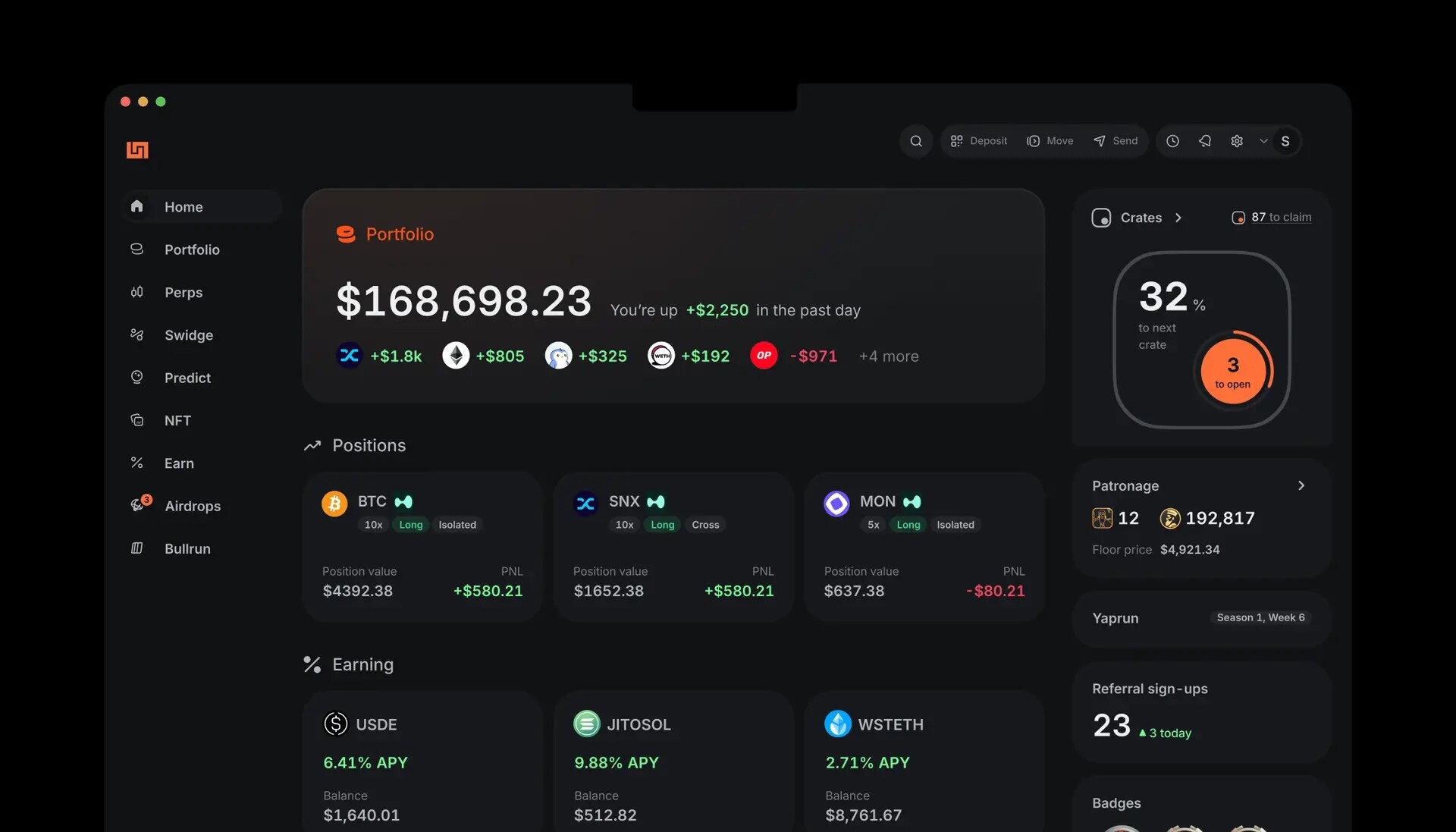
From a product positioning perspective, Infinex is not a single-function application but rather a full-stack DeFi service entry point. Its core capabilities include: acting as a non-custodial wallet covering multiple chains to host user assets; serving as a unified interface to aggregate and integrate various on-chain DeFi protocols and services; and through highly abstract interaction design, hiding complex concepts like address management, cross-chain bridging, seed phrases, and Gas fees in the background, allowing users to interact with DeFi applications without needing to understand the underlying mechanisms, resulting in an overall user experience closer to CeFi products.

To date, Infinex has supported 15 blockchain networks including Ethereum, Solana, and Base. The integrated DeFi functions cover cross-chain swaps (Swidge), perpetual contracts (Perp), liquid staking, and other yield-generating services (Earn), among others.

Infinex Token Sale New Regulations

According to the official Infinex documentation, the updated details of the Infinex token sale are as follows:

  • INX Token Sale Account Registration Date: Starting December 27th;
  • INX Token Official Sale Date: January 3rd to January 6th, 2026;
  • Infinex TGE Date: Planned for late January 2026;
  • Sale Quantity: 5% of the total token supply;
  • FDV: Valuation reduced from the initial $300 million to $99.99 million;
  • Lock-up Situation: Locked for one year;
  • Purchase Quantity: Minimum amount is $200, maximum amount is $2500. If the token sale is oversubscribed, the chance of obtaining an allocation can be increased by sharing participation details on X. Regular users can get a 3x multiplier by sharing on X, while Patreon NFT holders can get a 10x multiplier.

Additionally, the INX tokens in this sale offer an early unlock option. If the early unlock option is chosen, the corresponding valuation at TGE is a $300 million FDV, with a single token price of $0.03. Thereafter, this valuation will be linearly reduced over the following year, finally settling at a $99.99 million FDV, corresponding to a single token price of $0.0099.

Community Sentiment: Negative Voices Dominate, Patron NFT Holders Particularly Dissatisfied

"A $300 million valuation allows for full unlocking at TGE, so what was the point of me buying the Patron NFT at a $500 million valuation?" This is the most direct question raised by many Patron NFT holders after the new rules were announced. According to the previous sale expectations, participants could participate in the token sale at a $300 million FDV. If they wished to unlock at TGE, they would need to correspond to a higher valuation threshold, approximately a $1 billion FDV. It was under this expectation that some users chose to purchase Patron NFTs at a higher implied valuation to secure more certain allocation rights and earlier liquidity.

However, after the adjustment of the new plan, the valuation threshold for early unlocking was significantly reduced to a $300 million FDV, significantly weakening the Patron mechanism which originally used a high valuation to exchange for unlocking rights and priority. This means that the premium paid by Patron NFT holders previously for "certainty" and "early unlocking" is no longer valid, and some holders have turned to a state of negative returns both on paper and in expectation.

In response to this controversy, Kain Warwick stated that the purpose of the new plan is to promote broader distribution of the token and increase overall participation and market heat before TGE. However, in the view of some Patron holders, this explanation does not cover their core losses and fails to fully address the expectation gap suffered by early supporters due to the mechanism change, therefore not completely quelling the controversy.

Furthermore, the unchanged 1-year lock-up period remains the biggest pain point in community discussions. Although the significant reduction in FDV has somewhat alleviated market criticism of the high valuation, it has not changed the strong dissatisfaction of most community members towards the "1-year lock-up period," which they believe is almost equivalent to a "death sentence" in the current market environment.


Трендові криптовалюти

Пов'язані питання

QWhat are the two options for purchasing INX tokens in the updated Infinex token sale?

AThe two options are: purchasing at $0.0099 per token with a one-year lockup period, or purchasing at $0.03 per token for immediate unlocking at TGE.

QWhy was the Fully Diluted Valuation (FDV) for the Sonar token sale reduced from $300 million to $99.99 million?

AThe FDV was reduced in response to community feedback that the initial pricing was too high, in order to better adapt to the current market conditions.

QWhat negative impact did the new token sale rules have on Infinex Patrons NFT holders?

AThe new rules, which lowered the early unlock valuation threshold, significantly devalued the benefits of the Patron NFTs. This caused their floor price to drop nearly 10% as the premium paid for guaranteed allocation and early liquidity was undermined.

QWhat is the core product goal of the Infinex platform as described in the article?

AInfinex's core goal is to provide a full-stack DeFi service that offers a user experience close to that of a centralized exchange (CeFi) while maintaining the non-custodial and on-chain security of DeFi.

QWhat was the community's primary criticism that remained even after the FDV was lowered?

AThe community's biggest criticism, which was not resolved by the FDV reduction, was the mandatory one-year lockup period for tokens purchased at the lower price, which many considered excessively long and unfavorable in the current market.

Пов'язані матеріали

Misjudged A-Shares: Resilience, Expectations, and Confidence

China's A-share market recently faced selling pressure, especially in tech sectors, initially triggered by a global tech sell-off that began in South Korea. However, the article argues this is a case of "mistaken injury" and highlights the market's underlying resilience. This resilience stems from three main pillars: **1) Tech Sector Fundamentals:** Unlike Korea's market dominated by a few memory chip stocks, China's tech sector is diversified across computing, communications, electronics, and semiconductors, supported by dual narratives of global AI supply chains and domestic substitution. Core areas like optical modules and fiber optics continue to show strong earnings growth. **2) "National Team" Support:** State-backed institutions and large corporations have made significant market purchases and announced buybacks, providing liquidity and signaling confidence. This is seen as a stabilizing policy signal, often associated with market bottoms. **3) Broader Market Pillars:** Other major sectors are showing endogenous recovery momentum. Consumer stocks benefit from stabilizing CPI and signs of sector recovery (e.g., liquor price hikes). Cyclical sectors like aluminum have high earnings, potential price increases due to tight supply, and low valuations. The financial sector offers stable dividends and low valuations. The conclusion is that the sell-off was driven by external contagion, not a collapse in fundamentals. With strong policy support and recovering momentum across key sectors, the A-share market possesses the toughness to regain stability.

marsbit26 хв тому

Misjudged A-Shares: Resilience, Expectations, and Confidence

marsbit26 хв тому

The Clarity Act's Journey Through Congress: The Thorny Path of Bipartisan Compromise in the U.S.

The U.S. Congress is struggling to advance the crypto market structure bill known as the Clarity Act, with bipartisan compromise proving difficult. Key hurdles include unresolved disputes over "yield" products and, more critically, the inclusion of strong ethics provisions for elected officials—a non-negotiable demand for many Democrats. While a compromise on yield was reached in May, securing only limited Democratic support in committee, the separate Senate Agriculture Committee version later passed with no Democratic votes due to the ethics impasse. As Republicans push for a full Senate vote in July, demands for ethics rules have expanded, and other contentious issues like developer protections and concerns from law enforcement and large banks further complicate negotiations. Despite consensus on the need for legislation, the path forward is unclear. Recent discussions between senators and White House officials aim to find acceptable ethics language. Some lawmakers question whether a compromise text can garner enough bipartisan support, with one Democrat stating the current proposal lacks the strong ethics provisions required for their vote. Potential short-term goals for the crypto community include symbolic Senate action before the August recess, a longer-term aim for passage by 2026, or establishing a detailed framework that addresses ethics and other compromises. The process remains arduous, relying on the traditional, vote-by-vote effort to build bipartisan support.

marsbit46 хв тому

The Clarity Act's Journey Through Congress: The Thorny Path of Bipartisan Compromise in the U.S.

marsbit46 хв тому

Are Kalshi and Polymarket Founders at Odds? This Business Rivalry Is More Brutal Than You Think

"The Rivalry Between Kalshi and Polymarket Founders Turns Bitter and Litigious" The intense feud between Tarek Mansour, CEO of Kalshi, and Shayne Coplan, founder of Polymarket, has escalated far beyond typical business competition into personal animosity and regulatory battles. Both lead billion-dollar prediction market platforms, but their approaches differ sharply. Kalshi positions itself as the compliant operator, securing U.S. regulatory approval before launching. In contrast, Polymarket initially operated offshore, allowing U.S. users to access its platform via VPN, which drew regulatory scrutiny. The conflict reached a peak in November 2024 when FBI agents raided Coplan's New York apartment. While Coplan publicly blamed political motives, his team privately suspected Kalshi was involved. According to sources, Kalshi's lawyers had previously reported Polymarket's operations to federal prosecutors, highlighting its accessibility to U.S. users despite a ban. This incident fueled mutual accusations and underhanded tactics, including social media smear campaigns and attempts to sabotage each other's major business deals. Their rivalry also played out in Washington, influencing regulatory debates. Kalshi actively lobbied against Polymarket's practices, framing them as illegal and unethical. Polymarket, after facing a CFTC fine and investigation, later acquired a licensed U.S. firm to launch a domestic app, regaining a foothold. Despite the hostility, both companies have seen massive growth, with combined trading volumes soaring. However, increased regulatory scrutiny, particularly around insider trading on Polymarket's platform, continues to pose challenges. The founders' deep-seated mutual disdain ensures their battle for market dominance remains as much a personal vendetta as a commercial one.

marsbit55 хв тому

Are Kalshi and Polymarket Founders at Odds? This Business Rivalry Is More Brutal Than You Think

marsbit55 хв тому

Торгівля

Спот

Популярні статті

Як купити ONE

Ласкаво просимо до HTX.com! Ми зробили покупку Harmony (ONE) простою та зручною. Дотримуйтесь нашої покрокової інструкції, щоб розпочати свою криптовалютну подорож.Крок 1: Створіть обліковий запис на HTXВикористовуйте свою електронну пошту або номер телефону, щоб зареєструвати обліковий запис на HTX безплатно. Пройдіть безпроблемну реєстрацію й отримайте доступ до всіх функцій.ЗареєструватисьКрок 2: Перейдіть до розділу Купити крипту і виберіть спосіб оплатиКредитна/дебетова картка: використовуйте вашу картку Visa або Mastercard, щоб миттєво купити Harmony (ONE).Баланс: використовуйте кошти з балансу вашого рахунку HTX для безперешкодної торгівлі.Треті особи: ми додали популярні способи оплати, такі як Google Pay та Apple Pay, щоб підвищити зручність.P2P: Торгуйте безпосередньо з іншими користувачами на HTX.Позабіржова торгівля (OTC): ми пропонуємо індивідуальні послуги та конкурентні обмінні курси для трейдерів.Крок 3: Зберігайте свої Harmony (ONE)Після придбання Harmony (ONE) збережіть його у своєму обліковому записі на HTX. Крім того, ви можете відправити його в інше місце за допомогою блокчейн-переказу або використовувати його для торгівлі іншими криптовалютами.Крок 4: Торгівля Harmony (ONE)Легко торгуйте Harmony (ONE) на спотовому ринку HTX. Просто увійдіть до свого облікового запису, виберіть торгову пару, укладайте угоди та спостерігайте за ними в режимі реального часу. Ми пропонуємо зручний досвід як для початківців, так і для досвідчених трейдерів.

428 переглядів усьогоОпубліковано 2024.12.12Оновлено 2026.06.02

Як купити ONE

Обговорення

Ласкаво просимо до спільноти HTX. Тут ви можете бути в курсі останніх подій розвитку платформи та отримати доступ до професійної ринкової інформації. Нижче представлені думки користувачів щодо ціни ONE (ONE).

活动图片












